
This post in 30 seconds.
- There's no native Gorgias-Salesforce connector. Your two real options are an iPaaS tool (Zapier or Make) or a custom API build, and this guide walks both.
- The cost adds up fast: Salesforce Service Cloud Enterprise runs $165 per user per month on top of what you already pay for Gorgias and the connector.
- One thing the sync never touches: your phone line. Written for ops and CX leads at $10M-$100M Shopify brands running Gorgias with a number on the site.
You run support on Gorgias because it's built for ecommerce. Then sales, or a parent company, or a new B2B arm shows up running Salesforce, and now customer data lives in two places that don't talk to each other. Your reps tab between them, the account history sits in one system, the live ticket sits in the other, and nobody has the full picture on the call.
The good news: connecting them is doable. The catch is that you have to pick a method, and the "right" one depends on how deep your Salesforce setup actually goes.
If you run a Shopify brand doing $10M-$100M and your CS team is already drowning in calls while the data sits in silos, the integration is only half the fix. Book a 30-min call and we'll map where your phone volume actually goes before you wire anything together.
Gorgias vs Salesforce: what each one actually does
These tools solve different problems, which is exactly why brands end up running both.
Gorgias is an ecommerce helpdesk. It pulls email, chat, social, and SMS into one inbox, and because it's Shopify-native, your reps see the order, the refund button, and the customer history right next to the ticket. It's tuned for high-volume DTC support where most questions are "where's my order" and "can I change my size".
Salesforce, specifically Service Cloud, is a CRM-first platform. It's the system of record for the wider org: leads, accounts, opportunities, and long-term customer relationships. Bigger companies use it as the single source of truth across sales and service.
Gorgias is where the conversation happens; Salesforce is where the relationship gets recorded. The integration exists to make sure neither side is flying blind.
It isn't cheap to run Salesforce alongside Gorgias, either. Service Cloud Enterprise is $165 per user per month in 2026, and Unlimited is $330, both billed annually, according to Salesforce pricing breakdowns. Add-ons like Voice and Digital Engagement push that higher. So if you're wiring these two together, you're already committed to a real CRM spend.
Why connect Gorgias and Salesforce in the first place
The reason is simple: context. When the two systems are linked, your reps stop switching tabs to figure out who they're talking to.
A connected setup lets you do a few specific things:
- See CRM context inside the ticket. Lead status, account owner, and past sales notes show up next to the Gorgias conversation, so the rep answers with the full history.
- Push support records into the CRM. A resolved ticket or a conversation summary lands on the customer's Salesforce profile, so sales sees what support handled.
- Create leads from conversations. A pre-sales chat in Gorgias can spin up a new lead in Salesforce automatically.
The pain this fixes is real. Support agents jump between four and ten systems to troubleshoot a single issue, and only 22% of business leaders say their teams share data well, per Zendesk's data-silo research. Every extra silo is time your reps spend hunting instead of resolving.
The whole point of integrating is to get one clean view instead of four. That's the same reason brands obsess over their ecommerce customer service data living in one place.
The 3 ways to connect Gorgias and Salesforce
There are really three paths here. One of them is a non-starter, so let's be honest about it up front.
1. Native integration (there isn't one)
Gorgias does not offer a built-in, one-click Salesforce connector. If you go looking in Gorgias settings for a "Salesforce" toggle, you won't find it. Every connection you set up will run through a third-party tool or a developer.
That's not a knock on Gorgias. It's a helpdesk built for Shopify-native ecommerce, and a deep Salesforce sync sits outside its core job. But it means you can skip the search for a native option and go straight to the two real methods below.
2. iPaaS / middleware (Zapier, Make, and friends)
This is how most teams do it. An integration platform sits between the two apps and moves data based on rules you define. Zapier is the common pick, with Make, Integrate.io, and Patchworks as alternatives.
The model is trigger and action. A trigger is the event that starts the flow, like a new or updated record in Salesforce. An action is what happens next, like creating a ticket in Gorgias. You can run it in both directions.
Here's the setup, start to finish:
- Connect both accounts to your iPaaS tool with API keys or OAuth.
- Pick the trigger. For example, Salesforce "New/Updated Record" or Gorgias "Ticket Created".
- Map the fields. Match the Salesforce contact email to the Gorgias customer, the case subject to the ticket subject, and so on.
- Choose the action. Create the Gorgias ticket, or update the Salesforce record.
- Test it, then turn it on. Push one record through and confirm it lands where you expect.
I wired up the Zapier path to see how clean it actually is, and the trigger-and-action setup took a handful of steps with no code. The honest caveat: on lower Zapier tiers the sync runs in batches, so "real-time" is more like "every few minutes". You're also adding a third subscription (roughly $20 a month to start, scaling with volume) and a workflow you now have to maintain.
This is the right call for most DTC teams. No developer, predictable cost, and you can expand it as you go. If you already connect other tools this way, it's the same muscle, and our guide on connecting Gorgias to other apps covers the broader pattern.
3. Custom API and webhooks
If you need logic the no-code tools can't handle, you build it directly against both APIs. This is the most control and the most work.
On the Gorgias side, you use HTTP Integrations and the Gorgias API. Gorgias fires webhooks for ticket and customer events, ticket-created, ticket-updated, ticket-message-created, customer-created, and customer-updated. A couple of details worth knowing before you commit a developer: events arrive in about 10 seconds, and if your endpoint fails 100 times in a row, Gorgias auto-disables the integration to protect the system, per the Gorgias HTTP docs. On the Salesforce side, you call the REST API to create and update records.
The upside is you can build exactly the sync your business logic needs. The downside is developer time up front and ongoing maintenance every time either API changes. Unless you have an in-house team or a real edge case, the iPaaS route gets you 90% of the value for a fraction of the effort.
Here's how the three stack up:
| Method | Effort | Cost on top of both tools | Real-time? | Best for |
|---|---|---|---|---|
| Native connector | n/a (doesn't exist) | n/a | n/a | Not an option |
| iPaaS (Zapier, Make) | Low, no code | ~$20-$80/mo | Near, batchy on low tiers | Most DTC teams |
| Custom API + webhooks | High, needs a developer | Dev time + maintenance | ~10s via webhooks | Complex or high-volume orgs |
When you actually need this (and when you don't)
Not every Shopify brand needs a Gorgias-Salesforce sync. Before you add another tool to maintain, be honest about whether you have a Salesforce problem or just a tab-switching annoyance.
Connect them if:
- You run a genuine sales motion in Salesforce and reps need lead and account context live in the ticket.
- You have a B2B or wholesale arm where the Shopify B2B account history matters on every conversation.
- A parent company or finance team standardized on Salesforce as the system of record and your support data has to flow into it.
Skip it (for now) if:
- You're Shopify-only DTC with no real Salesforce setup. Adding Service Cloud at $165 per user just to "have a CRM" is an expensive way to create a second silo.
- Your reps mostly need order and shipping context, which Gorgias already pulls from Shopify natively.
If the honest answer is that your real bottleneck is call volume and not CRM data, the integration won't move the needle. Book a 30-min call and we'll look at where your support time actually goes.
The channel the sync never covers: your phone
Most integration guides stop at the text channels. A Gorgias-Salesforce sync moves email, chat, social, and case records between two systems. Your phone line sits outside both of them.
That matters more than it sounds, because the phone is where the heaviest repeat work lands. WISMO calls, the "where's my order" questions, run 30-40% of support volume and over 50% at peak, according to Salesforce. You can wire your CRM and your helpdesk together perfectly and still have a voicemail box filling up after 6 p.m. with the same five questions.
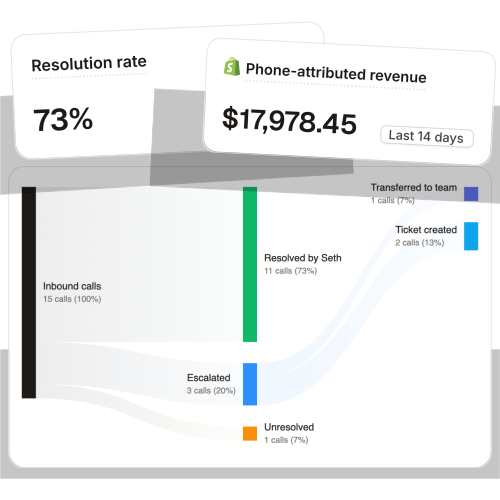
Ringly.io is AI phone support for Shopify brands. Instead of routing the phone into yet another silo, the AI answers inbound calls 24/7, finds orders in your Shopify store, handles returns and product questions, and escalates cleanly to Gorgias when a human is needed. Across 50+ brands, the AI resolves 73% of calls autonomously at roughly $0.42 per resolved call, so the phone stops being the channel your integration forgot.
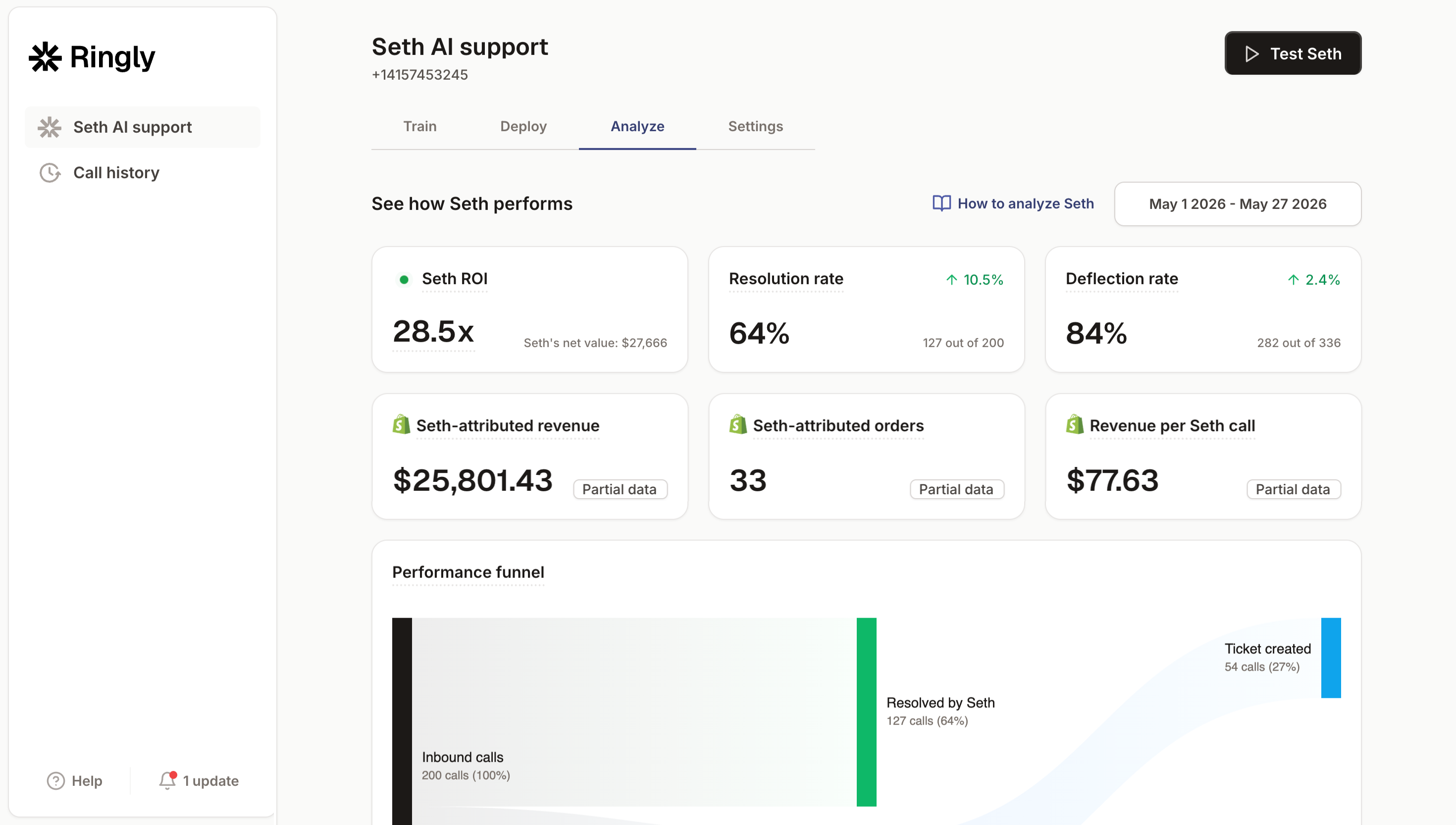
The call data flows into the same helpdesk you're already syncing, so the phone finally shows up in your reporting instead of disappearing into a voicemail box. WashCo, a Shopify brand we launched, recovered $22,664 in its first 7 days on the phone. That's revenue a CRM sync would never have caught, because the calls were never in the CRM to begin with. If you want the full picture, that's what ecommerce phone support is for.
Frequently asked questions
Is there a native Gorgias-Salesforce integration? No. Gorgias does not offer a built-in, one-click Salesforce connector. You connect the two through an iPaaS tool like Zapier or Make, or through a custom build against both APIs.
Can Zapier connect Gorgias and Salesforce? Yes. Zapier connects them with no code using a trigger-and-action model, for example a new Salesforce record creating a Gorgias ticket. It's the most common method and works in both directions.
How real-time is the sync? It depends on the method. Custom webhooks from Gorgias deliver events in about 10 seconds, while iPaaS tools on lower tiers often sync in batches every few minutes rather than instantly.
How much does it cost to integrate Gorgias and Salesforce? Beyond Gorgias and Salesforce themselves, an iPaaS tool starts around $20 a month and scales with volume. Salesforce Service Cloud is the bigger line item at $165 per user per month for Enterprise in 2026.
Does the integration cover phone calls? No. The sync handles email, chat, social, and case records. Phone calls are a separate channel, which is why brands add AI phone support that escalates into the same helpdesk.
Do I need a developer to connect Gorgias and Salesforce? Not for the iPaaS route, which is no-code. You only need a developer if you go the custom API and webhook path for logic the no-code tools can't handle.
Talk to us

If you run a $10M-$100M Shopify brand and you're wiring Gorgias and Salesforce together to kill data silos, a 30-min call is the fastest way to see the one silo the integration leaves behind: your phone line.
The 3-layer guarantee.
- Live in 14 days or it's free until launched.
- 65% resolution in 90 days or we refund the last 3 months of subscription fees.
- We keep working free until we hit 65%.
Ruben (Ringly co-founder) takes these calls personally.