
Gorgias is where your support team lives, but it isn't where your data lives. Orders sit in Shopify. Subscriptions sit in Recharge. Marketing events sit in Klaviyo. Shipping sits with a carrier nobody on the team can name. When you integrate Gorgias with the rest of that stack, an agent stops tab-hopping to answer one ticket, and handle time drops.
So the real question for a $20M brand isn't whether to integrate Gorgias. It's which method to use for each tool, because there are four, and picking the wrong one is how teams end up with a brittle automation that breaks every time a SKU prefix changes.
If you run support at a $10M to $100M Shopify brand, your CS team is fielding the same questions over and over, and most of those answers live one integration away. We've launched AI phone agents for 50+ Shopify brands that already run Gorgias, so we see which integrations actually cut handle time and which just look good in a demo. Book a 30-min call and we'll map your stack with you.
This post in 30 seconds.
- There are four ways to integrate Gorgias: the native App Store, HTTP integrations, Zapier or Make, and an AI phone agent that sits in front of it.
- Each method trades technical lift against control. We'll show which to use for which job.
- Written for founders and CX leads at $10M to $100M Shopify brands running Gorgias with a 3 to 12 rep team.
The 4 ways to integrate Gorgias, at a glance
Before you open the settings menu, know which lane you're in. Most tools you'll ever want belong in one of these four, and the right lane depends on whether the tool has an official app, an open API, or no real connection at all.
| Method | What it connects | Technical lift | Best for |
|---|---|---|---|
| Native App Store | 100+ tools with an official app (Shopify, Klaviyo, Recharge, Slack) | None, one click | Order, subscription, and marketing data in the ticket |
| HTTP integration | Any app with an open API | Low to medium | A tool you use that has no official Gorgias app |
| Zapier or Make | 9,000+ apps, no code | Low | Chaining alerts and simple actions across many tools |
| AI phone agent in front | The inbound phone call itself | None for you, we build it | Resolving the routine call before it becomes a human ticket |
The first three methods all do a version of the same thing: they move chat, email, and SMS data into the ticket so your team answers faster. The fourth solves a different problem, and most brands forget it exists until they look at their phone bill. More on that below.
Method 1: the native App Store (one-click)
This is the default, and for good reason. Open Settings, go to the App Store, click All apps, find the tool you want, and connect it. Gorgias groups the apps by function (Chat, Phone, SMS) and flags the popular ones in a Featured tab, so a non-technical teammate can do this without a ticket to engineering.
The native App Store is the most stable way to integrate Gorgias, so use it for anything that has an official app before you reach for anything custom. Once a tool is connected, its data shows up inside the ticket, your team can use it inside Macros, and they can act on it (refund an order, check a subscription) without opening a new tab.
The integrations worth installing first:
- Shopify: pulls order history, lets agents refund, cancel, and edit orders inside the ticket. If you only read one of our guides on this, read the Gorgias Shopify integration walkthrough.
- Klaviyo: support events flow into Klaviyo flows, and SMS or review events flow back into Gorgias as tickets. We covered the full setup in the Gorgias Klaviyo integration guide.
- Recharge: surfaces subscription status so an agent can see a pause or skip without leaving the ticket.
- Slack: posts ticket notifications to a channel and triggers actions, which is how most teams loop in logistics. Setup lives in our Gorgias Slack integration notes.
For the broader list and the click-by-click, see our guide on how to connect Gorgias to other apps.
Method 2: HTTP integrations (connect any app with an API)
Sometimes the tool you use doesn't have an official app. An older ERP, a regional carrier, a homegrown loyalty system. If it has an open API, you can still integrate Gorgias with it through an HTTP integration, no separate middleware required.
Go to Settings, find HTTP Integration, and click Add HTTP Integration. You'll configure a handful of fields:
- Integration name: something your team will recognize in six months.
- Triggers: the Gorgias events that fire the call, like a ticket being created or tagged.
- URL endpoint: where Gorgias sends the request.
- HTTP method: usually GET to pull data in, POST to push data out.
- Response content type and headers: how to read the response, plus any auth tokens the other service needs.
Once it's live, external data can appear inside the ticket, or ticket data can post out to the other system automatically. It's more setup than a one-click app, and someone has to own it when the endpoint changes, but it's the cleanest way to wire in a tool Gorgias doesn't natively support. If you want the developer-side detail, our Gorgias API overview goes deeper.
Method 3: Zapier and Make (no-code chaining to 9,000+ apps)
When you want to connect Gorgias to a lot of apps and you don't want engineers involved, Zapier and Make are the answer. Gorgias integrates with 9,000+ apps on Zapier, and the main Gorgias actions are Create Ticket and Create Ticket Message.
The pattern is simple. A trigger fires in one app, and Zapier performs an action in Gorgias, or the other way around. A common one: when a ticket gets tagged VIP or urgent, shoot a message to a Slack channel so your logistics team sees it without living in the helpdesk.
Where it works:
- Alerting: route high-priority tickets to the right team in real time.
- Light data movement: create tickets from form submissions, reviews, or other tools.
- Quick wins: ship a workflow in an afternoon with no code.
Where it breaks: Zapier is glue, not a system of record. If a Zap silently fails, nobody notices until a customer does. For anything mission-critical (order lookups, refunds, the data an agent needs on every single ticket) use the native app or an HTTP integration instead. We walk through the tradeoffs in our Gorgias Zapier guide.
Method 4: put an AI phone agent in front of Gorgias
Here's the gap. The first three methods all move chat, email, and SMS data into the ticket. None of them touch the inbound phone call. That call still gets answered by a human on your CS team, or it rolls to voicemail and nobody calls back.
That's expensive in two directions. WISMO ("where's my order") alone is 30 to 40% of support tickets, and over 50% at peak, and each one costs $3 to $8 to resolve manually. On the phone it's worse, because the meter runs in rep-minutes. And the calls you miss don't just disappear: businesses answer only 37.8% of inbound calls, and 85% of callers who can't reach a person never call back, with 62% switching to a competitor.
Ringly.io is AI phone support for Shopify brands. The phone shouldn't be a tax on your support team. Instead of growing headcount every time call volume goes up, the AI takes the routine inbound calls so your reps focus on the work that actually moves revenue.
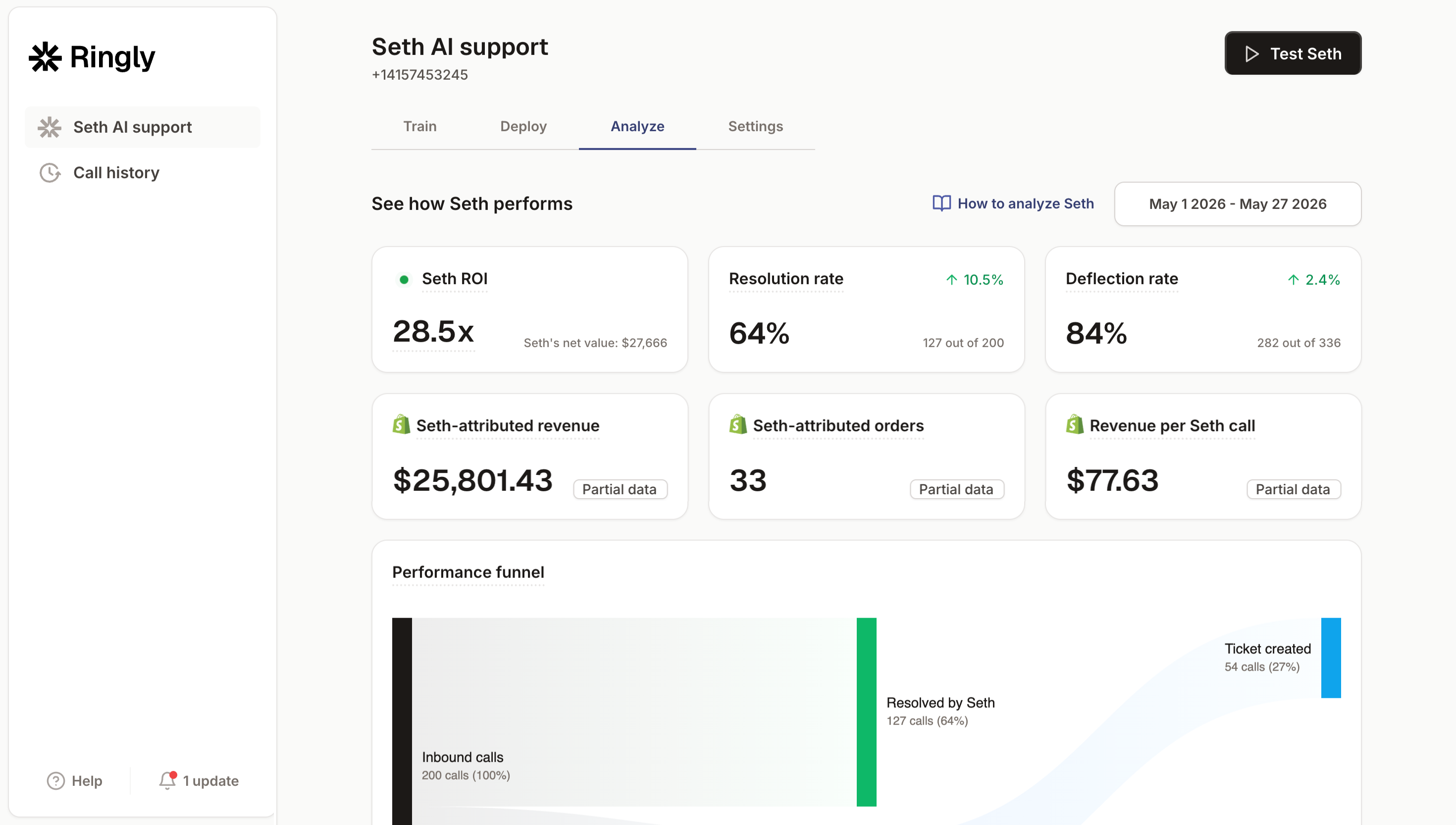
The AI answers inbound calls 24/7. It finds orders in your Shopify store, processes returns and exchanges, answers product questions from your knowledge base, and rescues abandoned carts. Across 50+ brands, the AI resolves 73% of calls autonomously at roughly $0.42 per resolved call. The calls that need a human escalate cleanly to Gorgias, Richpanel, Reamaze, or whatever helpdesk you already run, so your team picks up the hard call with the full ticket already in front of them.
This is the integration that changes the math, not just the tab count. WashCo, a Shopify brand we launched, recovered $22,664 in its first 7 days on the phone. And the part operators worry about most, the robot-voice problem, mostly goes away.
"My customers also feel like it's a normal person. They feel like they can communicate if they have questions."
Claudia Droge, TechCraft Studio
If your phone goes to voicemail after 6 p.m., that's the integration to look at first. Book a 30-min call and we'll review your missed calls with you.
What integrating Gorgias actually saves you
The native and no-code integrations cut handle time. The phone layer cuts headcount. To see the second one, take a typical $50M Shopify brand running a 6-rep CS team:
| Line item | Today | With Ringly |
|---|---|---|
| 6 reps × $4K loaded per rep | $24,000/mo | n/a |
| Ringly Enterprise (~$5K/mo) | n/a | $5,000/mo |
| Net monthly CS spend | $24,000/mo | $5,000/mo |
| Monthly savings | n/a | $19,000/mo |
| Annual savings | n/a | $228,000/yr |
That's roughly 70% of repeatable calls (order status, returns, product questions, the same five things over and over) handled by the AI. The other 30%, the genuinely complex calls, still go to your CS team, who now have time to solve them. For context, replacing a single rep who burns out costs $14,113, so the savings compound when you stop hiring against churn.
Exact Enterprise pricing is set on a call, and these are the savings shapes we see across 50+ Shopify brands. Book a 30-min call and we'll do the math on your real call volume.
How to choose the right integration method
Don't overthink it. Match the method to the job:
- Choose the native App Store if the tool has an official Gorgias app. It's the most stable, and your team can install it without engineering. Start here for Shopify, Klaviyo, Recharge, and Slack.
- Choose an HTTP integration if the tool has an open API but no official app, and the data needs to be reliable on every ticket.
- Choose Zapier or Make if you want to chain alerts and light actions across many apps with no code, and the workflow isn't mission-critical.
- Add an AI phone agent if your team is still answering routine inbound calls by hand, or your phone rolls to voicemail after hours.
Most $10M+ brands end up using three of the four at once: native apps for the core stack, an HTTP integration for the one odd tool, and a phone agent in front so the call volume stops scaling with headcount. If you're weighing helpdesks too, our Gorgias vs Richpanel comparison covers that decision, and our ecommerce customer service guide covers the operating model around it.
Frequently asked questions
How many ways are there to integrate Gorgias? Four. The native App Store for tools with an official app, HTTP integrations for any app with an open API, Zapier or Make for no-code chaining across 9,000+ apps, and an AI phone agent that sits in front of Gorgias to handle inbound calls.
Do I need a developer to integrate Gorgias? Not for most of it. The App Store and Zapier are no-code. HTTP integrations need someone comfortable with an API endpoint and headers, but no full build. An AI phone agent like Ringly is built for you, so there's nothing for your team to wire up.
Can Gorgias integrate with a tool that has no official app? Yes, as long as it has an open API. Use an HTTP integration to connect directly, or route it through Zapier if it's already on Zapier's network.
Does an AI phone agent replace Gorgias? No. It sits in front of Gorgias. The AI resolves the routine calls, and anything that needs a human escalates into Gorgias with the ticket context attached, so your reps keep working in the helpdesk they already use.
What does Ringly cost? Grow is $349/mo (1,000 minutes), Pro is $799/mo (2,500 minutes), and Enterprise is custom for $10M to $100M brands. There's a 65% resolution guarantee: if the AI resolves under 65% of your calls in 90 days, we refund the last 3 months.
Which integration cuts handle time the most? For ticket work, the Shopify and Recharge native apps, because order and subscription data is what agents look up most. For the phone, an AI agent that resolves the call before it ever becomes a human ticket.
Talk to us

If you run a $10M to $100M Shopify brand on Gorgias and your phone volume keeps climbing with headcount, a 30-min call is the fastest way to see what an AI phone agent in front of your helpdesk would change.
The 3-layer guarantee.
- Live in 14 days or it's free until launched.
- 65% resolution in 90 days or we refund the last 3 months of subscription fees.
- We keep working free until we hit 65%.
Ruben (Ringly co-founder) takes these calls personally.