

This post in 30 seconds.
- The exact order to migrate from Zendesk, Freshdesk, or Re:amaze to Gorgias without losing ticket history or running your team blind for a week.
- Gorgias imports tickets, macros, users, and tags at about 720 tickets an hour, up to 2 years back. Attachments and survey ratings do not come over.
- Built for founders, COOs, and Heads of CX at $10M-$100M Shopify brands with a visible phone number and a 3-12 person support team.
A help desk migration looks like a data problem on the kickoff call. It turns into a coverage problem on go-live weekend.
You map your fields, you run a demo import, you rebuild your macros. Meanwhile the actual support work keeps coming in: email, chat, and the channel everyone forgets to plan for, the phone line on your site. Most Gorgias migration guides walk you through the ticket import and stop there. The phone is where the quiet revenue leak shows up.
If you run support at a $10M-$100M Shopify brand and you're moving to Gorgias, here's the order I'd run it in, what actually breaks, and where the after-hours calls go while your team is heads-down rebuilding. If you want, book a 30-min call and we'll map the phone side of your cutover with you.
How I built this playbook
I co-founded Ringly, where we run AI phone support for 50+ Shopify brands. That means I sit next to a lot of helpdesk migrations, usually the part where a brand swaps Zendesk or Freshdesk for Gorgias and suddenly nobody is watching the phone.
The steps below come from real cutovers, not a vendor landing page. Here's what I checked against:
- What actually imports. I pulled the current Gorgias import limits straight from their docs, not from a 2023 blog rehash.
- What breaks on the way over. I traced which automations, macros, and ticket states survive and which need a full rebuild.
- Where the team loses time. I mapped the cutover window against the channels still taking live volume during the switch.
- The phone gap. I timed what happens to a brand's inbound calls during a typical 3-to-7-day migration, the thing no migration guide covers.
One thing I'll say up front: the data import is the easy 20%. The macros, the routing, and the live coverage during cutover are the 80% that decides whether your customers notice.
What Gorgias actually imports (and what it quietly drops)
Start here, because half of migration regret comes from assuming everything ports cleanly. It doesn't.
Gorgias imports your tickets, macros, users, tags, and ticket fields, but attachments and survey ratings stay behind. According to Gorgias's Zendesk migration docs, the import runs at roughly 720 tickets per hour and pulls up to 2 years of your most recent data. Your last two weeks come over first, then the historical backfill.
Here's what survives and what doesn't:
| Item | Imports to Gorgias? | Watch out for |
|---|---|---|
| Tickets (up to 2 years) | Yes | Tickets over 250 messages split into multiple tickets |
| Macros | Partly | Only reply-text and status-change actions import; the rest land empty |
| Users and tags | Yes | Map agent identities before you start |
| Ticket fields | Yes | Lookup-type fields are dropped |
| Attachments | No | Customer photos, screenshots, files do not transfer |
| Survey and rating data | No | Your CSAT history on those tickets is gone |
That attachments line matters more than it reads. If your team resolves a lot of where's my order and damaged-product calls, those threads lean on photos. Decide now whether you archive the old system read-only or accept the loss.
On status, Gorgias collapses your ticket states. Pending, on-hold, solved, and closed all land as Closed (pending tickets get auto-tagged so you can find them). If your reporting leans on a nuanced status taxonomy, rebuild that view in Gorgias rather than expecting it to carry over.
If you're coming from Freshdesk, Re:amaze, or Help Scout rather than Zendesk, the picture is similar but you'll usually route through a migration tool instead of the native Zendesk path. The free demo import (often 20 tickets and 20 knowledge base articles) is your dress rehearsal: run it, open the sample tickets in Gorgias, and check that contacts, custom fields, and threads landed the way you expect before you pay for the full set. Triggers, workflows, SLA policies, and rules from any of those systems still need to be rebuilt by hand, so don't let a clean ticket import fool you into thinking the automations came along.
The pre-migration audit nobody wants to do
Planning is most of the job. The execution is the part that feels like work, but the audit is the part that prevents the 2am "where did our tickets go" Slack.
Help Desk Migration's own data shows the most common failure modes are poor data quality, mapping complexity, downtime, automation conflicts, API rate limits, and security gaps. Every one of those is preventable in the audit.
Before you connect anything, inventory what you actually have:
- Ticket volume and age. Pull your real numbers. Around 100,000 tickets takes roughly 16 hours to migrate, so size the window honestly.
- Active vs dead macros. Most teams have 60 macros and use 12. Migrate the 12. Drop the rest.
- Every integration touching the helpdesk. Shopify, your returns app, your reviews tool, SMS, the phone line. List them, because reconnecting them is the slow part nobody budgets for.
- Your real routing and SLA rules. These do not port. You will rebuild them by hand in Gorgias.
- The clean-up list. Dedupe contacts, kill spam tickets, archive what you'll never reference. Clean data in, clean data out.
Skip this audit and you'll discover the missing data after you've already cut over, which is the worst possible time to find it. A clean inventory up front is the difference between a boring migration and a bad week.
Run a proper backup and a demo import first. Gorgias and most migration tools let you trial the move on a sample (often 20 tickets) so you can eyeball the field mapping before you commit the full set.
The cutover plan that keeps your team online
This is where downtime actually happens, and it's avoidable.
The mistake is treating migration as a single switch you flip. The fix is a delta migration: run the initial historical import, keep both systems live for a short overlap, then move only the records created or updated since, so nothing falls into the gap. This is also where good ecommerce customer service teams separate from the ones their customers complain about.
Here's the order that keeps coverage intact:
- Run the historical import into Gorgias while your old system still takes live volume. No customer notices anything yet.
- Rebuild macros, tags, and routing in Gorgias in parallel. Test them on the imported tickets.
- Reconnect integrations one at a time: Shopify first, then returns, then reviews, then SMS. Verify each before the next.
- Pick a low-volume window to cut email and chat over. Weekends or off-peak, not the Monday after a product drop.
- Run a delta migration to catch anything created during the overlap, then pause the old sync.
- Watch the queue for 48 hours with your most senior reps on it. The first two days surface every broken rule.
One hard constraint from the Gorgias docs: you can't have the same email address integrated in both platforms at once, and the continuous Zendesk sync only runs every 5 minutes. Plan the email handoff as a clean, scheduled switch, not a gradual fade.
Two more cutover details that trip teams up. First, you typically get one import per domain, so you can't casually delete and re-run the whole thing if the mapping looks wrong, which is exactly why the demo import matters. Second, watch the automations during the overlap window: migrated tickets can fire rules unexpectedly if your new triggers match historical records, so build your Gorgias rules to scope on dates or tags rather than firing on everything in the queue.
Never migrate during a launch week or the run-up to your seasonal spike. The one time your call and ticket volume triples is the one time you don't want your team learning a new tool.
Rebuilding macros and automations (budget real time here)
Your macros and workflows are where the migration timeline blows out.
Gorgias imports the text of your macros, but only reply-text and status-change actions are supported, so anything fancier comes in with an empty action list. Your triggers, SLA policies, and automation rules from Zendesk or Freshdesk do not transfer at all. You recreate them.
That's not a Gorgias knock, it's true of every helpdesk migration. The teams that handle it well treat it as a chance to delete cruft:
- Rebuild only the automations you actually use. The audit told you which ones. Resist porting all 40 rules out of habit.
- Redesign, don't replicate. Gorgias's native Shopify integration lets you refund, duplicate orders, and apply codes inside a ticket. Your old macros probably didn't, so rebuild around what the new tool can do.
- Test against imported tickets before go-live, not on live customers after.
"My customers also feel like it's a normal person. They feel like they can communicate if they have questions."
Claudia Droge, TechCraft Studio
This is also the moment most teams underestimate total cost. The migration "saving" you calculated on the pricing page gets eaten by data transfer, agent retraining, workflow rebuilding, and integration reconnection. Budget for the people-time, not just the license.
The channel your migration plan forgot: the phone
Every migration guide covers email and chat tickets. None of them cover the phone line on your site. That's the gap.
Here's what actually happens. Your team is heads-down for a week rebuilding Gorgias. Email and chat are getting handled because they're the migration's main characters. The phone rings, rolls to voicemail, and the voicemail doesn't get returned, because the person who'd return it is mapping ticket fields. For a $10M-$100M Shopify brand with a visible number, that's days of missed calls during the exact window you're already stretched.
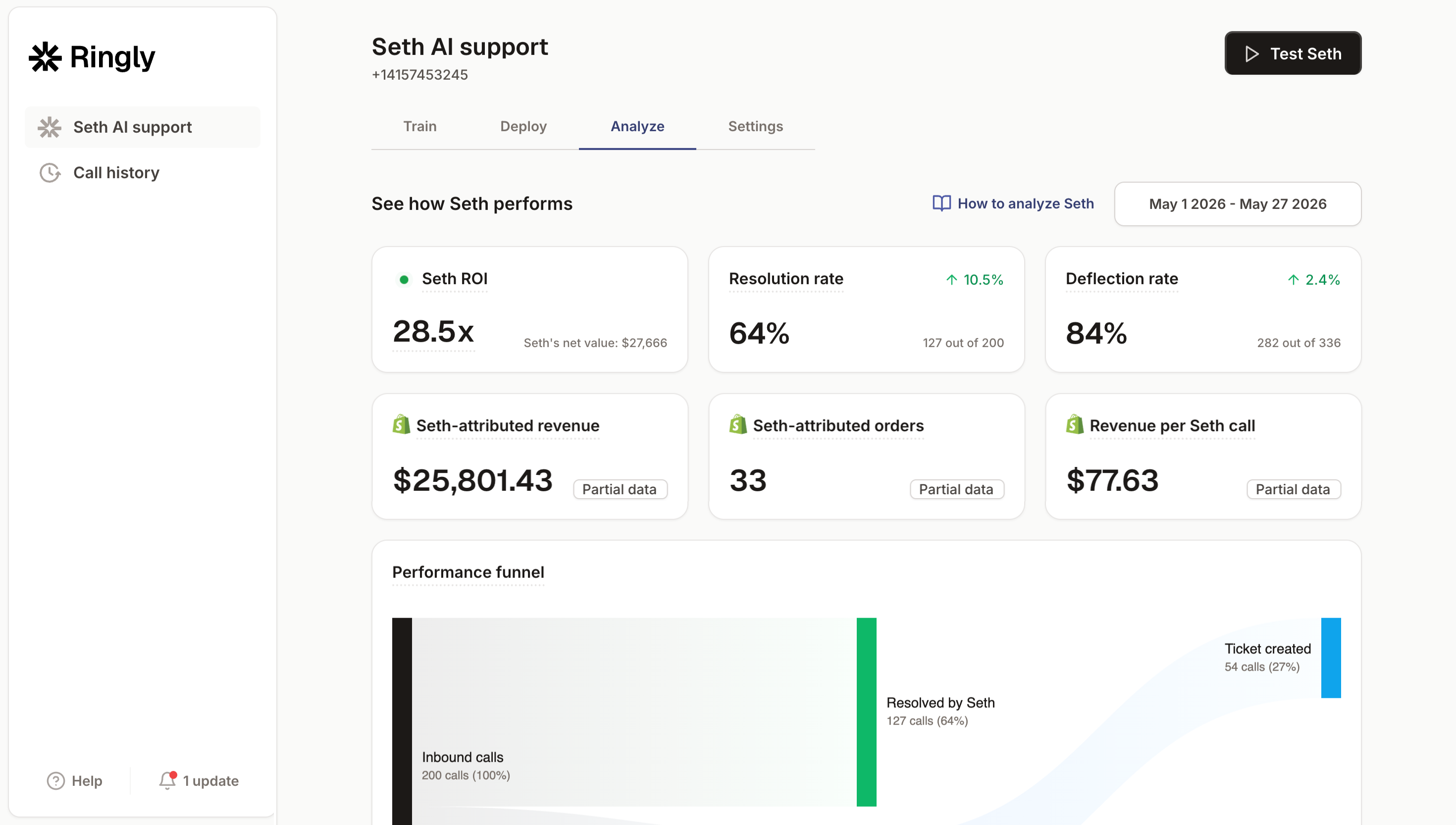
The fix is to put an AI phone agent on the line before you start the migration, so the phone channel is covered no matter how buried your team gets. Ringly.io is AI phone support for Shopify brands. It answers inbound calls 24/7, finds orders in your Shopify store, handles returns and product questions, and escalates cleanly to Gorgias (or whatever helpdesk you land on) when a call needs a human.
Across 50+ brands, the AI resolves 73% of inbound calls autonomously at roughly $0.42 per resolved call, which means the phone keeps working while your team rebuilds the helpdesk. WashCo, a Shopify brand we launched, recovered $22,664 in its first 7 days on the phone. It sits in front of Gorgias, not instead of it, so nothing about your migration plan changes except that the calls stop leaking.
If your number goes to voicemail after 6pm even on a normal week, book a 30-min call and we'll show you what the after-hours queue is actually costing.
What a Gorgias migration costs you in time vs hiring around it
Most brands staff up to cover the migration window. Here's the math on doing that with people.
Take a typical Shopify brand running a 6-rep support team:
| Line item | Today | With an AI phone layer |
|---|---|---|
| 6 reps x $4K loaded per rep | $24,000/mo | n/a |
| AI phone support (illustrative) | n/a | ~$5,000/mo |
| Net monthly support spend | $24,000/mo | $5,000/mo |
| Monthly savings | n/a | $19,000/mo |
| Annual savings | n/a | $228,000/yr |
That's roughly 70% of repeatable calls (order status, returns, the same questions over and over) handled without a human, while your reps focus on the migration and the genuinely hard calls. It's the same logic behind scaling support without hiring: you're not firing anyone, you're avoiding the temp hire you'd otherwise need to cover the cutover, and keeping the coverage permanently after.
The numbers are illustrative, but the shape holds across the brands we run. The point isn't the exact figure, it's that the phone channel doesn't have to be the thing that slips during your switch.
Common Gorgias migration mistakes to avoid
InvGate's migration research lists nine common mistakes. Five of them bite Shopify brands hardest:
- Migrating data without redesigning the process. Don't copy your Zendesk setup into Gorgias. Use the move to fix what was broken.
- Not mapping your integrations. The Shopify, returns, and SMS reconnections are the slow part. List them before you start.
- No real plan. Planning is most of the work. A demo import and a written cutover order are non-negotiable, the same way a Shopify Plus launch checklist keeps a replatform from going sideways.
- Too much change at once. Migrate the helpdesk, then optimize. Don't also redesign your whole CS org the same week.
- Ignoring total cost. The license is the cheapest line. Retraining and rebuild time cost more.
The sixth mistake, the one that isn't on InvGate's list, is leaving the phone uncovered while you do all of the above.
Frequently asked questions
How long does a Gorgias migration take? It depends on volume. Gorgias imports around 720 tickets an hour, and a large set (roughly 100,000 tickets) can take about 16 hours of pure import. Budget 1-2 weeks end to end once you include audit, macro rebuild, and integration reconnection.
Will I lose my ticket history when I migrate to Gorgias? You keep tickets, macros, users, and tags up to 2 years back, but attachments and survey or rating data do not import. If old photos and CSAT history matter, keep the source system read-only as an archive.
Do my Zendesk or Freshdesk macros and automations transfer? Partly. Gorgias imports macro reply text and status-change actions only, and triggers, SLA policies, and rules need to be rebuilt by hand. Treat it as a clean-up, not a copy-paste.
Can I migrate without any downtime? Close to it, if you run a delta migration: import history first, keep both systems live during a short overlap, cut email and chat over in a low-volume window, then sync only the records created since. The phone channel is the exception most plans miss.
What happens to my phone calls during the migration? By default, they roll to voicemail while your team is busy. Putting an AI phone agent on the line before you start keeps the calls answered 24/7, so the migration doesn't cost you missed orders. See our guide to 24/7 ecommerce phone support.
Is Gorgias the right helpdesk for my Shopify brand? For most DTC brands on Shopify, yes, its native integration is a real advantage. If you're still deciding, our Gorgias vs Zendesk for Shopify breakdown and the Gorgias alternatives roundup are the places to start.
Talk to us

If you're moving to Gorgias and your phone line is about to go quiet for a week, a 30-min call is the fastest way to keep the calls covered while your team rebuilds. We'll map the cutover against your real call volume and show you what's leaking after-hours.
The 3-layer guarantee.
- Live in 14 days or it's free until launched.
- 65% resolution in 90 days or we refund the last 3 months of subscription fees.
- We keep working free until we hit 65%.
Ruben (Ringly co-founder) takes these calls personally.
Book a 30-min call to scope the phone side of your migration.