
A Gorgias migration is mostly a logistics problem, not a data-loss problem.
- You'll get a source-agnostic plan to move TO Gorgias the right way: audit and clean first, run a demo, then cut over with no gap where new tickets fall through.
- The import itself is fast. Help Desk Migration moves roughly 2,000 tickets an hour, so even 100,000 tickets is about a 16-hour background job. The risk is the cutover, not the speed.
- Built for $10M-$100M Shopify brands with a 3-12 rep CS team moving off Zendesk, Freshdesk, Help Scout, Re:amaze, Intercom, or a raw shared inbox.
Most people planning a Gorgias migration are scared of the wrong thing. They picture history vanishing, tags gone, three years of customer context wiped. That almost never happens. What actually bites is messier: a few days where new tickets land in the old system, half your macros breaking on arrival, and the slow realization a week later that the phone problem you wanted to fix followed you straight over.
If you run customer experience or operations at a $10M-$100M Shopify brand, you already know switching helpdesks is one of those projects that looks like a weekend and turns into a month. This is the plan that keeps it a clean cutover. And at the end, the one thing the migration won't fix, so you're not surprised by it in week two.
We run AI phone support for 50+ Shopify brands, so we sit beside Gorgias on the phone channel all day. If your team is drowning in calls after-hours and you want to see what's leaking before you even start the move, book a 30-min call and we'll walk your missed calls with you.
When a Gorgias migration is actually worth it
Don't migrate because a competitor told you to. Migrate when the current tool is actively costing you time.
The usual triggers, in order of how often we hear them: integrations that don't reach your stack, repetitive manual work your reps do because the tool won't automate it, a clunky interface that slows response times, and a vendor bill that keeps climbing as volume grows. Gorgias frames these as its 5 signs it's time to migrate, and the signs are fair. As ticket volume grows, a tool that was fine at $5M starts leaking minutes everywhere at $30M.
The magnet pulling Shopify brands specifically is the depth of the Shopify integration. When a customer messages in, their profile, latest orders, cart, and connected apps like Recharge and AfterShip show up in the sidebar, and a rep can refund, cancel, or edit a Shopify order without ever opening the admin. According to eesel's 2026 Gorgias overview, that native depth is the single biggest reason brands move. Gorgias also reports brands seeing 43% faster first response and a 30% drop in labor costs after switching, though those are Gorgias-reported numbers, so treat them as a ceiling rather than a promise.
A quick gut-check before you commit. Migrate if two or more of these are true:
- Your reps copy-paste between the helpdesk and Shopify because the integration is shallow. That's loaded cost doing work the tool should do.
- Your response times climb every quarter even though headcount held flat.
- Your bill grows faster than your ticket volume, and you can't tell why.
- You're adding a channel (SMS, social, voice) and your current tool bolts it on awkwardly.
If only one is true, fix that one thing in your current tool first. A migration is a real project, and you don't want to run it to solve a problem a setting would have fixed.
Migrate to fix the inbox, and go in knowing it fixes the inbox, not the phone. That distinction matters more than anything else in this post, and we'll get to it. For now, if your reps spend their day on the same questions over and over inside an old tool, Gorgias is a real upgrade for the ticket side of the house.
How I built this guide
I'm Ruben, co-founder of Ringly. We don't sell helpdesk migrations, so I have no reason to talk you into one. What we do is run the AI phone layer that sits in front of helpdesks like Gorgias for 50+ Shopify brands, which means I watch what happens right after a migration goes live.
For this guide I walked the actual migration object and field-mapping flow brands use, read through the delta-migration mechanics that make a clean cutover possible, and pulled the throughput and timeline numbers from the tools that do the import. The steps below are the order I'd run it in if I were a Head of CX moving off Zendesk next month.
The one thing I kept noticing, on call after call, is the part nobody writes down: the migration moves your tickets, not your phone. Gorgias Voice still needs a human to pick up, and after a 2-minute round-robin with no available rep, the call drops to voicemail. Hold that thought. It changes how you should plan the whole project.
Step 1: audit and clean before you move anything
The biggest mistake is treating a migration like a copy-paste. You don't want a faithful copy of a messy system. You want a clean one.
Start with an honest inventory. Pull your ticket volume and age (most import tools reach back about two years of recent data), list every channel you run, and write down every integration that touches the helpdesk today. This is also your throughput math: at roughly 2,000 tickets an hour, you can estimate the import window before you commit to a date.
Write down four numbers before anything else:
- Total tickets and their age. This sizes the import window and tells you how far back you actually need history.
- Active channels. Email, chat, SMS, social, voice. Each one has its own migration and routing setup on the other side.
- Live integrations. Every app wired into the current helpdesk has to be rewired in Gorgias, and some won't have a one-to-one match.
- Reporting you can't lose. If a dashboard drives a weekly decision, confirm you can rebuild it in Gorgias before you cut over, not after.
Then clean the automations, because this is where brands carry junk into a fresh start. The typical CS team has around 60 macros but actively uses about 12. That's straight from the Help Desk Migration checklist, and it matches what we see. Migrate the 12 you use and let the other 48 die in the old system. Do the same with tags: kill the dead ones, consolidate the duplicates, so your new instance isn't cluttered on day one.
Quick cleanup pass to run this week:
- Macros: export the full list, mark the ones used in the last 90 days, migrate only those. See your current set in Gorgias macros.
- Tags: merge duplicates, delete anything not used in reporting or routing.
- Knowledge base: consolidate stale articles before they import. A tight knowledge base also makes any AI layer you add later far more accurate.
- Setup in Gorgias: pre-create your agents, groups, and custom fields in the target before you run the test migration, so the mapping step has something to map to.
Skip this and you'll spend your first month in Gorgias deleting things instead of resolving tickets.
Step 2: the migration mechanics, objects, mapping, and the demo
Once the source is clean, the mechanical part is genuinely straightforward.
You start by choosing your migration objects: tickets (with their comments and notes), agents, customers, knowledge base articles, tags, attachments, inline images, and even call recordings. Each is selectable, so you decide what comes over. Then you map: match each source agent to their Gorgias counterpart (identical profiles auto-match), set a default agent to catch tickets from deleted or unassigned users, and map your ticket fields.
Do not skip the demo migration. The Migration Wizard moves a free sample of your real data into Gorgias so you can check the records on the target, confirm the mappings look right, and get an upfront cost before you pay for the full run. Treat the demo as your dress rehearsal. If something maps wrong on 50 sample tickets, it'll map wrong on 50,000.
On DIY versus done-for-you: Gorgias maintains a list of reviewed, approved migration partners for managed jobs, per the official Gorgias migration docs. If your data is clean and your volume is moderate, the self-serve tool is fine. If you've got custom fields everywhere and a board watching the cutover, a partner is worth it.
The source you're coming from changes the details, not the shape of the project. Coming from Zendesk? The field model is closest, and we cover the specifics in our Gorgias vs Zendesk for Shopify breakdown. Coming from Freshdesk? Read our Freshdesk to Gorgias data migration walkthrough. For a deeper end-to-end version of this playbook, see our Gorgias help desk migration guide. The objects and the mapping flow are the same regardless of where you start, and once you're live, the Gorgias features you actually adopt matter more than the migration itself.
Step 3: the cutover plan that avoids a data gap
Here's the part the checklists gloss over. The import is fast and runs in the background. The danger is the window between starting the import and going fully live, when new tickets are still arriving somewhere.
Zero downtime isn't magic, it's delta migration. The mechanic is simple: run the initial historical import, keep both systems live for a short overlap, then run a delta pass that moves only the records created or updated since the first import. Nothing falls into the gap because the gap gets swept. Some tools also offer interval migration, scheduled syncs at set times, for longer overlaps. Both are documented in the Gorgias help desk migration docs.
Two rules during the move. First, freeze structural changes in the source: no last-minute macro edits, no new custom fields mid-migration, or your mappings drift. Second, plan a go-live week, not a go-live hour.
Your go-live QA checklist:
- Ticket integrity: spot-check a sample across old and new for missing comments, attachments, or tags.
- Macros: test every migrated macro. Ones with conditional logic, placeholders, or integrations often need a small manual fix after import, so budget for it.
- Shopify actions: confirm a rep can pull an order and issue a refund from inside Gorgias.
- Routing: send test messages through each channel and watch where they land.
- Phone: route a test call and listen to what happens after-hours. This is where most brands get a surprise.
For the broader project timeline and how it slots against a wider Shopify replatform, our Shopify migration timeline breaks down realistic windows. And once the inbox is settled, your ecommerce customer service operation is only as good as the channels you actually staff.
What a Gorgias migration won't fix: the phone
You moved the inbox. The phone is the part that didn't move.
This is the surprise from the go-live checklist, and it's worth being blunt about. Gorgias Voice does not autonomously answer or resolve inbound calls with AI. A person still has to pick up every call. Per the Gorgias Voice FAQs, when round-robin is on and no rep is available, the caller waits on hold music for up to 2 minutes and then gets sent to voicemail. During business hours, an unanswered call rings for 60 seconds and times out. As eesel's Gorgias Voice overview puts it plainly, Gorgias isn't the answer if you're prioritizing real voice capability.
So after a perfect migration, your after-hours phone behavior is identical to before: missed calls roll to voicemail, and voicemails you never return cost you customers. The numbers on that are ugly. PCN's 2026 study found 85% of callers who can't reach a person never call back and 62% switch to a competitor. And Eden's research found 80% of voicemail-routed callers hang up without leaving a message at all. The migration didn't touch any of that.
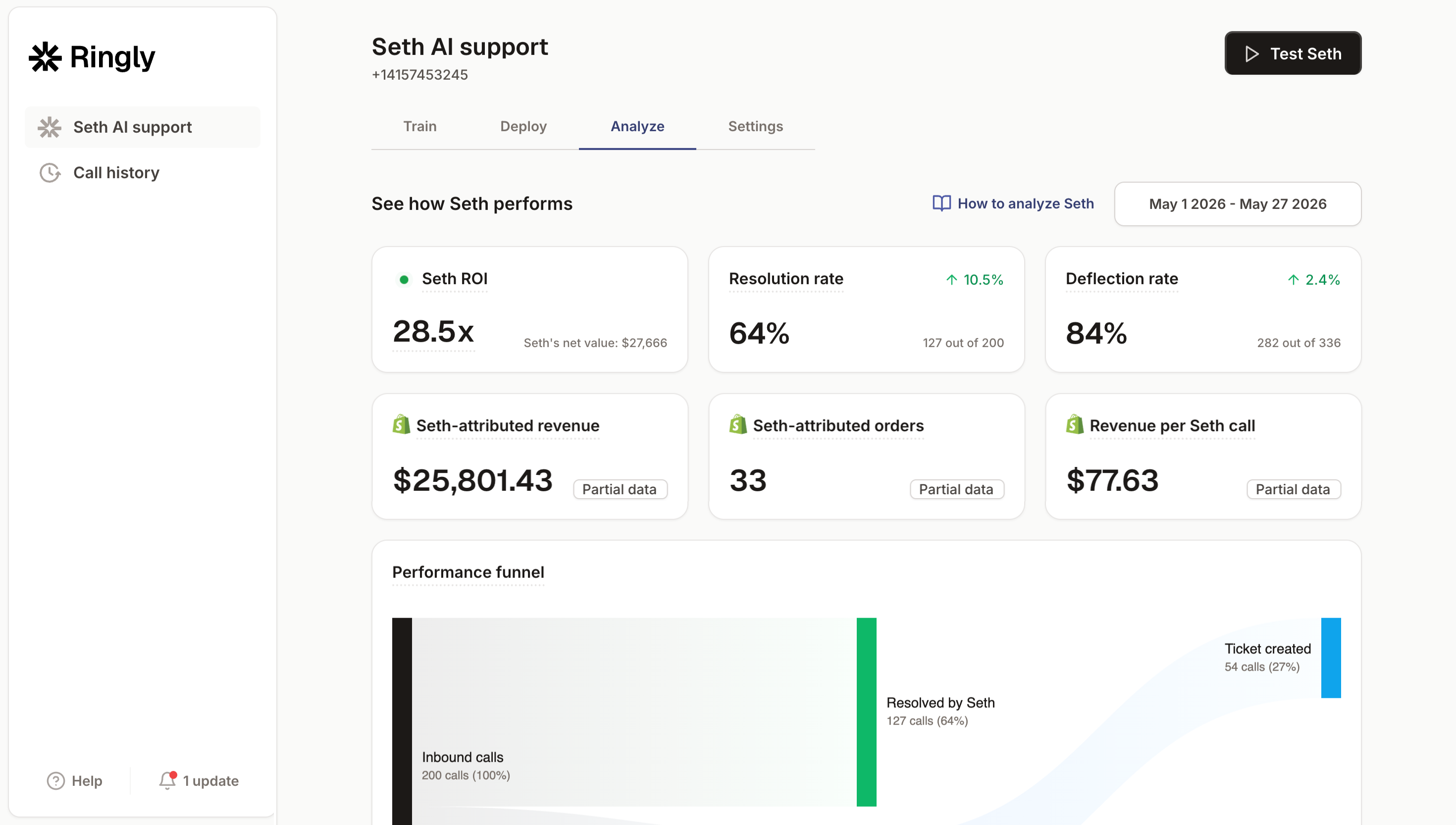
This is where an AI phone layer earns its place. Ringly.io is AI phone support for Shopify brands that sits in front of your helpdesk. The AI answers inbound calls 24/7, finds orders, processes returns, answers product questions from your knowledge base, and escalates the genuinely hard calls cleanly into Gorgias phone support so your reps still own them. Across 50+ brands the AI resolves 73% of calls autonomously at roughly $0.42 per resolved call. Gear Rider, a Shopify brand on Ringly, handled 1,595 calls in 90 days without a phone rep.
The cost math is the easy part. Take a $50M brand running a 6-rep CS team:
| Line item | Today | With an AI phone layer |
|---|---|---|
| 6 reps × $4K loaded per rep | $24,000/mo | n/a |
| Ringly (~$5K/mo) | n/a | $5,000/mo |
| Net monthly CS spend | $24,000/mo | $5,000/mo |
| Monthly savings | n/a | $19,000/mo |
| Annual savings | n/a | $228,000/yr |
That's roughly 70% of repeatable calls (order status, returns, the same product questions all day) handled by the AI. The 30% that need a human still go to your team, who now have time to actually solve them.
If you just migrated to Gorgias and the after-hours line still goes quiet, book a 30-min call and we'll show you what those missed calls are worth. Worth reading next to this: how WISMO calls pile up on the phone, why an after-hours answering service usually disappoints, and how automated phone support for Shopify brands actually works once your tickets live in Gorgias on Shopify.
Frequently asked questions
How long does a Gorgias migration take? The data import is fast, around 2,000 tickets an hour, so even 100,000 tickets is roughly a 16-hour background job that runs while your team keeps working. The full project takes longer because of the audit, cleanup, demo, and go-live QA. Plan for a week or two end to end, not a single afternoon.
Will I lose my ticket history, tags, or attachments? No, those objects are all selectable in the migration. You choose which to bring: tickets with comments, customers, agents, tags, attachments, inline images, and even call recordings. Run the free demo migration first to confirm everything maps the way you expect before you pay for the full run.
What happens to my macros and automations? Most transfer, but macros with conditional logic, placeholders, or integrations usually need a small manual fix after the move. The smarter play is to clean first: the typical team has about 60 macros and uses 12, so migrate only the active ones and rebuild any that break.
Can I migrate to Gorgias with zero downtime? Yes, through delta migration. You run the historical import, keep both systems live for a short overlap, then sweep only the records created or updated since, so no new ticket falls into a gap. The actual transfer happens in the background, so your team never goes offline.
Should I migrate myself or use a partner? If your data is clean and your volume is moderate, the self-serve migration tool handles it fine. If you have custom fields everywhere, complex routing, or a board watching the cutover, use one of Gorgias's reviewed migration partners. Either way, do the demo migration first.
Does migrating to Gorgias fix my phone support? No. A migration moves where your tickets live, not how your phone behaves. Gorgias Voice still needs a human to answer every call, and after-hours calls drop to voicemail after a 2-minute wait, which is why a lot of brands put an AI phone layer in front of Gorgias to actually pick up.
Talk to us

You moved the inbox. The phone is the part that didn't move. If you run a $10M-$100M Shopify brand and your after-hours calls still roll to voicemail after the migration, a 30-min call is the fastest way to see what you're leaving on the table.
The 3-layer guarantee.
- Live in 14 days or it's free until launched.
- 65% resolution in 90 days or we refund the last 3 months of subscription fees.
- We keep working free until we hit 65%.
Ruben (Ringly co-founder) takes these calls personally.