


Outsourcing customer support makes sense for growing businesses. You get 24/7 coverage without hiring a full in-house team.
But traditional contact centers like Global Response aren't your only option anymore.
AI phone agents, cloud platforms, and tech-enabled BPOs have changed the game. Some businesses need the human touch of a traditional call center.
Others want the speed and cost savings of AI. And some prefer to build their own solution.
This guide breaks down six alternatives to Global Response, from AI-powered phone agents to enterprise cloud platforms.
We'll cover what each option does best, what it costs, and who it's right for.
Editor’s note: Want to hear some sample AI support calls made for your Shopify store?
- Just paste your store URL
- Get sample calls in under 20 seconds (no email required)
- Listen to demo calls for my store
What is Global Response?
Global Response is a full-service contact center provider that's been in business for over 40 years.
They position themselves as "Brand Ambassadors" for their clients, training agents to embody each brand's culture and voice.

The company handles 18 million+ calls per year across retail, healthcare, financial services, and other industries.
Their services include inbound and outbound call center support, omnichannel customer service (voice, email, chat, social), help desk support, and customer retention programs.
Notable clients include FILA, LACOSTE, ASICS, and Rack Room Shoes.
FILA reported a 25% increase in online sales after switching to Global Response, along with a 28% decrease in order and refund queries.
Global Response doesn't publish pricing publicly. You'll need to contact their sales team for a custom quote based on your volume and requirements.
Setup typically takes 4-8 weeks for full deployment.
The main limitation? It's a traditional model. You're paying for human agents, which means higher costs and longer ramp times compared to newer AI alternatives.
How we evaluated Global Response alternatives
We looked at six different approaches to customer support outsourcing:
- AI phone agents for businesses wanting 24/7 automation
- Traditional BPOs for companies needing human agents at scale
- Tech-enabled BPOs for AI-enhanced human support
- Cloud platforms for businesses wanting full control
- Help desk software for email and chat-focused teams
- Cloud contact center software for enterprise reliability
For each option, we evaluated pricing, setup time, scalability, technology capabilities, and integration options.
We also considered what type of business each solution fits best.
Global Response alternatives at a glance
| Provider | Type | Best For | Starting Price (2026) | Setup Time |
|---|---|---|---|---|
| Ringly.io | AI Phone Agent | E-commerce (24/7 automation) | $349/month (Grow plan) | < 5 minutes |
| Teleperformance | Global BPO | Large enterprise (Scale & AI ops) | Custom quote | 6–10 weeks |
| Concentrix | Digital Transformation | Complex AI/GenAI transitions | Custom quote | 6–10 weeks |
| Twilio Flex | Cloud Platform | Custom-built contact centers | $1/hour or $150/user/mo | 2–4 weeks |
| Help Scout | Help Desk (SaaS) | SMBs (Email & Chat focus) | $25/user/month | 1–2 days |
| Five9 | CCaaS | Enterprise-grade voice/AI | $119–$159/user/mo | 4–6 weeks |
1. Ringly.io

Ringly.io offers an AI phone agent called an AI agent that handles customer calls for e-commerce businesses.
It's designed specifically for Shopify stores and online retailers that need 24/7 phone support without hiring a team.
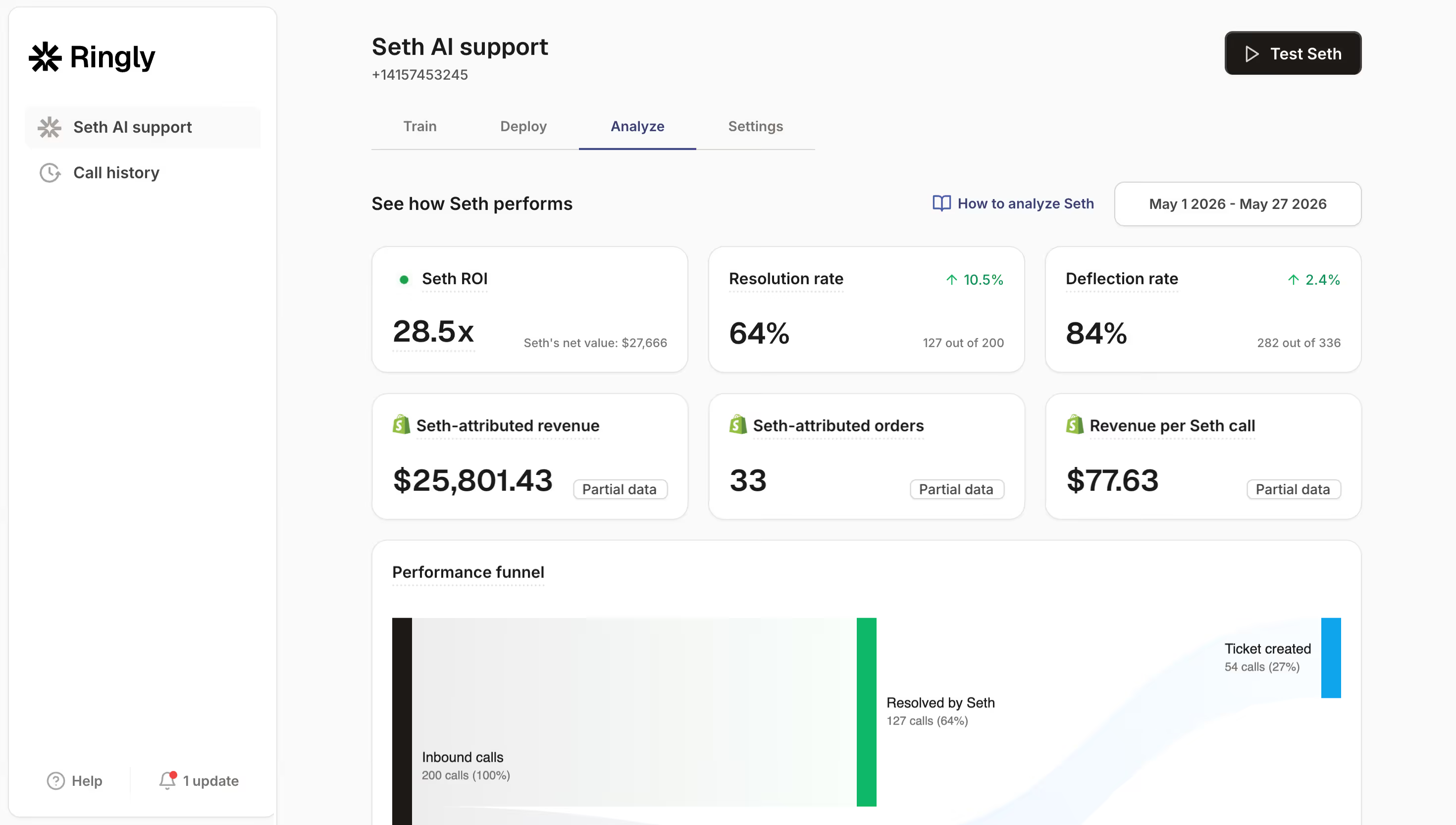
the AI answers calls, looks up orders, handles returns and exchanges, and answers FAQs. When a call requires human judgment, it escalates to your team.
The AI resolves about 73% of calls without human intervention.
Setup takes about 3 minutes. You connect your Shopify store, configure your policies, and get a phone number. the AI starts handling calls immediately.
The platform supports 30 languages, so you can serve international customers without hiring multilingual agents.
It also integrates directly with your Shopify data, so the AI can check order status, process returns, and handle common e-commerce queries in real time.
Pricing
| Plan | Monthly Price | Minutes Included | Best For |
|---|---|---|---|
| Grow | $349 | 1,000 | Growing stores with regular call volume |
| Enterprise | Custom | 5,000+ | High-volume stores needing custom setup |
Additional minutes cost $0.19 per minute. All plans include Shopify integration, call recordings, and analytics.
Pros and cons
Pros:
- Fast setup (3 minutes)
- Works 24/7 without breaks
- 73% average resolution rate
- 40-language support
- Direct Shopify integration
- No hiring or training needed
Cons:
- Best suited for e-commerce
- May not handle highly complex custom scenarios
- Requires clear policies for best results
Who it's for
Ringly.io fits e-commerce businesses that want affordable 24/7 phone support without managing a call center.
If you get repetitive calls about order status, returns, and basic product questions, the AI can handle most of them while escalating the complex cases to you.
2. Teleperformance

Teleperformance (branded as TP) is one of the world's largest customer experience companies.
They've been in business for nearly five decades and serve 100% of the Forbes Top 100 companies.
The company operates in 170+ countries and supports 300+ languages and dialects.
If you need to provide customer support globally, Teleperformance has the infrastructure already in place.
Their approach combines AI with human agents. TP.ai is their orchestrated AI platform that augments agent capabilities with tools like Agent Copilot, which expedites tasks and proposes responses.
But the human agent remains central to the experience.
Teleperformance reports impressive client results: a 114% increase in NPS for a global consumer electronics company, 79% improvement in sales conversions for an American tech company, and 64% increase in conversion rate for the world's largest hotel franchisor.
Pricing
Teleperformance uses custom enterprise pricing. You'll need to contact sales for a quote based on your volume, countries, and service requirements.
Typical BPO pricing ranges from $25-50 per hour per agent, but enterprise deals vary widely.
Pros and cons
Pros:
- Massive global scale (170+ countries, 300+ languages)
- 47+ years of experience
- Serves 100% of Forbes Top 100
- AI-enhanced human agents
- Proven results with major brands
Cons:
- High cost (enterprise pricing)
- Long setup time (6-10 weeks)
- Less flexibility than smaller providers
- Requires significant volume to justify cost
Who it's for
Teleperformance suits large enterprises that need global scale and established infrastructure.
If you're a Fortune 500 company or a rapidly growing business with international customers, they have the reach and resources to support you.
3. Concentrix

Concentrix is a global technology and services leader powering 2,000+ of the world's best brands.
They focus on "intelligent transformation" through AI-powered, data-driven solutions.
Unlike traditional BPOs, Concentrix leads with technology. Their iX Hero product is an agentic AI app built specifically for contact centers.
It brings the entire advisor workflow into one AI-powered workspace, helping human agents work more efficiently.
The company offers four main solution areas: Strategy & Design (AI-driven innovation), Data & Analytics (enterprise intelligence), Enterprise Technology (AI modernization), and Digital Operations (AI-powered customer engagement).
Concentrix serves industries including automotive, banking, healthcare, retail, ecommerce, and technology.
Their client base ranges from mid-market companies to Fortune 500 enterprises.
Pricing
Concentrix uses custom enterprise pricing. Contact their sales team for a quote based on your specific requirements.
Pros and cons
Pros:
- Strong AI focus with iX Hero platform
- Agentic AI that augments human agents
- Comprehensive transformation services
- 2,000+ global brand clients
- Industry-specific expertise
Cons:
- Enterprise-focused (may be overkill for smaller businesses)
- Custom pricing (no transparent rates)
- 6-10 week typical setup time
- Complex for simple use cases
Who it's for
Concentrix fits mid-to-large companies wanting AI-powered transformation of their customer experience.
If you're looking to modernize your contact center with AI rather than just outsource it to human agents, their technology-first approach makes sense.
4. Twilio Flex

Twilio Flex is a programmable cloud contact center platform.
Unlike traditional BPOs or out-of-box software, Flex gives you complete control to build exactly the contact center you want.
The platform supports omnichannel engagement including voice, messaging, video, and email.
You can customize workflows, build custom agent interfaces, and integrate with virtually any system through APIs.
Flex offers two pricing models. The per-hour model charges $1 per active user hour, which works well for seasonal businesses or part-time agents.
The per-user model costs $150 per named user per month with a contract, giving you predictable costs regardless of usage.
Add-ons include Agent Copilot for AI assistance ($0.035 per minute for voice, $0.005 per message for digital) and Flex Mobile for iOS/Android apps ($50 per user per month for mobile-only licenses).
Pricing
| Model | Price | Best For |
|---|---|---|
| Per-hour | $1/active hour | Seasonal businesses, fluctuating volume |
| Per-user | $150/user/month | Predictable costs, full-time teams |
| Free trial | 5,000 hours | Testing the platform |
Pros and cons
Pros:
- Complete customization and control
- Flexible pricing (pay per hour or per user)
- Strong developer ecosystem
- Omnichannel support
- AI integration capabilities
Cons:
- Requires technical resources
- Complex setup (2-4 weeks with developers)
- Self-managed (you build and maintain it)
- Not a turnkey solution
Who it's for
Twilio Flex suits tech-savvy companies that want full control over their contact center.
If you have developers on staff and specific requirements that off-the-shelf solutions can't meet, Flex gives you the building blocks to create exactly what you need.
5. Help Scout

Help Scout is a customer support platform designed for growing businesses that prioritize email and chat over phone support.
It's simpler and more affordable than enterprise help desk software.
The platform centers around a shared inbox that lets teams manage customer emails collaboratively.
It also includes knowledge base software (Docs) for self-service support, live chat for real-time engagement, and AI-powered features like AI Assist (expanding, shortening, and translating text) and AI Drafts (generating replies).
The Standard plan at $25 per user per month includes multiple inboxes, knowledge bases, basic workflows, and unlimited tags.
Plus at $45 adds advanced workflows, unlimited AI Drafts, and integrations with Salesforce, HubSpot, and Jira. Pro at $75 includes SSO/SAML, HIPAA compliance, and dedicated support.
One limitation: Help Scout doesn't include native phone support. You'll need to integrate with a third-party phone service like Aircall for voice channels.
Pricing
| Plan | Monthly Price | Users | Key Features |
|---|---|---|---|
| Free | $0 | Up to 5 | 1 Inbox, 1 Docs site, 100 contacts/mo |
| Standard | $25/user | Up to 25 | 2 Inboxes, basic workflows, AI Assist |
| Plus | $45/user | Up to 50 | 5 Inboxes, advanced workflows, AI Drafts |
| Pro | $75/user | Unlimited | 10 Inboxes, SSO, HIPAA, dedicated support |
AI Answers add-on: $0.75 per resolution.
Pros and cons
Pros:
- Simple and intuitive interface
- Affordable pricing
- Strong email collaboration features
- AI-powered assistance
- Quick setup (1-2 days)
Cons:
- No native phone support (requires integration)
- User limits on lower tiers
- Limited inboxes on lower plans
- Not a full call center replacement
Who it's for
Help Scout fits small-to-mid businesses that primarily handle email and chat support.
If phone calls are secondary to your support strategy and you want an affordable, easy-to-use platform, it's a solid choice.
6. Five9

Five9 is an enterprise cloud contact center software provider serving 3,000+ global customers.
They've been named a Leader in the Gartner Magic Quadrant for CCaaS for eight consecutive years.
The platform offers 99.999% uptime SLA, making it a reliable choice for businesses that can't afford downtime.
Features include AI Agents for automated handling of routine inquiries, Agent Assist for real-time AI help, omnichannel support across voice and digital channels, and workforce engagement management.
Five9's Genius AI platform powers their AI capabilities, creating what they call "Agentic CX" where AI agents work alongside human agents to deliver seamless customer experiences.
Client results are impressive. Alaska Airlines scaled omnichannel support while empowering remote workforce.
Central Bank achieved 80% intent-matching accuracy through AI Agents.
Exact Sciences reduced test scheduling time by 60%. Lumexa Imaging unlocked $4M in revenue through automated follow-up reminders.
Pricing
Five9 uses custom pricing. Contact sales for a quote based on your requirements.
Enterprise cloud contact center software typically ranges from $100-200 per user per month, but actual pricing varies by volume and features.
Pros and cons
Pros:
- 99.999% uptime SLA
- 8-time Gartner Leader
- Enterprise-grade reliability
- AI-powered Agentic CX
- Proven ROI with major brands
Cons:
- Custom pricing (no transparent rates)
- Requires internal team to operate
- Complex implementation (4-6 weeks)
- Enterprise-focused (may be overkill for small businesses)
Who it's for
Five9 suits mid-to-large enterprises that need reliable, scalable contact center software.
If you have an internal support team and need enterprise-grade infrastructure with AI capabilities, Five9 delivers.
Choosing the right Global Response alternative
The best alternative depends on your business needs, budget, and technical capabilities.
Choose Ringly.io if: You're an e-commerce business wanting affordable 24/7 AI phone support. It's fast to set up, cost-effective, and handles the repetitive calls that eat up your time.
Choose Teleperformance if: You're a large enterprise needing global scale with human agents. They have the infrastructure to support 170+ countries and 300+ languages.
Choose Concentrix if: You want AI-powered transformation of your customer experience, not just outsourced agents. Their technology-first approach modernizes how you deliver support.
Choose Twilio Flex if: You have technical resources and want complete control over your contact center. It's the most flexible option but requires developers.
Choose Help Scout if: Email and chat are your primary support channels. It's affordable, simple, and handles async support well.
Choose Five9 if: You need enterprise cloud contact center software with proven reliability. The 99.999% uptime SLA matters if downtime costs you customers.
Start automating your phone support today
AI phone agents represent a new category of customer support.
They don't replace human agents entirely, but they handle the repetitive work that bogs down your team. Order lookups, return requests, and FAQ answers happen instantly, 24/7.
For e-commerce businesses, this means customers get help even at 2 AM. Your team focuses on complex issues that actually need human judgment. And you don't pay for a full call center to handle basic queries.
If you're curious how AI phone support would work for your store, you can try Ringly.io free for 14 days. Setup takes 3 minutes, and you'll see exactly what the AI can handle for your business.
Frequently Asked Questions
What are the most affordable Global Response alternatives for small businesses?
Ringly.io at $349/month and Help Scout at $25/user/month are the most budget-friendly options. Ringly.io works best for phone-heavy e-commerce support, while Help Scout fits email and chat-focused teams.
Which Global Response alternative offers the fastest setup time?
Ringly.io sets up in about 3 minutes since it's AI-powered and connects directly to Shopify. Help Scout takes 1-2 days. Traditional BPOs like Teleperformance and Concentrix need 6-10 weeks to fully deploy.
Can AI phone agents really replace human call center agents?
Not entirely, but they can handle a significant portion of calls. Ringly.io's The AI resolves about 73% of calls without human intervention. The AI escalates complex issues to your team, so you get the best of both worlds: automation for routine calls, humans for complex ones.
What should I look for when evaluating Global Response alternatives for my business?
Consider your primary support channels (phone, email, chat), call volume, budget, and technical resources. If phone is critical and you want 24/7 coverage without hiring, AI solutions like Ringly.io make sense. If you need global human agents at scale, traditional BPOs like Teleperformance fit better.
Do any Global Response alternatives offer both AI and human agents?
Concentrix and Teleperformance both offer AI-enhanced human support. Ringly.io takes the opposite approach: AI handles most calls with human escalation for complex issues. The hybrid model depends on whether you want AI assisting humans or AI as the first line of defense.
How does pricing compare between Global Response alternatives?
AI solutions like Ringly.io ($349-$799/month) and help desk software like Help Scout ($25-75/user/month) have transparent pricing. Traditional BPOs (Teleperformance, Concentrix, Global Response) and enterprise platforms (Five9) use custom pricing that requires sales quotes.