

This post in 30 seconds.
- A real Freshdesk to Gorgias data migration: what moves automatically (tickets, contacts, tags, most macros), what you rebuild by hand (triggers, SLA, business rules), the tool to use, downtime, and a delta sync.
- The thing the migration vendors won't tell you: while your team moves email tickets, the phone line keeps ringing, and WISMO callers don't migrate.
- Built for founders, COOs, and Heads of CX at $10M-$100M Shopify brands switching off Freshdesk with a paid helpdesk and a visible phone number.
You picked Gorgias because it's built for Shopify and Freshdesk isn't. That part of the decision is easy. The migration is the part that keeps you up, because every Freshdesk to Gorgias data migration is a question of what survives the move and what quietly breaks.
Most of what you'll read online about this is a migration vendor's landing page. Useful for the mechanics, useless for the operator question: how do I switch helpdesks without dropping a customer mid-flight? This is the version written for the person whose name is on the cutover. If you want the broader view of moving any helpdesk onto Gorgias, we cover that in the general Gorgias help desk migration guide. This post stays on the exact Freshdesk path.
This guide is for the founder, COO, or Head of CX running a $10M-$100M Shopify brand on Freshdesk, with a real CS team and a phone number on the site. We've launched AI phone support for 50+ Shopify brands, a lot of them mid-helpdesk-switch. Book a 30-min call and we'll map the cutover for your store.
How I put this playbook together
I'm Ruben, co-founder of Ringly. I didn't write this from the migration tools' marketing pages. I wrote it from watching brands move onto Gorgias while we ran their phone line through the switch.
The steps below come from real cutovers, not a vendor demo. The "what doesn't transfer" list is the part operators get surprised by, so I put it first. And the one thing nobody planning a migration thinks about until it bites them, the phone, is the reason a phone-AI company is the one writing this. When a brand moves its tickets, the calls keep coming. I watched that gap eat a launch week more than once, so it's in here.
What transfers and what you rebuild by hand
Start here, because this table is the whole decision. A Freshdesk to Gorgias data migration moves your records cleanly. It does not move your logic. The tickets and contacts come over automatically; the automations you spent a year tuning get rebuilt by hand in Gorgias.
| Freshdesk data | Moves automatically? | Notes |
|---|---|---|
| Tickets (subject, body, replies, notes, ratings) | Yes | Full thread history preserved |
| Contacts / requesters | Yes | Matched by email |
| Companies / organizations | Yes | Linked to contacts |
| Tags | Yes | Become Gorgias labels |
| Agents | Yes (with matching) | You map each Freshdesk agent to a Gorgias user |
| Custom fields | Partial | System fields auto-match, custom fields need manual mapping |
| Attachments / inline images | Yes (optional toggle) | Can skip to speed the run |
| Knowledge base articles | Yes | Categories and folders included |
| Macros | Mostly | Standard macros move, conditional ones need a tweak |
| Triggers, business rules, automations | No | Rebuild in Gorgias |
| SLA policies | No | Rebuild in Gorgias |
| Routing rules, views, saved searches | No | Rebuild in Gorgias |
| App integrations (Recharge, Klaviyo, Loop) | No | Reconnect fresh in Gorgias |
Migration vendors quote a high compatibility number. Data Importer, one of the tools for this route, claims 92% compatibility on core objects and even converts your Freshdesk tags to Gorgias labels. That 92% is the records. The missing piece is the operating logic, and both the tool vendors and Gorgias agree on it: "triggers, workflows, macros, SLA policies, and rules should be recreated in Gorgias."
So the honest framing is: budget a day for the data and a week for the rebuild. The data is the easy 80%. The macros, the routing, the SLA timers, the app reconnections, that's the work.
Why the rebuild is worth it (the reason you're moving)
The rebuild work is real, so it's worth remembering why you took this on. You're not leaving Freshdesk because it's a bad tool. You're leaving because it isn't built for a Shopify store, and Gorgias is.
Freshdesk is a general-purpose helpdesk. It's solid for IT support, B2B services, and retail alike, but that flexibility is the problem for an ecommerce operator. It has no native Shopify order management, so order lookups and refunds happen in a separate browser tab. Gorgias reads your order data directly in the ticket, so a rep (or the AI) can check shipping, edit an order, or issue a refund without leaving the conversation. Gorgias claims its AI covers the topics that make up 80% of most ecommerce brands' support queries, and that "40% of the 250 largest stores on Shopify choose Gorgias."
There's a cost angle too. On Reddit, Freshdesk is the platform teams most often cite as the cheaper escape from Gorgias, with one operator noting it's "orders of magnitude less expensive" while keeping "about 80% of the functionality." So the trade is real: Gorgias costs more and earns it through Shopify-native actions, while Freshdesk is the budget general-purpose option. If you're moving toward Gorgias, you've already decided the ecommerce depth is worth the rebuild.
The migration tools (and why a raw CSV is a trap)
You have three paths. Two of them are fine. One is a mistake.
Choose an automated migration tool if you have more than a few hundred tickets and any real history worth keeping. Gorgias officially recommends Help Desk Migration, a partner-built tool that "handles complex mappings, large data volumes, Delta migration, Interval, and re-migration while preserving all relationships." It connects both accounts over a secure API, runs a sample first, then does the full transfer.
Choose a custom migration service if your Freshdesk instance is heavily customized, has non-standard field types, or you simply don't want to own the mapping. Services like Help Desk Migration and ClonePartner will run it for you. You pay more, you babysit less. This is also a good moment to look at how your stack connects to Shopify, since a Shopify-integrated helpdesk is the whole reason you're moving.
Do not choose a manual CSV export unless your dataset is tiny and disposable. Freshdesk can export to CSV, but the export-side specialists are blunt about the risk: you end up "forced to play with a CSV file that in certain cases has a mind of its own," and "data corruption is something that troubled many companies." Field mapping breaks, threads flatten, attachments get orphaned. For a brand doing $10M+, the labor to fix a broken CSV import costs more than the tool.
One quiet detail on the tools: macros "with conditional logic, placeholders, or integrations may require minor adjustments after migration," per Gorgias's own docs. So even the macros that "transfer" need a human to open each one and confirm the placeholders still resolve against Gorgias variables, not Freshdesk ones.
The step-by-step migration
Here's the sequence that keeps the data clean and the downtime near zero.
- Audit Freshdesk first. Pull a list of every active automation, SLA policy, macro, and integration. This is your rebuild checklist for Gorgias. Archive dead tickets and merge duplicate contacts now, because you don't want to pay to migrate junk.
- Connect both accounts in the migration tool over its secure API. Help Desk Migration encrypts the transfer and runs 2FA, with HIPAA, GDPR, and PCI DSS compliance on its servers.
- Map agents, custom fields, and statuses. System fields match automatically. Custom fields and any status names that differ between the two platforms need your sign-off before the full run.
- Run a free demo migration. Help Desk Migration gives you a free sample (around 20 records) and Gorgias lets you "run unlimited Demo Migrations to preview results." Don't skip this. The demo is where you catch a bad field map before it touches 50,000 tickets.
- Validate the demo in Gorgias. Open the sample tickets. Check assignments, tags, custom fields, timestamps, and that threads read in order. Review the tool's mapping report for skipped records.
- Run the full data migration. No downtime is required, and you can pause and restart the run (up to five pauses) to fit it around peak hours. A small account finishes under a day; a large one can run 1-2 weeks end to end.
- Run a delta migration. Any ticket created or updated in Freshdesk during the full run gets caught in a final delta sync, so nothing falls through the cutover gap.
- Rebuild the logic in Gorgias. Now you recreate the triggers, SLA timers, routing, and macros from your step-1 audit, and reconnect Recharge, Klaviyo, Loop, and the rest. Test each one against a live ticket.
That's the migration. Notice the downtime is effectively zero for email and chat, because both platforms stay live while the data copies and the delta sync closes the gap.
Want a second set of eyes on the cutover before you commit a date? Book a 30-min call and we'll walk your specific stack.
The pre and post migration checklist
Tape this to the wall for go-live week.
Before the full migration
- Freezeless cleanup. Archive closed tickets older than your retention window and merge duplicate contacts so you don't migrate noise.
- Logic inventory. Document every automation, SLA, macro, and integration in Freshdesk. This is your Gorgias rebuild list.
- Demo sign-off. Run the sample migration, validate it field by field, and only then approve the full run.
- Read-only window. Tell the team Freshdesk goes read-only during the final delta, so nobody replies in the old tool after cutover.
- Phone-line plan. Decide who answers calls while the team is heads-down on the migration (more on this below).
After the full migration
- Reconciliation. Compare ticket counts, contact counts, and tag counts between Freshdesk and Gorgias. Investigate any gap.
- Spot-check threads. Open 20-30 migrated tickets across date ranges and confirm full history, correct assignee, and intact attachments.
- Rebuild and test logic. Recreate triggers, SLA, routing, and macros, then fire a test ticket through each path.
- Reconnect apps. Wire up Recharge, Klaviyo, Loop Returns, and your order-management connections, then verify Gorgias can read and edit Shopify orders from the ticket.
- Redirect channels. Point your support email and any chat widget at Gorgias, and confirm autoresponders fire from the new tool. The phone channel is the one to plan separately, because it's the part a Shopify helpdesk switch never touches.
The channel that breaks during a cutover: your phone
Here's the gap every migration guide skips. A Freshdesk to Gorgias data migration moves your tickets, but it does nothing for your phone line, and the phone line doesn't pause for your cutover.
Think about where everyone's attention goes during go-live week. Tickets, mappings, macros, the demo, the delta sync. Email and chat are covered, because both platforms stay live. Meanwhile the calls keep coming, and a big share of them are the same question: where's my order. WISMO is 30-40% of support tickets in normal periods and 50% or more at peak, per Salesforce, and those callers don't care that you're switching helpdesks. They dial, they hit voicemail, and a chunk of them buy from someone else. That's the case for keeping 24/7 phone support live through the switch.
This is where Ringly fits, and it's why a phone-AI company wrote a migration post. Ringly is AI phone support for Shopify brands. It isn't a Gorgias replacement, it sits in front of it. The AI answers inbound calls 24/7, finds the order in your Shopify store, handles returns and product questions, and escalates the genuinely hard calls cleanly into Gorgias once you're live. So the phone stays covered through the exact window your team is buried in the migration.
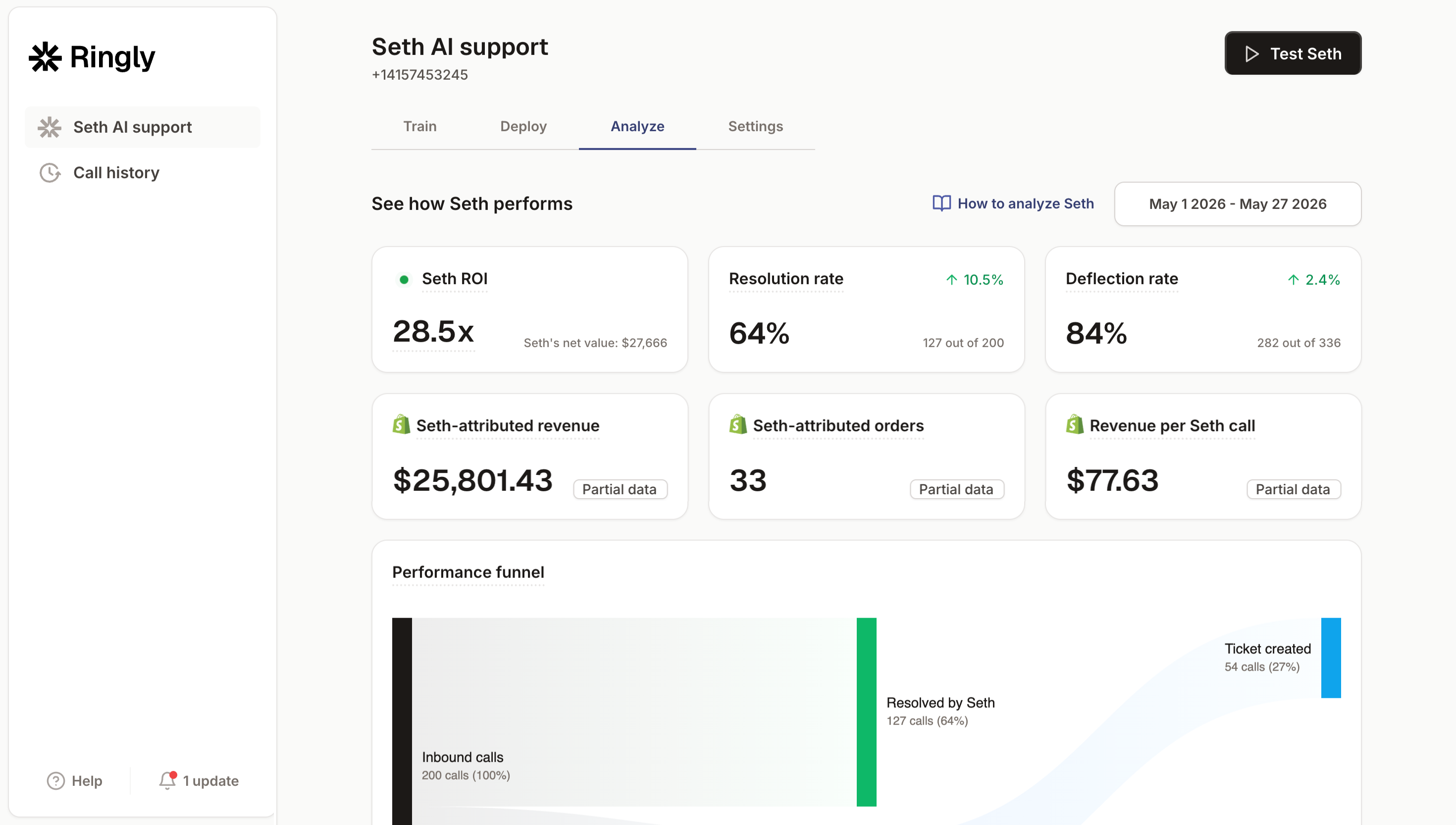
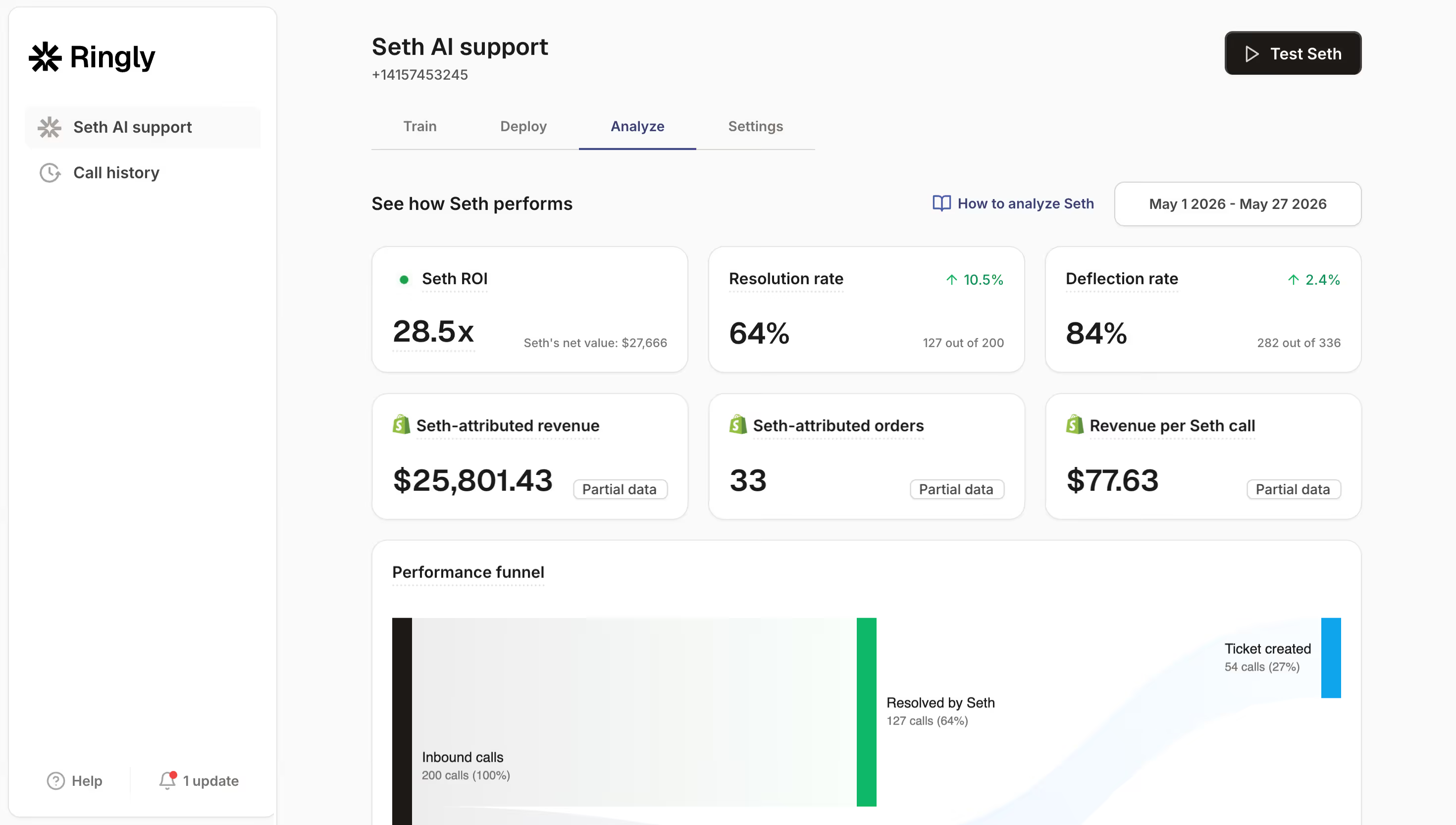
The numbers hold up outside a launch crunch too. Across 50+ brands, the AI resolves 73% of inbound calls autonomously at roughly $0.42 per resolved call. WashCo, a Shopify brand we launched, recovered $22,664 in its first 7 days on the phone. That's revenue that would otherwise have rolled to voicemail while the team was deep in a helpdesk migration.
"My customers also feel like it's a normal person. They feel like they can communicate if they have questions."
Claudia Droge, TechCraft Studio
Adding it during the switch is low-lift: you keep your current phone number, your Gorgias instance, and your workflows. The AI takes the routine calls so your team can put their heads down on the migration without the phone backlog piling up behind them.
What the move actually costs you
The migration tool cost is small and volume-based. The real cost of a Freshdesk to Gorgias data migration is your team's time, and it shows up twice: once on the data, once on the calls you miss while you're focused on the data.
Run the second number. Take a brand on a 6-rep CS team:
| Line item | During a manual cutover | With the phone covered |
|---|---|---|
| 6 reps x $4K loaded per rep | $24,000/mo | $24,000/mo |
| Calls answered during go-live week | A fraction (team is on the migration) | 24/7, automatically |
| Revenue rolling to voicemail | n/a (you don't see it) | Recovered |
You can't staff your way out of this without pulling reps off the migration, which slows the migration. Letting the AI hold the phone line through the switch is the cleaner trade. Across the brands we've launched, the routine calls (order status, returns, the same questions over and over) are the 70-80% of ecommerce customer service that doesn't need a human anyway.
Frequently asked questions
Does a Freshdesk to Gorgias migration cause downtime?
No, not for email or chat. Both platforms stay live while the data copies, and a final delta sync catches anything created during the run. The only "read-only" window is a short final sync, and you control when it happens.
Do my Freshdesk tags and ticket history transfer to Gorgias?
Yes. Tickets, full thread history, contacts, and tags all migrate automatically, with tags becoming Gorgias labels. Custom fields move too, but the custom ones need manual mapping before the full run.
What doesn't transfer in a Freshdesk to Gorgias migration?
Your automations. Triggers, business rules, SLA policies, routing, and app integrations should be recreated in Gorgias. Most macros transfer, but ones with conditional logic or placeholders need a quick adjustment after the move.
Should I use a migration tool or a manual CSV export?
Use a tool for anything beyond a few hundred tickets. Gorgias recommends Help Desk Migration. A manual CSV risks data corruption and broken field mapping, and the cleanup labor costs more than the tool for a brand doing $10M+.
How long does the migration take?
A small account can finish under a day. A large account with heavy history runs 1-2 weeks end to end, and you can pause and restart the transfer to fit it around your peak hours.
Can Ringly keep our phone covered during the switch?
Yes. Ringly is AI phone support that sits in front of Gorgias, answers inbound calls 24/7, finds orders in Shopify, and escalates the hard calls into Gorgias once you're live. It keeps the phone backlog from building while your team runs the migration.
Talk to us

If you're moving a $10M-$100M Shopify brand off Freshdesk and onto Gorgias, the data is the part everyone plans for. The phone is the part that quietly leaks revenue while you're focused on the data. A 30-min call is the fastest way to see how to cover it.
The 3-layer guarantee.
- Live in 14 days or it's free until launched.
- 65% resolution in 90 days or we refund the last 3 months of subscription fees.
- We keep working free until we hit 65%.
Ruben (Ringly co-founder) takes these calls personally.
Book a 30-min call and we'll scope the Launch Sprint for your store.