
This post in 30 seconds.
- A returns department isn't one team. A single return passes through five owners (support, warehouse, finance, a returns lead, and merch), and most brands never name them.
- You'll get the headcount-trigger math: when one returns FTE pays for itself, when to split CS-side from warehouse-side, and when to hire a returns lead.
- Built for founders, COOs, and Heads of CX at $10M-$100M Shopify brands where everyone touches returns and no one owns them.
Returns are the one part of an ecommerce operation that nobody designs on purpose. They just accrete. A request lands in Gorgias, a rep handles it between WISMO tickets, the box shows up at the warehouse a week later, someone in finance eventually issues the refund, and the customer calls twice in between asking where their money is. No one owns the whole thing. That works until your return volume crosses a line, and then it becomes the slowest, most expensive, most complaint-generating part of the business.
If you run a $10M-$100M Shopify brand and you've started feeling that, this is the org-design version of the fix. Not a returns policy, not a software pick. The actual department: who owns each step, when to dedicate people to it, and how a visible phone line plus some automation changes the headcount math. We've read 200,000+ real support calls across the brands we run phone support for, and the returns call is one of the most repeatable calls in the whole stack. That read shapes most of what's below.
Before the deep dive: if your CS team is drowning in return-status calls and you're trying to decide whether the answer is a new hire or a different setup, book a 30-min call and we'll do the math on your actual volume.
In this post:
What an ecommerce returns department actually does
Start with the work, not the org chart. A return isn't one task. It's six, and they live in different parts of the building.
A returns department is a relay race, and the baton gets dropped at every handoff nobody owns. Here's the actual sequence a single returned item runs through:
- Intake. The customer requests the return, you approve or deny it, you send a label. This is where the "is this even eligible" judgment call lives.
- Inbound logistics. The box travels back and shows up at your warehouse, often with no paperwork the receiver can match to an order.
- Inspection and grading. Someone opens it, checks condition, decides: restock as new, restock as open-box, repair, liquidate, or trash.
- Disposition. The item goes back to a shelf or it doesn't. Only about 48% of returned items resell at full price, according to Eightx's 2026 returns data. The other half is a margin problem someone has to manage.
- The refund. Finance issues the money, reconciles it against the order, and watches for fraud and double-refunds.
- Root cause. The "why did this come back" data gets fed to merch and product, or it doesn't and the same SKU keeps coming back.
The volume behind this is bigger than most operators model. The average ecommerce return rate in 2026 sits around 19-20%, per Eightx, and it's wildly uneven by category. Apparel runs about 25% and shoes hit 31.4%, while supplements sit near 7% and pet around 10%, according to Richpanel's category benchmarks. If you sell apparel at $40M, one in four orders is coming back, and every one of those is a relay race.
And it isn't free to run. Processing a single return costs $15-30 in direct handling on the conservative end, climbing to $25-35 for apparel and $35-55 for electronics once you load in labor, shipping, and inspection, per Eightx's per-item cost breakdown. Multiply that by your monthly return count and you get the real reason returns deserve their own department: it's a five-figure-a-month line item being run by people who were hired to do something else.
The 5 owners of a return (the org map nobody draws)
Here's the map almost no brand under $100M has actually drawn. Five owners, five different failure modes when the owner is unnamed.
| Step in the return | Owner | What they actually own | Where it breaks without them |
|---|---|---|---|
| Intake + eligibility + "where's my refund" | Customer service | Approvals, labels, status calls, exceptions | CS drowns; refund-status calls eat the queue |
| Receiving + inspection + grading | Warehouse / fulfillment | Condition grade, restock vs quarantine | Boxes pile up; sellable stock sits in limbo |
| Refund + reconciliation + fraud | Finance / ops | Issuing money, matching to orders, fraud flags | Double-refunds, margin leakage, chargebacks |
| Policy + SOP + vendor + exceptions | Returns / RMA lead | The whole workflow, the edge cases | Everyone improvises; no two returns handled the same |
| Why-returned data | Merch / product | Root-cause fixes, SKU-level return rate | Same product comes back forever |
The one most teams miss is the first row, and it's the expensive one. The return-status call, the "where's my refund," is not a warehouse problem. It lands on your CS team. Reading our own call logs across Shopify brands, return eligibility and refund-status questions are some of the most repeated calls a support team fields, right alongside WISMO. WISMO alone is 20-40% of support tickets and 50%+ at peak, per Salesforce, and the returns cousin rides right behind it.
That's why returns quietly inflate CS headcount instead of warehouse headcount. The physical work scales with bodies in the building. The call work scales with bodies on the phone. WashCo, a Shopify brand we launched, recovered $22,664 in its first 7 days on the phone, mostly by catching the repeatable calls that were going to voicemail before. If you only staff the warehouse side of returns, the CS side bleeds out quietly, and you don't see it until a rep quits.
When to dedicate people to returns (the headcount math)
This is the question operators actually want answered: at what point does returns stop being "the CS team handles it" and start being a job?
How I built this math
I'm Ruben, co-founder of Ringly.io. I didn't pull these triggers from a staffing template. I built them from two sources: the live call data across the Shopify brands we run phone support for, and the loaded-cost numbers our customers actually use on calls.
- I counted the call load. Across 150,000 calls, I logged how much of a returns department's volume is repeatable status-and-eligibility questions versus genuine judgment calls. The repeatable share is high, which is what makes the CS-side trigger fire earlier than people expect.
- I used real wages, not list prices. A returns processor in the US averages about $16.74/hr, roughly $34,822/yr, per ZipRecruiter's 2026 data. A loaded CS rep is closer to $4,000/mo once you add benefits, training, and attrition.
- I factored in the churn tax. Replacing one CS rep runs about $14,113, per Insignia's research, and most new reps don't last a year. That makes "just add a body" more expensive than it looks.
The triggers below are the shapes I see repeat across brands, not a guarantee for yours.
Dedicate your first full-time returns person the month your returns clear roughly 800-1,000. A specialist working returns end-to-end (receive, inspect, grade, trigger the refund) handles about 30-50 a day at 10-15 minutes each, which is 700-1,000 a month per person. Below that, you're paying a full salary for part-time work. Above it, your warehouse team is dropping returns to handle returns.
| Monthly returns | What to add | Why |
|---|---|---|
| Under 800 | Nobody dedicated; CS + warehouse share it | Volume doesn't fill a role |
| 800-2,500 | 1 returns specialist (warehouse-side) | Physical processing now fills a job |
| 2,500-5,000 | Split: 1 warehouse-side + dedicated CS-side coverage | The call/approval load needs its own owner |
| 5,000+ or $30M+ revenue | Add a returns lead (owns SOP, fraud, vendor) | The workflow itself needs an owner |
The split at 2,500 is the one brands get wrong. They add a warehouse processor and assume the call side is handled. It isn't. The refund-status calls keep landing on the general CS queue, and your customer service team absorbs a second job it was never staffed for.
The returns SOP and who owns each step
A department without a written SOP isn't a department. It's a habit. The whole point of a returns SOP is that any two returns get handled the same way regardless of who's on shift. Here's the skeleton, with the owner named at every step.
- Step 1: Request and eligibility (CS owns). Customer initiates through a self-serve portal or contacts support. The rule (or the AI) checks the window, the condition policy, and the SKU exceptions. Final-sale items and worn goods get caught here, not at the warehouse.
- Step 2: Authorize and label (CS owns). Approved returns get an RMA number and a prepaid or customer-paid label per your policy. This is where your return policy becomes a workflow instead of a webpage.
- Step 3: Receive and match (warehouse owns). The box arrives, the receiver scans the RMA, and the system matches it to the order. No RMA, no match, and the package goes to an exception shelf.
- Step 4: Inspect and grade (warehouse owns). Condition gets graded against a fixed rubric. This step decides whether the item is revenue or loss.
- Step 5: Disposition and restock (warehouse owns). Sellable stock goes back to inventory. Everything else routes to open-box, repair, liquidation, or trash.
- Step 6: Refund and reconcile (finance owns). Money goes back, the refund matches the order, and fraud patterns get flagged. This is also where exchanges and store credit get decided instead of straight refunds.
- Step 7: Escalate exceptions (returns lead owns). Damaged-in-transit, suspected fraud, repeat abusers, and anything off-policy goes to the lead. Everyone else follows the SOP; the lead handles the 10% that doesn't fit it.
The SOP is also what makes the work delegable. You can't hand returns to a new hire, an offshore team, or an AI agent until the steps and owners are written down. Most of the returns management pain operators describe is really just an unwritten SOP making every return a one-off.
One more thing the SOP fixes: the response time on the refund-status call. The "where's my refund" call exists because the customer can't see where their return is in this seven-step relay. Every handoff that isn't visible to the customer becomes a phone call to you. Brands that send automated return-status updates cut that reverse-WISMO call volume by 40-60%, because the customer stops needing to ask. If you write the SOP and wire a status notification to steps 3 and 6, you remove a big chunk of the call load before you ever staff for it.
How to staff the returns department: in-house vs offshore vs AI
Once the SOP exists, staffing is a set of trade-offs, not a single answer. Here's how the four common models compare for a $10M-$100M brand.
| Model | Rough cost | Best for | Where it breaks |
|---|---|---|---|
| In-house team | $4K/mo loaded per rep | Brand-sensitive verticals, complex products | Scales linearly; hard to staff after-hours |
| Offshore BPO | $1.50-$3.50 per interaction | High volume, simple returns | Quality drift, training overhead, time zones |
| Returns software portal | $200-$1,000+/mo | Self-serve eligibility + label flow | Handles the form, not the phone call |
| AI phone layer | Flat monthly | The repeatable call load (status, eligibility) | Hands off the genuine exceptions to humans |
Most brands need a mix. A self-serve portal handles the form-fillers, the warehouse owns the physical side, and the question is what to do with the call load that the portal doesn't catch. That's the part that keeps growing.
In-house is the default and the most expensive. A US-based rep runs about $4,000/mo loaded, and you can't economically staff one to cover after-hours refund-status calls because the volume isn't steady. Offshore BPO gets cheaper per interaction but trades quality and adds a management layer, which is exactly the in-house vs outsource decision most operators agonize over. A returns portal is great at the form and useless at the phone, because the customer who calls is usually the one whose return didn't fit the form.
What this costs you today vs with an AI phone layer
Take a typical $50M Shopify brand running a 6-rep CS team, where two of those reps' time is effectively returns and refund-status work.
| Line item | Today | With Ringly |
|---|---|---|
| 6 reps × $4K loaded per rep | $24,000/mo | n/a |
| Ringly (~$5K/mo) | n/a | $5,000/mo |
| Net monthly CS spend | $24,000/mo | $5,000/mo |
| Monthly savings | n/a | $19,000/mo |
| Annual savings | n/a | $228,000/yr |
That's roughly 70% of repeatable calls (return eligibility, "where's my refund," exchange logistics, label resends) routed to the AI. The other 30%, the genuinely complex returns (fraud, damaged-in-transit, the angry escalation), still go to your CS team, who now have the time to actually solve them.
If your returns department is the reason you're about to hire rep #5, book a 30-min call and we'll run your real numbers before you post the job.
How automation reshapes the returns org
When you put an AI phone layer in front of the returns department, the org chart changes shape. The CS side stops scaling linearly with return volume, because the repeatable status-and-eligibility calls don't hit a human anymore.
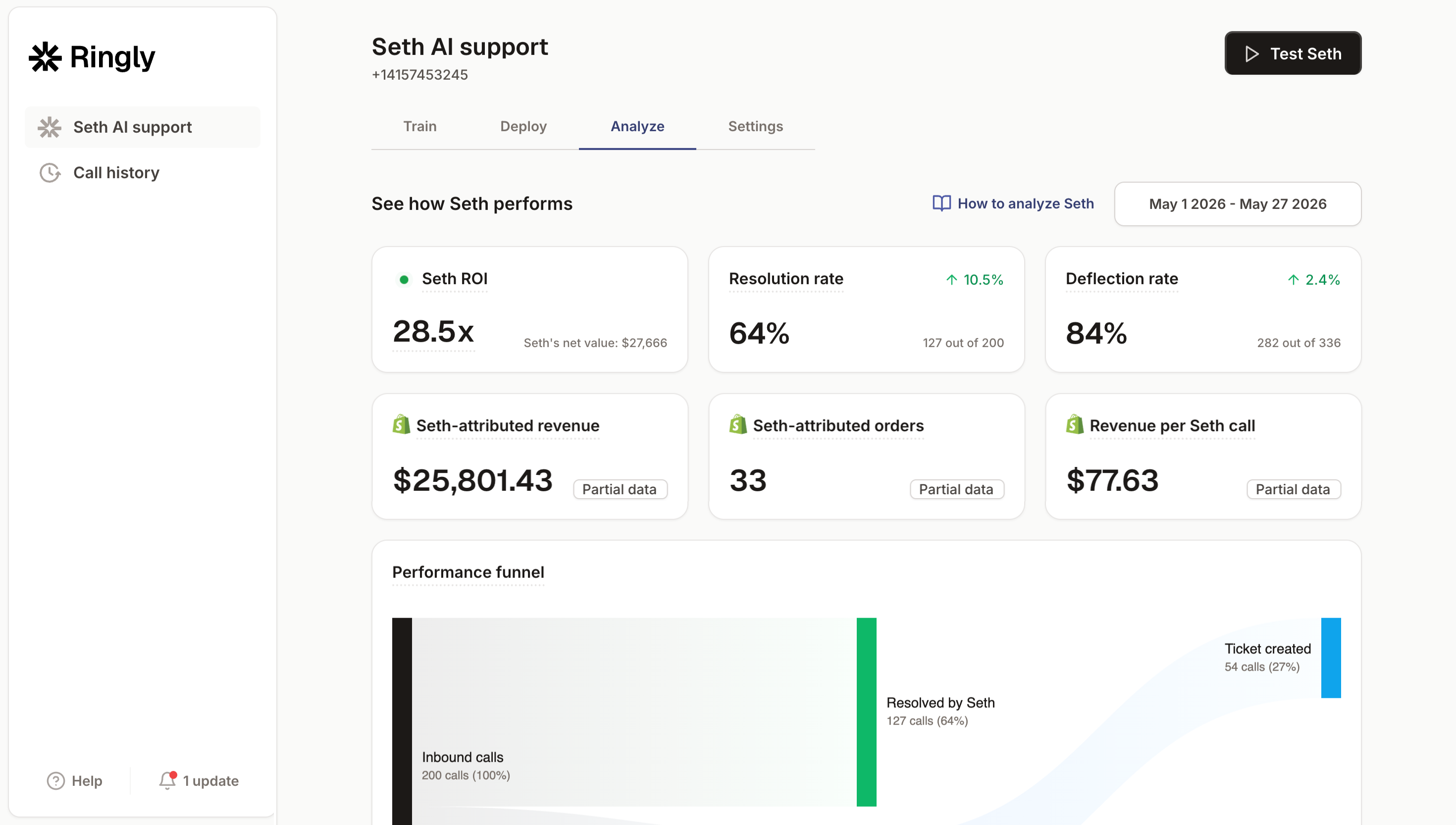
The humans don't disappear; they move up the value chain. Your team stops answering "where's my refund" for the fortieth time today and starts handling the inspection disputes, the fraud reviews, and the exceptions that actually need judgment. Across the brands we run, the AI phone agent resolves up to 90% of inbound calls on its own, and it checks order and return status straight from Shopify. Calls that need a person escalate cleanly to whatever helpdesk you already run.
"My customers also feel like it's a normal person. They feel like they can communicate if they have questions."
Claudia Droge, TechCraft Studio
The practical effect is that you delay or skip the next CS hire entirely, and you cover the seasonal spike (January returns, post-holiday refund wave) without temp staff. The warehouse still scales with bodies. The phone side doesn't.
It also changes who you hire. When the repeatable call load is handled, you stop hiring entry-level reps to answer the same eligibility question all day and start hiring one returns lead who can own the SOP, read the fraud patterns, and feed the why-returned data back to merch. That's a more senior, higher-impact role, and it's the one that actually moves your return rate down over time instead of just processing it. The org gets smaller and smarter at the same time, which is the opposite of what happens when you scale a returns department by adding bodies to the queue.
The numbers behind this matter because returns are not a rounding error. With overall ecommerce return rates near 19-20% and apparel above 25%, a brand doing $40M in apparel is processing tens of thousands of returns a year, and every one of them is a potential call. The question isn't whether you'll build a returns department. You already have one, scattered across three teams. The question is whether you'll design it before the volume forces you to.
Common mistakes when building a returns department
A few patterns show up over and over once a brand crosses into real return volume.
- Treating returns as a warehouse-only problem. The physical side is visible, so it gets staffed. The call side is invisible until a rep burns out. Staff both.
- No written SOP. Every return becomes a judgment call, which means every return is slow and inconsistent. Write the seven steps and name the owner on each.
- Letting refund-status calls sit in the general queue. "Where's my refund" is a distinct, high-frequency call. If it's competing with sales and complaint calls, it's both slowing your queue and frustrating the customer.
- Hiring before measuring. Operators add a rep when the queue feels bad, not when the volume math says so. Pull your actual monthly return count and the call mix first.
- Ignoring the why-returned data. If merch never sees that one SKU returns at 40%, you'll keep paying to process the same mistake. The root cause fix is cheaper than the processing.
Frequently asked questions
What roles do you need in an ecommerce returns department? At minimum, you need someone owning intake and refund-status on the CS side, someone owning receiving and inspection on the warehouse side, and finance owning the refund and fraud check. Past $30M or 5,000 returns a month, add a dedicated returns lead who owns the SOP, the exceptions, and the vendor relationships.
When should you hire a dedicated returns person? The month your returns clear roughly 800-1,000. Below that, a full-time hire is part-time work; above it, your warehouse or CS team is dropping their real job to handle returns. Split the role into warehouse-side and CS-side coverage once you cross about 2,500 returns a month.
Should returns sit under customer service or the warehouse? Both, because a return is two jobs. The physical processing belongs to the warehouse, and the customer-facing intake plus the refund-status calls belong to customer service. The mistake is staffing one side and assuming the other is covered.
How much does it cost to process a single return? Roughly $15-30 in direct handling on the conservative end, climbing to $25-35 for apparel and $35-55 for electronics once you load in labor, shipping, and inspection, per Eightx. And only about 48% of returned items resell at full price, so the disposition decision carries real margin weight.
What is an RMA process and who owns it? RMA stands for return merchandise authorization. It's the number and approval that ties a returned box back to an order so the warehouse can match it on arrival. Customer service owns issuing it; the returns lead owns the policy behind it.
How do you handle "where's my refund" calls without adding headcount? Route the repeatable ones to automation. Return-status and eligibility questions are some of the most repeated calls a support team fields, and an AI phone agent can pull the status from Shopify and answer them 24/7, escalating the genuine exceptions to your team.
How do you structure returns for peak season? Returns spike in January after the holiday wave, so build surge capacity into the SOP rather than hiring temps who need training mid-crisis. Automating the call side covers the seasonal spike without adding bodies, while the warehouse flexes hours.
Can you outsource the returns department? You can outsource pieces of it. The repeatable call load fits automation, the physical processing fits a 3PL or in-house warehouse team, and the form-filling fits a self-serve portal. The exceptions and fraud reviews are the part you keep in-house.
Talk to us

If you run a $10M-$100M Shopify brand and your returns department is quietly turning into a second CS team, a 30-min call is the fastest way to see which part of that call load you can take off your team's plate without losing the customer.
Our 3 promises.
- Live in under 1 hour. Setup and test calls are free.
- 30-day money back on the $99 plan fee.
- 65% resolution guarantee: if Seth resolves under 65% of your support calls in a month, that month comes back as credit (after 90 days on Pay per call).
Ruben (Ringly co-founder) takes these calls personally.