
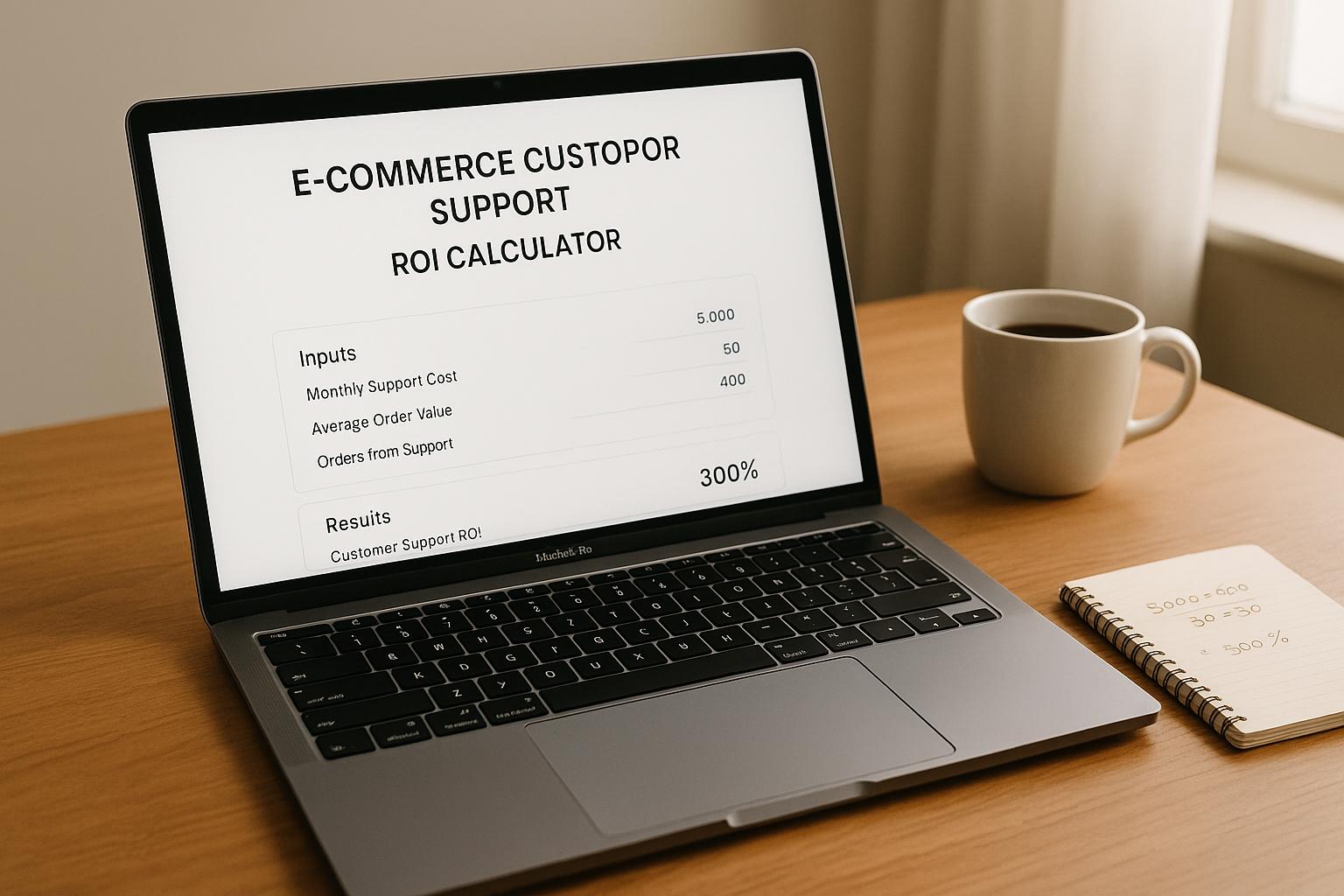
Use this free e-commerce customer support ROI calculator to see how much revenue your support team generates and whether the investment pays back. Built for Shopify merchants in supplements, beauty, CBD, pet, and apparel. Enter your costs and inquiry volume, pick your industry, and see how your support ROI stacks up against real benchmarks.
E-commerce Customer Support ROI Calculator
Plug in your annual support costs, inquiry volume, and the revenue you keep per resolved customer. The calculator shows the revenue your support team generates and the ROI on every dollar spent.
Resolution-rate ladder (hold revenue constant, vary resolution %)
| Resolution % | Revenue generated | Net contribution | ROI |
|---|
Maximize Your E-commerce Growth with a Support ROI Calculator
Running an online store comes with endless challenges, from inventory headaches to marketing puzzles. But one area often overlooked is customer support—and how it directly ties to your profits. Figuring out the return on investment for your support operations can be a game-changer, revealing whether your team is fueling growth or draining resources.
Why Customer Support Matters More Than Ever
In the fast-paced world of e-commerce, a single bad experience can send a customer packing. On the flip side, stellar support can lock in loyalty and even boost sales. That’s where a tool to evaluate your support’s financial impact becomes invaluable. By crunching numbers like annual costs and revenue tied to resolved issues, you get a clear picture of what’s working. It’s not just about cutting costs; it’s about investing smarter.
Take Control of Your Bottom Line
E-commerce businesses thrive on data, and your support metrics are no exception. Tools that break down complex figures into actionable insights empower you to make decisions with confidence. Whether you’re scaling up or fine-tuning operations, understanding the value of every customer interaction is key to long-term success.
Also read: 7 AI Strategies to Improve Ecommerce Support and Sales
FAQs
Why should I care about customer support ROI?
Great question! Customer support isn’t just a cost center, it’s often a hidden revenue driver. When handled well, support can turn frustrated customers into loyal buyers or save a sale that might’ve slipped away. Calculating your ROI helps you see if you’re getting a return on what you spend or if there’s room to improve. It’s all about making sure every dollar works for your business.
What if my ROI is negative? Does that mean my support is failing?
Not necessarily. A negative ROI might mean your support costs are high compared to the revenue they’re generating right now, but it doesn’t tell the whole story. Support also builds trust and long-term loyalty, which can be harder to measure. Take a closer look at your processes—maybe there’s a way to streamline costs or train your team to resolve more inquiries into sales. Use this as a starting point to dig deeper.
How accurate are the results from this calculator?
The results are as accurate as the data you provide. We use a straightforward formula to calculate ROI based on your inputs: annual support costs, inquiry volume, revenue per customer, and resolution rate. If your numbers are estimates, the output will be too. For the best insights, try to use real data from your store’s analytics or CRM system. It’s a solid way to get a clear snapshot of your support’s financial impact
+ Math.abs(n).toLocaleString('en-US', { minimumFractionDigits: 0, maximumFractionDigits: 0 }); } function fmtMoney2(n) { if (!isFinite(n)) return '-'; var s = n < 0 ? '-' : ''; return s + 'Maximize Your E-commerce Growth with a Support ROI Calculator
Running an online store comes with endless challenges, from inventory headaches to marketing puzzles. But one area often overlooked is customer support—and how it directly ties to your profits. Figuring out the return on investment for your support operations can be a game-changer, revealing whether your team is fueling growth or draining resources.
Why Customer Support Matters More Than Ever
In the fast-paced world of e-commerce, a single bad experience can send a customer packing. On the flip side, stellar support can lock in loyalty and even boost sales. That’s where a tool to evaluate your support’s financial impact becomes invaluable. By crunching numbers like annual costs and revenue tied to resolved issues, you get a clear picture of what’s working. It’s not just about cutting costs; it’s about investing smarter.
Take Control of Your Bottom Line
E-commerce businesses thrive on data, and your support metrics are no exception. Tools that break down complex figures into actionable insights empower you to make decisions with confidence. Whether you’re scaling up or fine-tuning operations, understanding the value of every customer interaction is key to long-term success.
Also read: 7 AI Strategies to Improve Ecommerce Support and Sales
FAQs
Why should I care about customer support ROI?
Great question! Customer support isn’t just a cost center, it’s often a hidden revenue driver. When handled well, support can turn frustrated customers into loyal buyers or save a sale that might’ve slipped away. Calculating your ROI helps you see if you’re getting a return on what you spend or if there’s room to improve. It’s all about making sure every dollar works for your business.
What if my ROI is negative? Does that mean my support is failing?
Not necessarily. A negative ROI might mean your support costs are high compared to the revenue they’re generating right now, but it doesn’t tell the whole story. Support also builds trust and long-term loyalty, which can be harder to measure. Take a closer look at your processes—maybe there’s a way to streamline costs or train your team to resolve more inquiries into sales. Use this as a starting point to dig deeper.
How accurate are the results from this calculator?
The results are as accurate as the data you provide. We use a straightforward formula to calculate ROI based on your inputs: annual support costs, inquiry volume, revenue per customer, and resolution rate. If your numbers are estimates, the output will be too. For the best insights, try to use real data from your store’s analytics or CRM system. It’s a solid way to get a clear snapshot of your support’s financial impact
+ Math.abs(n).toLocaleString('en-US', { minimumFractionDigits: 2, maximumFractionDigits: 2 }); } function setMode(mode) { currentMode = mode; document.querySelectorAll('.rwcr .rw-mode').forEach(function(el) { el.classList.toggle('active', el.dataset.mode === mode); }); if (mode === 'tr') { $('rw-cr-target').disabled = false; $('rw-cr-target').className = ''; $('rw-cr-revenue').disabled = true; $('rw-cr-revenue').className = 'computed'; } else { $('rw-cr-target').disabled = true; $('rw-cr-target').className = 'computed'; $('rw-cr-revenue').disabled = false; $('rw-cr-revenue').className = ''; } calc(); } function pos(roi) { if (!isFinite(roi)) return 0; if (roi <= 0) return 0; if (roi >= DIST_MAX * 1.4) return 100; // Map 0 to DIST_MAX*1.4 onto 0-100. Industry markers sit at their %. var pct = (roi / (DIST_MAX * 1.4)) * 100; return Math.max(0, Math.min(100, pct)); } function verdict(roi, industry) { var name = NAMES[industry] || 'ecommerce'; var bench = BENCH[industry] || 220; if (!isFinite(roi)) return 'Enter valid costs and inquiries to see your benchmark position.'; if (roi < 0) return 'Negative ROI. Support is costing more than the revenue it produces. The fastest fix is raising resolution rate, not cutting headcount.'; if (roi < bench * 0.5) return 'Well below the ' + name + ' benchmark of ' + bench + '%. Most of this gap closes by lifting resolution rate or shifting volume to lower-cost channels.'; if (roi < bench) return 'Below the ' + name + ' median of ' + bench + '%. Room to push by routing repeat questions to AI or self-serve, freeing agents for higher-value tickets.'; if (roi < bench * 1.3) return 'Above the ' + name + ' median of ' + bench + '%. Strong support ROI. Worth checking whether you can scale volume without breaking the model.'; return 'Top tier for ' + name + ' brands (median ' + bench + '%). Either you have a high-AOV product, strong CSAT-driven retention, or a lean team punching above its weight.'; } function renderLadder(costs, inquiries, revenue, pctResolved) { if (!isFinite(costs) || costs <= 0 || !isFinite(inquiries) || inquiries <= 0 || !isFinite(revenue) || revenue <= 0) { $('rw-cr-ladder-body').innerHTML = 'Maximize Your E-commerce Growth with a Support ROI Calculator
Running an online store comes with endless challenges, from inventory headaches to marketing puzzles. But one area often overlooked is customer support—and how it directly ties to your profits. Figuring out the return on investment for your support operations can be a game-changer, revealing whether your team is fueling growth or draining resources.
Why Customer Support Matters More Than Ever
In the fast-paced world of e-commerce, a single bad experience can send a customer packing. On the flip side, stellar support can lock in loyalty and even boost sales. That’s where a tool to evaluate your support’s financial impact becomes invaluable. By crunching numbers like annual costs and revenue tied to resolved issues, you get a clear picture of what’s working. It’s not just about cutting costs; it’s about investing smarter.
Take Control of Your Bottom Line
E-commerce businesses thrive on data, and your support metrics are no exception. Tools that break down complex figures into actionable insights empower you to make decisions with confidence. Whether you’re scaling up or fine-tuning operations, understanding the value of every customer interaction is key to long-term success.
Also read: 7 AI Strategies to Improve Ecommerce Support and Sales
FAQs
Why should I care about customer support ROI?
Great question! Customer support isn’t just a cost center, it’s often a hidden revenue driver. When handled well, support can turn frustrated customers into loyal buyers or save a sale that might’ve slipped away. Calculating your ROI helps you see if you’re getting a return on what you spend or if there’s room to improve. It’s all about making sure every dollar works for your business.
What if my ROI is negative? Does that mean my support is failing?
Not necessarily. A negative ROI might mean your support costs are high compared to the revenue they’re generating right now, but it doesn’t tell the whole story. Support also builds trust and long-term loyalty, which can be harder to measure. Take a closer look at your processes—maybe there’s a way to streamline costs or train your team to resolve more inquiries into sales. Use this as a starting point to dig deeper.
How accurate are the results from this calculator?
The results are as accurate as the data you provide. We use a straightforward formula to calculate ROI based on your inputs: annual support costs, inquiry volume, revenue per customer, and resolution rate. If your numbers are estimates, the output will be too. For the best insights, try to use real data from your store’s analytics or CRM system. It’s a solid way to get a clear snapshot of your support’s financial impact