

Ecommerce returns are not one cost. They're three.
- Roughly one in five online orders comes back. That's the headline number, and it's the least interesting part.
- A single return costs you on three fronts at once: the reverse shipping and handling, the margin you never recover, and a layer almost nobody counts, the customer service calls the return generates.
- If you run a $10M-$100M Shopify brand with a visible phone number, the third layer is probably landing on a team of three to twelve reps who are already underwater. This is the full picture, plus where the call cost actually goes.
Returns are the part of running a store that everyone treats as weather. It rains, you get wet, you move on. The National Retail Federation pegged returned retail goods at around $890 billion in 2024, with close to a fifth of all online orders eventually coming back. For most operators that number lives in a spreadsheet, gets labeled "cost of doing business," and never gets looked at again.
The problem is that returns don't cost you in one place. They cost you in three. And the one that gets ignored, the one I want to spend most of this on, is the call your returns process generates after the package is already on its way back.
If you're a founder, COO, or head of CX at a Shopify brand doing eight or nine figures, you already feel the third layer even if you've never put a number on it. The same questions over and over. "Where's my refund." "Did you get my return." Voicemails after 6 p.m. that nobody returns until Tuesday. We build AI phone agents for Shopify brands trying to get that queue back, and the refund-status call is the single most common thing it picks up. Book a 30-min call and we'll show you what that part of your returns process is quietly costing.
In this post:
What counts as an ecommerce return (and what doesn't)
Before the numbers mean anything, the words have to. People use "return," "refund," and "exchange" as if they're the same event. They're three different outcomes with three different cost profiles.
A return is the physical event: the customer sends the product back. A refund is the money moving back to their card, which may or may not follow a return. An exchange is a swap, same product different size or a different product entirely, and it's the cheapest of the three for you because the revenue stays in the building. A chargeback is none of those. That's the customer going around you to their bank, and it carries fees and fraud risk a normal return doesn't. The distinction matters operationally too, because each one routes differently inside your store and generates a different kind of support contact. A pending exchange and a pending refund feel identical to the customer ("where's my stuff"), but they live in two different places in your system, and a rep has to know which one to check.
Your return rate is the most-quoted and least-standardized metric in ecommerce, so check how yours is calculated before you benchmark it. Some teams measure returned units against units sold. Some measure returned orders against total orders. Some measure returned dollars against revenue. Those three give you wildly different numbers for the same store, and a category benchmark you find online almost never tells you which one it used. If you want the deeper data, our ecommerce return statistics breakdown walks through the definitions and the 2026 numbers.
For this post, when I say "return rate" I mean returned orders as a share of total orders, because that's the one that maps cleanly to call volume. Every returned order is a candidate to generate a "where's my refund" call, no matter how many units were in it.
How big is the ecommerce returns problem really
Online stores get returns back at roughly two to three times the rate of physical retail. The blended ecommerce average sits near 20% in 2026, against 5% to 9% for brick-and-mortar. But the average hides everything that matters, because return rate is mostly a function of what you sell.
Here's how it breaks down by category, pulled from 2026 benchmarking by Eightx and Richpanel:
| Category | Typical online return rate | Why it runs high or low |
|---|---|---|
| Apparel | 20% to 40% | Fit and sizing, ordering two sizes on purpose |
| Footwear | 17% to 30% | Same fit problem, higher ticket |
| Electronics | 8% to 15% | Defects and buyer's remorse, less subjective |
| Beauty and cosmetics | 4% to 12% | Hard to resell, often non-returnable |
| Home and furniture | 5% to 15% | Damage in transit, "looked different online" |
| Ecommerce blended average | ~20% | The number nobody actually has |
If you sell apparel, a 30% return rate is not a crisis, it's Tuesday, and the lever isn't getting to 8%. It's making the 30% cost less. That reframe matters because a lot of operators burn months chasing a return rate their category will never let them hit, instead of fixing the cost per return, which they fully control.
Two more numbers to keep in your head. Returns spike to roughly 30% during the holiday window, so the queue you're staffing in January is not the queue you staffed in September. And returns are not evenly distributed across your customers. A small slice of serial returners drives a disproportionate share, which is why blanket-policy changes tend to punish your best customers to catch your worst ones.
The other thing the blended average hides is the call load. Two brands with the same 20% return rate can have completely different support burdens, because one of them sends proactive status updates and the other lets every refund go quiet for ten days. Same return rate, very different phone queue. That gap is the whole reason the third cost layer is worth measuring on its own.
Why customers return things
You can't reduce returns you don't understand, and most teams are guessing at their own return reasons because the dropdown menu at checkout-return is too coarse to be useful. When you actually dig into the data, the reasons cluster into a short list.
- Size and fit. The big one. Sizing and fit account for roughly 40% to 50% of all apparel and footwear returns, per Outvio. This is also the most fixable, because it's a product-page problem more than a product problem.
- The item wasn't what they expected. Around 51% of online returns trace to a gap between what the product page promised and what showed up, according to Loop Returns. Wrong color, thinner fabric, smaller than it looked. Your photos and copy are writing checks the product can't cash.
- It arrived damaged or defective. Roughly 42% of shoppers name this as a top return reason. There's no saving this one with better copy. It's fulfillment, packaging, and QC.
- Buyer's remorse. About 10% to 15% of returns are the customer changing their mind after the dopamine wore off. Flash sales and countdown timers buy you the order and the return in the same motion.
- Late delivery. Another 6% to 8% arrive after the customer needed them, especially around gifting, and a late gift is an automatic return.
- Wardrobing and fraud. The customer wears it once and sends it back, or games the policy outright. Smaller in volume, ugly in margin.
The reason this taxonomy matters: each bucket has a different fix, and lumping them together as "returns are high" guarantees you fix none of them. Sizing is a PDF and a size chart. Damage is a warehouse conversation. Remorse is a merchandising conversation. If you want the playbook on actually moving the number down, we wrote a separate guide on how to reduce product returns.
The true cost of a return (three layers)
This is the section every returns guide gets half-right. They count layer one, sometimes touch layer two, and skip layer three entirely.
Layer one: reverse logistics. This is the obvious cost, the physical movement of the product back to you. Processing a single return runs anywhere from $10 to $65 depending on category, distance, and complexity, with a conservative direct-processing estimate of $15 to $30 per return. Return shipping, the label, the receiving labor, the inspection. Reverse logistics can eat around 8% of total sales for a returns-heavy brand.
Layer two: margin erosion. Here's the one that should scare you. Only about 48% of returned items get resold at full price. The other half get discounted, liquidated, donated, or thrown out. So the return doesn't just cost you the shipping, it often costs you most of the product's value too. And it's non-linear: a 25% return rate can compress your contribution margin by closer to 70%, not 25%, because you're losing the sale, the product, and the processing all at once. Returns eat margin twice, and people only ever subtract it once.
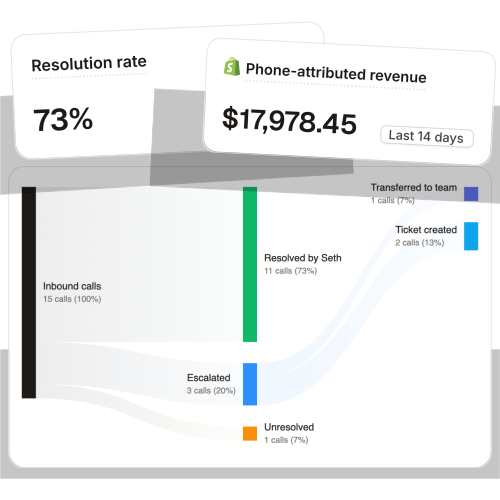
Layer three: the support load. Every returned order is a candidate to generate a contact, and refund-status questions alone make up 15% to 25% of support tickets at a lot of brands. At one DTC brand, returns became the single biggest source of customer service tickets, ahead of everything else. This is the layer your finance team never models, because it doesn't show up on the reverse-logistics invoice. It shows up as headcount, as after-hours coverage, as your refund calls eating the same team that's already drowning in WISMO tickets.
Add the three together and a return is rarely the $15 line item it looks like on paper. For a lot of brands it's that plus a chunk of lost product value plus a slice of a CS rep's day.
How the returns process actually works
Behind every refund is a chain of steps most customers never see, and most founders couldn't fully diagram. This is reverse logistics, the physical flow of getting a product back and deciding what to do with it. Returns management is the strategic layer on top: the policy, the inventory math, the customer experience, the partners you use. If you're scoping a system, our guide to ecommerce returns management goes deeper on the tooling.
The flow itself, per Shopify, looks like this:
- Request and authorize. The customer asks to return. A return merchandise authorization (RMA) approves the request and gives you a tracking handle for it.
- Ship it back. A label gets issued. The customer ships it or drops it at a pickup point or store.
- Receive and inspect. The parcel lands at your warehouse and someone checks its condition.
- Decide the disposition. Restock, refurbish, recycle, liquidate, or dispose. This decision is where the 48%-resold number gets made.
- Refund or exchange. The money goes back or the swap goes out.
- Update inventory. Stock counts get corrected so you don't oversell a unit sitting in a returns bin.
The step that creates almost all of your return-related calls is the one in the middle, the gap between "we received it" and "the money is back on your card." Once you issue a refund, it still takes 5 to 10 business days to settle because of bank and card-network processing, not anything on your end. The customer doesn't know that. They just know they're owed money and they can't see it. So they call. For the deeper tooling side, our overview of returns management services covers the options.
The refund-status call nobody counts
WISMO, "where is my order," is the call every ecommerce operator knows. It's up to half of inbound call volume at a lot of brands. WISMR, "where is my refund" or "where is my return," is its twin, and almost nobody talks about it.
It's the same call wearing a different hat. The customer already shipped the product back, or they're chasing a refund mid-process, and they want to know where their money is. And it's a worse call than WISMO in every way that matters to your team. It's repeatable, the same handful of questions all day. It spikes after hours, because anxiety about money owed doesn't keep business hours. And it's emotionally loaded in a way an order-status call isn't, because the customer feels like you're holding their money.
I read a lot of real return and refund call transcripts. I pull the patterns from call data across the Shopify brands we run phone support for, and the refund-status call is remarkably consistent. The customer is calm if they reach someone. They are not calm if they hit a voicemail at 9 p.m., leave a message, and wait. That second customer is the one who doesn't reorder, and the one who leaves the one-star review that says "couldn't reach anyone about my refund."
This is the layer Ringly was built for. Ringly.io is AI phone support for Shopify brands. Instead of growing your support headcount every time returns spike, the AI answers inbound calls 24/7, finds the order, checks the return and refund status in your Shopify store, and tells the customer exactly where their money is. It resolves up to 90% of calls autonomously, and the genuinely complex returns, the damaged-in-transit dispute, the "I want to speak to someone" escalation, hand off cleanly to your team via whatever helpdesk you already run.
WashCo, a Shopify brand we launched, recovered $22,664 in attributed revenue in its first 7 days on the phone, much of it from calls that would otherwise have gone to voicemail. If you want to see what your refund-status queue looks like, book a 30-min call and we'll walk through your numbers.
What the support layer costs you, and what it costs to fix
Put rough numbers on it. Take a $50M Shopify brand running a 6-rep support team that spends a big chunk of its week on returns and refund-status calls.
| Line item | Today | With Ringly |
|---|---|---|
| 6 reps x $4K loaded per rep | $24,000/mo | n/a |
| Ringly (~$5K/mo) | n/a | $5,000/mo |
| Net monthly support spend | $24,000/mo | $5,000/mo |
| Monthly savings | n/a | $19,000/mo |
| Annual savings | n/a | $228,000/yr |
That's roughly 70% of the repeatable calls, the refund-status checks, the "did you get my return," the same five questions over and over, routed to the AI. The other 30%, the calls that genuinely need a human, still go to your reps, who now have the time to actually handle them well. For the broader picture on the support side, our guide to ecommerce customer service is a good companion read.
How to reduce returns and soften the cost
There are two separate jobs here, and most brands only work on the first. Reduce the returns you can. Soften the cost of the ones you can't.
To reduce the returns you can prevent:
- Fix sizing first, because it's the biggest and most controllable bucket. Size charts, fit guides, model measurements, and "this runs small" notes do more than any policy change.
- Make the product page tell the truth. Better photos, accurate color, real fabric detail, video. Mismatched expectations drive over half of returns, and that's a copy-and-imagery fix.
- Tighten QC and packaging. Damaged-on-arrival returns are pure loss. No customer-service finesse recovers them.
- Push exchanges over refunds. An exchange keeps the revenue in the building. Our guide to Shopify exchanges covers how to nudge customers toward a swap instead of a refund.
To soften the cost of the returns you'll always have:
- Send proactive refund-status updates. Telling the customer "we got your return, your refund is processing, it'll hit your card in 5 to 10 days" kills the call before it happens. Automated status updates alone cut refund-related ticket volume by 50% to 70%.
- Cover the phone after hours. The refund-status call spikes at night. Voicemail is where reorders go to die. This is the layer AI phone coverage handles cleanly.
- Be careful with return fees. 72% of US retailers now charge them in 2026, up from 41% in 2023, and 53% saw return rates drop as a result. But 77% of shoppers check the return policy before they buy, so a fee that lowers returns can also lower conversion. Test it, don't assume it.
On the fee question specifically: there's a real tradeoff between a stricter policy and your conversion rate, and the brands that get it right treat the return policy as a conversion lever, not just a cost-control lever. For the full operator playbook, see our ecommerce returns best practices and DTC returns best practices. Reducing returns is also a retention story, since an easy return is one of the strongest drivers of repeat purchase: 92% to 96% of shoppers will buy again from a brand that made the return painless.
Frequently asked questions
What is a good ecommerce return rate? It depends entirely on your category. Apparel and footwear run 20% to 40%, while electronics and beauty sit in the high single digits to mid teens. The blended ecommerce average is around 20%, so compare yourself to your category, not the average.
How much does an ecommerce return cost? Direct processing runs $15 to $30 per return conservatively, and up to $65 for complex or bulky items. But that's only the logistics layer. Once you add lost product value (only about half of returned items resell at full price) and the support calls the return generates, the true cost is meaningfully higher.
What is reverse logistics? Reverse logistics is the physical process of moving a product back from the customer to you: authorization, return shipping, inspection, and the decision to restock, refurbish, recycle, or dispose. It's the operational half of returns management, which also covers policy, inventory, and customer experience.
Why do refunds take so long? Once you issue the refund, the money still takes 5 to 10 business days to settle on the customer's card because of bank and card-network processing, not anything on your end. That lag is exactly why "where's my refund" is such a common and repeatable support call.
What's the difference between a return, a refund, and an exchange? A return is the product physically coming back. A refund is the money going back to the customer's card. An exchange is a swap for a different size or item, and it's the cheapest outcome for you because the revenue stays in the business.
Can you actually reduce ecommerce returns? Yes, but only the preventable ones. Sizing tools, accurate product pages, and better QC move the biggest buckets. You can't eliminate buyer's remorse or category-level fit returns, so the smarter play is reducing what you can and lowering the cost of the rest.
Should I charge a return fee? 72% of US retailers do as of 2026, and many saw return rates fall as a result. The catch is that 77% of shoppers check the return policy before buying, so a fee can cost you conversion. Test it against your own numbers before committing.
Can AI handle refund-status calls? Yes, and they're close to the ideal use case. Refund-status calls are repeatable, spike after hours, and follow a predictable pattern. An AI phone agent can look up the order, check the return and refund status, and tell the customer where their money is, escalating only the genuinely complex cases to a human.
Do returns hurt margins more than the shipping cost suggests? Much more. Because only about 48% of returned items resell at full price, you lose product value on top of processing. A 25% return rate can compress contribution margin by closer to 70%, since you're losing the sale, the product, and the handling at once.
Talk to us

If you run a $10M-$100M Shopify brand and the refund-status calls are landing on a team of three to twelve, a 30-minute call is the fastest way to see what that queue is actually costing you. We'll pull the math on your returns-driven call volume and show you what the AI would pick up versus what stays with your team.
Our 3 promises.
- Live in under 1 hour. Setup and test calls are free.
- 30-day money back on the $99 plan fee.
- 65% resolution guarantee: if Seth resolves under 65% of your support calls in a month, that month comes back as credit (after 90 days on Pay per call).
Ruben (Ringly co-founder) takes these calls personally.