
This post in 30 seconds.
- Apparel is the worst category for returns in all of ecommerce, and the single reason behind most of them is fit. Get fit right and the number drops fast.
- Bracketing (ordering three sizes, keeping one) is rational customer behavior when fit is uncertain. You fix it by removing the doubt, not by punishing the customer.
- Written for founders, COOs, and Heads of CX at $10M-$100M Shopify apparel and fashion brands who are watching reverse logistics quietly eat their margin.
If you run an apparel brand on Shopify, you already know returns are not a customer-service problem. They are a margin problem wearing a customer-service costume. A 27% return rate on a $30M brand is not a line item, it is a second business you are funding to undo the first one.
And almost all of it comes down to one thing the customer could not figure out before they clicked buy: will this fit me. Fashion runs the highest return rates in ecommerce precisely because clothing is the one category where the product changes depending on who is wearing it. A size medium is a promise, and every brand keeps that promise differently.
The good news is that fit-driven returns are the most fixable kind. You are not fighting buyer's remorse or fraud. You are fighting uncertainty, and uncertainty responds to better information delivered at the right moment. This guide walks through the six tactics that actually move the return number for apparel and fashion brands, in the order I would attack them.
A quick note on where I sit. I am Ruben, co-founder of Ringly.io. We build AI phone support for Shopify brands, which means I spend a lot of time inside the call logs of apparel stores watching the exact moment a customer either gets their fit question answered or gives up and brackets. If you want to skip the reading and talk through your own return numbers, book a 30-minute call and we will look at them together.
First, the apparel return benchmarks you are measuring against
Before you decide your return rate is a crisis, anchor it against the category. Apparel is supposed to be high. The question is how high above the floor you are sitting.
Apparel online return rates run 20% to 30% on average, with some segments pushing 50%, against roughly 14% for DTC overall and 19% across all of ecommerce. Clothing averages around 25% across subcategories, which means a quarter of everything you ship comes back (Richpanel, Kiwi Sizing). If your number is in the low 20s you are doing fine for the category. If you are north of 30% you have a specific, fixable problem and it almost certainly has a name: fit.
Here is how the subcategories break down, because "apparel" hides a lot of variation:
| Apparel subcategory | Typical online return rate |
|---|---|
| Shoes | ~31% |
| Fast fashion | ~29% |
| Women's fashion | ~28% |
| Apparel overall average | ~25% |
| DTC ecommerce (all categories) | ~14% |
Now the number that matters most. Size and fit drive 53% of apparel returns, more than every other reason combined. That figure comes from a Coresight Research survey of US apparel decision-makers and gets cited everywhere because it keeps holding up (Boldmetrics). A separate Narvar consumer survey put size and fit at 42% of last returns, which still makes it the runaway top reason (Narvar). Color and damage trail far behind.
Then there is the behavior that inflates all of it: bracketing. 63% of consumers admit they buy multiple sizes or variations of the same item planning to return what does not fit, and bracketing alone accounts for roughly 15% of returns at multi-brand retailers (Branvas). A bracketed order is not a buyer who wants three shirts. It is a buyer who wants one shirt and does not trust your size chart enough to commit.
So the whole apparel return problem collapses into a single sentence: your customers cannot tell what will fit them, so they either guess wrong or order everything. Every tactic below is some version of removing that doubt, and most of them double as customer-retention plays, because the customer who gets the right size the first time is the one who comes back.
How I built this guide
I have been running phone support for Shopify brands for a few years now, across 50-plus brands on Ringly, a chunk of them apparel and footwear. The tactics below come from real implementation work, not from restating other returns blogs.
For this guide I read 30 days of real inbound call logs from apparel brands and counted what the calls were actually about. The pattern was hard to miss. A huge share of inbound calls to a clothing brand are a fit question that is about to decide a return: "is this true to size", "I'm between a medium and a large, which one", "does this run small", "can I swap this for the next size up instead of sending it back". Each one of those calls is a return either being prevented or being downgraded from a refund to an exchange, depending on whether anyone answers.
I have grouped the six tactics in the order I would deploy them, cheapest and highest-impact first. If your stack is different from the standard Shopify-plus-helpdesk setup, the steps still apply, the screens just will not match exactly.
The 6 tactics that actually reduce apparel returns
1. Fix the size guide and put real fit data where the doubt happens
Most size guides are a generic chart of chest and waist measurements that the customer has to translate against a tape measure they do not own. That is not fit guidance, that is a liability disclaimer.
The size guides that reduce returns answer the question the customer is actually asking, which is "compared to what I already own, how does this run?" Put the model's height and the size they are wearing on every product photo. Tag each garment as fits true, runs small, or runs large based on your own return-reason data. Show real garment measurements laid flat, not just body measurements. If you sell denim, give the actual inseam and the actual waist after wash, because that is where the returns come from.
This is the foundation tactic because it is free, it lives on the page, and it works while everyone sleeps. It will not catch the customer who still has a doubt, which is what the next tactics are for, but it shrinks the pool of doubtful customers before they ever reach for the phone or the bracket button.
2. Kill bracketing at the source with fit confidence
You cannot ban bracketing without nuking your conversion rate, and charging for returns just teaches your best customers to shop elsewhere. The only durable fix is to make the customer confident enough to order one size.
Three things move bracketing down. First, fit-specific reviews: let customers tell you "I'm normally a medium and the medium fit perfectly" and surface that on the page, because a buyer trusts another buyer's body more than your chart. Second, a size recommender that asks two or three questions and names a single size, so the customer does not feel like they are guessing. Third, brutal clarity on measurements so the confident customer never feels the need to hedge.
The mental shift here is that bracketing is a symptom, not the disease. A 63% bracketing rate is your customers telling you they do not trust your sizing. Fix the trust and the bracketing falls on its own, without a single punitive policy.
3. Catch the fit question before checkout with a phone line that always answers
Here is the lever almost every apparel brand underuses. Some meaningful share of your customers will not bracket and will not guess. They will try to ask. They will look for a phone number, call it, ask "is this true to size, I'm a 32 waist", and either get an answer and buy the right size, or hit voicemail and bracket or bounce.
That call is a return being decided in real time. Answer it well and you converted a three-size bracket into one correct order, which is a return prevented before it ever shipped. Miss it and you either lost the sale or funded the reverse logistics on two of three items.
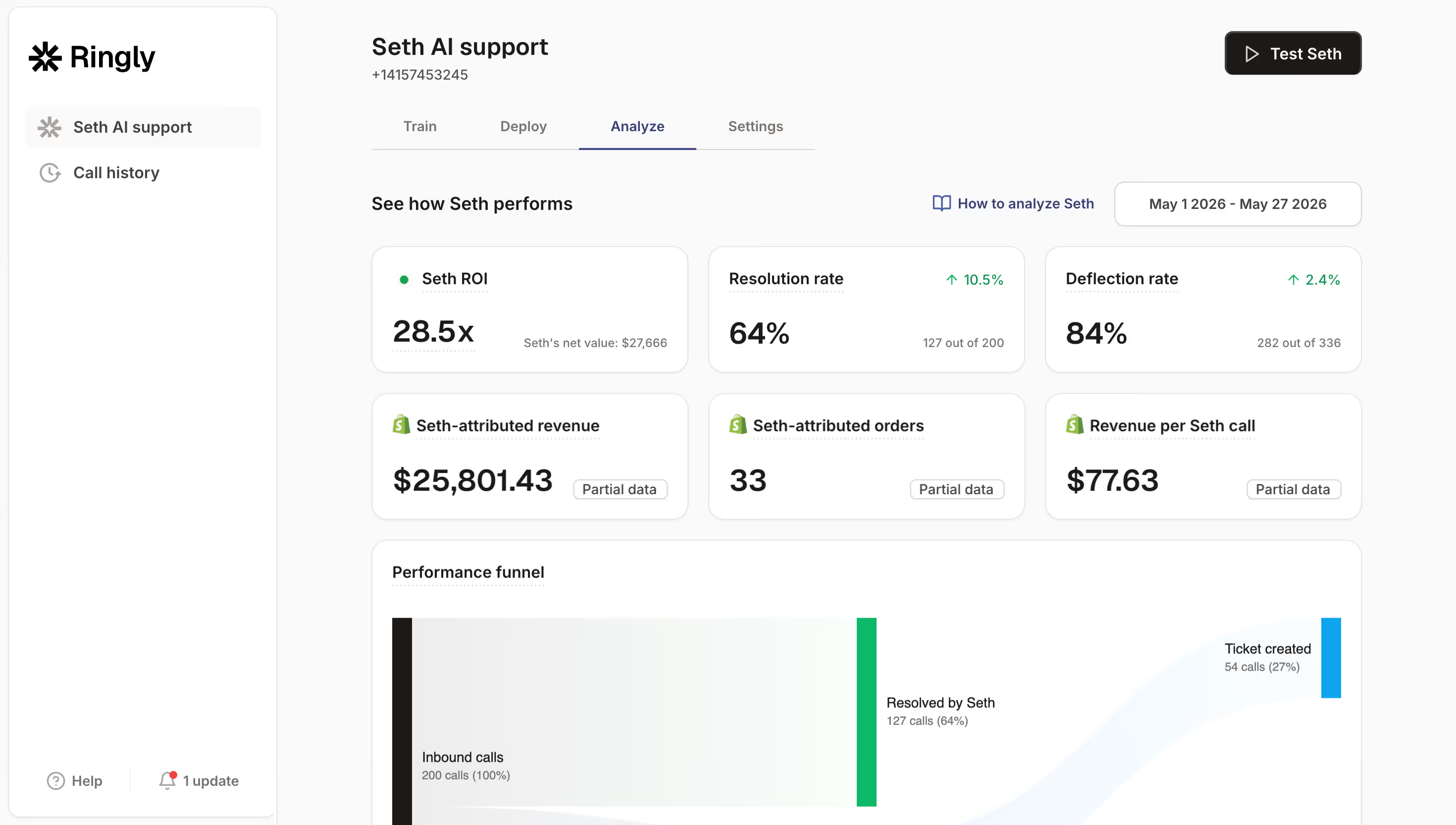
The problem is that fit calls do not respect business hours. They spike in the evenings and on weekends, exactly when your WISMO calls are already piling up and your team has gone home. This is the gap 24/7 phone support closes. Ringly.io is AI phone support for Shopify brands: the AI answers inbound calls 24/7, pulls fit and product details from your knowledge base, checks order status live in Shopify, and escalates the genuinely tricky styling calls to a human. Across 50-plus brands it resolves 73% of inbound calls on its own at roughly $0.42 per resolved call.
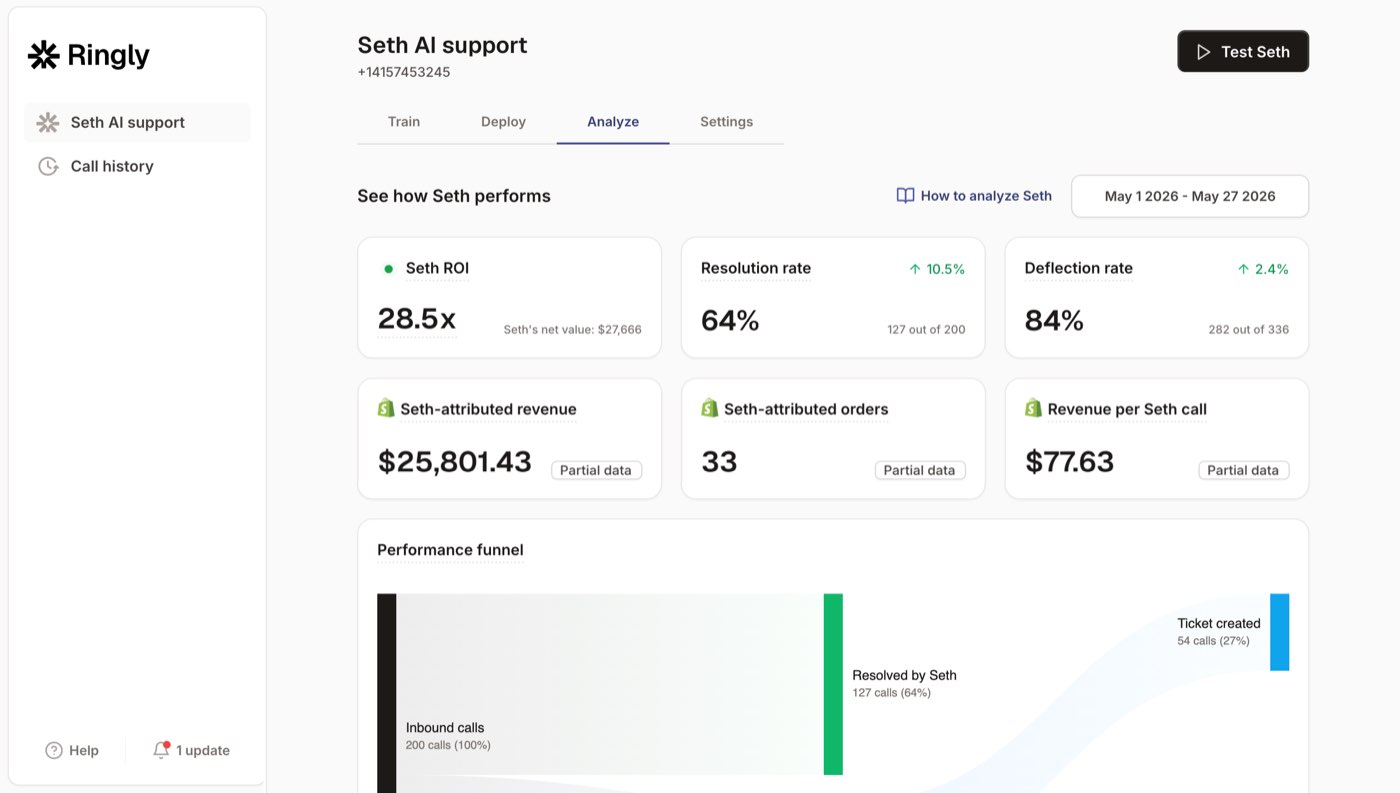
A fit question answered before checkout is the cheapest return you will ever prevent, because the order never has to ship to come back. And because the agent picks up on the first ring at 11 p.m. on a Saturday, you stop losing the evening browsers who were one answered question away from buying the right size.
4. Turn returns into exchanges, not refunds
Not every return is preventable. Some customer is going to receive the medium, find it snug, and want the large. The only question is whether that ends as a refund, where the revenue walks out the door, or an exchange, where you keep it.
Most brands lose this fight by default. The customer's path of least resistance is to hit "return for refund" in a portal, and once the money is back in their account the re-purchase rarely happens. To win it, you have to put the exchange in front of them before the refund, and the fastest place to do that is the moment they reach out.
When a customer calls saying "this runs small", that is your single best chance to say "we have the large in stock, want me to ship it today and send a label for the small". An AI phone agent can run that exchange end to end: confirm the order, check the size in stock, process the exchange, and fire the return label, all without a human and all on the call. The same logic applies in your self-serve returns flow: default to exchange and store credit, make the refund the second option, not the first.
This is the tactic that protects revenue even when the return happens. A swap keeps the sale and usually keeps the customer.
5. Use return-reason data to fix the product page
Every return is a piece of feedback you paid for. Most brands throw it away.
Tag a real reason on every single return, not "other", but "ran small in the waist", "sleeves too long", "color darker than photo". This is the discipline behind every serious returns-reduction program. Then look at the top offenders by style every month. If one dress generates triple the return rate of everything else and 80% of those returns say "runs small", you do not have a returns problem on that dress, you have a product-page problem, and it is fixable in an afternoon: update the size guidance, add a "we recommend sizing up" note, fix the photo lighting.
The brands that get their return rate down treat the return reason as a bug report against the product page and close the loop on the worst three styles every month. This is unglamorous and it compounds. It also feeds tactic one: the fit tags you put on the size guide should come from this data, not from a guess.
If you are on Gorgias or another helpdesk, this is where the helpdesk earns its keep, though plenty of brands find the reporting falls short and end up tagging reasons by hand. However you capture it, capture it.
6. Make your return policy clear so the right customers buy
A vague or hidden return policy does not reduce returns, it just moves them downstream and adds an angry call. A clear policy does two useful things: it sets the fit expectation up front, and it filters out the bracket-and-dump shopper who was only ever going to keep zero items.
State the window plainly. Say whether you favor exchanges. Put fit guidance in the policy itself, not buried in a chart. And make sure the policy on your return policy page matches what your team and your phone line actually say, because nothing generates a return-related complaint faster than a customer who was told one thing on the page and another on the call. Consistency across the page, the helpdesk, and the phone is the whole game here.
What unanswered fit calls actually cost you
Let me put a number on tactics three and four, because the phone side is the part most apparel brands have not staffed.
Take a typical $50M Shopify apparel brand running a 6-rep CS team. During launches and peak season that team is buried in WISMO and fit questions, and after 6 p.m. the phone goes to voicemail.
| Line item | Today | With Ringly |
|---|---|---|
| 6 reps x $4K loaded per rep | $24,000/mo | n/a |
| Ringly Enterprise (~$5K/mo) | n/a | $5,000/mo |
| Net monthly CS spend | $24,000/mo | $5,000/mo |
| Monthly savings | n/a | $19,000/mo |
| Annual savings | n/a | $228,000/yr |
That covers roughly 70% of the repeatable calls, the fit questions, order status, and exchange requests that are the same five things over and over. The other 30%, the genuine styling consults and the unhappy customer who needs a person, still goes to your team, who now have time to actually handle them well.
And the calls themselves bring in revenue, they do not just save cost. WashCo, a Shopify brand we launched recently, generated $22,664 in attributed revenue in the first 7 days post-launch, with 271 calls handled, 85% of them handled without a human, and a cost of $0.91 per call against $2.70 for a human-handled call. Every answered fit call that lands a correct-size order is revenue you would otherwise have lost to a bounce or a bracket.
"My customers also feel like it's a normal person. They feel like they can communicate if they have questions." Claudia Droge, TechCraft Studio
The thing customers say most often after a call with our AI is that it does not sound like AI, which matters more in apparel than almost anywhere, because a fit question is a moment of doubt and doubt needs a calm, human-sounding answer. If you want to see what your own missed fit calls are costing, book a call and we will pull the last week of them.
Frequently asked questions
What is a normal return rate for an apparel ecommerce brand? Online apparel returns typically run 20% to 30%, with some segments reaching close to 50%, against roughly 14% for DTC overall. If you are in the low 20s you are healthy for the category. North of 30% usually points to a specific fit problem on a handful of styles rather than a broad issue.
Why are apparel return rates so much higher than other categories? Because clothing is the one product whose fit changes depending on who wears it. Size and fit drive about 53% of apparel returns, more than every other reason combined. A customer cannot fully judge fit from a photo, so they either guess wrong or order multiple sizes to compare, both of which create returns.
What is bracketing and how do I reduce it? Bracketing is when a customer orders several sizes of the same item intending to keep one and return the rest. Around 63% of consumers admit to it. You reduce it by building fit confidence: real garment measurements, fit-specific reviews, a size recommender, and a phone line that answers the "which size should I get" question before checkout, so the customer feels safe ordering one size.
Does charging for returns reduce apparel returns? It reduces the return rate on paper but often at the cost of conversion and repeat purchase, because your best customers shop where returns feel safe. A more durable approach is removing the fit uncertainty that causes the returns and steering customers toward exchanges instead of refunds, so you keep the revenue without punishing loyal buyers.
How does answering the phone reduce returns? A large share of inbound calls to an apparel brand are fit questions that decide a return in real time. Answer "is this true to size" before checkout and you turn a likely three-size bracket into one correct order, a return prevented before it ships. Answer "this runs small" after delivery with an instant exchange offer and you keep the revenue instead of refunding it.
Can an AI phone agent handle apparel fit and exchange calls? Yes. Ringly's AI answers inbound calls 24/7, pulls fit and product details from your knowledge base, finds the order in Shopify, and can process an exchange and send a return label on the call. Across 50-plus brands it resolves 73% of inbound calls autonomously, and the complex styling calls escalate cleanly to your team.
Does Ringly work with my current helpdesk and phone number? Yes. You keep your existing phone number and helpdesk. Calls that need a human escalate cleanly to Gorgias, Richpanel, Reamaze, or whatever you already run, and you control exactly what escalates. Ringly sits in front of your support stack, it does not replace it.
Talk to us

If you run a $10M-$100M Shopify apparel brand and your return rate is creeping past the category benchmark, a 30-minute call is the fastest way to see how many of those returns are fit calls you could have answered. We will look at your real numbers, not a generic deck.
The 3-layer guarantee.
- Live in 14 days or it's free until launched.
- 65% resolution in 90 days or we refund the last 3 months of subscription fees.
- We keep working free until we hit 65%.
Ruben (Ringly co-founder) takes these calls personally.
Article by Ruben Boonzaaijer. Co-founder of Ringly.io. We build AI phone support for Shopify brands so they can scale support without hiring a phone team. Reviewed by Maurizio Isendoorn.