
AI voice agents have moved from experimental tech to business-critical infrastructure.
The global Voice AI Agents market is expected to hit $10.96 billion by 2029, growing at 37.2% annually.
Companies are automating everything from appointment scheduling to debt collection, and the tools available today are remarkably capable.
Dialora AI has built a solid reputation in this space, offering business-ready voice automation with transparent pricing.
But it is not the only option, and depending on your technical resources, call volume, and compliance needs, another platform might serve you better.
This guide compares the top Dialora alternatives, with real pricing, feature breakdowns, and honest assessments of where each platform excels (and where it falls short).
Editor’s note: Want to hear some sample AI support calls made for your Shopify store?
- Just paste your store URL
- Get sample calls in under 20 seconds (no email required)
- Listen to demo calls for my store
Quick comparison of the best Dialora alternatives
| Platform | Starting Price | Best For | Key Differentiator |
|---|---|---|---|
| Retell AI | $0.07/min | Batch calling | No platform fee |
| Vapi AI | $0.05/min + costs | Developers | Full API control |
| Synthflow | Pay-as-you-go | Compliance | SOC2/HIPAA certified |
| Bland AI | $299/mo + $0.09/min | Simple setup | Pioneer in space |
| Poly AI | Custom ($150K+/yr) | Enterprise | Best voice quality |
| Kore AI | Custom | Fortune 500 | XO GPT engine |
| Ringly.io | $349/mo | E-commerce | Shopify-native |
The 7 best Dialora alternatives in detail
1. Retell AI

What it does: Retell AI is a voice platform built for unlimited concurrent calls and large-scale outbound campaigns.
It treats voice AI like an outsourced call center, where you pay only for what you use with no base platform fee.
Key features:
- No-code agent builder with drag-and-drop interface
- Native CRM integrations including Cal.com, GoHighLevel, and OpenAI
- Advanced IVR navigation and voicemail detection
- 18+ languages supported
- ~600ms latency for natural conversations
Pricing:
| Plan | Price | Includes |
|---|---|---|
| Pay-as-you-go | $0.07-$0.31/min | $10 free credits, 20 concurrent calls, 10 knowledge bases |
| Enterprise | As low as $0.05/min | Custom deployment, dedicated support |
Component pricing breaks down as:
- Voice Engine (Elevenlabs/Cartesia): $0.07/min
- Voice Engine (OpenAI): $0.08/min
- Telephony: $0.015/min
- Knowledge Base add-on: +$0.005/min
Pros:
- No subscription required, start with $10 free credits
- Excellent for massive outbound campaigns
- Strong compliance certifications for regulated industries
Cons:
- Requires an engineer for initial setup
- Per-minute costs add up quickly at scale
- Higher technical barrier than Dialora
Best for: Call centers running large outbound campaigns, teams with technical resources who need unlimited concurrency.
2. Vapi AI
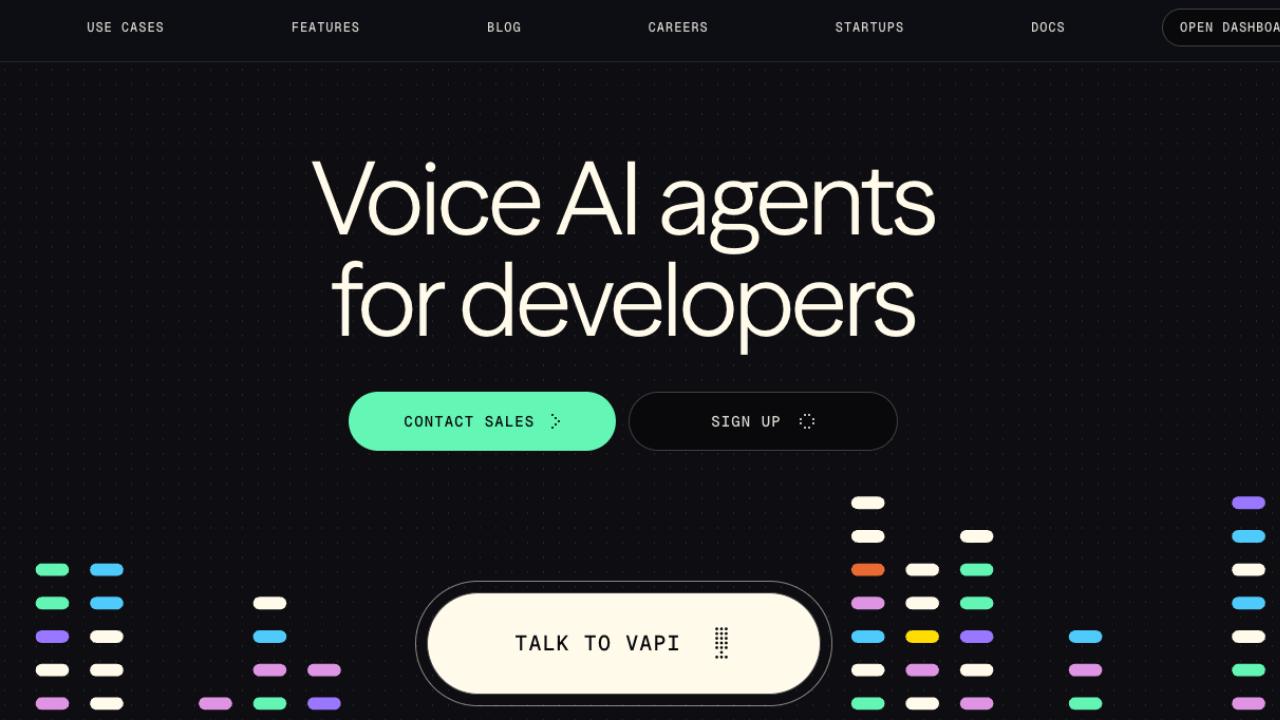
What it does: Vapi AI is developer infrastructure for building custom AI voice solutions.
It is API-first, highly configurable, and designed for teams that want maximum control over their voice stack.
Key features:
- API-first architecture with 40+ integrations
- 100+ language support
- A/B testing for prompts, voices, and flows
- Bring your own language models (OpenAI, Anthropic, custom)
- Tool calling for real-time data fetching
- Automated testing to identify hallucination risks
Pricing:
| Plan | Price | Includes |
|---|---|---|
| Pay As You Go | $0.05/min + provider costs | $10 free credits, 10 concurrent lines |
| Enterprise | Custom | Volume-based pricing, 99.99% SLA |
Total cost typically ranges $0.15-$0.30/minute depending on which providers you choose for transcription, LLM, and text-to-speech.
Pros:
- Maximum flexibility and customization
- Swap between OpenAI, Anthropic, or custom models anytime
- Choose your own voice synthesis provider
Cons:
- Built for technical teams, non-developers will struggle
- Documentation-heavy support, not hands-on
- You are responsible for integrating all the pieces
Best for: Startups with engineering teams, companies building voice into existing products, anyone who needs full API control.
3. Synthflow
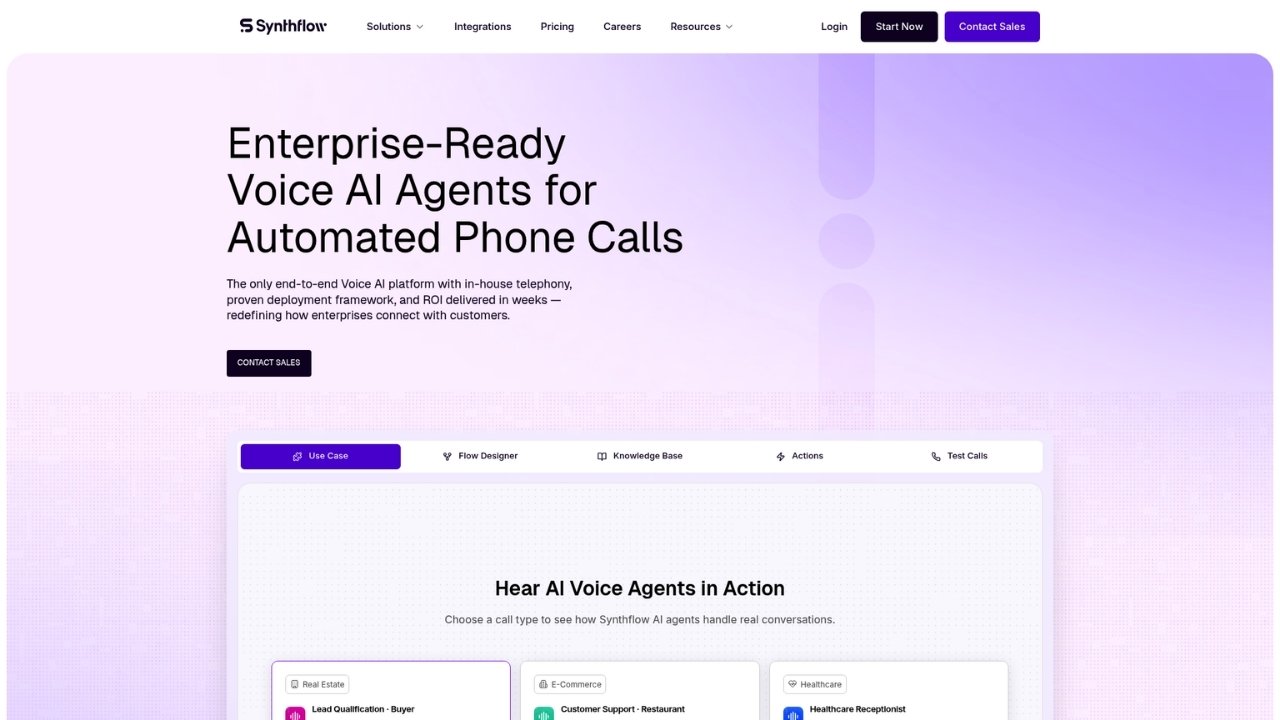
What it does:Synthflow is an enterprise-grade voice AI platform with its own telephony infrastructure.
It powers over 65 million customer calls monthly and focuses on compliance-heavy industries.
Key features:
- Visual Flow Designer for no-code conversation building
- BELL Framework: Build, Evaluate, Launch, Learn lifecycle
- In-house telephony with sub-100ms latency
- 99.99% uptime guarantee
- 200+ native integrations
- Omnichannel support (voice, chat, SMS)
Pricing:
| Plan | Price | Includes |
|---|---|---|
| Pay As You Go | Usage-based | 5 concurrent calls, unlimited agents, SOC2/GDPR |
| Enterprise | Custom (10K+ min/mo) | 99.99% SLA, unlimited concurrency, white-label |
Component pricing:
- Voice Engine: $0.09/min
- GPT-4.1: $0.05/min
- Extra concurrency: $20/month per line
- Performance Routing: +$0.04/min
Pros:
- Strong compliance for regulated industries (healthcare, finance)
- Visual flow builder requires no coding
- In-house telephony means better reliability
Cons:
- Pricing model still charges per-minute overages
- Setup takes weeks compared to hours for simpler platforms
- Can get expensive for high-volume operations
Best for: Healthcare, finance, and other regulated industries needing enterprise compliance.
4. Bland AI

What it does: Bland AI is one of the pioneers in AI phone calling.
It offers a straightforward API for voice automation with a focus on simplicity.
Key features:
- Simple API for voice calls
- Voice cloning capabilities
- Multilingual support
- Basic analytics and reporting
Pricing:
| Plan | Monthly Cost | Per-Minute | Notes |
|---|---|---|---|
| Build | $299/month | $0.09/min | Base features |
| Scale | $499/month | $0.09/min | Higher limits |
Calls under 10 seconds cost a $0.015 minimum. Extra charges apply for voice cloning and advanced features.
Pros:
- Established player with proven track record
- Straightforward API
- Good documentation
Cons:
- Users report call delays and dropped connections
- Bills can spiral with high volume
- Limited language support compared to newer alternatives
Best for: Teams wanting a simple API-first solution with predictable (if potentially high) costs.
5. Poly AI
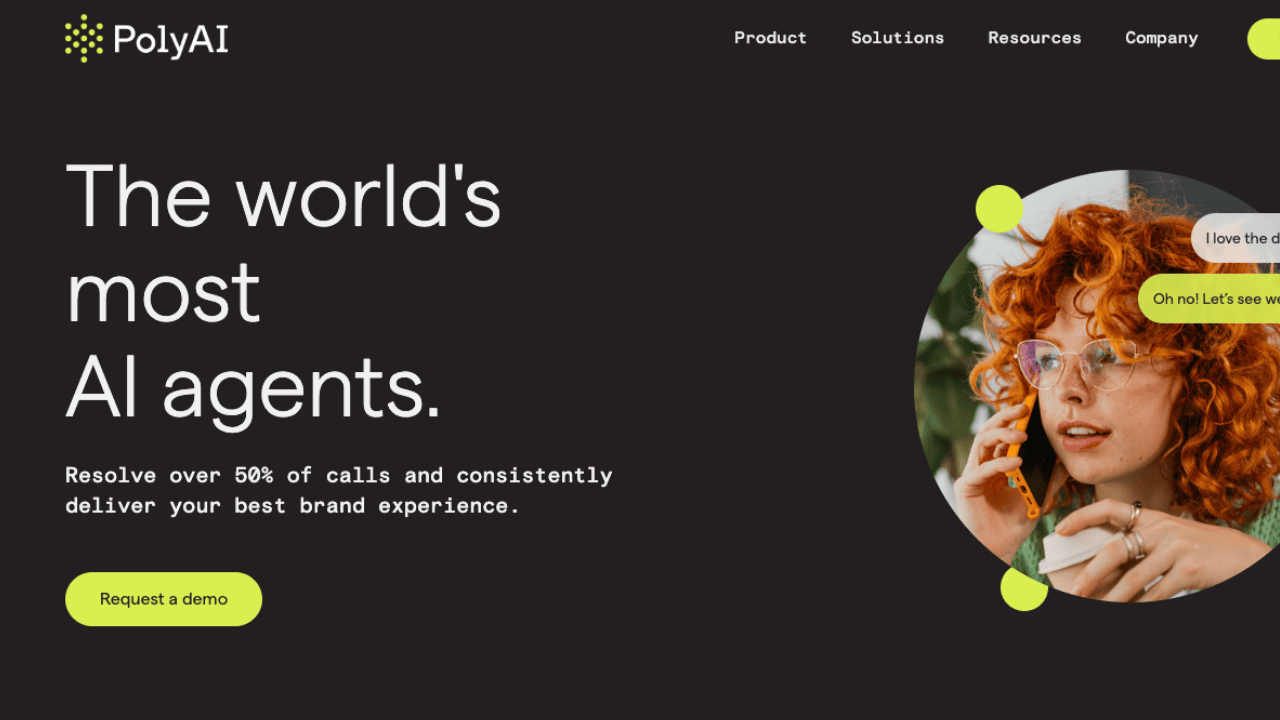
What it does: Poly AI specializes in enterprise contact center voice automation.
The platform is known for exceptional conversational quality and is used by major brands for high-volume operations.
Key features:
- Exceptional voice naturalness and conversational flow
- 12 languages with accent/dialect support
- Automatic language detection and switching
- Six-week implementation promise
- Handles interruptions and topic shifts better than competitors
Pricing:
- No self-service signup
- Minimum contracts around $150,000/year
- Custom pricing based on call volume and languages
Pros:
- Best-in-class voice quality
- Handles complex multi-turn conversations
- Strong multilingual capabilities
Cons:
- No free trial or sandbox
- Must speak with sales to evaluate
- Six-figure minimum commitment
- Requires IT resources for ongoing management
Best for: Enterprise call centers processing 100K+ minutes monthly, global operations with multilingual needs.
6. Kore AI
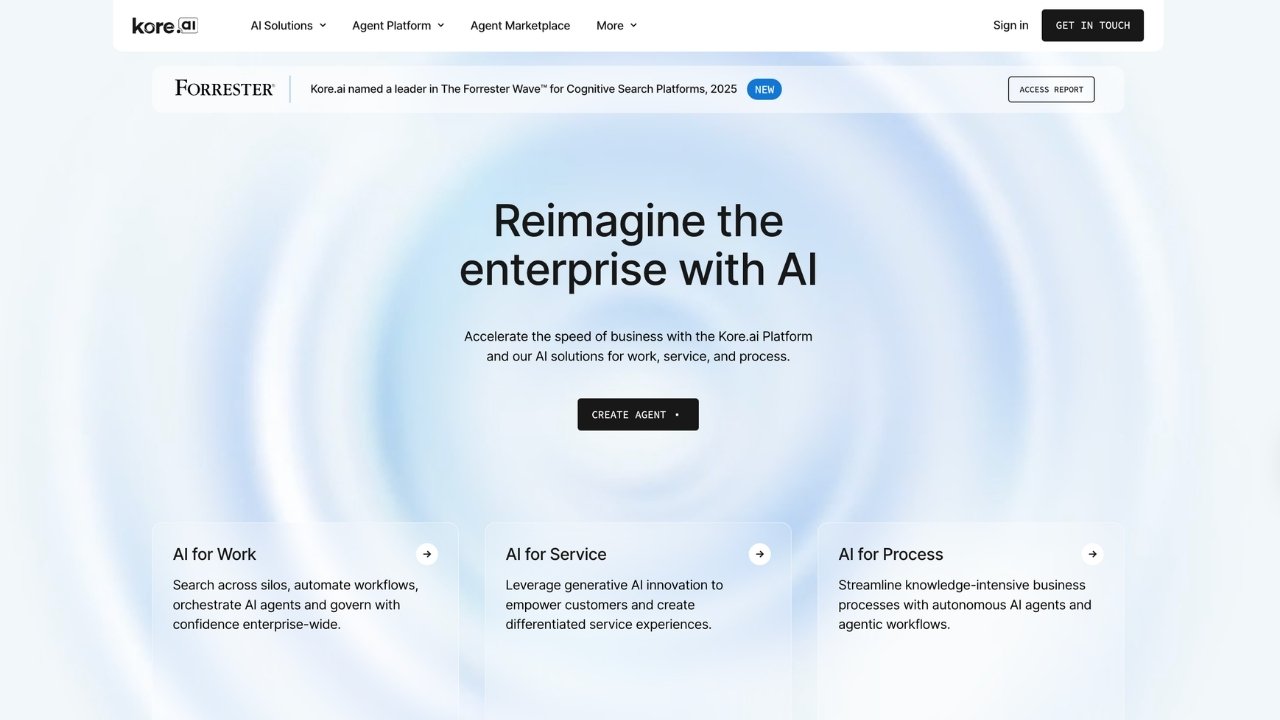
What it does: Kore AI is a full-stack conversational AI platform serving Fortune 500 companies.
It offers deep customization and eliminates dependency on external LLMs.
Key features:
- XO GPT Bot Builder with proprietary LLM
- Multi-agent orchestration (work, service, process agents)
- Knowledge base integration
- Enterprise-grade security and governance
- Used by Coca-Cola, PNC Bank, Cigna, AT&T, Airbus
Pricing:
- Standard Plan: Limited features, 30-day trial
- Enterprise Plan: Custom quotes only
- No public pricing available
Pros:
- Battle-tested with major enterprises
- Eliminates reliance on external LLMs
- Deep customization for complex workflows
Cons:
- Opaque pricing requires negotiation
- Longer deployment timelines
- Steep learning curve for non-technical users
Best for: Fortune 500 companies, organizations with complex multi-department needs and dedicated IT resources.
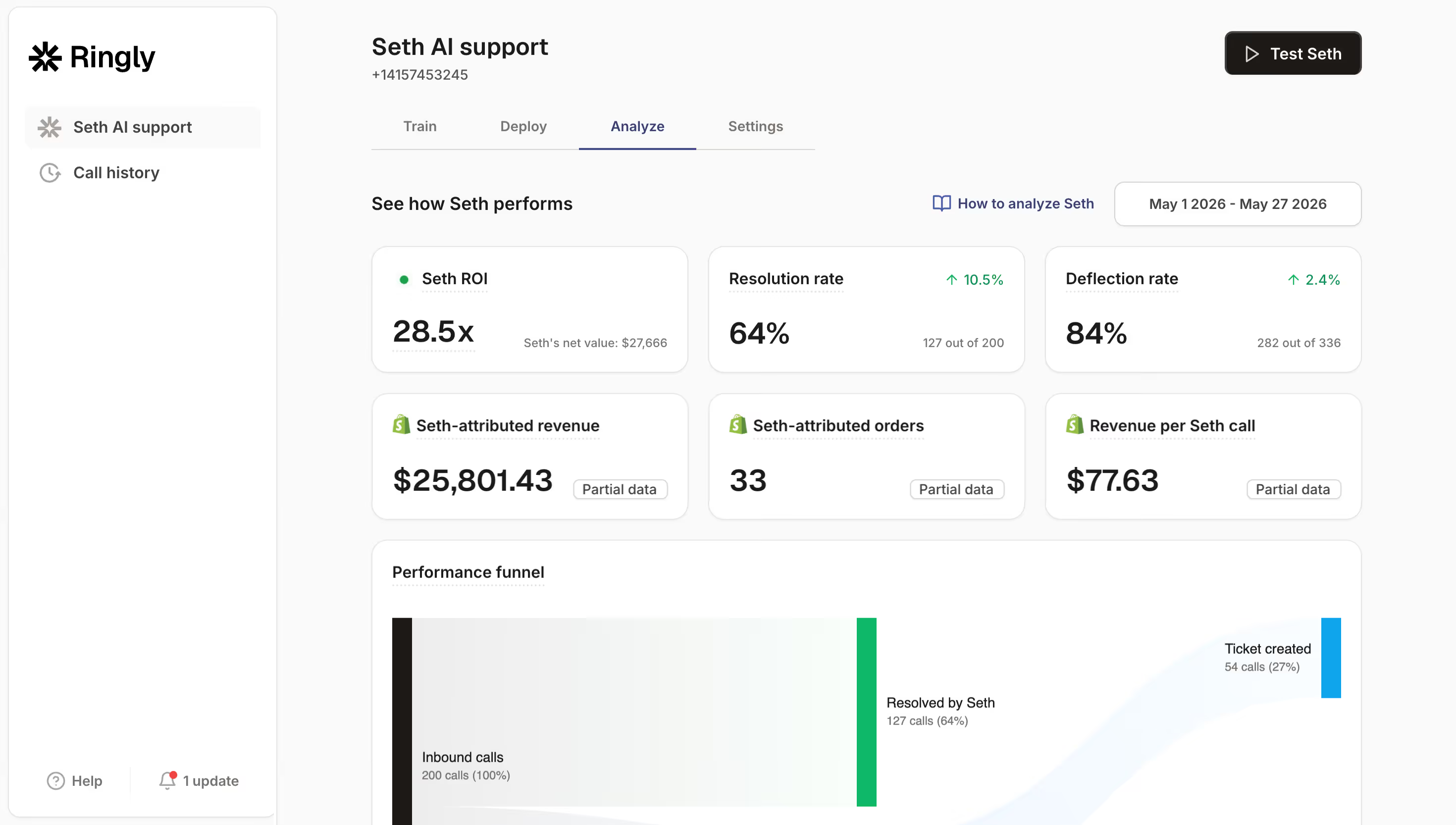
7. Ringly.io

What it does: Ringly.io is AI phone support specifically designed for e-commerce businesses using Shopify.
It handles inbound calls 24/7 with deep integration into your store.
Key features:
- the AI AI agent handles inbound calls 24/7
- Deep Shopify integration (order lookup, returns, exchanges)
- Resolves approximately 73% of calls without human intervention
- 40+ languages supported
- Setup in under 3 minutes
- Call recordings, transcripts, and analytics
Pricing:
| Plan | Monthly Cost | Minutes | Overage |
|---|---|---|---|
| Grow | $349/month | 1,000 | $0.19/min |
| Enterprise | Customnth | 5,000+ | Custom |
14-day free trial available.
Pros:
- Purpose-built for e-commerce
- Native Shopify integration
- Fastest setup time among alternatives
- Transparent pricing
Cons:
- E-commerce focus limits general use cases
- Smaller ecosystem than enterprise platforms
Best for: Shopify stores, e-commerce businesses needing phone support automation.
How to choose the right Dialora alternative
Picking the right platform comes down to a few key factors. Here is how to think through the decision.
Assess your technical resources. Do you have developers on staff? If yes, Vapi AI gives you maximum flexibility.
If not, Synthflow or Ringly.io offer no-code options that are much easier to deploy.
Calculate true costs. Per-minute pricing sounds cheap until you scale. A platform charging $0.07/minute costs $4,200 for 60,000 minutes.
Dialora's flat-rate model might be cheaper depending on your volume. Run the numbers for your specific call volume.
Consider compliance needs. Healthcare and finance require SOC2, HIPAA, or PCI compliance. Synthflow, Retell AI, and Poly AI all meet these standards.
Vapi AI and Bland AI require more scrutiny for regulated use cases.
Evaluate deployment timeline. Need something live this week? Ringly.io promises setup in under 3 minutes. Poly AI takes six weeks minimum.
Match your timeline to the platform's implementation process.
Check integrations. Your voice agent needs to talk to your CRM, helpdesk, and other tools. Review each platform's integration list before committing.
.jpeg)
Final recommendations by use case
For developers building custom solutions: Vapi AI offers the most control.
For high-volume outbound campaigns: Retell AI handles unlimited concurrency.
For regulated industries: Synthflow has the strongest compliance certifications.
For enterprise contact centers: Poly AI or Kore AI if budget allows.
For e-commerce stores: Ringly.io is purpose-built for Shopify.
For simple API needs: Bland AI offers straightforward integration.
Get started with AI voice automation today
The right Dialora alternative depends on your specific situation. Technical teams might prefer Vapi AI's flexibility.
Enterprises with compliance needs should look at Synthflow or Poly AI. E-commerce businesses will find Ringly.io fits their workflow best.
If you run a Shopify store and want to see how AI phone support works, Ringly.io offers a 14-day free trial.
Setup takes under 3 minutes, and you can see how the AI handles real customer calls before committing.
The voice AI space is evolving fast. The platforms that work best today might not be the leaders in two years.
But the fundamentals matter: low latency, reliable uptime, good integrations, and transparent pricing. Focus on those, and you will make the right choice.
Frequently Asked Questions
What are the best Dialora alternatives for small businesses?
For small businesses, Ringly.io (starting at $349/month) and Bland AI ($299/month) offer the most accessible entry points. Both have lower technical barriers than developer-focused platforms like Vapi AI.
Which Dialora alternative has the best voice quality?
Poly AI is widely recognized for having the best voice quality and most natural conversational flow. However, it comes with enterprise pricing ($150K+/year). For mid-market budgets, Retell AI and Synthflow both offer excellent voice quality at more accessible price points.
Are there any free Dialora alternatives?
No platform offers a fully free tier for production use. However, Retell AI and Vapi AI both provide $10 in free credits to test their platforms. Ringly.io offers a 14-day free trial with no credit card required.
Which Dialora alternative is best for healthcare?
Synthflow and Retell AI both offer HIPAA compliance out of the box. Synthflow has additional PCI DSS certification, making it suitable for healthcare organizations that also handle payments.
How do Dialora alternatives compare on pricing?
Pricing models vary significantly. Dialora uses flat monthly rates ($97-$1,499). Retell AI and Vapi AI use per-minute pricing ($0.05-$0.31/min). Poly AI and Kore AI require custom enterprise contracts ($150K+/year). Calculate based on your expected call volume to find the best value.
Can I switch from Dialora to one of these alternatives easily?
Migration complexity depends on your setup. Platforms like Ringly.io offer quick setup (under 3 minutes) for standard use cases. More complex implementations with custom integrations may require weeks of migration work, especially with enterprise platforms like Poly AI or Kore AI.
Which Dialora alternative has the best integrations?
Vapi AI leads with 40+ integrations including OpenAI, Anthropic, ElevenLabs, and major CRMs. Synthflow offers 200+ integrations focused on enterprise systems. For Shopify specifically, Ringly.io provides the deepest native integration.
Also read: