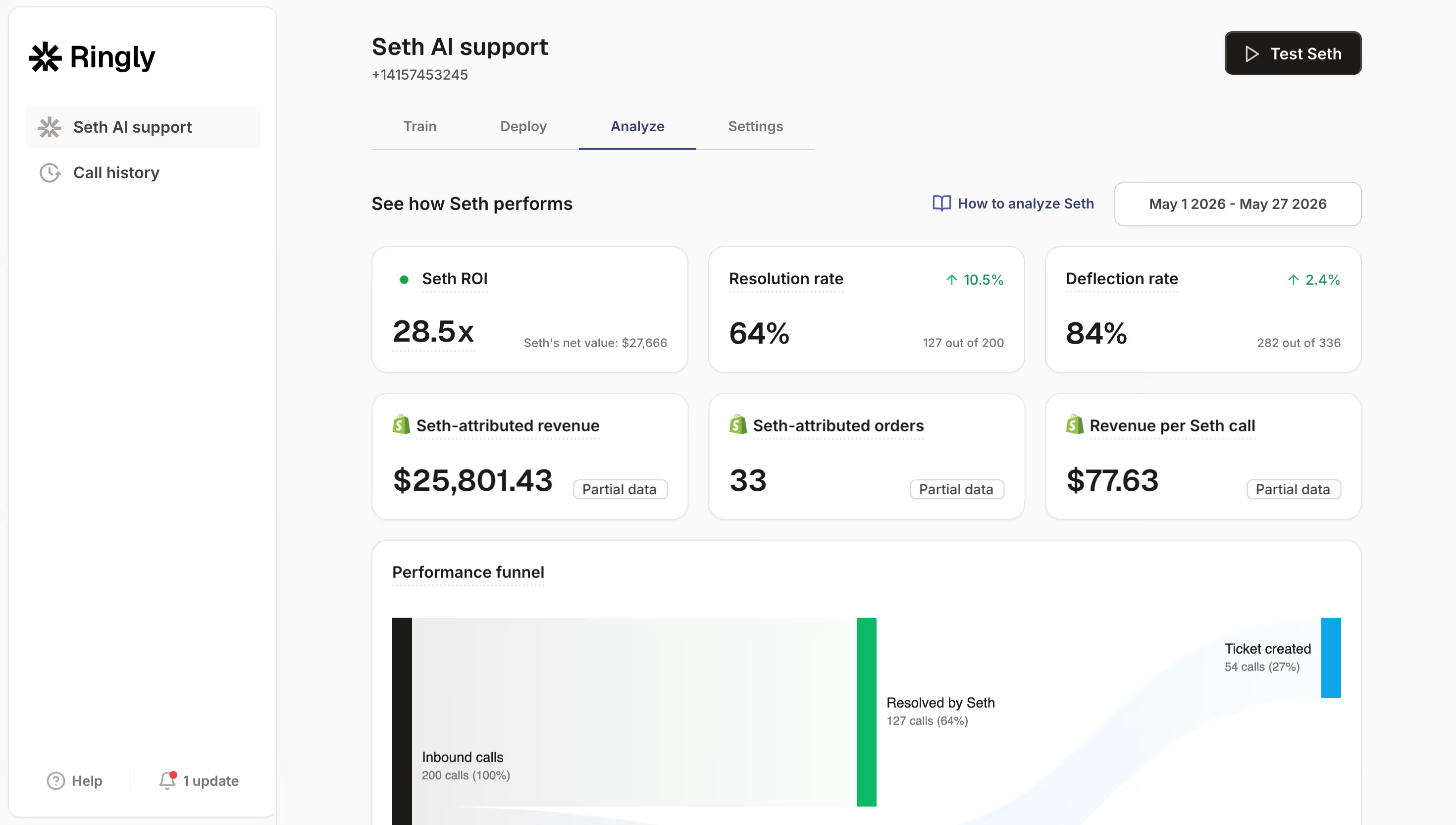



Decagon AI made waves when it launched in 2023, quickly reaching unicorn status with a $1.5 billion valuation.
But not every team needs (or wants) what Decagon offers. Some find it too technical. Others want to keep their existing help desk. And many simply can't get clear pricing upfront.
If you're looking for Decagon alternatives, you're not alone. Teams switch for all sorts of reasons: they need voice support, want faster deployment, or prefer transparent pricing they can budget around.
This guide covers seven solid Decagon alternatives worth considering in 2026.
Each one solves different problems, so you can find the fit that makes sense for your specific situation.
Editor’s note: Want to hear some sample AI support calls made for your Shopify store?
- Just paste your store URL
- Get sample calls in under 20 seconds (no email required)
- Listen to demo calls for my store
What is Decagon AI?
Decagon is an AI agent platform that automates customer support across chat, email, and voice.
It uses large language models to handle conversations without human intervention, escalating only when necessary.
The company has impressive credentials. Founded in 2023 by Jesse Zhang and Ashwin Sreenivas, it raised $231 million total, including a $131 million Series C led by Andreessen Horowitz and Accel.
Customers include Notion, Duolingo, Substack, Bilt, Rippling, and ClassPass.
So why do teams look elsewhere?
Standalone platform requirement. Decagon wants to be your primary system.
That means migrating away from Zendesk, Intercom, or whatever help desk you're already using. For teams with years of conversation history and established workflows, that's a heavy lift.
Technical complexity. Decagon's Agent Operating Procedures require engineering support to set up and maintain.
If your CX team wants self-service control, this can feel limiting.
Pricing opacity. Decagon doesn't publish pricing. You contact sales, negotiate, and hope the usage-based model doesn't surprise you later.
Limited customization. Some users describe Decagon as a "black box" where you can't easily modify agent behavior once configured.
These limitations create openings for alternatives that take different approaches.
How we chose these Decagon alternatives
We evaluated platforms based on what teams actually complain about when switching away from Decagon:
- Integration flexibility. Can it work with your existing help desk, or does it force migration?
- Deployment speed. How long until you're live and resolving tickets?
- Pricing transparency. Can you see costs upfront, or is everything "contact sales"?
- Use case fit. Does it specialize in your specific needs (ecommerce, voice, enterprise) or try to be everything?
The seven alternatives below represent different strategic bets: voice-first, ecommerce-native, enterprise-grade, and managed service approaches.
Quick comparison: Decagon alternatives at a glance
| Platform | Best For | Key Strength | Starting Price |
|---|---|---|---|
| Ringly.io | Ecommerce phone support | Voice-first AI for Shopify | $349/month |
| Sierra | Managed AI deployment | Fully vendor-managed service | Custom |
| KODIF | Ecommerce automation | Full customer journey coverage | Custom |
| Bland AI | Voice & SMS | Self-hosted models, compliance | Custom |
| Cognigy | Enterprise workflows | Hybrid rule-based + LLM | Custom |
| Fin by Intercom | Intercom users | Native help desk integration | Included with Intercom |
| Cresta | Human+AI combined | Real-time agent guidance | Custom |
1. Ringly.io
Best for: Ecommerce brands needing AI phone support

While most AI support tools focus on chat, Ringly.io built something different: a voice-first AI phone agent specifically for Shopify stores.
the AI, Ringly's AI phone rep, handles the calls ecommerce businesses get every day. Order tracking, returns, exchanges, product questions.
It works 24/7, so customers get help even when your team is offline.
The setup is fast. Most stores are live in about 3 minutes, not weeks. You keep your existing help desk (Zendesk, Gorgias, whatever you're using).
the AI just plugs into your phone number and starts handling calls.
Resolution rates run around 73% without human intervention. When the AI can't handle something, the call transfers to your team with full context so customers don't repeat themselves.
Pricing:
| Plan | Monthly Price | Minutes Included | Best For |
|---|---|---|---|
| Start | $349/month | 250 | Small stores testing AI phone support |
| Grow | $349/mo | 1,000 | Growing stores with regular call volume |
| Enterprise | Custom | 5,000+ | High-volume stores needing custom setup |
Extra minutes cost $0.19 each. You can try it free for 14 days.
Pros:
- Fastest deployment in this comparison (3 minutes)
- Transparent, published pricing
- Ecommerce-native with Shopify integration
- No engineering required
- 40+ languages supported
Cons:
- Phone-focused (not a chat-first solution)
- Shopify-centric (though other platforms supported)
2. Sierra
Best for: Brands wanting fully managed AI deployment

Sierra takes a different approach: instead of giving you tools to build AI agents yourself, they build and manage everything for you.
The platform offers both no-code (Agent Studio) and code-based (Agent SDK) options. The SDK uses TypeScript and includes CI/CD tooling and multi-agent orchestration. You can deploy across chat, SMS, WhatsApp, email, voice, and even ChatGPT from a single build.
Sierra's big differentiator is outcome-based pricing. You pay for value delivered, not per conversation.
For brands worried about unpredictable usage costs, this can be appealing.
Security certifications are comprehensive: SOC 2 Type II, ISO 27001, ISO 42001 (AI certification), HIPAA, GDPR, EU AI Act compliance, and STAR Level One.
Notable customers include Rocket Mortgage, Gap, SoFi, SiriusXM, Sutter Health, The North Face, Wayfair, Deliveroo, Discord, DIRECTV, and Brex.
Pros:
- No internal AI expertise required
- Vendor handles implementation and optimization
- Strong brand-aligned CX focus
- Comprehensive security certifications
Cons:
- Enterprise-only pricing (no self-serve option)
- Less direct control over customization
- Requires vendor for updates and changes
3. KODIF
Best for: Ecommerce brands wanting full-journey automation
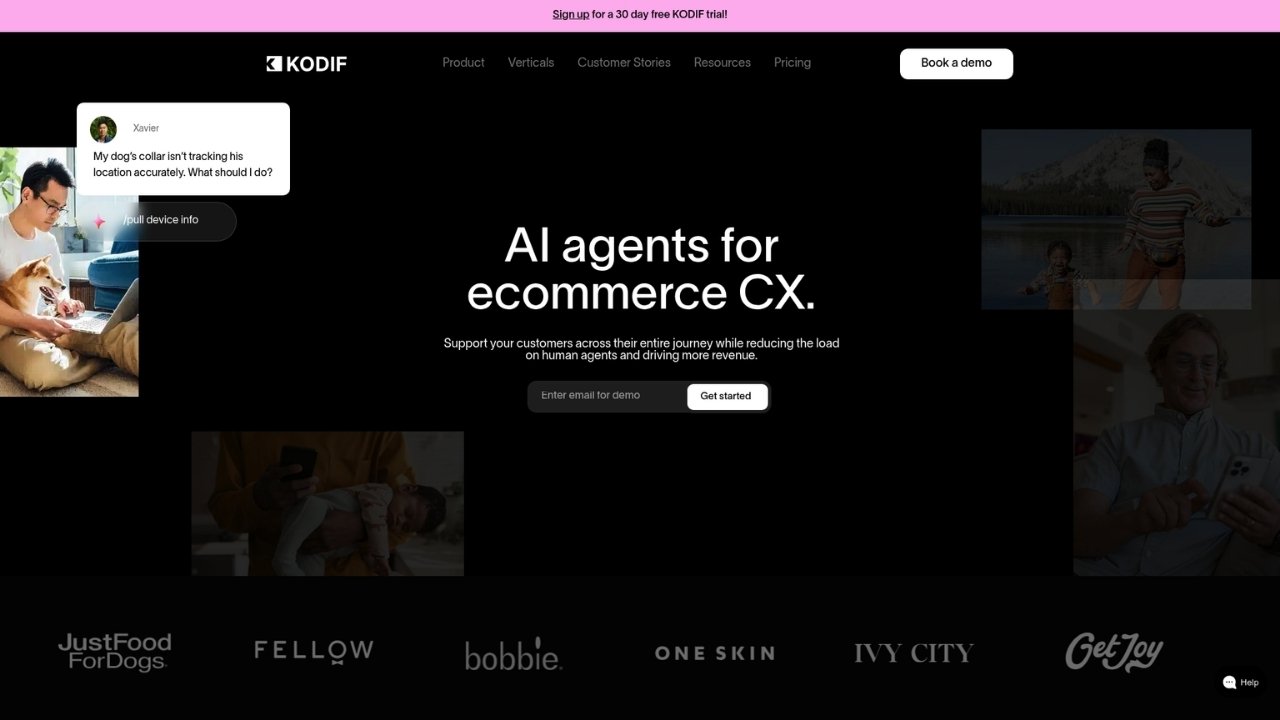
KODIF built their platform specifically for ecommerce, and it shows.
They cover the complete customer journey from pre-purchase questions through post-purchase support.
The platform includes four AI components: Agent for autonomous resolution, Copilot for agent assistance, Analyst for insights and knowledge gap detection, and Manager for workflow optimization and A/B testing.
Resolution rates vary by ticket type but are impressive: 92% for technical support, 88% for order and shipping, 82% for product information, 80% for incident reporting, and 76% for account management.
Integrations are extensive: 100+ ecommerce integrations including Recharge and Skio for subscriptions, Loop Returns and Returnly for returns, Shopify and BigCommerce for platforms, and Gorgias and Zendesk for help desks.
Deployment takes about 15 days with white-glove onboarding. They assign you a dedicated AI engineer to get everything configured.
Pros:
- Highest reported resolution rates in this comparison
- Full customer journey automation (not just support)
- Fast deployment for the feature depth (~15 days)
- No-code platform lets CX teams own it
Cons:
- Ecommerce-only focus (not suitable for other industries)
- Custom pricing only (no published tiers)
4. Bland AI
Best for: Enterprises needing voice with compliance

Bland AI focuses exclusively on voice and SMS automation for enterprises. They don't do chat-first; they do phone-first, and they do it at serious scale.
The platform handles up to 1 million concurrent calls. That's not a typo.
They run self-hosted models on dedicated infrastructure, which means you can customize voices, fine-tune models on your own recordings, and maintain complete data control.
Compliance is a major selling point. Bland supports SOC 2 Type II, GDPR, HIPAA patterns, and data residency controls.
You can deploy multi-regionally so data never crosses borders.
Their "Conversational Pathways" feature gives strict dialogue control. You define exactly how conversations flow, what the AI can and cannot say, and when to transfer to humans.
Customers include Samsara, Snapchat, Gallup, Clipboard Health, Better, and the Cleveland Cavaliers.
Pros:
- Complete data ownership and privacy
- Compliance-ready for regulated industries
- Voice-native architecture (not chat adapted to voice)
- Massive scale capability
Cons:
- Enterprise-only pricing and contracts
- Technical implementation requires engineering resources
- Not suitable for smaller teams or simple use cases
5. Cognigy
Best for: Global enterprises needing workflow control

Cognigy (now NiCE Cognigy after being acquired by NiCE in 2026) serves over 1,250 brands worldwide.
Their platform takes a hybrid approach, combining rule-based workflows with LLM-powered conversations.
The visual workflow builder lets you design predictable conversation paths while still leveraging AI for natural language understanding.
This appeals to enterprises that want governance and audit trails alongside AI capabilities.
They offer on-premise deployment options, which matters for organizations with strict data residency requirements.
Channels include phone, chat, messaging, and digital platforms.
Performance metrics from their website: 1 billion+ annual interactions processed, 99% routing accuracy, and 70% average handle time reduction.
Notable customers include Toyota, Flix, Nestle, Bosch, Lufthansa, Greyhound, Mercedes-Benz, and Munich Airport.
Pros:
- Predictable conversation flows with AI flexibility
- Enterprise security certifications (SOC 2, GDPR)
- Flexible deployment options (cloud or on-premise)
- Gartner Magic Quadrant Leader for Conversational AI
Cons:
- Complex setup compared to newer platforms
- Higher technical requirements
- Custom pricing (no self-serve option)
6. Fin by Intercom
Best for: Teams already using Intercom
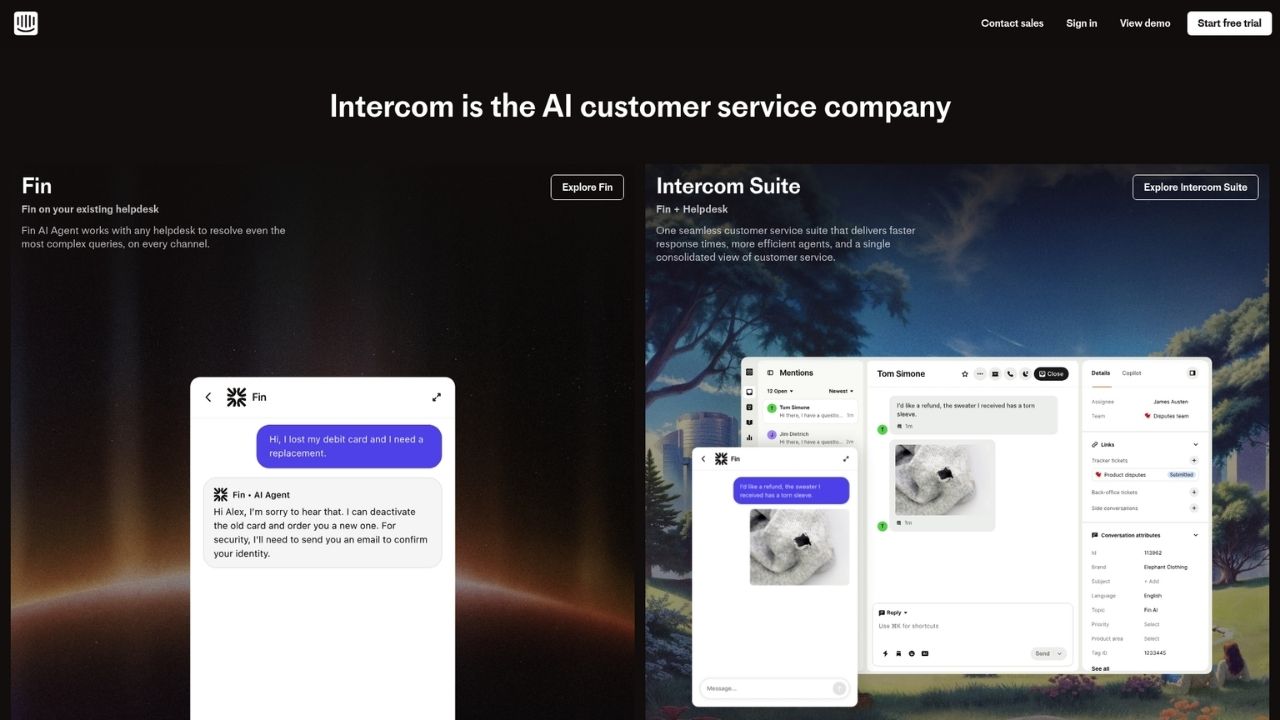
If you're already on Intercom, Fin is the obvious choice.
It's native AI built directly into the platform you already use, not a third-party add-on.
Fin works with your existing conversation history, help articles, and customer data. It handles chat, email, voice, SMS, and social channels.
Configuration is no-code, so your team can adjust behavior without engineering tickets.
The big advantage here is unity. Your AI agent, human agents, knowledge base, and reporting all live in one system.
No data silos, no integration headaches, no context loss when transferring between AI and humans.
Pricing is bundled with Intercom subscriptions, so you're not negotiating separate contracts or managing multiple vendors.
Pros:
- Seamless if already on Intercom
- Fast deployment for existing users
- Unified with help desk (no integration gaps)
- No-code configuration
Cons:
- Requires Intercom subscription (can't use standalone)
- Limited to Intercom ecosystem
- Not suitable if you want to switch help desks
7. Cresta
Best for: Contact centers wanting human+AI approach
Cresta takes a different philosophy: instead of replacing human agents, they augment them.
The platform combines AI agents with real-time guidance for human agents.
The AI Agent handles autonomous conversations. Agent Assist provides real-time coaching, suggested responses, and knowledge lookup for human agents. Conversation Intelligence analyzes every interaction (AI and human) for insights. Quality Management automates scoring and feedback.
Post-handoff continuity means when an AI conversation transfers to a human, the context comes too. Customers don't repeat themselves.
Customer results are documented: Propel Holdings saw 58% containment rates and 50% reduction in after-call work.
Cox achieved 20% revenue increase and 40% span of control improvement. Brinks Home got a 30-point NPS increase and 50% QM cost reduction.
Cresta was named a Forrester Wave Leader for Conversation Intelligence in Q2 2025.
Pros:
- Improves both AI and human agent performance
- Deep analytics and coaching capabilities
- Enterprise-grade security (SOC 2, HIPAA, PCI DSS, ISO 27001)
- Proven results with major brands
Cons:
- Complex implementation
- Enterprise pricing (custom contracts)
- Overkill for smaller teams
Choosing the right Decagon alternative
Here's how to think about which platform fits your situation:
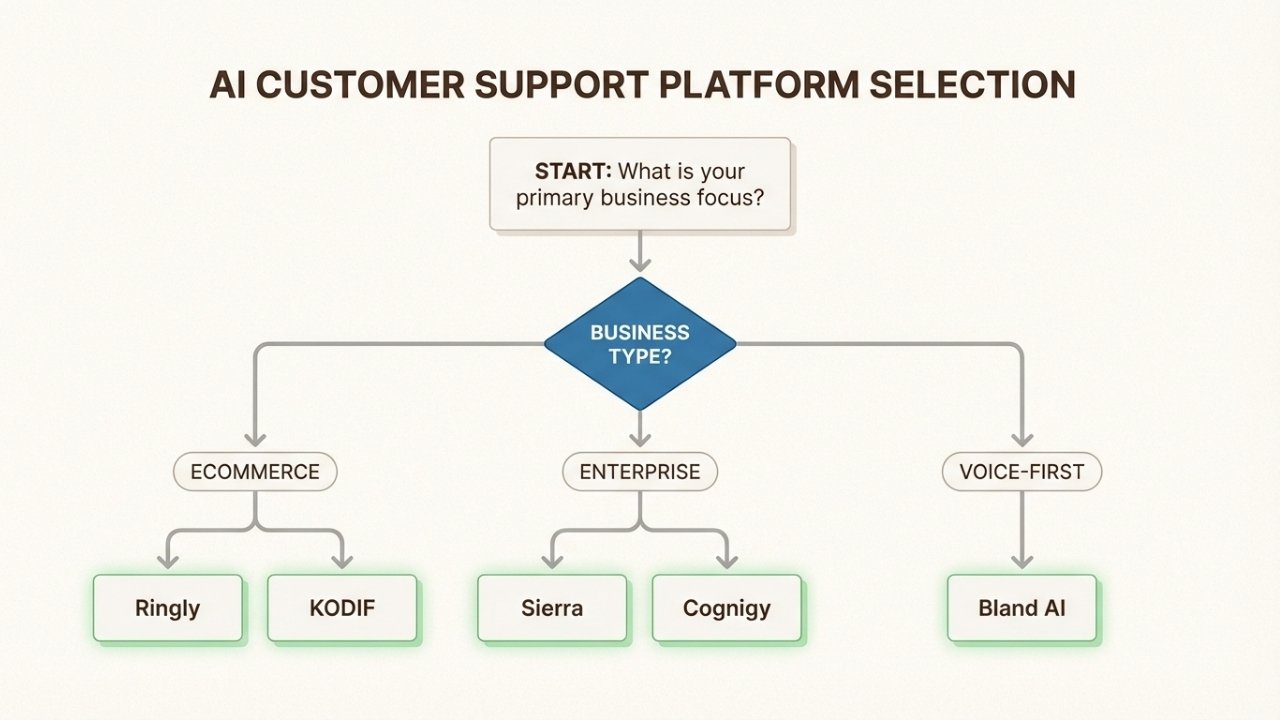
For ecommerce brands: Ringly.io and KODIF are purpose-built for online stores. Ringly focuses on phone support with fast deployment. KODIF covers the full customer journey with higher resolution rates but longer setup.
For voice-first needs: Ringly.io for Shopify stores, Bland AI for enterprises needing compliance and scale.
For managed service: Sierra if you want the vendor to handle everything and you're okay with enterprise pricing.
For enterprise governance: Cognigy if you need hybrid rule-based + AI with on-premise options. Cresta if you want to improve both AI and human agents together.
For Intercom users: Fin is the obvious choice. Don't overthink it.
The right choice depends on your current stack, team size, technical resources, and whether you prioritize speed, control, or comprehensive features.
Get started with AI phone support for your store
If you run a Shopify store and want to see what AI phone support looks like in practice, start a free trial.
It takes about 3 minutes to set up, and you can see how The AI handles your actual customer calls.
Ringly offers a 14-day free trial with full features. No engineering required, no migration needed.
You keep your existing help desk and just add AI phone coverage.
For stores handling hundreds of calls monthly, the math usually works out quickly. At $349/mo for the Grow plan, if The AI resolves even a portion of your calls without human intervention, the time savings add up fast.
Frequently Asked Questions
What should I look for in Decagon alternatives before making a decision?
Focus on three things: integration flexibility (will it work with your existing help desk?), deployment timeline (how long until you're live?), and pricing transparency (can you see costs upfront or is everything custom quotes?). The best Decagon alternative for you solves your specific pain points, not just the ones Decagon has.
Are there affordable Decagon alternatives for small ecommerce stores?
Yes. Ringly.io starts at $349/mo with published pricing, making it accessible for smaller stores. Most enterprise-focused alternatives like Sierra, Bland AI, and Cognigy require custom contracts and significant minimums, so they're better suited to larger operations.
Which Decagon alternatives work best for voice and phone support?
For ecommerce phone support, Ringly.io specializes in Shopify stores with quick setup. For enterprise voice with compliance needs, Bland AI offers self-hosted models and up to 1 million concurrent calls. Both take a voice-native approach rather than adapting chat AI to phone calls.
How do Decagon alternatives compare for deployment speed?
Ringly.io is fastest at ~3 minutes for basic setup. KODIF takes about 15 days with white-glove onboarding. Enterprise platforms like Sierra, Bland AI, and Cognigy typically need weeks to months depending on complexity and customization requirements.
Can I keep my existing help desk with these Decagon alternatives?
Most alternatives let you keep your current setup. Ringly.io, KODIF, and Cresta integrate with existing help desks. Fin by Intercom requires Intercom. Sierra typically wants to be your primary platform. Always verify integration capabilities before committing.
What resolution rates can I expect from Decagon alternatives?
Reported rates vary: Ringly.io resolves ~73% of calls without human intervention. KODIF reports 76-92% depending on ticket type (92% for technical support, 76% for account management). Your actual results will depend on use case complexity and how well you configure the AI.
Are there Decagon alternatives that don't require engineering resources?
Yes. Ringly.io and KODIF both emphasize no-code setup that CX teams can manage. Fin by Intercom is also no-code within the Intercom platform. Sierra, Bland AI, and Cognigy typically require more technical involvement for implementation and ongoing management.