


This post in 30 seconds.
- Specialty-food customer service isn't a volume problem, it's a mix problem: ship-by dates, cold-chain anxiety, allergen questions, gift logistics, phone orders, and spoiled arrivals all hitting one older buyer who won't self-serve.
- We went through 50+ specialty-food call logs across the brands we run and counted what people actually call about. Cold-chain anxiety is its own category, and it spikes in summer, not just at the holidays.
- Built for $10M-$100M Shopify specialty-food brands running a paid helpdesk and a visible phone line, with 3-12 reps and a CS leader who's tired of staffing the seasonal spike twice a year.
Most playbooks for ecommerce customer service assume you're a beauty brand with a launch calendar or a supplement brand with subscription churn. Specialty food is its own animal. Your customer is older, calls more, and asks a set of questions nobody else in DTC gets: will it arrive cold, is it nut-free, can it land by my dad's birthday. We went through 50+ call logs across the specialty-food and coffee brands we run to write this, and the pattern was consistent enough that you can build a whole CS function around it.
If you run support at a specialty-food brand doing $10M-$100M on Shopify, you already know the seasonal spike comes twice. Once in November for gifting, once in July when the heat turns every chocolate order into a freshness question. This is the operating manual for handling both without drowning in calls or hiring a team you can't justify in February. If you want to talk through your specific call mix, book a 30-min call and we'll map it for you.
In this post:
What your customers actually contact you about
Start here, because everything downstream (your routing, your knowledge base, your escalation rules, your staffing) is determined by the contact mix. And specialty food has a mix you won't find in any generic CS guide.
When we counted across those 50+ call logs, six categories did almost all the work:
- Order status and ship-by. The biggest bucket. "When does it ship, when does it land, will it make it by Friday." WISMO ("where's my order") runs 30-40% of all support contacts in normal periods and climbs past 50% at peak, according to Salesforce. For a food brand, every WISMO call carries a freshness clock the customer is anxious about.
- Cold-chain and freshness anxiety. This is the category no other vertical has. "Will it arrive cold." "Will the chocolate melt." "It sat on my porch for six hours, is it still good." It spikes in summer heat on its own, separate from the holiday rush.
- Allergen and ingredient questions. "Is this gluten-free." "Made in a nut-free facility." High-stakes, and the answer has to be sourced and confident. A wrong answer here isn't a refund, it's a health incident.
- Gift logistics. Gift notes, address changes, delivery-date assurance. Concentrated in November and December, and emotionally loaded because someone's holiday depends on it.
- Phone orders. A real chunk of your older customers won't place an order on the website. They call and read it to a person. You can't automate that intent away, you can only route it well.
- Spoiled, melted, or late arrivals. Lower volume, highest emotional weight. These are the calls that become one-star reviews if they're handled badly.
Roughly 70-80% of that mix is repeatable logistics, freshness, and gift questions, and the remaining 20% is where your team's judgment actually earns its salary. The spoiled-product call, the allergen edge case, the order someone wants to dictate by phone, those need a human. The rest is the same five questions on a loop.
The cost of getting this wrong is brutal in food specifically. Public review sites are full of it. A perishable box ruined after 50 hours in transit and ruled "not our issue." A coffee line that played an automated message saying they were busy, then disconnected the call with no option to wait. That's the failure mode you're designing against, and it's worse for you than for a beauty brand because your product is literally rotting while the customer waits on hold.
One specialty-food brand we work with, Gear Rider, handled 1,595 inbound calls in 90 days without a single phone rep on the routine volume. That's the shape of what's possible once you know the mix and route it deliberately.
Pick the right channel mix for an older buyer
Here's where specialty food breaks the standard advice. Every other DTC playbook tells you to push customers to self-serve channels, chat and email, and treat the phone as a last resort. For your buyer, the phone is the first resort.
Phone matters more for specialty food than for any other DTC category, because your customer skews older and treats a phone number as a trust signal, not an inconvenience. Hide the number and you don't reduce contacts, you reduce orders. The older buyer who can't find a phone number assumes you're not a real business.
So the channel mix looks like this:
- Phone: the priority channel. Keep it visible, keep it staffed during business hours, and have a real plan for after-hours phone coverage. This is the order-placement channel and the reassurance channel both.
- Email: the paper trail. Allergen confirmations, gift-receipt issues, anything the customer wants in writing. Slower is acceptable here, but a 2026 customer expects a first response inside a few hours, not a day.
- Chat: the skimmable layer. Good for the younger slice of your base checking order status. Don't over-invest if your demographic is 55+.
The after-hours gap is where specialty food bleeds money quietly. Calls roll to voicemail after six, and 80% of voicemail-routed callers hang up without leaving a message, per Eden's data. 78% of buyers abandon a brand after one unanswered call. For an older customer placing a $120 gift order, that abandoned call is a lost sale and a lost relationship, and you'll never see it in your analytics because it never became a ticket. The fix isn't a longer voicemail greeting. It's coverage, which we'll get to in the AI section.
Build the team and decide the next hire
Specialty-food CS teams run small year-round, usually 3 to 8 reps, then need to double for the gifting season. That's the trap. You either over-hire and pay loaded cost for reps who are idle in February, or you under-hire and your CSAT craters every December.
A US-based rep runs about $4,000/month loaded once you count salary, benefits, training, and the cost of churn. The next hire is rarely the right answer, because the volume that's pushing you toward hiring is the repeatable 70-80%, not the work a human is actually needed for. You'd be paying $48K a year to have someone read ship-by dates off a tracking page.
The hiring math gets worse when you look at retention. Replacing one CS rep costs about $14,113, per Gartner data cited by Insignia, and the customer-service industry churns reps at over 30% a year. New reps take six to eight months to ramp on your product, and a meaningful share quit inside year one. For a brand where reps need to know the difference between a single-origin and a blend, or which products survive a heat wave, that ramp is expensive and the turnover resets it constantly.
So before you post the job, separate the work:
- Work that needs your team: spoiled-arrival calls, allergen edge cases, the customer who wants to place a complex order by phone, any call with an emotional charge.
- Work that doesn't: ship-by lookups, "will it arrive cold" reassurance, gift-note edits, the same five questions on repeat.
Staff your humans for the first list. Cover the second list another way. That's the whole reframe, and it's how a small team holds CSAT through a spike without doubling headcount.
Design the knowledge base around food questions
A specialty-food knowledge base is not a generic FAQ. It has to answer questions that carry health and freshness stakes, and it has to be confident, because a hedged answer to an allergen question is worse than no answer.
Build it in layers:
- Allergen and ingredient answers. Source these directly from your spec sheets, not from memory. "Made in a facility that also processes tree nuts" is a sentence your KB must produce verbatim, every time, with zero improvisation. This is the layer that protects you legally and protects your customer physically.
- Cold-chain and freshness answers. Pre-write the responses to "will it arrive cold," "will it melt," and "is it still good." Tie them to your actual packaging (gel packs, insulated liners, dry ice) and your real transit times. Customers calm down fast when you can tell them exactly how the product ships.
- Ship-by and gift logistics. Connect this to live order data so the answer is "your order ships Tuesday and lands Thursday," not a generic policy. Gift-date assurance is the single most reassuring thing you can say in November.
- Roast date, harvest, and product config. Coffee customers ask about roast date. Tea and olive oil customers ask about harvest. These belong in the KB with current data so a rep, or an AI knowledge base, never guesses.
Then write the escalation rules, because the KB's most important job is knowing what it should NOT answer:
- Spoiled, melted, or damaged arrival: escalate to a human immediately. This is an emotional, refund-adjacent call, and handling the complaint well is what keeps it off your reviews. A script can't own it.
- Allergen question your source can't confirm with certainty: escalate. Never let confidence get faked on a health question.
- Refund or compensation: escalate. Money decisions stay with your team.
- Order placement by phone: route to a human. You don't want a machine taking a credit card and a complex gift order by voice.
The brands that handle specialty-food CS well aren't the ones with the biggest teams, they're the ones whose knowledge base knows exactly where the human line is. Everything above the line gets answered instantly and consistently. Everything below it reaches a person fast.
Run the two-season peak playbook
Most operators plan for one peak. Specialty food has two, and the summer one sneaks up on teams that only braced for the holidays.
Peak one: November and December gifting. Volume on gift logistics, ship-by anxiety, and address changes goes vertical. The stakes are higher than normal because a late gift is a ruined occasion. And the FTC actually regulates this: sellers have to ship within the time they advertise, and if there's a delay, you owe the customer the choice of waiting or a full refund. Your CS team needs that policy memorized and your KB needs it written down, because in December that exact question comes in hundreds of times a day.
Peak two: the summer heat window. This one's invisible until it hits. As temperatures climb, cold-chain anxiety spikes on its own. Every chocolate, cheese, or temperature-sensitive order generates a "will it survive shipping" call. The US cold chain logistics market is set to clear $330 billion in 2026, per Grand View Research, which tells you how many brands are now shipping perishables to doorsteps and fielding the questions that come with it.
The playbook for both is the same shape:
- Forecast from last year's contact data, not last year's sales. Contacts spike differently than revenue, especially the freshness calls.
- Pre-stage your KB answers for the spike questions before the season, not during it.
- Decide in advance what gets automated vs staffed. The reassurance and logistics volume can be covered without seasonal hiring. The emotional and complex calls stay with your team.
- Protect after-hours hard. Gift buyers and anxious freshness callers don't keep business hours, and a dropped call in peak season is a one-star review waiting to happen.
If you nail the two-spike plan, you stop the annual scramble of hiring eight seasonal reps, training them in three weeks, and laying them off in January.
Track the six metrics that actually matter
You can't run a CS function on vibes, and most specialty-food brands track the wrong things. Here are the six that tell you whether the operation is healthy.
- First contact resolution. The percentage of contacts solved in one interaction. The 2026 benchmark has moved up: where 70% used to be fine, strong teams now target 80%+, per Lorikeet's benchmark data. For food, FCR is everything, because a customer who has to call twice about a perishable order is already angry.
- Ship-by accuracy. The percentage of orders that land when you said they would. This is a CS metric disguised as a logistics metric, because every miss becomes a contact.
- First response time by channel. Phone under 3 minutes, email inside a few hours. 88% of customers expect faster responses than a year ago.
- CSAT. The 2026 bar has moved to 85%+. Track it by contact category so you can see if your spoiled-arrival handling is dragging the average down.
- Allergen-answer confidence. A specialty-food-specific metric: what percentage of allergen questions get a sourced, definite answer versus a hedge. This should be 100%, and anything less is a risk you're carrying.
- Cost per contact. What each resolved contact actually costs you, fully loaded. This is the number that tells you whether your channel mix and your automation are working.
Track these by category, not just in aggregate, because the specialty-food average hides the two things that hurt you most: spoiled-arrival CSAT and after-hours abandonment. The right KPIs for an ecommerce CS team are the ones that surface the failures before they hit your reviews.
Where an AI phone agent fits (and where it doesn't)
Everything above is the function. This is the layer that lets a small team run it without the seasonal hiring scramble. An AI phone agent isn't a replacement for your CS team, it's the thing that takes the repeatable 70-80% so your people can own the 20% that actually needs them.
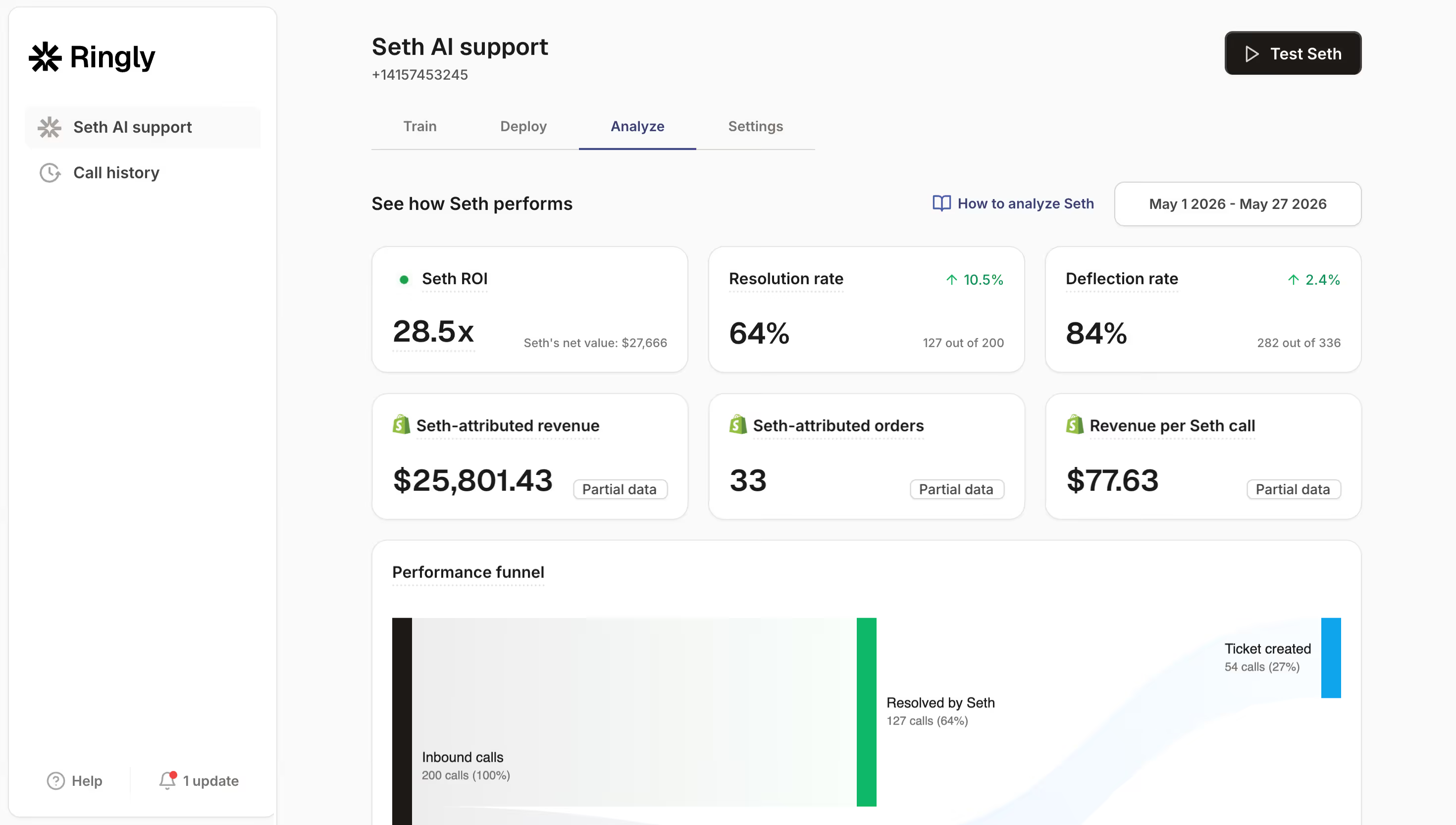
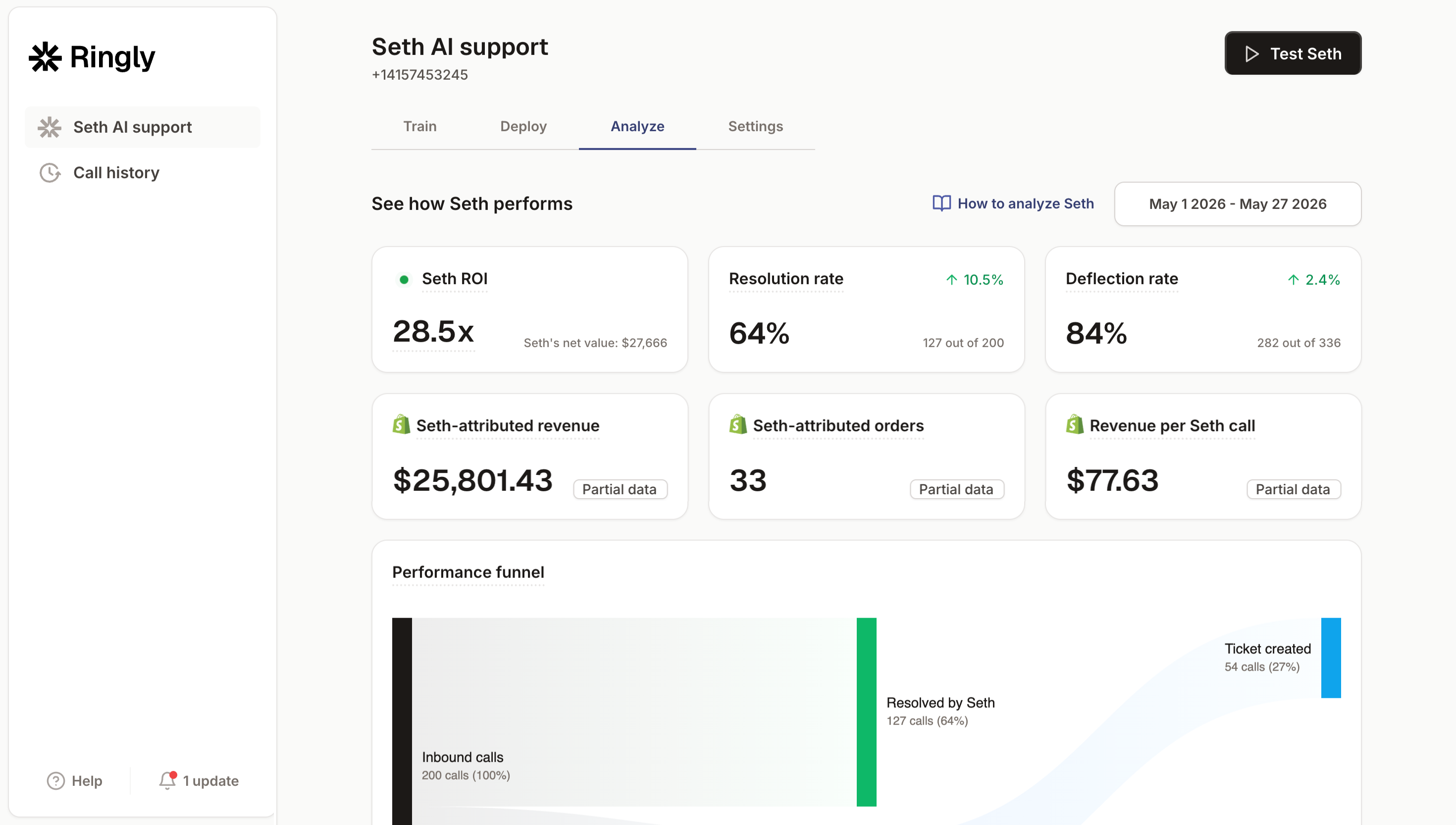
Ringly.io is AI phone support for Shopify brands. The phone shouldn't be a tax on your support team. Instead of doubling headcount every gifting season, the AI answers inbound calls 24/7, finds orders in your Shopify store, answers ship-by and freshness questions from your knowledge base, and rescues abandoned carts. Across 50+ brands, the AI resolves 73% of calls autonomously at roughly $0.42 per resolved call, versus $7-$16 per call for a human BPO. Calls that need a person, the spoiled arrivals, the allergen edge cases, the customer who wants to place an order by voice, escalate cleanly to Gorgias, Richpanel, Reamaze, or whatever helpdesk you already run. You control exactly what escalates.
Where it fits cleanly for specialty food:
- Ship-by and order status, 24/7. The biggest bucket, answered instantly from live Shopify data instead of a rep reading a tracking page.
- Cold-chain reassurance. "Here's how we pack it, here's the transit time, here's why it arrives cold." Pre-written, consistent, calm.
- Gift logistics. Address changes, gift-note edits, delivery-date confirmation.
- After-hours and weekend coverage. The gap where you were losing calls to voicemail is now covered.
Where it doesn't, by design:
- Spoiled or melted arrivals route straight to a human. Emotional, refund-adjacent, never automated.
- Allergen questions the source can't confirm with certainty escalate. No faked confidence on health.
- Phone orders. The AI doesn't take a credit card by voice. It routes order-intent to your team or sends an SMS payment link.
The objection we hear most in this vertical: older customers won't accept AI. It's the right thing to worry about, and it's also the thing that surprises people. The most repeated piece of feedback we get is that customers don't realize they're talking to AI.
"My customers also feel like it's a normal person. They feel like they can communicate if they have questions."
— Claudia Droge, TechCraft Studio
WashCo, a Shopify brand we launched recently, generated $22,664 in attributed revenue in its first 7 days, handling 271 calls at 85% deflection and $0.91 per call versus $2.70 for a human. That's the revenue you're currently leaking to voicemail.
What it costs vs covering it with Ringly
A typical $20M specialty-food brand runs four reps year-round and adds four seasonal reps for the gifting quarter:
| Line item | Today | With Ringly |
|---|---|---|
| 4 reps × $4K loaded, year-round | $16,000/mo ($192K/yr) | — |
| 4 seasonal reps × $4K × 3 months | $48,000/yr peak | — |
| Ringly Enterprise (~$3K-$5K/mo) | — | ~$4,000/mo |
| True annual CS spend | ~$240,000/yr | ~$48,000/yr |
| Annual savings | — | ~$140K-$180K/yr |
That's the routine ship-by, freshness, and gift volume on the AI, with the spoiled-arrival and allergen calls still going to your team, who now have time to handle them well. Exact Enterprise pricing is set on a call. These are the savings shapes we see across 50+ Shopify brands.
The call makes sense if:
- You're a Shopify (or Shopify Plus) specialty-food brand doing $10M-$100M
- You run a paid helpdesk (Gorgias, Zendesk, Gladly, Re:amaze, or Intercom)
- You have a visible phone number on your store
- Your CS team is 3-12 people and you dread the seasonal hire
What happens on the call.
- We pull your last 7 days of missed calls live, on the call. No homework for you.
- We show you the recovered revenue at the resolution rates we see for food brands.
- You decide if it's worth going deeper. No deck, no follow-up sequence.
If that's you, book a 30-min call and we'll run the numbers on your actual call volume. We'll do the math live.
Frequently asked questions
What do specialty food customers contact support about most? Order status and ship-by dates are the biggest bucket, with WISMO running 30-40% of contacts normally and over 50% at peak. After that come cold-chain and freshness questions, allergen and ingredient questions, gift logistics, phone orders from older buyers, and spoiled-arrival complaints. The mix is heavier on phone than any other DTC vertical.
Why do specialty food brands get so many phone calls? Your customer skews older and treats the phone as the default channel, not a last resort. Many won't place an order on the website at all, so they call to read it to a person, and freshness anxiety drives a lot of pre-purchase reassurance calls too.
How do I handle spoiled or melted product complaints? These should always reach a human fast. They're emotional, refund-adjacent, and they turn into one-star reviews if mishandled, so hard-code them as an immediate escalation in your routing and never let an automated system own them.
Should an AI handle allergen questions? Only the ones it can answer with a sourced, certain response pulled directly from your spec sheets. Anything the source can't confirm with confidence should escalate to a human, because a hedged or guessed answer on an allergen is a health risk, not a CS miss.
How do I staff customer service for the holiday gifting spike? Forecast from last year's contact data, pre-stage your knowledge base answers before the season, and decide in advance what gets automated versus staffed. The reassurance and logistics volume can be covered without seasonal hiring, leaving your team for the complex and emotional calls.
Can an AI phone agent take orders over the phone? Not by taking a credit card by voice. A good setup routes order-placement intent to a human or sends the caller an SMS payment link, while the AI handles the routine status, freshness, and gift questions around it.
What customer service metrics should a specialty food brand track? First contact resolution (target 80%+), ship-by accuracy, first response time by channel, CSAT (target 85%+), allergen-answer confidence, and cost per contact. Track them by contact category, not just in aggregate, so spoiled-arrival CSAT and after-hours abandonment don't hide in the average.
How much does customer service cost for a specialty food brand? A typical $20M brand running four reps year-round plus four seasonal reps spends around $240K a year fully loaded. Moving the routine 70-80% to an AI phone agent typically brings that down to roughly $48K while keeping humans on the complex calls.
Talk to us

If you run a $10M-$100M Shopify specialty-food brand and you're tired of staffing the seasonal spike twice a year, a 30-min call is the fastest way to see what your phone line is leaving on the table. We'll pull your missed calls live and show you the recovered revenue at the resolution rates we see for food brands.
The 3-layer guarantee.
- Live in 14 days or it's free until launched.
- 65% resolution in 90 days or we refund the last 3 months of subscription fees.
- We keep working free until we hit it.
Ruben (Ringly co-founder) takes these calls personally.