

Four ways to wire a form into Gorgias, and a clear answer on which to use.
- The native Gorgias contact form is the fastest path. Third-party builders route through the Gorgias plugin or Zapier. The API is for the edge cases.
- The real problem isn't the connection. It's a form that shows "thanks, we got it" and then drops the message somewhere nobody is watching.
- Routing the form into one inbox fixes the typed inlet. Built for $10M-$100M Shopify brands running Gorgias with a phone number on the site.
A customer fills out your contact form. The page says "thanks, we'll be in touch." Then nothing happens, because that submission quietly landed in an email address no one checks, or the notification broke and no one noticed. Shopify's own community is full of these threads: stores that stopped receiving contact form messages for days while the form kept telling customers everything was fine.
If you run a $10M-$100M Shopify brand on Gorgias, you already moved email, chat, and social into one inbox so nothing slips. The web form is the inlet most people forget. This guide covers the four ways to connect a form to Gorgias, with the exact setup for each and a straight answer on which one fits your store.
A quick note before the steps. I'm Ruben, co-founder of Ringly.io, and we wire these integrations for Shopify brands every week. If your support team is drowning in the same questions over and over and you want a second opinion on where your messages are actually going, book a 30-min call and we'll walk your setup live.
The four methods at a glance
Here's the short version before we get into the clicks.
| Method | Best for | Setup effort | Keeps your form design? | Developer needed? |
|---|---|---|---|---|
| Native Gorgias contact form | Most stores; fastest start | Low | No (Gorgias-styled) | No |
| Third-party builder + Gorgias plugin | Keeping an existing branded form | Low to medium | Yes | No |
| Zapier or Make | Any form builder without a plugin | Medium | Yes | No |
| Gorgias HTTP / API integration | Custom forms, sidebar widgets | High | Yes | Yes |
Three of the four need zero code. Pick the first one that matches your situation and stop there. You do not need the API unless the other three genuinely can't reach your form.
Why route your form into Gorgias at all
A contact form is a promise. The customer types a question, hits submit, and trusts that a human will read it. The Shopify default form keeps that promise only as far as the email address behind it, and those addresses break or get buried more often than anyone admits.
Routing the form into Gorgias turns each submission into a ticket instead of an email someone has to remember to check. Once a form submission becomes a ticket, every rule you already built fires on it automatically: auto-tag, auto-assign, auto-respond. According to Gorgias's own documentation, the same rules that run your inbox run on contact-form tickets, so a "returns" form question lands in the returns view without anyone touching it.
There's a volume reason too. Most of what comes through a store's form is the same handful of asks: where's my order, can I change my address, how do returns work. WISMO alone is 30-40% of support tickets, and over 50% at peak, per Salesforce. Putting the form in the same Shopify helpdesk inbox as everything else means your team handles those repeat questions in one place, with one set of macros, instead of context-switching between a buried inbox and the helpdesk.
How I tested these four methods
I didn't want to summarize four help docs and call it a guide. So I wired all four connection paths on a live Shopify store, submitted a real test entry through each one, and timed how long until it showed up as a ticket in Gorgias.
Here's what I scored each method on:
- Setup time. From a blank Gorgias account to a working connection, no developer in the room.
- Clean ticket creation. Did the submission land as a real ticket with the customer's name, email, and message attached, or a half-empty record.
- Rules firing. Did my auto-tag and auto-assign rules actually run on the form ticket.
- Keeping the store's existing form. Could I route data without ripping out a form the brand already designed.
- Failure behavior. What happens on a broken or empty submission, and whether I'd ever find out.
The methods below are ordered the way I'd actually reach for them. The native form was live in a few minutes. The API took the longest and needed code. Everything in between is a trade between control and effort.
Method 1: the native Gorgias contact form
Best for: most stores. It's the fastest way to connect a form to Gorgias, and it's already included with your Gorgias helpdesk.
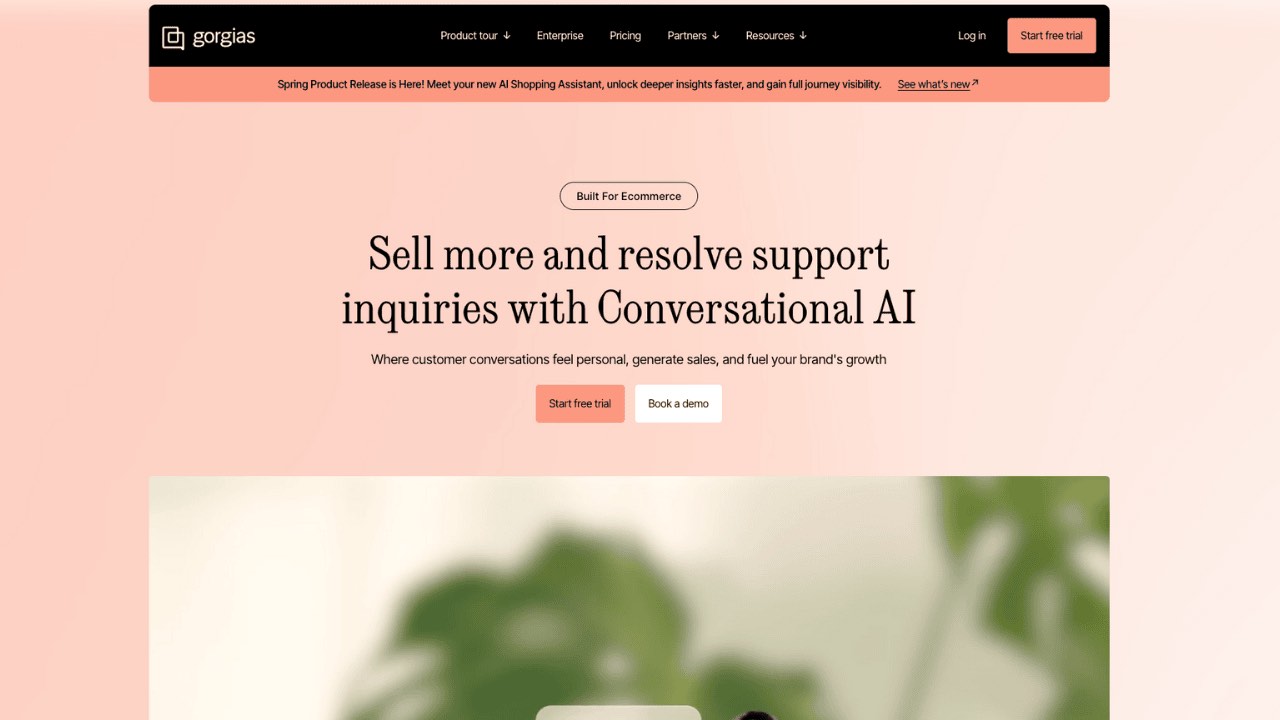
Gorgias has a built-in contact form that funnels submissions straight into the helpdesk as tickets. You don't connect anything external. You build the form inside Gorgias's ticketing system and either share its link or drop it on your site.
Setup, per the Gorgias docs:
- Go to Settings → Channels → Contact Form and click Create Contact Form.
- Give it a name, pick a default language, and connect your Shopify store. Note that the store connection is permanent, so pick the right store the first time.
- Customize the subject lines, fields, and appearance.
- Under Publish, choose how it goes live: a direct shareable link, a manual HTML embed, or Automatically embed on your website (you pick a new or existing page, set a page name and slug, then hit Embed Form).
For the form to create a ticket, the customer fills in their full name, a subject, their email, and a message. On submit, Gorgias opens a new ticket with the channel shown as Contact Form, and it auto-creates a matching view so all form tickets sit together. File attachments come through too. If you're still setting up the wider Gorgias Shopify integration, the contact form is one of the simpler pieces to get live.
What works
- Zero external tools. It's part of Gorgias, so there's nothing to connect or pay extra for.
- Rules fire out of the box. Auto-tag, auto-assign, and auto-respond run on every form ticket.
- Multiple forms per store. You can run several forms as long as they aren't on the same page.
What doesn't
- Less design control. The form is Gorgias-styled, not your custom-built one.
- The store link is permanent. Connect the wrong store and you're rebuilding the form.
Verdict: if you don't have a hard requirement to keep an existing branded form, start and end here. It's the cleanest path.
Method 2: a third-party form builder via the Gorgias plugin
Best for: stores that want to keep a form they already designed in a dedicated builder.
If your form lives in something like Formspree or Typeform, you don't have to abandon it. Plenty of builders connect to Gorgias through a plugin, and the data flows in without changing how the form looks to your customer.
Using Formspree as the example, their help docs lay it out: your form needs at minimum an input named email and one named message. Once those exist, you connect the form to your Gorgias account through the Gorgias plugin, and from then on every submission creates a new ticket with the contact name, email, and any other fields you mapped.
What works
- Keeps your form. Your design, your fields, your page. Only the routing changes.
- Field mapping. You decide which form fields land on the ticket.
What doesn't
- Plugin-dependent. Your builder has to offer a Gorgias connection. Not all do.
- Naming matters. If your fields aren't named the way the plugin expects, the ticket comes through half-empty.
Verdict: the right call when the form itself is non-negotiable. If you don't care about keeping a specific builder, Method 1 is less to maintain.
Method 3: Zapier or Make
Best for: any form builder that doesn't have a direct Gorgias plugin.
When there's no native connection, automation tools bridge the gap with no code. The pattern is always the same: the trigger is a new form submission, and the action is Create Ticket in Gorgias. Zapier connects Shopify and Gorgias this way, and the same approach covers Google Forms, Typeform, and thousands of other tools.
My rule of thumb, which mirrors what I laid out in our guide to connecting Gorgias to other apps: try the native or App Store path first, fall back to Zapier when there's no plugin, and only reach for the API when there's a public endpoint but no Zapier path.
What works
- Huge coverage. Almost any form tool you can name has a Zapier trigger.
- Free-form field mapping. You map exactly which fields become the ticket subject, body, and customer.
What doesn't
- Task costs at volume. A busy form burns Zapier tasks, which adds up.
- One more tool. It's another connection to monitor when something breaks.
Verdict: the reliable middle ground. Slightly more to maintain than a native plugin, far less than building your own integration.
Method 4: the Gorgias HTTP / API integration
Best for: custom forms with no Zapier path, or teams that want a custom sidebar widget.
Gorgias has a public API with a create-ticket endpoint, so a developer can POST your form data straight into the helpdesk as a ticket. This is the most flexible option and the only one that requires writing code. The Gorgias API also powers custom sidebar widgets, so it's the path teams take when they've outgrown the off-the-shelf options.
What works
- Full control. You decide exactly how the ticket is shaped and which data rides along.
- No middleman. No Zapier task limits, no plugin constraints.
What doesn't
- Developer required. This isn't a settings-page job.
- You own it. When Gorgias updates the API or your form changes, the maintenance is yours.
Verdict: only worth it when the other three genuinely can't reach your form, or when you specifically need a sidebar widget.
Which method should you pick
Most of this decision makes itself once you answer one question: do you have to keep your existing form?
- No, I just need a form that works. Use the native Gorgias contact form (Method 1). Fastest, free, rules fire automatically.
- Yes, and my builder has a Gorgias plugin. Use the plugin (Method 2). Keep your design, route the data.
- Yes, but there's no plugin. Use Zapier or Make (Method 3). It connects almost anything.
- My form is fully custom, or I want a sidebar widget. Build the HTTP integration (Method 4) with a developer.
Ninety percent of $10M-$100M Shopify brands are done at Method 1 or Method 3. The API is real and useful, but it's the exception, not the default. Don't pay for engineering time you don't need.
The inlet this doesn't fix: your phone line
Here's the part the help docs leave out. Connecting your form fixes the inlet where customers type. It does nothing for the inlet where they call.
And they do call, especially the higher-AOV orders. When someone can't reach a person, the cost is brutal: 85% of callers who can't get through never call back, and 62% switch to a competitor, per a 2026 PCN study. Your form might be perfectly wired into Gorgias while your phone rings to voicemail every evening and weekend, leaking the exact customers who cared enough to dial.
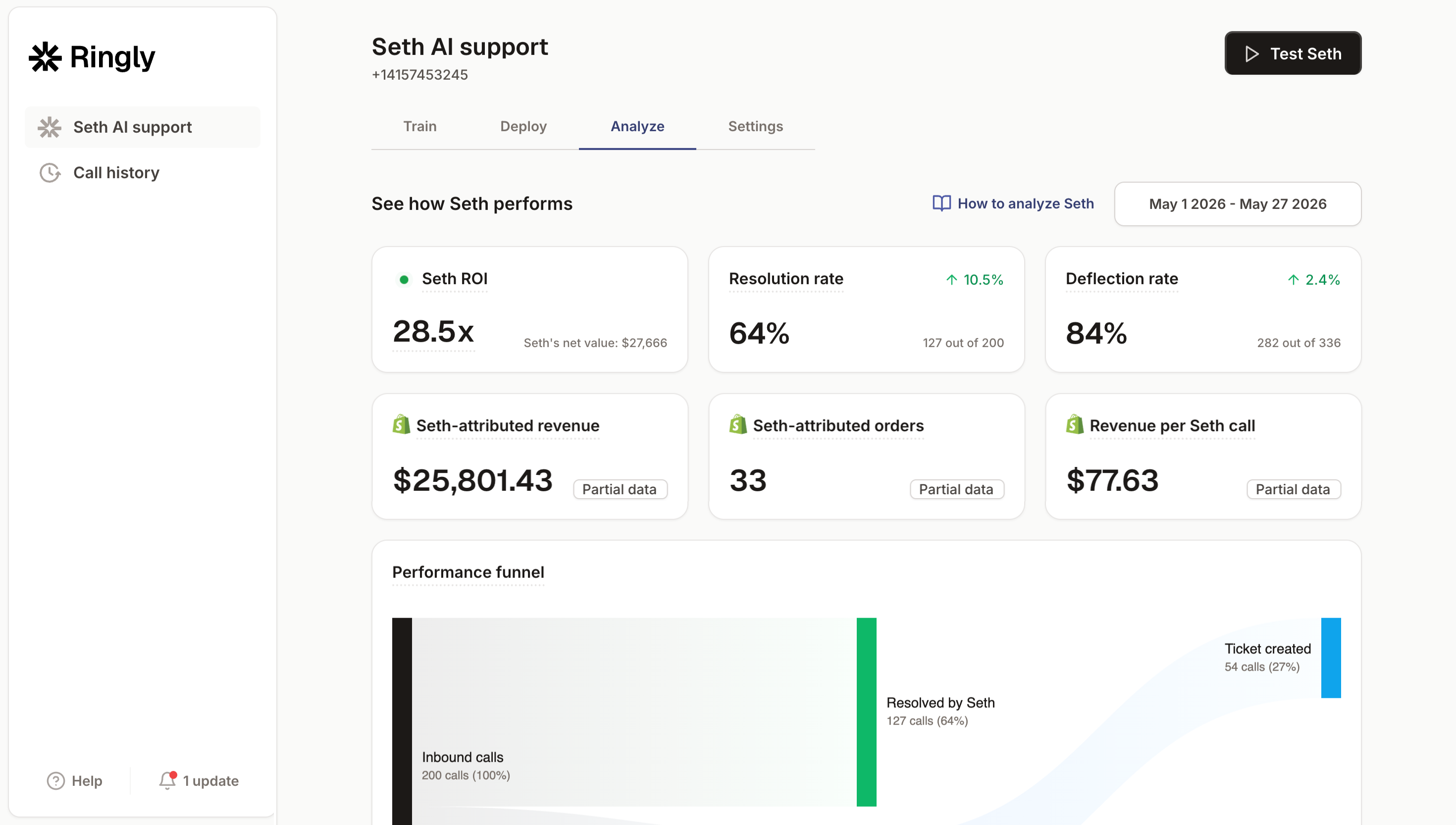
This is where Ringly.io fits. Ringly is AI phone support for Shopify brands. Stop hiring a new rep every time call volume climbs. The AI answers inbound calls 24/7, finds orders in your Shopify store, handles returns and product questions from your knowledge base, and rescues abandoned carts with outbound follow-up. Across 50+ brands, the AI resolves 73% of calls autonomously at roughly $0.42 per resolved call. Calls that need a human escalate cleanly into Gorgias, so round-the-clock phone support becomes one more channel in the same inbox your form now feeds, right alongside the rest of your ecommerce customer service.
The math is the same shape as consolidating your form, just bigger. Take a $50M brand running a 6-rep CS team:
| Line item | Today | With Ringly |
|---|---|---|
| 6 reps × $4K loaded per rep | $24,000/mo | n/a |
| Ringly Enterprise (~$5K/mo) | n/a | $5,000/mo |
| Net monthly CS spend | $24,000/mo | $5,000/mo |
| Monthly savings | n/a | $19,000/mo |
| Annual savings | n/a | $228,000/yr |
That's roughly 70% of the repeatable calls, the same WISMO and returns questions your form gets, routed to the AI. The genuinely complex calls still reach your team, who now have time to solve them properly. WashCo, a Shopify brand we launched, recovered $22,664 in its first 7 days on the phone.
"My customers also feel like it's a normal person. They feel like they can communicate if they have questions."
Claudia Droge, TechCraft Studio
If your form is sorted but your phone still goes quiet after 6 p.m., book a 30-min call and we'll show you what's slipping through.
Common mistakes when connecting a form to Gorgias
A few things trip people up, and most of them only show up after a real customer hits the form.
- No email field. If the submission has no email, you get a ticket you can't reply to. Every method needs a customer email to be useful.
- Leaving the old notification on. If your Shopify form still emails a store inbox AND routes into Gorgias, two people handle the same message. Turn off the legacy notification once the helpdesk route is live.
- Never testing a live submission. Wire it, then actually submit the form yourself and confirm the ticket lands with the right fields. The number-one reason a form connection "doesn't work" is that nobody submitted a real test entry before launch.
- Expecting rules to apply backwards. Your auto-tag and auto-assign rules only run on tickets created after the rule exists. Set the rules first, then point the form at Gorgias.
Frequently asked questions
What fields does a Gorgias contact form need to create a ticket? The native form needs a full name, a subject, an email, and a message. The email is the one that matters most, since without it you have no way to reply. Third-party and Zapier routes need an email and message field at minimum.
Does the Gorgias contact form create a ticket automatically? Yes. Each submission opens a new ticket with the channel shown as Contact Form, and Gorgias auto-creates a view so all form tickets sit together. You don't have to convert anything by hand.
Can I connect my existing Shopify contact form to Gorgias? Yes. If your form builder has a Gorgias plugin, use that. If not, a Zapier or Make automation with a "Create Ticket" action covers the Shopify default form and almost any other builder.
Do my Gorgias rules apply to tickets from a form? Yes. Auto-tag, auto-assign, and auto-respond all fire on contact-form tickets, the same way they do on email. Just make sure the rules exist before the form goes live, because they don't apply retroactively.
Can I connect Typeform, Google Forms, or Formspree to Gorgias? Yes. Formspree connects through the Gorgias plugin. Typeform and Google Forms route in through Zapier or Make using a "Create Ticket" action, or through the Gorgias API if you want full control.
Do I need a developer to connect a form to Gorgias? No, for most stores. The native form, the plugin route, and the Zapier route are all no-code. You only need a developer for the HTTP / API integration or a custom sidebar widget.
What about phone calls, can Gorgias capture those too? Gorgias handles voice, but an unanswered call still becomes a missed call, not a resolved one. An AI phone agent like Ringly answers the calls 24/7 and escalates the hard ones into Gorgias, so the phone lands in the same inbox as your form.
Talk to us

Connecting your form is the easy half. If you run a $10M-$100M Shopify brand and your phone is the inlet still ringing out after hours, a 30-min call is the fastest way to see what you're leaving on the table.
The 3-layer guarantee.
- Live in 14 days or it's free until launched.
- 65% resolution in 90 days or we refund the last 3 months of subscription fees.
- We keep working free until we hit 65%.
Ruben (Ringly co-founder) takes these calls personally.