
This post in 30 seconds.
- Coffee brands get more calls than most ecommerce, and the bill for answering them spikes exactly when you can least afford the headcount.
- I ran the loaded-cost math on staffing a coffee phone line through the December gifting surge, then priced the same coverage three other ways. The numbers are below.
- Built for $10M-$100M Shopify coffee brands running a paid helpdesk with a visible phone number, weighing how to staff phone support without hiring a seasonal team every November.
Every coffee operator I talk to hits the same wall around the third week of November. You open a spreadsheet, you look at last December's call volume, and you have to decide: do you hire three seasonal reps to cover the gifting surge, or do you let the overflow roll to a voicemail nobody checks until Monday?
Neither answer feels good. Three reps at $4,000 a month loaded is $12,000 you're spending for maybe ten weeks of real volume. Voicemail means lost gift orders and a fresh batch of 1-star reviews in January. So most brands split the difference, understaff it, and quietly accept that a chunk of December calls just won't get answered.
If you run customer experience at a Shopify coffee brand doing $10M-$100M, you already know this trade-off. The phone backlog is real and it gets worse every gifting season. We've launched AI phone agents for 50+ Shopify brands stuck in exactly this spot, and this post is the staffing math behind the decision. Book a 30-min call and we'll pull your last week of missed calls and price the coverage live.
In this post:
- Why a coffee brand gets so many phone calls
- What it actually costs to staff that phone line
- The after-hours and gifting-spike problem
- Your four ways to staff coffee phone support
- How to run AI phone support without losing the customer
- What this costs vs paying in headcount
- Frequently asked questions
Why a coffee brand gets so many phone calls
Coffee is one of the few ecommerce categories where the phone never went away. Part of it is the buyer. A real chunk of specialty coffee revenue comes from older customers who don't feel comfortable putting a card into a website, so they call to place the order instead. Part of it is the product. Coffee is perishable and time-sensitive in a way a hoodie isn't, and people get anxious about it.
The calls cluster into a handful of patterns, and most of them are answerable without a human if you can see the store. Roast date and freshness ("will this still be fresh when it arrives?"). Ship-by and delivery timing, which spikes hard in December when half the orders are gifts. Subscription pause, skip, and swap. And the eternal where's my order call, which Salesforce puts at 30-40% of all support tickets, climbing past 50% at peak.
There's a quieter pattern too. Coffee customers don't talk in SKUs. They call and ask about "the dark roast," not "item 1247." A scripted answering service for coffee brands can't map that to an order or a product page. Someone, or something, that can actually see your Shopify store can.
You can watch this play out across the category. Trade Coffee gets grind-and-roast questions a website dropdown can't fully settle. Black Rifle and Death Wish have both eaten public complaints about calls that disconnected or went unanswered under load. The pain is consistent, and it's specific to how people buy coffee. Perfect Daily Grind covered the broader shift toward more attentive service in specialty coffee in January 2026, and the phone is where it shows up first. Gear Rider, a Ringly customer, handled 1,595 inbound sales calls in 90 days without a phone rep on the line, which is the volume shape a busy roaster sees in a good quarter.
What it actually costs to staff that phone line
Here's where the November spreadsheet gets uncomfortable. The cost of a coffee phone line isn't the wage on the rep's offer letter. It's everything stacked on top.
A US customer service rep runs about $19.74 an hour in base wage in 2026, before benefits. Load that with payroll tax, training, software seats, shrinkage, and the cost of replacing them when they leave, and the number coffee operators actually use is $4,000 a month per rep. When you factor in turnover and after-hours coverage, the true cost lands at $12 to $17 per call for ecommerce. That's not a typo for a category where the average order is a $22 bag of beans.
I'll show you the math the way I'd run it on a call. Take a $20M coffee brand with four reps year-round. To cover the December gifting surge, you add four seasonal hires for three months. Four reps at $4K loaded is $16,000 a month, $192,000 a year. The four seasonal reps add roughly $48,000 across the quarter. So your true annual phone-support spend is around $240,000, and a big slice of it is paying for a peak you only hit for about ten weeks.
WashCo, a Shopify brand we launched recently, ran calls at $0.91 each versus the $2.70 a human-handled call costs them. That gap is the whole argument, and it widens every time you have to staff for a spike.
Then there's the part that never makes the spreadsheet: turnover. First-year attrition in customer service runs 65-70%, with a 6-8 month ramp to full productivity, and replacing one rep costs $12,000 to $35,000 once you count recruiting, training, and lost output. Your seasonal December hire is gone by February, and you start the cycle over before the next gifting season. For most coffee brands the real cost of phone support is this churn, not the calls themselves.
The after-hours and gifting-spike problem
The seasonal headcount problem has a twin: the clock. Coffee buyers skew older, and older buyers call in the evening, on weekends, and they do not leave voicemails. Roughly 80% of callers routed to voicemail hang up without leaving a message, and once they can't reach a person, 85% never call back and 62% just dial a competitor.
The average business answers only 37.8% of its inbound calls, which means most of what hits your line after 6 p.m. is simply gone. For a coffee brand the math is worse than for most, because a missed December call isn't one lost sale. It's a lost gift order, a customer who wanted to send their dad coffee for his birthday and couldn't reach anyone, and the kind of moment that turns into a public review in January.
So the question isn't really "how many reps do we hire." It's "how do we cover the hours and the spike without buying headcount we don't need eleven months a year." That's a staffing-model question, and you've got four real answers. Want to walk through them against your actual call data? Book a 30-min call and we'll do it live.
Your four ways to staff coffee phone support
There are four practical ways to answer a coffee brand's phone. Each one trades cost against coverage against control. Here they are side by side before the detail.
| Model | Rough monthly cost | After-hours + spike coverage | Best for |
|---|---|---|---|
| AI phone agent (Ringly) | $349-$799 self-serve; Enterprise by call | 24/7, absorbs spikes with no new headcount | Brands that want most calls answered now |
| In-house reps | ~$4,000/mo per rep | Only the hours you staff | Brands where every call is a phone order |
| Offshore BPO / answering service | $7-$42/hr per agent | 24/7 if you pay for it | High volume, low product complexity |
| Voicemail + callback | "Free" | None in real time | Brands fine with losing the after-hours call |
1. AI phone agent (Ringly)
Best for: coffee brands that want the routine calls (roast date, ship-by, WISMO, subscription changes) answered around the clock without hiring for the spike. Ringly.io is AI phone support for Shopify coffee brands.
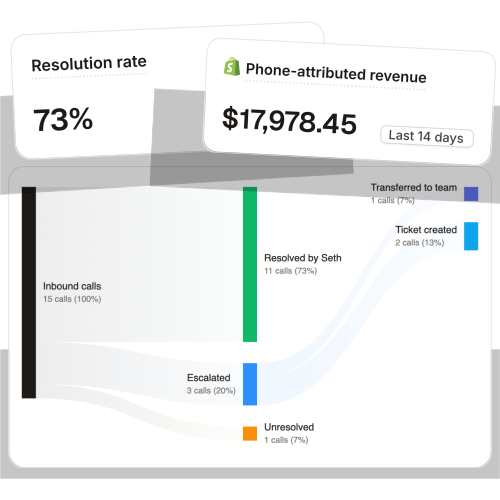
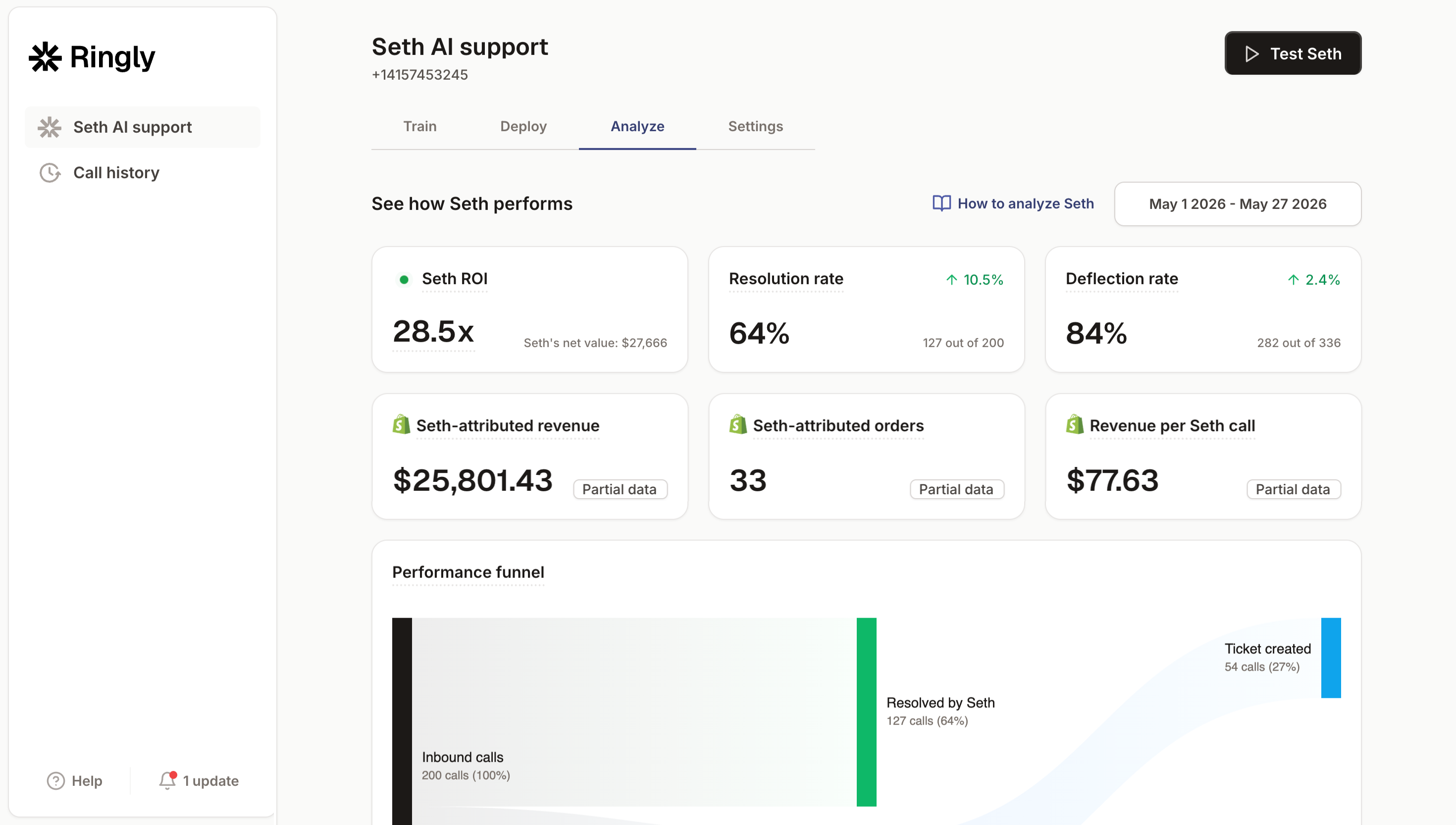
Instead of growing your support headcount every time call volume goes up, the AI takes the routine inbound calls so your team can focus on the work that actually moves revenue. It answers 24/7, finds orders in your Shopify store, processes returns and exchanges, answers product questions from your knowledge base, and rescues abandoned carts with outbound follow-up. Across 50+ brands, the AI resolves 73% of calls autonomously at roughly $0.42 per resolved call. Calls that need a human, the phone orders and the genuinely complex ones, escalate cleanly to Gorgias, Richpanel, Re:amaze, or whatever helpdesk you already run.
Pricing
| Plan | Price | Included |
|---|---|---|
| Grow | $349/mo | 1,000 minutes (~500 calls) |
| Pro | $799/mo | 2,500 minutes (~1,250 calls) |
| Enterprise | By call | Custom volume for $10M-$100M brands |
What works
- No seasonal hiring. The same agent that covers a quiet Tuesday absorbs the December gifting spike. No ramp, no offer letters, nobody let go in February.
- Sees your store. It maps "the dark roast" to the actual product and the caller's order, which a scripted service can't.
- 24/7 by default. The 6 p.m. and weekend calls older coffee buyers make get answered, not banked as voicemail.
- Keeps your stack. It sits in front of your helpdesk and escalates cleanly. You keep your number, your Gorgias instance, your workflows.
- 65% resolution guarantee. If it resolves under 65% of calls in 90 days, you get the last 3 months of fees back.
What doesn't
- It won't take a full phone order natively. For the older buyers who call to order, it transfers to a human or sends an SMS payment link. If most of your revenue is phone orders, this is a real limitation.
- Real-time inventory is a daily sync, not live to the second.
Why it ranks first
For a coffee brand, the cost shape is the whole problem, and the AI is the only model that doesn't make you buy headcount for a peak you hit ten weeks a year. It's first because it answers the seasonal-spike question directly.
2. In-house reps
Best for: brands where a large share of revenue genuinely comes from phone orders and the human relationship is the product.
Hiring your own reps gives you the most control and the highest quality on complex, relationship-heavy calls. The catch is cost and coverage. You pay roughly $4,000/mo loaded per rep, you only get the hours you actually staff, and you eat the 65-70% first-year attrition every coffee brand sees.
What works
- Highest quality on hard calls and full phone-ordering.
- Total control over voice, tone, and escalation.
What doesn't
- Costs scale linearly with volume, which is brutal during the gifting spike.
- Coverage gaps after hours and on weekends unless you pay for shifts that sit idle most of the time.
Why it ranks second
Right for the rare coffee brand that's mostly phone orders. Wrong for the majority, where 70% of calls are repeatable questions a rep is overqualified to answer.
3. Offshore BPO or answering service
Best for: high call volume with low product complexity, where you mostly need a warm body to read a script.
Outsourcing moves the cost down: offshore agents run $7-$16/hr, US-based $29-$42/hr, with pay-per-resolution models around $4 each. You can buy 24/7 coverage. The problem for coffee specifically is that scripted agents can't see your store, can't map "the dark roast," and tend to fall over under load. This is the model behind the public complaints about coffee lines that put callers on hold and then disconnected.
What works
- Cheaper than in-house per hour, and 24/7 if you pay for it.
What doesn't
- No store visibility, so WISMO and product calls get fumbled or escalated back to you.
- Quality drops under load, exactly when the December spike hits. Compare the models on our outsourced Shopify customer service breakdown.
Why it ranks third
Fine for volume, weak for coffee. The product context that coffee calls require is the thing a generic call center outsourcing contract is worst at.
4. Voicemail and callback
Best for: honestly, almost no coffee brand at $10M+.
Routing after-hours calls to voicemail costs nothing on paper. It costs a lot in practice. With 80% of voicemail callers hanging up and 85% of unanswered callers never trying again, this isn't a coverage model, it's a slow leak. We only list it because plenty of brands default to it without ever deciding to.
Why it ranks fourth
It's the absence of a decision. If you're at this scale, an after-hours answering option of any kind beats voicemail.
How to run AI phone support without losing the coffee customer
The model is one thing. Running it well for coffee is another, and the older-buyer demographic is unforgiving. Here's how I'd set it up if it were my brand.
I've helped launch phone support for 50+ Shopify brands, and the coffee setups all share the same five moves:
- Load roast and freshness logic into the knowledge base. Roast dates, the 7-21 day peak window, degassing, "will it be fresh when it lands." These are your most common calls and they're pure KB.
- Wire up order status to Shopify so the agent can answer ship-by and WISMO questions by looking at the actual order, including gift orders with a different shipping address.
- Route phone orders to a human. The older buyer who calls to order gets a clean transfer or an SMS payment link. Don't fake it. This is the one thing the AI shouldn't try to do alone.
- Handle subscription pause, skip, and swap as custom actions, since coffee subscriptions are now a real channel and a real chunk of after-hours calls. We go deeper on this in our coffee subscription customer service guide.
- Set escalation rules for the emotional calls. A spoiled gift, a missed birthday delivery, a complaint. These go to your team with full context, not into a script.
The thing that decides whether older coffee customers accept any of this is voice quality. The most repeated compliment we hear across all 50+ brands is that the agent doesn't sound like AI, which matters more in coffee than in any other category because the demographic is the most skeptical.
"My customers also feel like it's a normal person. They feel like they can communicate if they have questions."
— Claudia Droge, TechCraft Studio
What this costs vs paying in headcount
Put the staffing models against real numbers. Here's the $20M coffee brand from earlier, the one staffing four reps year-round plus four seasonal hires for the gifting quarter.
| Line item | Today | With Ringly |
|---|---|---|
| 4 reps × $4K loaded, year-round | $16,000/mo ($192K/yr) | — |
| 4 seasonal reps × $4K × 3 months | ~$48,000/yr peak | — |
| Ringly (handles 70-80% of calls) | — | ~$3K-$5K/mo |
| True annual phone-support spend | ~$240,000/yr | ~$36K-$60K/yr |
| Annual savings | — | ~$140K-$180K/yr |
The AI handles roast-date, ship-by, WISMO, and subscription calls year-round and absorbs the December spike without a single seasonal hire. Your team takes the 20-30% that actually need a human, the phone orders and the emotional calls, and they finally have the bandwidth to do it well.
Real numbers from WashCo, a Shopify brand we launched recently:
- $22,664 in attributed revenue, first 7 days post-launch
- 271 calls handled
- 85% deflection rate
- 66% resolution rate
- $0.91 per call vs $2.70 per human-handled call
Source: Ringly dashboard, verified live data.
The call makes sense if:
- You're a Shopify (or Shopify Plus) coffee brand doing $10M-$100M
- You run a paid helpdesk (Gorgias, Zendesk, Gladly, Re:amaze, or Intercom)
- You have a visible phone number on your store
- Your CS team is 3-12 people
If that's you, the math usually works. Book a 30-min call and we'll run it live on your store.
What happens on the call.
- We pull your last 7 days of missed calls live, on the call. No homework for you.
- We show you the recovered revenue at the resolution rates we see for coffee brands.
- You decide if it's worth a deeper conversation. No deck, no follow-up sequence.
If you're weighing the December staffing decision right now, book a 30-min call and we'll do the math against your actual call data before you write a single offer letter.
Frequently asked questions
How many phone calls does a coffee brand get? More than most ecommerce categories of the same size, because older buyers prefer the phone and the product is perishable. A busy roaster can see Gear Rider's shape: around 1,595 inbound calls in a single 90-day stretch, heavily weighted toward WISMO and gifting questions.
Should a coffee brand staff its own phone support or outsource it? It depends on how much of your revenue is genuine phone orders. If it's most of it, keep humans. If 70-80% of calls are repeatable questions (roast date, ship-by, WISMO), an AI phone agent answers those around the clock and routes the order-takers to a person.
How much does it cost to run phone support for a coffee brand? A US rep costs about $4,000/mo loaded, and the true cost lands at $12-$17 per call once you count turnover and after-hours coverage. A $20M brand staffing for the gifting spike often spends near $240,000 a year. AI phone support runs roughly $0.42 per resolved call.
Can AI phone support take coffee orders over the phone? Not natively. For the older buyers who call to order, the agent transfers to a human or sends an SMS payment link. It handles the WISMO, roast-date, gifting, and subscription majority and leaves the order-takers to your team.
Will older coffee customers accept an AI on the phone? This is the make-or-break for coffee, and it comes down to voice quality. The most repeated thing customers say after a call is that the agent doesn't sound like AI, which is why the demographic that's most skeptical tends to be the most surprised.
How do I handle the December gifting-season call spike? The cleanest way is a model that doesn't require new headcount. AI phone support absorbs the spike at the same per-call cost as a quiet week, so you're not hiring seasonal reps in November and laying them off in February.
Does AI phone support work with my Shopify store and helpdesk? Yes. It reads orders directly from Shopify and escalates calls that need a human to Gorgias, Richpanel, Re:amaze, or whatever helpdesk you already run. You keep your phone number and workflows. Live in under an hour.
What happens to calls the AI can't handle? They escalate to your team with full context, so the rep isn't starting cold. You set the rules for what always goes to a human, like phone orders, spoiled-gift complaints, or anything emotionally charged.
Talk to us

If you run a $10M-$100M Shopify coffee brand and the December queue scares you, a 30-min call is the fastest way to see what the phone is actually costing you. We'll pull your missed calls and price the coverage live, against your real numbers, not a generic benchmark.
The 3-layer guarantee.
- Live in 14 days or it's free until launched.
- 65% resolution in 90 days or we refund the last 3 months of subscription fees.
- We keep working free until we hit 65%.
Ruben (Ringly co-founder) takes these calls personally.