
If you're evaluating call center options beyond Callzilla, you're not alone.
Many businesses find themselves weighing the costs and complexities of traditional BPO outsourcing against newer approaches like cloud-based software and AI-powered automation.
This guide breaks down seven alternatives across three categories: AI phone agents, cloud call center software, and enterprise contact center platforms.
Each option serves different needs, budgets, and team sizes.
Editor’s note: Want to hear some sample support calls made for your Shopify store?
- Just paste your store URL
- Get sample calls in under 20 seconds (no email required)
- Listen to demo calls for my store
What is Callzilla?
Callzilla is a Florida-based BPO (business process outsourcing) company that provides outsourced contact center services for US and European enterprises.
Founded in 2005, the company operates nearshore centers in Miami, Bogota (Colombia), and South Africa.
Their service model centers on providing live agents for inbound customer communications.
This includes phone support, email, chat, SMS, and social media monitoring across platforms like Twitter, Facebook, Instagram, and TikTok.
Callzilla positions itself with strong performance metrics: 90% first call resolution and 83% year-over-year agent retention (compared to an industry where most agents leave within a year).
They support multiple languages including English, Spanish, French, and Portuguese.
Why businesses look for Callzilla alternatives
The reasons for exploring alternatives typically fall into a few categories.
Cost structure concerns. BPO outsourcing involves per-agent fees, training costs, and management overhead. For smaller teams or businesses with fluctuating call volumes, this model can feel inflexible.
Scaling challenges. Traditional outsourcing often requires multi-month contracts and staffing commitments. Ramping up or down quickly isn't always possible.
Technology preferences. Some businesses want direct control over their call center software. They prefer managing their own systems rather than relying on an outsourced provider.
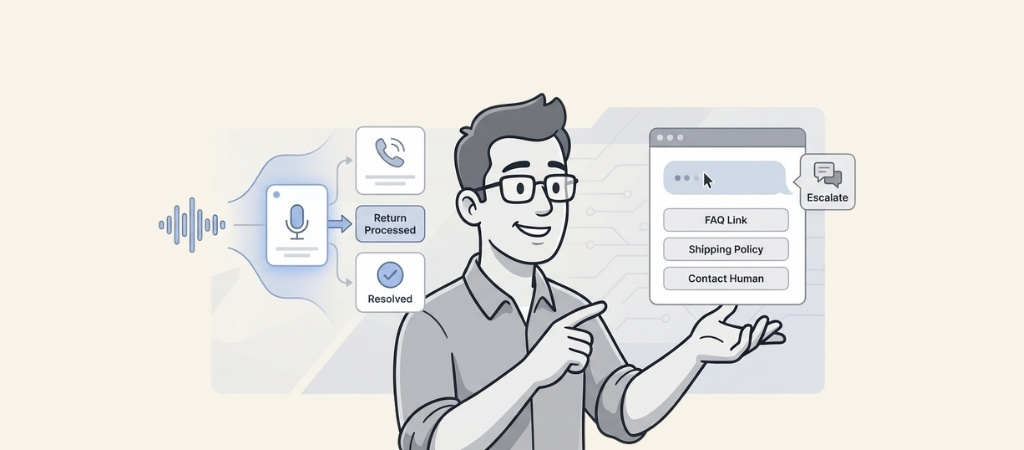
AI automation interest. A growing number of companies want to reduce human agent dependency. Repetitive tasks like order tracking, returns processing, and FAQ responses are perfect for automation.
Integration requirements. Specific needs for CRM, helpdesk, or e-commerce platform integrations may not align with what a BPO provider offers.
When evaluating alternatives, three main categories emerge:
- AI-powered phone agents that automate calls without human staffing
- Cloud call center software for self-managed, in-house teams
- Enterprise contact center platforms for large-scale operations
How we evaluated these Callzilla alternatives
To make this comparison useful, we evaluated each alternative using consistent criteria.
Pricing transparency. Does the vendor publish clear pricing, or is everything quote-only?
Feature set. What's included for call routing, IVR, analytics, integrations, and AI capabilities?
Ease of setup. How quickly can a team deploy the solution? Are there technical requirements?
Scalability. Can the platform grow from a small team to enterprise-level operations?
Customer support. What support channels are available? When are they available?
Use case fit. Is the tool better suited for sales teams, support teams, or mixed workflows?

Each alternative excels in different areas depending on your team size and call volume
7 best Callzilla alternatives
1. Ringly.io

Best for: E-commerce businesses wanting AI-powered phone support without hiring agents
Ringly.io takes a different approach to phone support. Instead of providing human agents, their AI phone rep (named the AI) handles inbound calls 24/7 autonomously.
The AI resolves approximately 70-73% of calls without human intervention.
This includes order tracking, returns and exchanges, product questions, and FAQ responses. For everything else, calls escalate to your existing team.
The platform integrates with Shopify, pulling order data in real-time so callers get accurate answers about their purchases.
Most stores go live within an hour rather than weeks. No technical expertise required.
Pricing:
| Plan | Price | Minutes Included | Best For |
|---|---|---|---|
| Start | $349/month | 250 mins (~125 calls) | Small stores getting started |
| Grow | $349/mo | 1,000 mins (~500 calls) | Growing e-commerce businesses |
| Enterprise | Custom | 5,000+ mins | High-volume stores |
Overage minutes cost $0.19/minute beyond your plan allocation. The platform supports 40+ languages.
Pros:
- No per-agent costs or staffing headaches
- Pay-for-performance trial (billing starts after 65% resolution rate over 100 calls)
- 14-day free trial with full features
- Deep Shopify integration for real-time order data
Cons:
- Best suited for e-commerce; limited fit for non-retail use cases
- Requires existing phone support workflows to measure against
The economics work differently here. Rather than paying per-seat or per-agent, you pay for resolved calls. For e-commerce stores handling repetitive queries, this can mean cost savings compared to staffing agents around the clock.
2. CloudTalk
Best for: Sales and support teams needing advanced call center features with CRM integrations
CloudTalk is a cloud-based call center platform designed for both sales and support teams.
The platform focuses on CRM integration, with 160+ native connections including HubSpot, Salesforce, Pipedrive, and Zendesk.
Their AI Conversational Intelligence features include call transcription, sentiment analysis, and emotion analytics.
These come included on all plans rather than as paid add-ons.
The platform covers 160+ countries. It offers power dialer functionality for outbound sales teams, smart queuing for inbound support, and real-time monitoring for supervisors.
Pricing:
| Plan | Monthly | Annual | Key Features |
|---|---|---|---|
| Essentials | $40/user | $30/user | 3-seat min, IVR, call recording (1yr), 100+ integrations (HubSpot/Zendesk) |
| Professional | $70/user | $50/user | Salesforce CTI, Power Dialer, Live Monitoring, unlimited call storage |
| Custom | Quote | Quote | 25-seat min, Unlimited international calling, API support, dedicated account manager |
Note: Expert plan has a 3-user minimum.
Pros:
- AI features included on all plans (not sold separately)
- 160+ native integrations
- 24/7 human support on Essential and higher plans
- Migration typically takes 1-10 days with vendor assistance
Cons:
- Costs add up at scale (10-person team on Expert = $690/month)
- Mobile app receives mixed reviews compared to desktop
- 3-user minimum on Expert plan
Our call volume tripled in only 2 years, from around 10,000 calls to 30,000 per quarter and with CloudTalk, we can now handle all of this communication easily.
3. Nextiva

Best for: Businesses needing omnichannel support with HIPAA compliance
Nextiva is a unified communications platform that combines voice, chat, email, SMS, and social media in a single interface.
The platform backs its reliability with a 99.999% uptime guarantee (five nines).
Support is 24/7 and US-based, which matters for teams that need responsive help during off-hours.
Nextiva includes a built-in CRM and customer journey tools. This reduces the need for separate integrations. The contact center features include skills-based routing, supervisor tools, and automated chatbots on higher tiers.
Pricing:
| Plan | Annual Price | Key Features |
|---|---|---|
| Core | $15/user/mo | Unlimited Voice, 100 SMS/user, Video meetings, AI Voicemail transcription, Basic IVR |
| Engage | $25/user/mo | Everything in Core + 250 SMS/user, Toll-free number, Web Chat (Live & Bot), Advanced Reporting |
| Power Suite CX | $75/user/mo | Everything in Engage + AI Call Summaries, Skills-based routing, Supervisor Dashboards, CRM/CDP integration |
The $15/user entry point is among the lowest in the industry for a full-featured platform.
Pros:
- HIPAA-compliant option for healthcare
- Competitive entry-level pricing ($15/user)
- 99.999% uptime guarantee
- US-based 24/7 support
Cons:
- Admin interface has a learning curve
- Advanced features (supervisor tools, skills-based routing) require Power Suite tier
- Call routing setup requires technical knowledge
4. RingCentral

Best for: Mid-size to enterprise teams wanting a comprehensive UCaaS platform
RingCentral is an industry leader with over 500,000 companies using the platform.
Their customer roster includes Toyota, Lufthansa, HP, and AT&T.
The platform combines unified communications (phone, video, messaging) with contact center capabilities through RingCX. They offer 200+ integrations covering Salesforce, Zendesk, Microsoft Teams, Slack, and compliance tools like Smarsh.
AI Assistant features for transcription and real-time notes come included on all paid plans. This handles meeting summaries and call documentation automatically.
Pricing:
| Plan | Annual Price | Key Features |
|---|---|---|
| Core | $20/user/mo | AI Assistant, 100 toll-free mins, 25 SMS/user, basic IVR, 100-person video |
| Advanced | $25/user/mo | Auto call recording, 1,000 toll-free mins, 100 SMS/user, CRM integrations (Salesforce/HubSpot) |
| Ultra | $35/user/mo | 10,000 toll-free mins, 200 SMS/user, unlimited storage, 200-person video, advanced analytics |
| RingCX | $65+/user/mo | Full omnichannel contact center, 20+ digital channels, AI Agent Assist, workforce management |
Pros:
- Proven reliability with enterprise customers
- 200+ integrations
- 24/7 support on all paid plans
- AI transcription included (not an add-on)
Cons:
- Base plans have limited toll-free minutes (100 on Core)
- Add-ons increase costs significantly
- Custom pricing only available for 100+ employees
Within the first week, we deployed to hundreds of employees. A few weeks later, thousands. The app works great for users, managers and admins. User adoption rate is impressive.
5. Aircall

Best for: SMBs wanting quick setup and Salesforce/HubSpot integration
Aircall positions itself around fast deployment. Their tagline is "minutes, not weeks" for setup.
This appeals to teams that need to move quickly.
The platform serves 22,000+ companies. It offers native integrations with Salesforce and HubSpot out of the box.
Power dialer functionality is included on the Professional plan for outbound sales teams.
Aircall offers unlimited US/Canada calling on all plans. This includes IVR, call recording, and SMS support.
Pricing:
| Plan | Monthly | Annual | Key Features |
|---|---|---|---|
| Essentials | $40/license | $30/license | 3-seat min, IVR, SMS/MMS, 100+ integrations (HubSpot, Pipedrive) |
| Professional | $70/license | $50/license | 3-seat min, Salesforce native, Power Dialer, Live Monitoring, Queue Callback |
| Custom | Quote | Quote | 25-seat min, Unlimited global calls, API developer support, SSO, Custom onboarding |
Note: 3-license minimum on Essentials/Professional; 25-license minimum on Custom. Extra phone numbers cost $6/month each. AI transcription is an add-on at $9/license/month.
Pros:
- Quick deployment (minutes to get started)
- Strong CRM integrations out of the box
- 50% nonprofit discount available
- Power dialer included on Professional (typically a premium add-on elsewhere)
Cons:
- Call quality complaints from some users (choppy calls, dropped connections over Wi-Fi)
- Limited to 1 number per plan (extras $6/mo each)
- AI features cost extra ($9/license/mo)
- 3-license minimum creates higher entry cost
The call quality is horrible for both outbound and inbound calls. Phone numbers are all marked as SPAM. Their service is SUPER expensive and their support team...
The mixed reviews around call quality are worth noting. Some users report excellent experiences while others cite persistent issues.
6. Talkdesk
Best for: Enterprise contact centers needing AI-driven analytics and industry-specific solutions
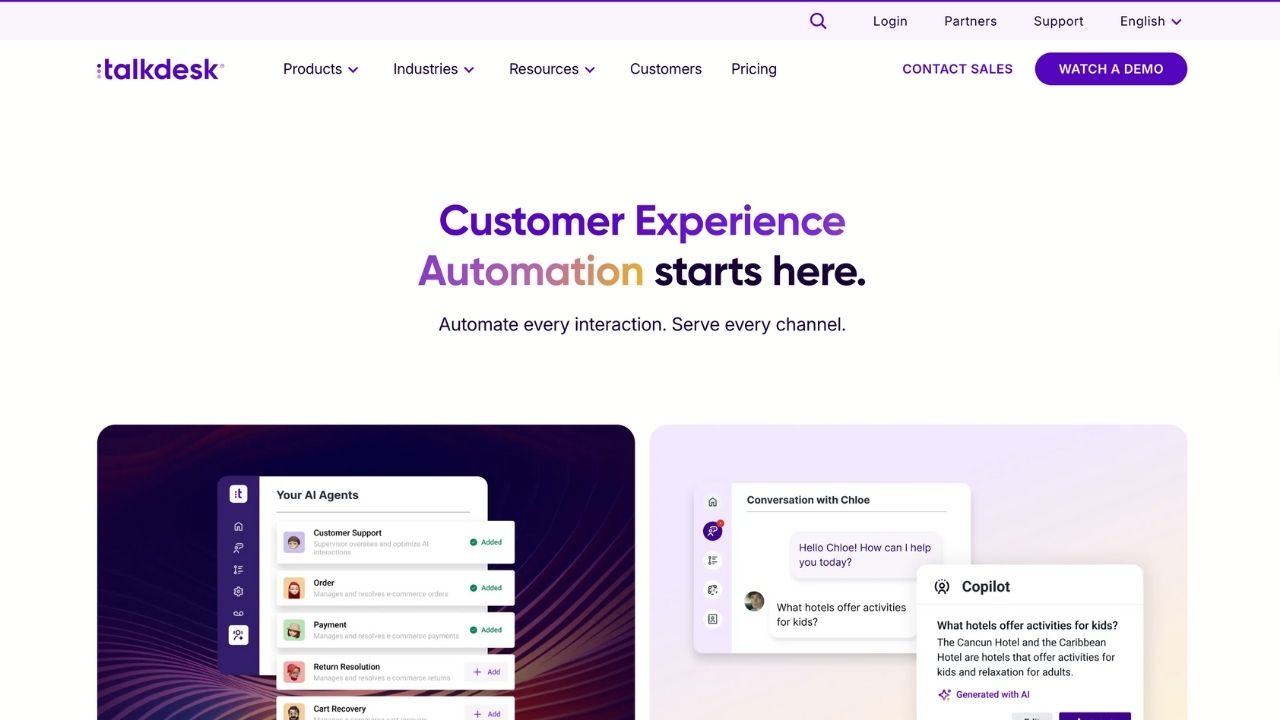
Talkdesk is a 2025 Gartner Magic Quadrant Leader for CCaaS (Contact Center as a Service).
The platform targets large enterprises with complex requirements.
Their differentiation includes industry-specific "clouds" for healthcare, financial services, and retail.
These come pre-configured with relevant compliance settings, terminology, and workflows.
AI capabilities include Copilot for real-time agent assistance with suggested responses.
Autopilot provides autonomous AI agents for routine interactions. Speech analytics, sentiment analysis, and quality management tools round out the feature set.
Pricing:
| Plan | Price | Key Features |
|---|---|---|
| Digital | $119/user/mo | Digital channels only (Email, SMS, Chat, Social), Recording, Workflow Automation |
| Core | $159/user/mo | Everything in Digital plus Voice, AI Summaries, Live Transcription, CRM/UC Adapters |
| Plus | Custom Quote | Everything in Core plus Advanced AI (Agent Assist, AI Knowledge), Full Omnichannel |
| Pro | Custom Quote | Everything in Plus plus Workforce Engagement (QM, WFM, Performance Analytics) |
| Enterprise | Custom Quote | Full suite: Advanced AI, WEM, Workflow Automation, and custom API/SDK support |
Pros:
- Industry-specific solutions (healthcare, finance, retail)
- Advanced AI and analytics capabilities
- Scalable for large enterprises
- 2025 Gartner Magic Quadrant Leader
Cons:
- Expensive entry point ($85/user minimum)
- True omnichannel (voice + digital) only on Elevate plan and above
- AI Copilot requires Elite tier ($145/user)
- Overkill for small businesses
At $85/user minimum, Talkdesk targets organizations with 100+ agents and complex requirements. The industry-specific clouds can accelerate implementation for regulated industries.
7. Five9
Best for: Large enterprises needing workforce optimization and predictive dialing
Five9 is a cloud contact center platform focused on enterprise operations.
The platform prioritizes AI agents, workforce optimization, and flexible dialing options.
Their dialing capabilities include predictive, progressive, and preview dialers.
This makes Five9 particularly strong for outbound-heavy operations like sales campaigns or collections.
Workforce management tools cover scheduling, forecasting, and adherence tracking.
The platform offers omnichannel routing across voice, email, chat, social, and SMS.
Pricing:
Five9 starts at approximately $119/user/month, but specific pricing requires contacting sales. Options include:
- Per-user monthly subscription
- Per-minute billing for outbound-heavy operations
- Concurrent agent pricing for variable volume
Pros:
- Comprehensive enterprise features
- Strong workforce optimization tools
- Flexible dialing options (predictive, progressive, preview)
- Open API architecture for custom integrations
Cons:
- Premium pricing not suited for small teams
- Complex implementation timeline (can take 6+ months for large deployments)
- Requires dedicated admin resources
- No published pricing tiers
Five9 makes sense for organizations with 100+ agents who prioritize workforce optimization and need flexible outbound dialing capabilities.
Comparison table: Callzilla alternatives at a glance
| Alternative | Starting Price | Best For | Key Differentiator |
|---|---|---|---|
| Ringly.io | $349/month | E-commerce AI support | 73%+ calls resolved by AI "Seth" |
| CloudTalk | $25/user/mo | High-volume sales teams | 160+ international numbers & Power Dialer |
| Nextiva | $15/user/mo | Small to mid-size businesses | HIPAA compliance & unified productivity suite |
| RingCentral | $20/user/mo | Global mid-size teams | Massive integration library (300+ apps) |
| Aircall | $30/user/mo | Fast-growing SMBs | Quick 3-minute setup & simple CRM sync |
| Talkdesk | $85/user/mo | Specialized industries | Industry-specific "Experience Clouds" |
| Five9 | $119/user/mo | Enterprise contact centers | Workforce Optimization (WFO) & deep AI insights |
How to choose the right Callzilla alternative
The right choice depends on your specific situation. Here's a framework to help narrow it down.
Choose AI-powered automation (Ringly.io) if:
- You run an e-commerce store with repetitive support queries like order tracking, returns, and FAQs
- You want to reduce headcount without sacrificing availability
- 24/7 coverage matters but hiring night staff doesn't make sense
- You prefer pay-per-usage over per-agent licensing
Choose cloud call center software (CloudTalk, Nextiva, RingCentral, Aircall) if:
- Your team handles complex issues requiring human judgment
- You need deep CRM integration for sales workflows
- You want granular control over call routing and analytics
- You have an existing team and need better tools
Choose enterprise contact center (Talkdesk, Five9) if:
- You operate at high volume with 100+ agents
- You need industry-specific compliance for healthcare or finance
- Workforce optimization and predictive dialing are priorities
- Budget is secondary to capability
Questions to ask before deciding:
- What percentage of your calls could be automated?
- Do you need omnichannel support or just voice?
- What CRM and helpdesk integrations are non-negotiable?
- What's your monthly call volume and expected growth?
- Do you have technical resources for implementation?
Get started with AI-powered phone support
For e-commerce businesses tired of the complexity and cost of traditional BPO outsourcing, AI-powered phone support offers a practical alternative. Instead of managing agents or paying per-seat fees, you pay for resolved calls.
Ringly.io's The AI handles the repetitive work like order tracking, returns, and FAQs. Complex issues escalate to your team.
The platform integrates directly with Shopify to pull real-time order data, so callers get accurate answers about their specific purchases.
With a 14-day free trial and billing that only starts after proving 65% resolution rates, there's no risk in testing it.
Start your free trial and see how many calls the AI can handle for your store.
Frequently Asked Questions
What are the best Callzilla alternatives for small businesses?
For small businesses, Nextiva ($15/user/mo) and CloudTalk ($19/user/mo) offer the lowest entry pricing for cloud call center software. For e-commerce specifically, Ringly.io ($349/mo flat) provides AI-powered phone support without per-agent costs.
Which Callzilla alternatives offer AI-powered automation?
Ringly.io provides full AI phone automation that resolves 70%+ of calls without human agents. CloudTalk includes AI transcription and sentiment analysis. Talkdesk offers AI Copilot for agent assistance and Autopilot for autonomous interactions on their Elite plan.
What Callzilla alternatives are best for e-commerce businesses?
Ringly.io is purpose-built for e-commerce with deep Shopify integration, handling order tracking, returns, and product questions automatically. Aircall also offers Shopify integration for businesses that prefer human agents with software support.
Are there HIPAA-compliant Callzilla alternatives?
Yes. Nextiva offers built-in HIPAA compliance on their platform. Talkdesk provides healthcare-specific industry clouds with compliance configurations. Callzilla itself is also HIPAA compliant for businesses considering traditional BPO.
Which Callzilla alternatives have transparent pricing?
CloudTalk, Nextiva, RingCentral, and Aircall all publish their pricing online. Ringly.io also lists clear pricing tiers. Talkdesk publishes base prices but requires sales contact for full quotes. Five9 requires contacting sales for any pricing information.
What Callzilla alternatives work best for sales teams?
CloudTalk and Aircall both focus on sales features like power dialers and CRM integrations with HubSpot, Salesforce, and Pipedrive. Five9 offers predictive dialing for high-volume outbound operations.
How do Callzilla alternatives compare on integration options?
RingCentral leads with 200+ integrations. CloudTalk offers 160+ native connections. Aircall provides 100+ integrations with strong Salesforce/HubSpot focus. Ringly.io integrates deeply with Shopify and supports Zapier/Make.com for broader workflows.