
This post in 30 seconds.
- Good call routing for an ecommerce store comes down to one decision: which calls a human ever needs to pick up.
- Across 50+ Shopify brands, the AI resolves 73% of inbound calls autonomously, which moves the routine call types off your reps before any queue exists.
- Built for $10M-$100M Shopify brands running 3-12 reps and a visible phone line.
Most call-routing advice treats it like a phone-tree project. Pick your menu options, set your departments, done. That misses the thing that actually drains your team.
The real problem is volume of the same five things. Order status is 30-50% of all DTC support contacts (Gorgias 2024 CX report), and at peak it climbs past 50%. Your reps answer "where's my order" over and over, then returns, then a product question, then another WISMO. Nights and weekends the phone rolls to voicemail, and most of those voicemails never get returned.
So routing isn't really about which menu option a caller presses. It's about deciding what a human should ever pick up in the first place. If you run customer experience at a Shopify brand doing $10M-$100M, you already know your team isn't drowning in hard calls. They're drowning in repeatable ones. Book a 30-min call and we'll look at your last week of calls and show you which ones never needed a person.
What call routing actually decides for an ecommerce store
Call routing is the set of rules that send each inbound call to the right place: auto-resolved, queued to the right rep, escalated to a human, or handled after-hours. That's the textbook version, and it's true.
But for an ecommerce operator the useful version is narrower. Every routing rule you write either takes work off your team or adds friction for the caller, and the routine calls are where you win or lose. Route them well and your reps only see the calls that actually need them. Route them badly and you've just built a fancier hold queue.
And callers have no patience for a hold queue. 60% hang up after one minute on hold, and 90% are gone by five minutes (Brightmetrics). A deeper phone menu doesn't fix that. It usually makes it worse. The fix is to resolve the routine call before it ever lands in a queue.
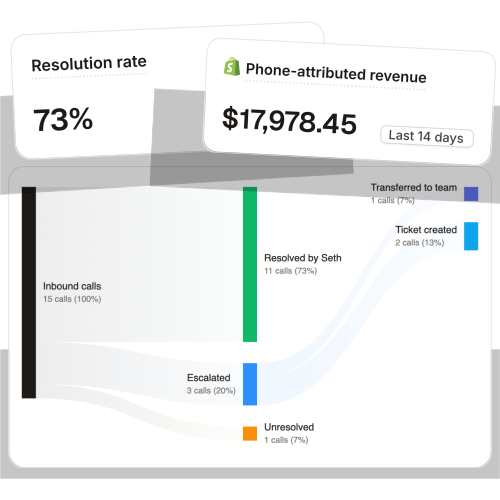
This is why we think about routing as automate-vs-escalate first, menus second. The cheapest routing win isn't a better tree. It's auto-resolving the 70% of calls that are the same questions over and over, so the only thing left to route is the genuinely hard 30%.
The five routing methods, and where each one fits
Most guides list routing types and stop there. Here's the short version plus where each one actually earns its place in a DTC support setup.
| Routing method | Routes calls based on | Best for | Watch-out |
|---|---|---|---|
| Skills-based | Issue type (WISMO, returns, product) | Sending the hard calls to the rep who can close them | Useless if 70% of calls are routine and shouldn't hit a rep at all |
| Time-based | Business hours vs after-hours | Closing the nights-and-weekends gap | Voicemail is not a routing destination |
| Location / language | Caller region or language | Multi-region brands, multilingual support | Adds menu friction if overused |
| Intent detection | What the caller actually wants | Replacing deep IVR menus | Needs an agent that understands the question, not just keywords |
| Overflow / round-robin | Spillover when the queue is full | The seasonal spike | Spillover to voicemail still loses the caller |
Skills-based routing is the one everyone reaches for, and it works: routing a call to a rep with the right context lifts first-call resolution by 15-25% (SQM Group). But here's the catch. Skills-based routing only matters for the calls a human should take, and for most DTC brands that's the minority of the volume. If you skills-route a WISMO call to your best rep, you've just used your most expensive resource on the cheapest question.
Intent detection is the modern replacement for the phone tree. Instead of "press 1 for orders, press 2 for returns," the agent asks what the caller needs and routes on the answer. That matters because the old menu is part of what callers hate. They want a person or an answer, not a maze.
The call-type routing blueprint: route the routine, escalate the rest
This is the part nobody else writes down. Here's how we'd actually route the common DTC call types, mapped to a destination instead of a menu number.
| Call type | Share of volume | Where it should route | Why |
|---|---|---|---|
| Where's my order (WISMO) | 30-50% | Auto-resolve | Pure lookup. A human adds nothing. |
| Returns and exchanges | 10-20% | Auto-resolve, escalate edge cases | Policy-driven, mostly scriptable |
| Product questions | 10-15% | Auto-resolve from your knowledge base | Same answers, all day |
| Subscription pause / cancel | 5-15% | Auto-resolve or custom action | High volume for subscription brands |
| Order placement (sales intent) | 5-10% | AI + SMS payment link | Caller wants to buy, don't lose them |
| Complaints / emotional | 5-10% | Hard-coded handoff to a rep | A person should take these, always |
| After-hours overflow | varies | Auto-resolve, never voicemail | The leak most stores never close |
The pattern is simple. The repeatable call types route to an AI phone agent that resolves them end to end, pulling the order from Shopify, checking order status, answering from your knowledge base, or sending an SMS payment link. The calls that need a human get a clean escalation to your team, with the context already attached.
This isn't theory. BioLongevity Labs, a supplement brand on Ringly, hits 79% resolution autonomously, which means roughly four in five callers never need a rep. That's what the blueprint looks like running live.
One more thing about the emotional calls. The instinct is to worry customers will hate getting an AI. In our experience the opposite happens on the routine calls. As Claudia Droge at TechCraft Studio put it:
"My customers also feel like it's a normal person. They feel like they can communicate if they have questions."
Claudia Droge, TechCraft Studio
The point of the handoff rule is that you decide where the line is. Grief, a serious complaint, a high-value account: those route straight to a person. Everything else gets resolved before it ever needs one.
The after-hours routing hole most stores never close
I called a handful of DTC store phone lines after 6 p.m. last week. Most of them rolled to voicemail. A couple just rang out. None of them got back to me.
That's the hole. For a lot of brands a big chunk of call volume lands outside staffed hours, and voicemail is where calls go to die. 80% of voicemail-routed callers hang up without leaving a message (Eden). And 78% of buyers abandon a brand after a single unanswered call (PCN). So the after-hours call isn't a deferred ticket. It's a lost customer and, often, a lost sale.
The routing rule is the boring one nobody implements: after-hours calls route to auto-resolve, not to voicemail. Your after-hours coverage stops being a backlog you'll never get to and starts being calls that actually get answered. The agent handles the WISMO, the returns question, the late-night reorder, and only pings your team in the morning for the few that need it. You get 24/7 phone coverage without staffing a night shift.
The revenue side is real, not hypothetical. WashCo, a Shopify brand we launched, recovered $22,664 in its first 7 days on the phone. A lot of that is calls that used to roll to voicemail.
What an AI routing layer costs vs hiring the next rep
Here's the math most teams skip. The alternative to routing the routine away from humans is hiring more humans to absorb it.
Take a typical $50M Shopify brand running a 6-rep CS team:
| Line item | Today | With Ringly |
|---|---|---|
| 6 reps x $4K loaded per rep | $24,000/mo | n/a |
| Ringly Enterprise (~$5K/mo) | n/a | $5,000/mo |
| Net monthly CS spend | $24,000/mo | $5,000/mo |
| Monthly savings | n/a | $19,000/mo |
| Annual savings | n/a | $228,000/yr |
That's roughly 70% of repeatable calls (order status, returns, product questions, the same five things over and over) routed to the AI. The other 30%, the genuinely complex calls, still go to your CS team, who now have time to actually solve them.
The per-call number tells the same story. An in-house rep runs about $2.70 per call loaded. Across our 50+ brands, a resolved call costs roughly $0.42, versus $7-$16 for human BPO. Routing the routine isn't a soft "efficiency" play. It's the difference between hiring rep #5 and not needing to.
Want to run your own numbers against your current setup? Book a 30-min call and we'll do the math live.
How to set up call routing without annoying your customers
You don't need to rip out your phone system. The setup that works is mostly about routing decisions, not infrastructure.
- Keep your existing number. Forward your current line to the AI agent. Caller ID stays the same and you don't migrate anything. If you're on a VoIP setup, see how the routing layer sits on your existing stack.
- Use intent over menus. Skip the deep phone tree. Let the agent ask what the caller needs and route on the answer instead of making them navigate options.
- Escalate cleanly to your helpdesk. Calls that need a human should hand off with context, creating a ticket in Gorgias or whatever helpdesk you already run. You decide what escalates.
- Set explicit business-hours rules. Define what happens during hours (route to the queue if needed) and after hours (auto-resolve, never voicemail). The after-hours rule is the one most stores forget.
- Measure resolution on the dashboard. Track what's getting resolved vs escalated so you can tighten the rules over time. Call analysis tells you which call types still need a human and which don't.
If you've been thinking about a full ecommerce call center build, this is the lighter path. You're not staffing a contact center. You're routing the routine away from the team you already have.
Frequently asked questions
What is call routing in ecommerce customer service? It's the set of rules that decide where each inbound call goes: auto-resolved by an AI agent, queued to a rep with the right skills, escalated to a human, or handled after-hours. For an ecommerce store, the routing decision that matters most is which call types a human should ever touch at all.
What's the best way to route WISMO calls? Auto-resolve them. "Where's my order" is 30-50% of DTC support contacts and it's a pure lookup, so routing it to a human wastes your most expensive resource on the cheapest question. An AI agent that checks order status in Shopify resolves it without a rep.
Should I use an IVR phone menu or AI intent detection? Intent detection, in most cases. Deep phone menus are part of what callers hate, and 60% hang up within a minute on hold. An agent that asks what the caller needs and routes on the answer removes the maze entirely.
How do I route after-hours and weekend calls? Route them to auto-resolve, not voicemail. 80% of voicemail-routed callers hang up without leaving a message, so the "we'll call back" plan loses most of them. An AI agent handling after-hours calls keeps the routine ones answered and flags only the few that need a person.
Does call routing work with Gorgias or my existing helpdesk? Yes. The routing layer sits in front of your helpdesk, not instead of it. Calls that need a human escalate cleanly and create a ticket in Gorgias, Richpanel, Re:amaze, or whatever you run, and you control what escalates.
How much can call routing reduce my support costs? For a 6-rep team at roughly $24,000/mo loaded, routing the repeatable 70% to AI typically nets around $19,000/mo in savings. Per call, a resolved call runs about $0.42 across our brands versus $2.70 for an in-house rep.
Talk to us

If you run a $10M-$100M Shopify brand and your phone rolls to voicemail after 6 p.m., a 30-minute call is the fastest way to see what that's costing you. We'll pull your real call patterns and map the routing for your store live.
The 3-layer guarantee.
- Live in 14 days or it's free until launched.
- 65% resolution in 90 days or we refund the last 3 months of subscription fees.
- We keep working free until we hit 65%.
Ruben (Ringly co-founder) takes these calls personally.