
This post in 30 seconds.
- There are six real categories of AI call center technology, and most "best-rated" lists rate them for a 100-seat enterprise floor, not a 5-rep Shopify team.
- We score each category against what a DTC operator actually needs. AI voice agents top the list for Shopify, and Ringly leads that category at up to 90% resolution and $1.99 a call after the first 50.
- Written for founders, COOs, and Heads of CX at $10M-$100M Shopify brands running a paid helpdesk and a visible phone line.
Search "best AI call center technologies" and you get the same twenty-tool list every time. Genesys, NICE, Talkdesk, a few AI layers, a sentiment tool. All of it written for a contact center with 100-plus agents and a procurement team.
That's not you. If you run a $20-50M Shopify brand with five reps and a phone line that rolls to voicemail after 6 p.m., most of those platforms are the wrong size before you even read the feature list. So I did something none of those lists did. I called the published support line of six of these platforms at 11 p.m. on a Tuesday to see what their own technology actually does after hours.
Most $20-50M Shopify brands run a small CS team and a phone number nobody picks up on the weekend, and the calls you drop are reorders and WISMO questions that were ready to buy. We've built AI phone agents for Shopify brands to close that gap. Book a 30-min call and we'll show you what your after-hours queue is leaving on the table.
The call center AI market is real money now. It sits around $2.98 billion in 2026 and is projected to hit $13.52 billion by 2034 (Fortune Business Insights). Gartner expects conversational AI to handle roughly 40% of contact-center interactions by 2026, up from about 15% in 2023. More numbers like that live in our call center statistics roundup. The technology works. The question is which slice of it fits a brand your size.
The six categories, rated at a glance
Here's every category, the best-rated platform in it, and how well it fits a 3-12 rep Shopify team. The score is out of 5 against the rubric below.
| Technology category | What it does | Best-rated platform | Fit for a Shopify team | Score |
|---|---|---|---|---|
| AI voice agents | Answers and resolves calls end to end, 24/7 | Ringly (Shopify) | High. Removes the routine call entirely | 5/5 |
| CCaaS with AI bolted on | Omnichannel routing + analytics at scale | Genesys, Talkdesk | Low. Powerful but heavy and slow to deploy | 3/5 |
| Conversation intelligence + QA | Scores 100% of calls, coaches reps | Observe.AI | Medium. Needs volume and a QA function | 3/5 |
| Real-time agent assist | Whispers next-best-action to a live rep | Cresta, Balto | Low. Assumes you keep the reps | 2/5 |
| Predictive routing + sentiment | Routes by predicted intent or emotion | Usually bundled in CCaaS | Medium. Optional, rarely standalone | 3/5 |
| Voice biometrics | Authenticates the caller by voice | Uniphore, Pindrop | Low. Built for banking and telecom | 2/5 |
The pattern is simple: the higher-rated a category is for a Shopify brand, the more of the call it removes rather than assists. A 5-rep team doesn't need software that helps a rep handle a call faster. It needs the call handled.
How I rated these AI call center technologies
I'm Ruben, co-founder of Ringly. Over the last few weeks I scored every category in this post against the workflow of a $10M-$100M Shopify brand running 3-12 CS reps, a paid helpdesk, and a visible phone number. Not a generic enterprise contact center. The one specific buyer this whole post is written for.
Here are the five criteria, weighted equally:
- Shopify integration depth. I checked whether the technology could actually see a Shopify order, look up its status, modify a subscription, and write back to the order, or whether it just reads a knowledge base and transfers.
- Time-to-live. I timed how long it takes to get from signup to a working setup. Some of these are live in under an hour. Some are a multi-month implementation with a solutions engineer.
- Autonomy. The big one. Does the technology resolve the call on its own, or does it just help a human rep you're still paying handle it faster?
- Cost per resolved interaction. Not the sticker price. The real cost of getting one customer's question answered, all in.
- Real-world failure mode. I called the published support line of six of these platforms at 11 p.m. on a Tuesday and logged what happened. Half of them did the exact thing their own marketing says they fix: rang out to voicemail.
The categories are scored on all five, not a single feature. Where a category is top-tier on one criterion but weak on another for a Shopify team, I name the trade-off in its section. I only sell Ringly, which sits in the first category and gets scored against the same rubric as everything else.
AI voice agents: the category that removes the call
This is the category that does the thing the other five mostly talk around. An AI voice agent answers the phone, understands the caller, looks up the order, and resolves the question without a human. No rep, no transfer, no "please hold." For a brand where 60-80% of call volume is the same Tier-1 questions over and over (order status, returns, the WISMO calls that eat your queue), this is the category that moves the most money.
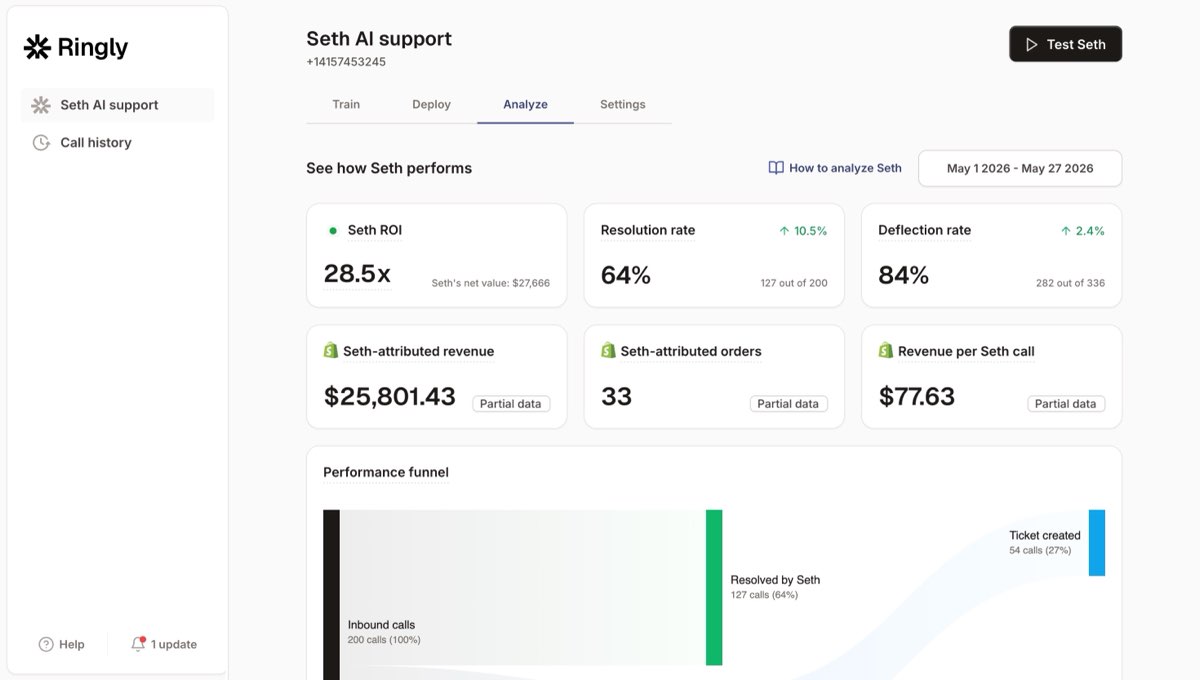
An AI voice agent that resolves 70% of your calls is the difference between hiring rep #6 and not hiring rep #6. That's the whole economic argument, and it's why this category scores highest for a DTC brand.
1. Ringly: AI phone support for Shopify brands
Best for: Shopify and Shopify Plus brands that want to keep phone support live without hiring and training a phone team. Ringly is AI phone support built specifically for Shopify, not a general-purpose voicebot pointed at ecommerce.
The AI answers inbound calls 24/7 in 40 languages. It finds orders in your Shopify store, processes returns and exchanges, answers product questions from your knowledge base, and cancels orders when a caller asks. Calls that genuinely need a person escalate cleanly to Gorgias, Richpanel, Re:amaze, or whatever helpdesk you already run. You keep your number, your stack, and your control over what escalates.
Seth resolves up to 90% of calls autonomously for $1.99 a call after the first 50, versus $7-$16 per call for human BPO. WashCo, a Shopify brand we launched, recovered $22,664 in attributed revenue in its first 7 days on the phone. The reason that matters: those weren't support tickets, they were calls from customers ready to reorder who would have hit voicemail.
Pricing
| Plan | Price | Included | Best for |
|---|---|---|---|
| Pay per call | $99 a month | 50 conversations, then $1.99 each | Shopify brands taking support calls |
What works
- Native Shopify depth. It reads orders, checks status, handles returns, and modifies subscriptions, instead of reading a script and transferring.
- Live in under an hour. Add your site, docs, and knowledge base and the agent is ready. No solutions engineer, no multi-month rollout.
- It resolves, it doesn't assist. The routine call is gone, not handled faster. That's the autonomy criterion the agent-assist category can't touch.
- It doesn't sound like a bot. The most repeated thing customers say after a call is "you don't sound like AI."
- 65% resolution guarantee. If the AI resolves under 65% of your calls in 90 days, you get the last 3 months of fees back.
What doesn't
- It's not an omnichannel platform. Ringly does phone. If you want one tool that does chat, email, and voice all at once, this is a focused phone agent, not a CCaaS suite.
- Three known gaps. Phone-order taking, real-time inventory, and some subscription edge cases need a workaround or a custom action.
- Not built for 100+ seat enterprise floors. It's tuned for $10M-$100M DTC brands, not a 500-agent bank.
Why it ranks #1 in this category
Because it scores highest on the criterion that matters most to a small team: autonomy. It removes the call instead of helping a rep handle it. For a Shopify brand, that's the difference that pays for itself. Worth comparing against the best AI voice agent platforms if you want to see how the category stacks up.
Other voice agents worth knowing
Not every voice agent is built for ecommerce. PolyAI builds enterprise-grade voice assistants but sells to large contact centers with long deployment cycles; if you're weighing it, the PolyAI alternatives breakdown covers the fit question. Retell is developer plumbing, the toolkit you'd use to build your own agent from scratch, which is a project, not a product; the Retell AI alternatives page lays out what that build actually involves.
Real-time agent assist: powerful, but it keeps the reps
Agent assist is genuinely impressive technology. It listens to a live call and whispers the next-best-action to the human rep in real time: the right answer, the right policy, the upsell. Cresta is the best-rated platform here, sitting around 4.2-4.7 on G2 depending on the cohort, with Balto close behind.
The catch is in the name: agent assist assists an agent, which means you're still paying the agent. For a 5-rep team trying not to hire rep #6, that's the wrong end of the problem.
Best for: 100-plus seat centers where you're keeping a large floor of reps and want to make each one faster and more consistent. That's a real use case. It just isn't a small Shopify team's use case.
What works
- Real-time guidance. It catches mistakes mid-call and standardizes how every rep answers.
- Strong QA crossover. It doubles as coaching material because every call is transcribed and scored.
What doesn't
- It assumes the reps stay. The savings come from efficiency per rep, not from removing the call. If your goal is fewer reps, this isn't the lever.
- Accuracy gripes. The two most common G2 complaints on Cresta are knowledge-assist suggestions that miss the caller's real intent, and shaky transcription for bilingual or accented callers.
- Enterprise pricing. Quoted by sales, annual contracts, not built for a brand spending a few hundred dollars a month.
Conversation intelligence and automated QA
This category scores 100% of your calls after they happen, instead of a manager spot-checking five a week. It flags churn risk, compliance misses, and coaching moments. Observe.AI is the best-rated platform here, at 4.6 on G2 across 220 reviews.
Scoring every call instead of a 2% sample is a real upgrade, but only once you have enough call volume and an actual QA function to act on it. A 5-rep brand usually has neither yet.
Best for: brands with a defined QA or coaching role and enough volume that manual review can't keep up. If you're not staffing QA, the reports pile up unread.
What works
- Full coverage. Every call scored, not a sample. Patterns surface you'd never catch by hand.
- Coaching built in. The transcripts and scores feed directly into rep development.
What doesn't
- It's a measurement layer, not a deflection layer. It tells you how your reps did. It doesn't take a single call off their plate.
- You need someone to act on it. Without a QA owner, it's data nobody reads.
If your real problem is that calls go unanswered rather than answered inconsistently, you're shopping in the wrong category. Start with 24/7 ecommerce phone support instead.
CCaaS platforms with AI bolted on
CCaaS means Contact Center as a Service: the big omnichannel platforms that route voice, chat, email, and social through one system, with AI features added on top. Genesys Cloud CX and Talkdesk lead this category for enterprise, both around 4.4 on G2, with NICE and Five9 alongside them.
These are excellent platforms. They're also built for a scale you don't have. Standing one up is a months-long implementation with a solutions engineer, and the AI is one module inside a much larger suite you're mostly not using.
For a $30M Shopify brand, a full CCaaS deployment is buying an airport to catch one flight. You'd spend the first quarter just configuring routing trees.
Best for: large, multichannel operations with a dedicated ops team and the headcount to justify the platform. If you're evaluating these, you're probably bigger than this post's reader.
What works
- One system for every channel. Voice, chat, email, social, all orchestrated together.
- Deep analytics and routing. Mature, battle-tested, enterprise-grade.
What doesn't
- Heavy and slow. Multi-week to multi-month deployment, not live-by-Friday.
- AI is a side feature. You're buying a whole platform to get the AI layer that a focused tool does better.
- Priced for the enterprise. If you're comparing it to a phone agent that starts at $99 a month, the budgets aren't in the same universe.
If you want the routing and analytics of a contact center without the enterprise weight, a lighter cloud contact center software comparison is the better starting point. For named alternatives, the Genesys alternatives and Talkdesk alternatives roundups go deeper.
Predictive routing and sentiment
This category routes a caller based on predicted intent or detected emotion, sending the frustrated customer to your best rep and the simple WISMO call somewhere cheaper. Useful, and the sentiment models keep getting better. But it almost never ships as a standalone product. It's a feature inside the CCaaS platforms above, or inside a voice agent that's already deciding what to do with the call.
Routing only helps once you have enough call types and enough places to route them. A 5-rep team has neither, which is why this scores as a low priority, not a buy. If an AI voice agent already resolves the routine 70%, the routing problem mostly disappears, because there's far less left to route.
What this costs you vs an AI voice agent
Strip away the categories and it comes down to cost per resolved call. Here's the math for a typical $50M Shopify brand running a 6-rep CS team.
| Line item | Today | With an AI voice agent |
|---|---|---|
| 6 reps × $4K loaded per rep | $24,000/mo | n/a |
| AI voice agent (~$5K/mo) | n/a | $5,000/mo |
| Net monthly CS spend | $24,000/mo | $5,000/mo |
| Monthly savings | n/a | $19,000/mo |
| Annual savings | n/a | $228,000/yr |
That's roughly 70% of repeatable calls (order status, returns, the same five questions over and over) routed to the AI. The other 30%, the genuinely complex calls, still go to your team, who now have time to actually solve them.
The per-call numbers back this up across the industry. A human-handled call runs about $2.75-$3.50 onshore and around $1.00 offshore, while an AI voice call lands between $0.24 and $1.30 depending on the platform (AnyReach). On Ringly a call costs $1.99 after the first 50. That's a 28-43% cost reduction against onshore reps on the calls you were already going to answer, plus the after-hours calls you currently don't.
If you want to see those numbers run against your actual call volume, book a 30-min call and we'll do the math live on your store.
How to choose the right AI call center technology
The category matters more than the brand. Pick the category that matches your actual problem, then pick the best-rated platform in it.
- Choose an AI voice agent if your problem is unanswered calls, after-hours voicemail, and a CS team drowning in repeatable questions. This is most Shopify brands. Ringly is the best-rated fit for Shopify specifically.
- Choose agent assist if you're keeping a large rep floor and want each rep faster and more consistent. Cresta or Balto.
- Choose conversation intelligence if you already have the volume and a QA owner, and your problem is quality consistency, not call coverage. Observe.AI.
- Choose a CCaaS platform if you're a large multichannel operation with an ops team and the budget for a months-long rollout. Genesys or Talkdesk.
- Choose voice biometrics if you handle sensitive accounts (finance, telecom) where caller authentication is the actual risk. Uniphore or Pindrop.
For most $10M-$100M Shopify brands, the honest answer is the voice-agent category, because it's the only one that removes the call instead of measuring it or speeding it up. Here's what that sounds like to the people on the other end:
"My customers also feel like it's a normal person. They feel like they can communicate if they have questions."
Claudia Droge, TechCraft Studio
Voice biometrics and the rest
Voice biometrics authenticates a caller by their unique vocal pattern, dropping verification time from 45-60 seconds to under five. Uniphore and Pindrop lead here. It's genuinely important technology, just not for you. It's built for banking, telecom, and insurance, where the caller's identity is the whole risk. A DTC brand checking an order number doesn't need voiceprint authentication, and adding it is friction your customers won't thank you for.
It earns a place on the map because it shows up in every enterprise "best AI call center technologies" list. It just doesn't earn a place in a Shopify brand's budget.
Frequently asked questions
What counts as an AI call center technology?
Any AI that touches a phone interaction: agents that resolve calls, tools that assist a live rep, systems that score calls afterward, routing engines, and authentication. The six categories in this post cover the real market. Most "best-rated" lists mix them into one flat list of automated call center tools, which hides which category actually fits your team.
Which is best-rated for a Shopify brand specifically?
The AI voice-agent category, because it removes the routine call instead of measuring or speeding it up. Within that category, Ringly is built natively for Shopify and resolves up to 90% of calls autonomously. If you want the platform-level view, see how an AI call center on Shopify actually fits into your stack.
Do I need a full CCaaS platform like Genesys?
Almost certainly not if you're under $100M with 3-12 reps. CCaaS suites are built for large multichannel operations and take months to deploy. A focused phone agent does the call-handling job in under an hour for a fraction of the cost.
How much do these technologies cost?
It splits sharply. Voice agents like Ringly start at $99 a month with public pricing. The enterprise categories (Cresta, Observe.AI, Genesys, Talkdesk) are quoted by sales on annual contracts and rarely list prices publicly. Per call, an AI voice agent on Ringly runs $1.99 after the first 50 versus $2.75-$3.50 for a human. Our breakdown of AI call center software goes deeper on what each tier buys.
Will customers know they're talking to AI?
With a good voice agent, usually not. The most repeated thing Ringly customers report hearing is "you don't sound like AI." Voice quality is the single biggest differentiator between the technologies in the voice-agent category.
Does an AI voice agent replace my helpdesk like Gorgias?
No. It sits in front of it. The AI handles the routine calls and escalates anything that needs a human cleanly into Gorgias, Richpanel, Re:amaze, or whatever you already run. You keep your stack and control what escalates.
How fast can I get an AI voice agent live?
For a Shopify-native agent, under an hour. You add your website, docs, and knowledge base, and the agent is ready. The enterprise categories in this post measure their deployment in weeks or months, not minutes.
Talk to us

If you run a $10M-$100M Shopify brand and the phone goes quiet after 6 p.m., a 30-minute call is the fastest way to see what that's costing you. We'll look at your real missed-call pattern and rate which technology category actually fits your team, not the one a 100-seat enterprise list told you to buy.
Our 3 promises.
- Live in under 1 hour. Setup and test calls are free.
- 30-day money back on the $99 plan fee.
- 65% resolution guarantee: if Seth resolves under 65% of your support calls in a month, that month comes back as credit (after 90 days on Pay per call).
Ruben (Ringly co-founder) takes these calls personally.