


Uniphore has built a solid reputation in the conversational AI space.
The $2.5 billion unicorn offers enterprise-grade features like real-time agent assist, emotion detection, and automated QA. But it's not the right fit for everyone.
The platform's complexity, lengthy deployment cycles, and enterprise-focused pricing push many teams to look elsewhere.
Whether you need something more affordable, easier to implement, or better suited for your specific use case, there are compelling alternatives worth considering.
Let's break down the seven best Uniphore alternatives for 2026, comparing what each does well and where they fall short.
Editor’s note: Want to hear some sample AI support calls made for your Shopify store?
- Just paste your store URL
- Hear sample calls for your store (no email required)
- Listen to demo calls for my store
What is Uniphore?
Uniphore is an American software company that develops AI platforms for business use. Their flagship offering combines real-time agent guidance, conversation analytics, emotion detection, and automated quality assurance into one enterprise platform.
The tool works best for large contact centers that need sophisticated conversational AI to analyze customer interactions, support agents during live calls, and automate quality workflows. It handles voice, video, and text channels while offering deep customization for complex enterprise needs.
Here's the catch: all that power comes with trade-offs. Implementation requires significant technical resources and time. Pricing sits at enterprise levels, often requiring custom quotes. And the real-time guidance, while powerful, can feel rigid compared to newer adaptive platforms.
For teams that don't need the full enterprise stack, or those wanting faster deployment, alternatives often make more sense.
How we evaluated these Uniphore alternatives
We looked at platforms that compete directly with Uniphore's core strengths: real-time agent assistance, conversation intelligence, and QA automation. Each alternative was assessed on:
- Real-time guidance capabilities and flexibility
- QA automation and compliance features
- Analytics depth versus actionability
- Ease of deployment and maintenance
- Integration ecosystem
- Pricing transparency and value
The list includes options for large enterprises needing full-suite solutions, mid-market teams wanting faster deployment, and specialized tools for specific use cases.
Top 7 Uniphore alternatives compared
| Platform | Real-time assist | Automated QA | Emotion AI | Pricing | Best for |
|---|---|---|---|---|---|
| NICE | ✅ | ✅ | ✅ | Contact sales | Large enterprise |
| Verint | ✅ | ✅ | ✅ | Contact sales | Enterprise WFO |
| Balto | ✅ | ✅ | ❌ | Contact sales | Mid-market guidance |
| Observe.AI | ✅ | ✅ | ❌ | Contact sales | QA-focused teams |
| Talkdesk | ✅ | ✅ | ❌ | From $25/agent/mo | All-in-one CCaaS |
| Cresta | ✅ | ❌ | ❌ | Contact sales | Sales teams |
| Level AI | ❌ | ✅ | ❌ | Contact sales | Advanced analytics |
The best Uniphore alternatives for 2026
1. NICE

NICE offers one of the most comprehensive alternatives to Uniphore with its CXone platform powered by Enlighten AI. The platform combines real-time agent assist, automated quality management, and workforce optimization into a unified ecosystem.
Key features:
- Enlighten AI-powered interaction analytics across voice and digital channels
- Automated QA scoring and compliance monitoring at high volume
- Real-time agent assist with next-best-action recommendations
- Workforce and service optimization tools within the CXone suite
- Extensive CCaaS, CRM, and ecosystem integrations
Pros:
- One of the most comprehensive analytics and QA automation platforms available
- Strong real-time guidance with deep automation capabilities
- Highly scalable for global, multi-site operations
- Unified ecosystem that consolidates multiple point solutions
Cons:
- More complex and resource-intensive than standalone AI tools
- Can be expensive for mid-market or fast-growing teams
- Longer implementation cycles compared to lighter platforms
- Real-time assist may require specific modules and configuration
Pricing: Enterprise pricing requires contacting sales. No public pricing available.
Best for: Large, enterprise contact centers needing a full-suite AI, QA, and analytics platform with deep automation and scalability.
2. Verint
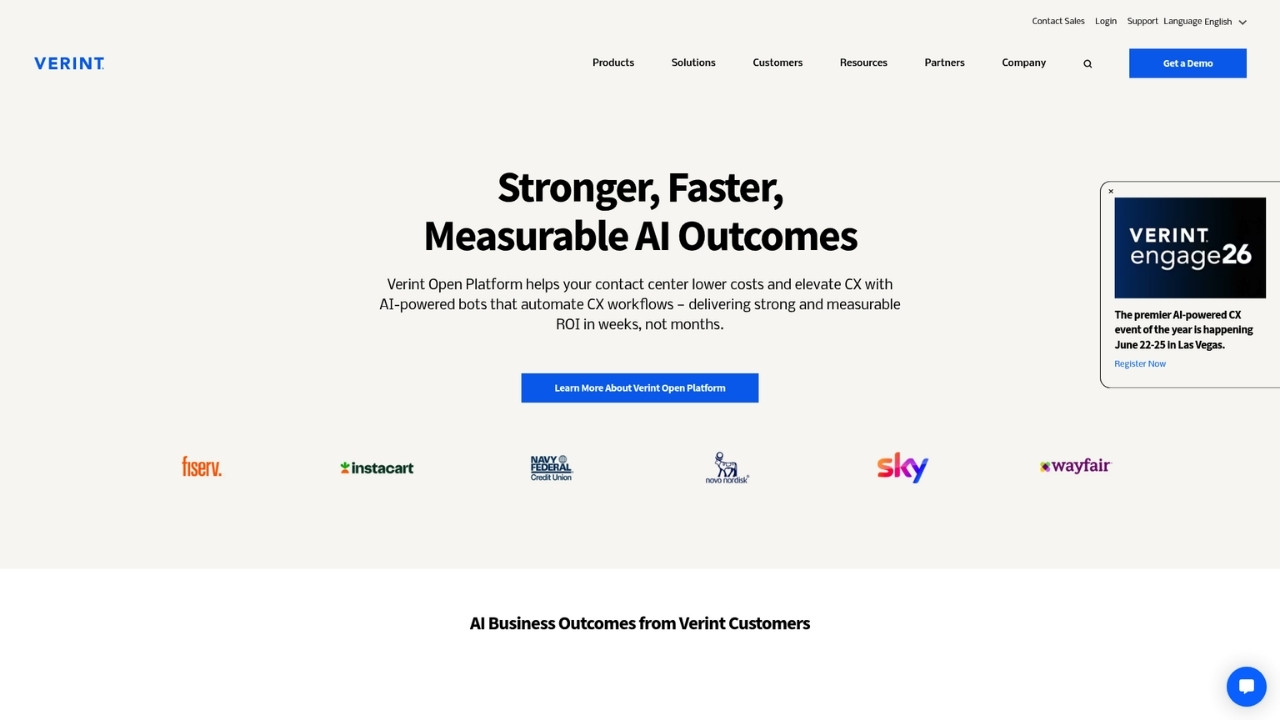
Verint combines behavioral intelligence technology with workforce optimization to deliver a powerful mix of analytics, automated QA, and real-time coaching. The platform emphasizes measurable AI business outcomes delivered in weeks, not months.
Key features:
- Automated QA scoring and compliance workflows across large call volumes
- Cogito-powered real-time behavioral cues that detect tone, stress, and empathy levels
- Advanced interaction analytics with trend and root-cause insights
- Workforce optimization tools for forecasting, scheduling, and performance management
- Enterprise-grade integrations across CCaaS, CRM, and WEM systems
Customer outcomes:
- A bank saved $10M by containing 10M interactions with 80% containment rate
- A health insurance company reduced AHT by 50%
- A telecom company achieved $5M annual savings through proactive outreach
Pros:
- Best-in-class behavioral guidance and emotional intelligence modeling
- Highly scalable QA and analytics for large global centers
- Strong coaching and performance management workflows
- Deep WFO/WEM capabilities beyond conversational AI
Cons:
- More complex and costly than lighter-weight agent-assist platforms
- Real-time guidance focuses on behavior rather than process workflows
- Implementation requires significant configuration and enterprise coordination
Pricing: Enterprise pricing requires contacting sales.
Best for: Enterprises wanting behavioral real-time coaching plus automated QA and analytics within a mature WFO ecosystem.
3. Balto
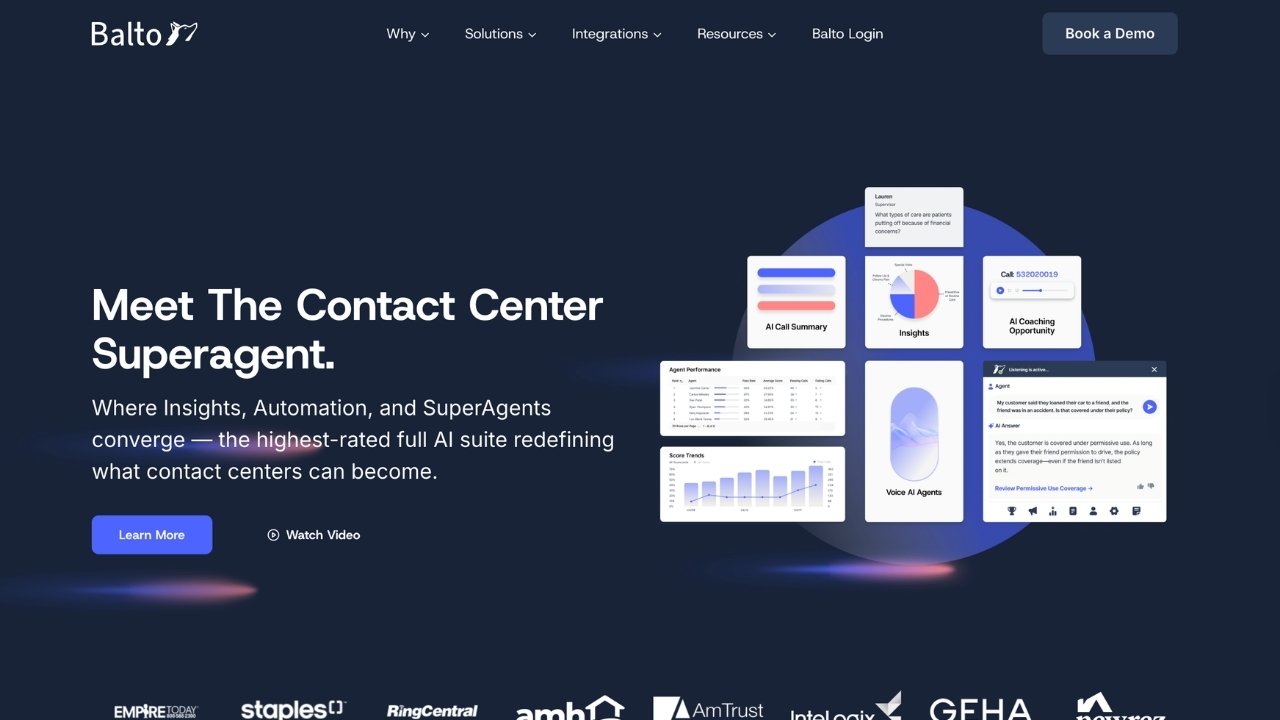
Balto focuses on real-time agent guidance with adaptive prompts that adjust instantly to customer conversations. The platform is known for faster deployment and easier maintenance compared to enterprise-heavy solutions like Uniphore.
Key features:
- Real-time dynamic prompts and next-best-action workflows
- Automated QA scoring and compliance monitoring
- AI-driven post-call summaries and coaching insights
- Agent assist for voice and digital channels
- Integrations with major CCaaS and CRM platforms
Pros:
- Delivers more adaptive real-time guidance than Uniphore
- Faster to deploy and easier to maintain across large teams
- Strong automated QA functionality out of the box
- Improves consistency and first-call resolution immediately
Cons:
- Not designed for emotion detection or multimodal analysis
- Less suited to extremely complex enterprise orchestration use cases
- Not a full WFO/WEM or CCaaS suite
Pricing: Contact sales for pricing. No public tiers available.
Best for: Contact centers needing highly flexible real-time guidance and automated QA that improve performance during every interaction.
4. Observe.AI
Observe.AI offers a next-generation GenAI-powered conversation intelligence platform with VoiceAI Agents, Real-time AI, and Post-interaction AI products. The platform serves 350+ customers including Signify Health, DailyPay, and Accolade.
Key features:
- VoiceAI Agents for natural caller conversations
- Real-time AI agent assist with contextual tools
- Post-interaction AI for Auto QA and performance coaching
- Conversation intelligence analyzing 100% of interactions
- Screen recording for compliance and coaching
Pricing plans:
| Plan | Focus | Best For |
|---|---|---|
| VoiceAI Agents | AI-powered caller conversations | Scale capacity, improve CX, boost revenue |
| Real-time AI | Agent assist tools | Reduce AHT, improve FCR, boost productivity |
| Post-interaction AI | Auto QA and coaching | Improve compliance and operational efficiency |
| Enterprise Advanced | Real-time + Post-interaction plus insights | Enterprise-wide impact |
| Enterprise Unlimited | All features plus summarization and knowledge AI | Maximum capabilities |
Recognition:
- Leader in CMP Report for Real-Time Agent Assist & Copilot
- Strong Performer in Forrester Wave for Real-Time Revenue Execution Platforms
- Leader in Speech Analytics and Conversation Intelligence on G2
Pros:
- Powerful QA automation and conversation intelligence
- Multiple product tiers for different needs
- Strong recognition from analyst firms
- Serves 350+ enterprise customers
Cons:
- Pricing requires contacting sales
- Some advanced features only in top tiers
- May be overkill for smaller teams
Best for: Contact centers needing powerful, scalable QA automation and post-call analytics without the complexity of a full enterprise conversational AI platform.
5. Talkdesk

Talkdesk is a cloud contact center (CCaaS) platform with integrated AI capabilities for automation, self-service, analytics, and real-time agent assistance. Unlike standalone AI tools, Talkdesk offers a unified approach built directly into its ecosystem.
Key features:
- AI-powered Agent Assist with contextual recommendations
- Automated QA and scoring through Talkdesk Quality Management AI
- Virtual agents for voice and digital channels
- Workflow automation and orchestration with Talkdesk Studio
- Analytics dashboards across CX, QA, and operational performance
- Deep integrations with CRM, ticketing systems, and back-office apps
Pros:
- Strong all-in-one CCaaS platform with built-in AI and automation
- Easier and faster to deploy compared to standalone enterprise AI stacks
- Solid real-time assistance and QA automation capabilities
- Flexible workflow automation for routing, escalations, and processes
Cons:
- Emotion AI and behavioral modeling are not as advanced as Uniphore
- Real-time guidance is less adaptive than specialized tools like Balto
- Some analytics require add-on modules to reach Uniphore-level depth
Pricing: Starts at $25 per agent per month. Enterprise pricing available on request.
Best for: Teams that want a modern CCaaS platform with integrated AI for routing, automation, QA, and real-time agent support.
6. Cresta
Cresta is an AI agent-assist and coaching platform that delivers real-time guidance, automated summaries, and performance insights. The platform focuses on sales and service teams with a modern, flexible user experience.
Key features:
- Real-time coaching and next-best-action recommendations
- Automated call summaries and after-call work reduction
- Performance analytics and coaching dashboards
- AI-powered playbooks for sales, support, and service agents
- Integrations with leading CCaaS and CRM platforms
Recognition:
- Named a Leader in The Forrester Wave: Conversation Intelligence Solutions for Contact Centers, Q2 2025
Pros:
- Strong real-time guidance with a more flexible UX than Uniphore
- Automated summaries streamline agent wrap-up
- Easier to deploy and manage than enterprise-heavy AI platforms
- Effective coaching tools for improving agent behavior
Cons:
- Limited or no emotion detection compared to Uniphore
- Not as robust in QA automation as Observe.AI or Balto
- Less suited for complex enterprise workflow orchestration
Pricing: Contact sales for pricing information.
Best for: Teams wanting modern real-time coaching and automated summaries without the complexity of an enterprise-scale AI stack.
7. Level AI
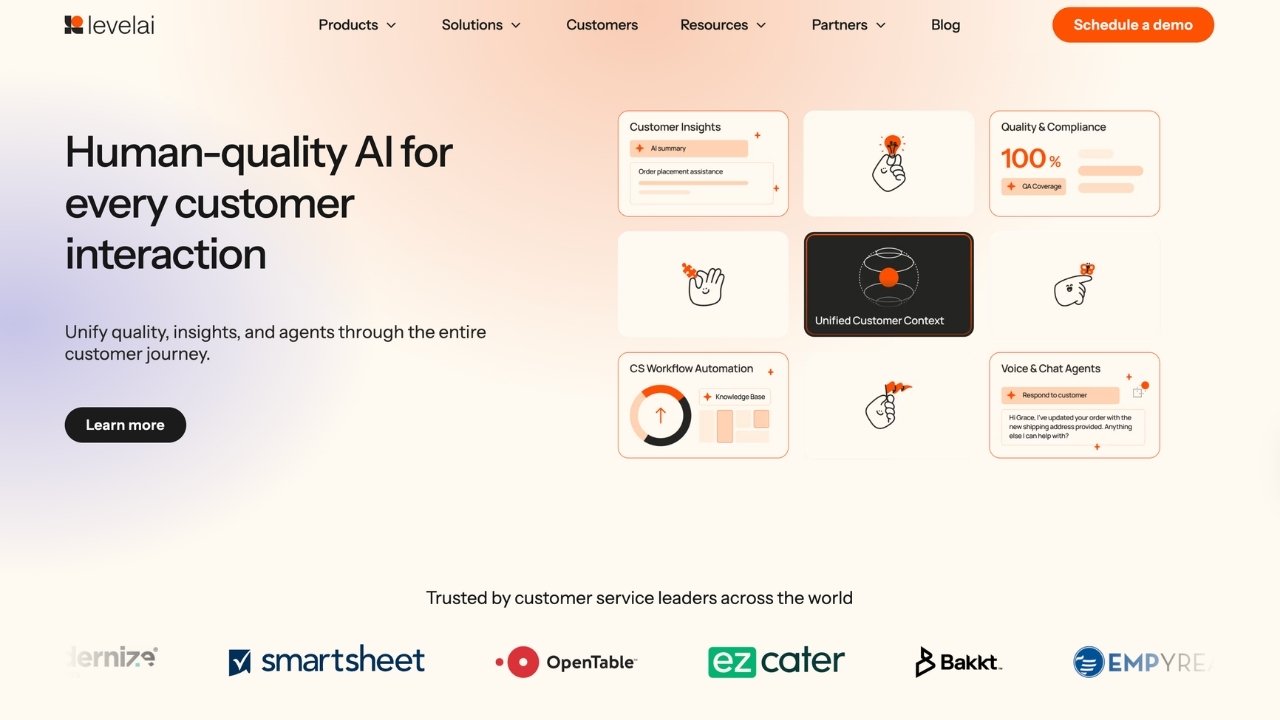
Level AI provides human-quality AI for customer interactions using generative AI and semantic intelligence. The platform unifies quality, insights, and automation across the customer journey. Notable customers include Carta and Grubhub.
Key features:
- Generative AI for conversation intelligence
- Semantic tagging with 82%+ accuracy on intent classification
- Near-human accuracy auto-scoring for QA
- AI coaching with agent-specific personalization dashboards
- Screen recording for visual QA context
Customer outcomes:
- 5x faster QA evaluations
- 30% decrease in agent churn
- 100% visibility into Voice of Customer insights
- 25% increase in CSAT scores
- 20% increase in contact center efficiency
Pros:
- State-of-the-art generative AI technology
- High accuracy on semantic tagging and intent classification
- Comprehensive QA automation
- Strong focus on actionable insights
Cons:
- No real-time agent assist (post-interaction focus)
- Newer entrant with smaller market presence
- Pricing not publicly disclosed
Pricing: Contact sales for pricing.
Best for: Teams wanting advanced generative AI analytics, semantic tagging, and comprehensive QA automation rather than live agent support.
Which Uniphore alternative should you choose?
The right choice depends on your specific needs and constraints.
Choose NICE or Verint if: You run a large enterprise contact center with complex requirements, need deep workforce optimization, and have the resources for a comprehensive implementation. Both offer the most complete feature sets but require significant investment.
Choose Balto or Cresta if: You want modern, adaptive real-time guidance without the enterprise complexity. These platforms deploy faster and focus specifically on improving agent performance during live conversations.
Choose Observe.AI or Level AI if: QA automation and conversation analytics are your priorities. Both excel at analyzing interactions and providing coaching insights, with Level AI offering particularly advanced generative AI capabilities.
Choose Talkdesk if: You want an all-in-one CCaaS platform with integrated AI rather than adding a standalone AI layer to your existing stack. The unified approach simplifies deployment and management.
Getting started with AI phone support
Switching from Uniphore or choosing your first conversational AI platform requires careful planning. Start by identifying your biggest pain points: Is it agent performance? QA efficiency? Customer satisfaction? Compliance?
Run a pilot program with one team before rolling out across your entire operation. Look for solutions that offer clear ROI metrics and don't require months of implementation.
If you're running a Shopify store and need AI phone support specifically designed for e-commerce, consider Ringly.io. the AI, our AI phone agent, handles order lookups, returns, and customer questions 24/7 while escalating complex issues to your team. Most stores go live within an hour, not months.
Frequently Asked Questions
What are the best Uniphore alternatives for small businesses?
For smaller teams, Talkdesk offers transparent pricing starting at $25 per agent per month. Balto and Cresta also cater to mid-market teams with faster deployment than enterprise-focused platforms.
Which Uniphore alternative offers the best real-time agent guidance?
Balto is widely regarded for its adaptive real-time guidance that adjusts instantly to customer conversations. NICE and Verint also offer strong real-time capabilities but with more enterprise complexity.
Are there any free alternatives to Uniphore?
Most enterprise conversational AI platforms do not offer free tiers. However, some alternatives like Tidio offer free plans for basic chat functionality, though these are not direct replacements for Uniphore's full feature set.
Which Uniphore alternative is best for QA automation?
Observe.AI and Level AI both excel at QA automation. Observe.AI offers Auto QA with post-interaction analysis, while Level AI provides near-human accuracy auto-scoring using generative AI.
How do Uniphore alternatives compare on pricing?
Most alternatives follow similar enterprise pricing models requiring custom quotes. Talkdesk is one of the few with publicly listed pricing starting at $25 per agent per month. According to Level AI's research, Uniphore pricing runs approximately $35 per agent plus $1,500 per integration plus platform fees.
Can I switch from Uniphore to one of these alternatives easily?
Migration complexity depends on your current setup and the alternative you choose. Platforms like Balto and Talkdesk are known for faster deployment than traditional enterprise solutions. Plan for data migration, integration reconfiguration, and agent retraining regardless of which platform you select.