


If you're running an eCommerce business on Avaya, you've probably received the memo by now.
Avaya's 200-seat minimum for its AXP cloud service became mandatory on June 30, 2025.
For a company with 50 support agents, that means paying for 150 seats you'll never use.
This isn't a minor policy tweak. Avaya has filed for bankruptcy twice since 2017, sunset core products like voice recording and SIP trunking earlier this year, and now essentially told SMBs and mid-market businesses: we're not building for you anymore.
Their cloud UCaaS is powered by RingCentral, not developed in-house, which raises questions about long-term product direction.
The good news? There are better options built specifically for how ecommerce businesses actually operate.
This guide covers 7 alternatives evaluated for online retail use cases, with transparent pricing, no arbitrary seat minimums, and modern features like AI automation that Avaya lacks.
Editor’s note: Want to hear some sample support calls made for your Shopify store?
- Just paste your store URL
- Get sample calls in under 20 seconds (no email required)
- Listen to demo calls for my store

Why ecommerce businesses are leaving Avaya
The question "What is the Avaya controversy?" keeps coming up, and the answer involves more than just the seat minimum.
The 200-seat minimum enforcement hit hardest.
Effective June 30, 2025, any organization using Avaya's AXP cloud contact center must commit to at least 200 seats. If you have a 30-person support team, you're paying for 170 ghost agents every month.
Product sunsetting accelerated throughout 2025. Voice recording ended March 25. SIP trunking and Communication APIs/CPaaS both sunset April 28. These aren't minor features for ecommerce operations that depend on call recording for quality assurance and custom integrations for order tracking.
Business stability concerns remain. Two bankruptcy filings since 2017 have eroded trust. When your communications platform might not exist in three years, planning becomes difficult.
The on-premises burden still exists. Traditional Avaya deployments require hardware maintenance, dedicated IT staff, and 3-6 month implementation timelines. That's a problem when your store needs to scale for Black Friday in three weeks, not three months.
For ecommerce specifically, these issues compound. Online stores need flexible support that handles seasonal spikes without being locked into seat minimums that assume static call volume year-round.
What to look for in an Avaya alternative for ecommerce
Before comparing platforms, here's what actually matters for online retail support operations.
No seat minimums. Your support team might be 10 people in January and 40 people in December. Platforms that force you to pay for unused seats don't understand ecommerce.
Ecommerce integrations. Native connections to Shopify, WooCommerce, or your order management system mean agents (human or AI) can actually look up orders without copying and pasting between five different windows.
Omnichannel support. Customers reach out via phone, chat, email, SMS, and WhatsApp.
Managing these in separate systems creates gaps.
AI and automation capabilities. Conversation intelligence, automated responses, and smart routing reduce the volume that reaches human agents.
Pricing transparency. If you need a sales call to find out what something costs, budget planning becomes guesswork.
Deployment speed. Cloud alternatives should go live in hours to weeks.
If implementation takes months, you're buying yesterday's technology.
Uptime SLAs. 99.9% minimum is table stakes for ecommerce reliability.
Downtime during peak sales hours is expensive.

These factors matter most when your support volume spikes 300% during peak sales
7 best Avaya alternatives for ecommerce in 2026
Here's how these platforms stack up for online retail operations.
1. Ringly.io
Best for: Shopify and ecommerce stores wanting AI-first phone support with deep store integration.

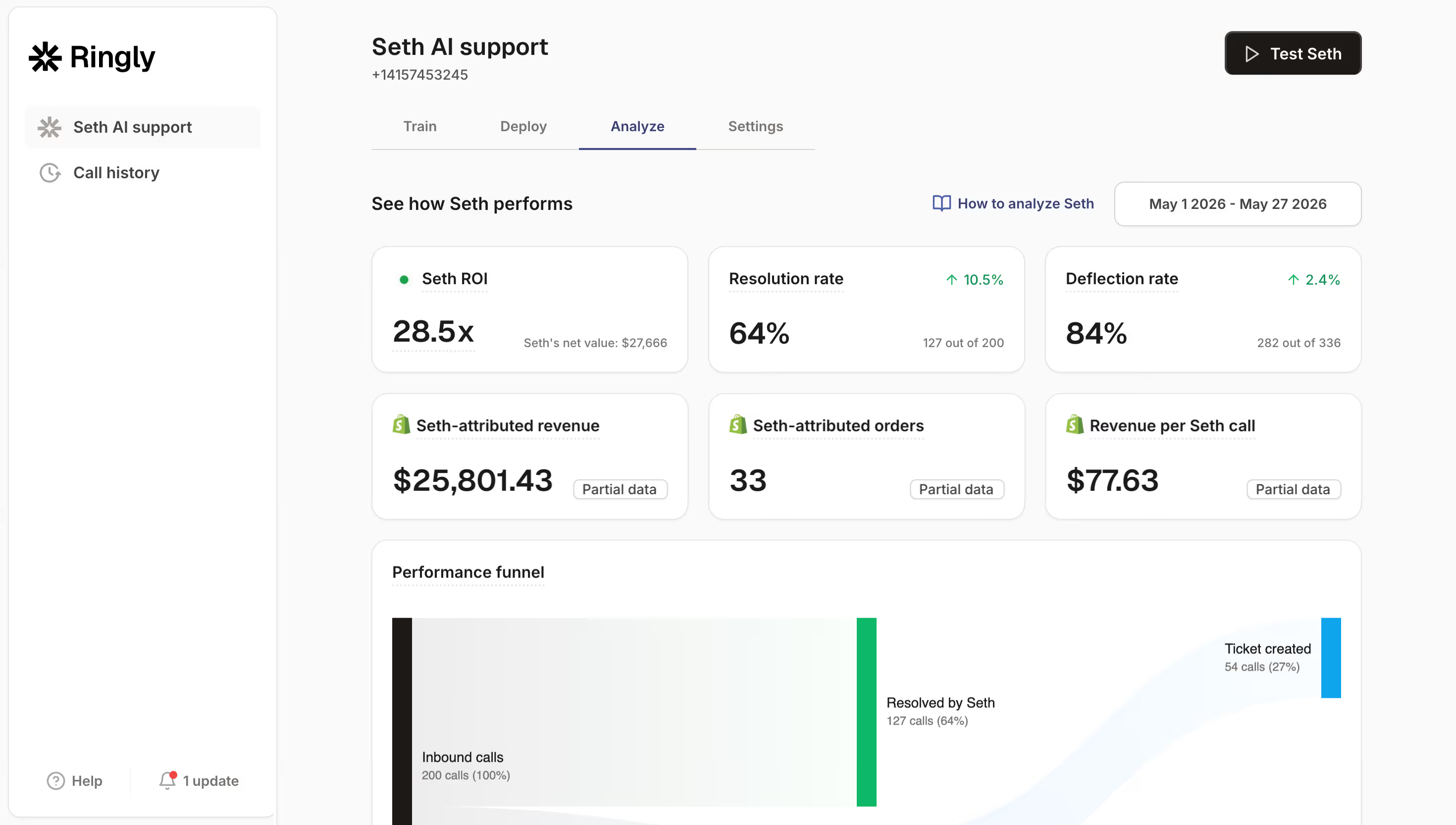
A screenshot of Ringly.io's landing page.
Ringly.io takes a different approach than traditional contact center platforms.
Instead of helping you manage human agents more efficiently, their AI phone agent The AI handles inbound calls directly. the AI answers questions, looks up orders, processes returns, and only escalates to your team when necessary.
This isn't a basic IVR or chatbot. the AI actually resolves 70-73% of calls without human intervention across the Shopify stores currently using the platform.
For ecommerce stores where most calls are "where's my order?" or "how do I return this?", that automation rate translates to significant cost savings.
Key ecommerce features:
- Native Shopify integration pulls order data, product info, and customer history automatically
- 40+ language support for global stores
- Automated returns and exchanges processing
- Knowledge base uploads for products and policies
- 3-minute no-code setup
Pricing:
| Plan | Monthly Price | Minutes Included | Overage Rate | Best For |
|---|---|---|---|---|
| Grow | $349 | 1,000 | $0.19/min | Growing brands needing full Shopify write-access. |
| Enterprise | Custom | 5,000+ | $0.19/min | High-volume enterprises with custom integration needs. |
Overage minutes run $0.19/minute. No seat minimums.
Pros:
- Deep ecommerce focus built specifically for online stores
- Pay-for-performance model (billing starts after 65% resolution rate achieved)
- Fast deployment without IT involvement
Cons:
- Phone-focused (not a full omnichannel platform for chat/email)
- Best suited for Shopify stores specifically
Start a free trial to test it with your store's actual call data.
2. Dialpad
Best for: SMBs wanting AI-powered unified communications with budget-friendly pricing.

Dialpad combines UCaaS and CCaaS with conversation intelligence trained on 2 billion minutes of data.
The AI capabilities aren't bolted on as an afterthought. They've been built into the platform since 2018.
For ecommerce teams, this means real-time transcription, sentiment analysis during calls, and automated call summaries that document every customer interaction.
The platform covers voice, video, and messaging in one interface.
Key ecommerce features:
- Real-time transcription and automated call summaries
- Sentiment analysis for customer interactions
- CRM integrations with Salesforce and HubSpot
- 99.9% uptime SLA for Enterprise users
Pricing:
| Plan | Annual Price | Monthly Price | User Minimum | Key Features |
|---|---|---|---|---|
| Standard | $15/user/mo | $27/user/mo | 1 Seat | Unlimited domestic calls/SMS, AI Recaps, G-Suite/M365 sync |
| Pro | $25/user/mo | $35/user/mo | 3 Seats | CRM integrations (Salesforce/HubSpot), 24/7 phone support, Global SMS |
| Enterprise | Custom Quote | Custom Quote | 100 Seats | 100% Uptime SLA, SSO (Okta/Azure), Unlimited office locations |
No seat minimums on any tier.
Pros:
- Most affordable entry point at $15/user/month
- AI-native conversation intelligence included on all plans
Cons:
- Some users report reliability issues and dropped calls
- Limited native ecommerce platform integrations (no Shopify connector)
3. Nextiva

Best for: Growing ecommerce businesses needing unified communications with strong uptime.
Nextiva markets itself explicitly as an Avaya alternative, and the contrast is intentional.
Where Avaya requires 200 seats, Nextiva starts at one. Where Avaya's pricing page returns a 404 error, Nextiva publishes everything openly.
The platform combines UCaaS features with contact center capabilities and backs it with a 99.999% uptime SLA.
That's five nines, meaning roughly 5 minutes of downtime per year, with financial backing if they miss it.
Key ecommerce features:
- Omnichannel support across voice, chat, email, and SMS
- Built-in CRM and customer journey tracking
- Call analytics and workforce management tools
- 40+ VoIP features included on all plans
Pricing:
| Plan | Annual Price | Monthly Price | Key Features |
|---|---|---|---|
| Digital | $20/user/mo | $25/user/mo | Shared inbox, social media management, live chat (No Voice) |
| Core | $15/user/mo* | $30/user/mo | Unlimited voice/video, 100 SMS/user, AI voicemail transcription |
| Engage | $25/user/mo* | $50/user/mo | CRM integrations, call recording, chatbot, 500 SMS/user |
| Power Suite | $75/user/mo | $75/user/mo | Inbound/outbound call center, AI summarization, unlimited SMS |
No seat minimums.
Pros:
- 99.999% uptime SLA with financial backing
- 92% customer recommendation rate per company data
Cons:
- G2 reviews indicate some inconsistency in support quality
- No native Shopify integration (requires Zapier for automation)
4. Talkdesk
Best for: Mid-market ecommerce companies needing cloud-native contact center with AI workflow automation.
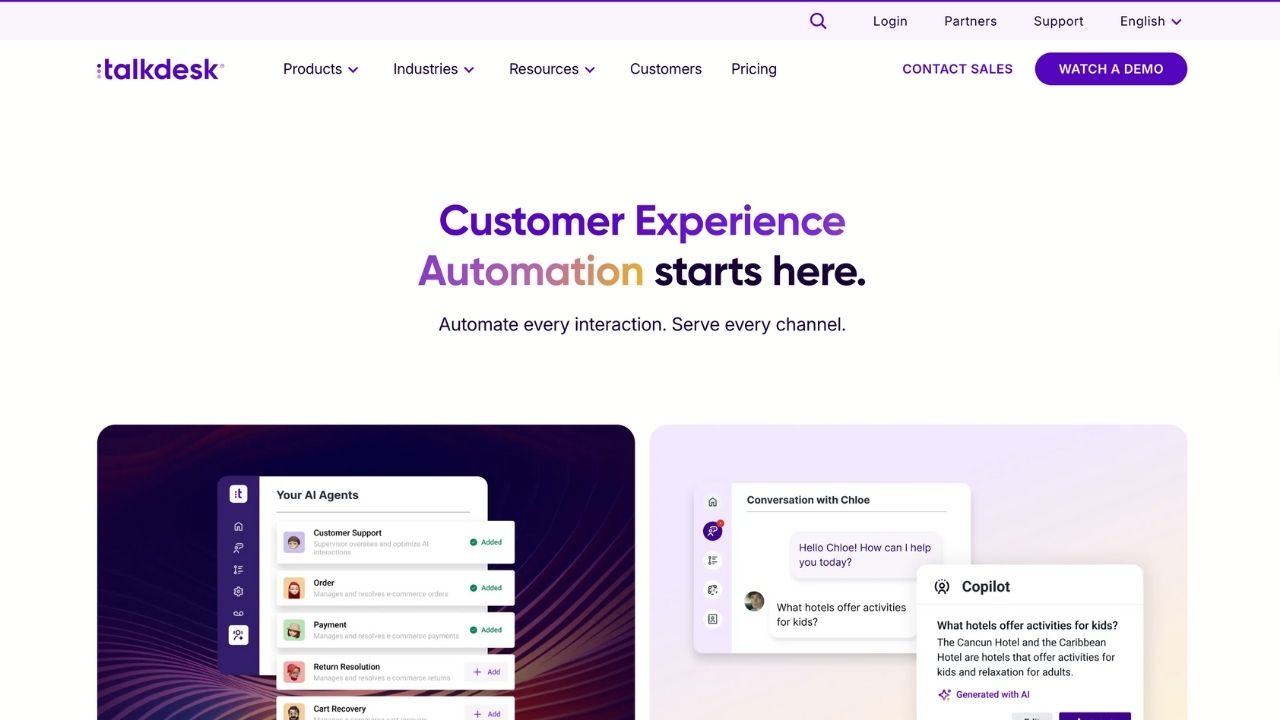
Talkdesk earned recognition as a 2025 Gartner Magic Quadrant Leader for CCaaS.
The platform is cloud-native, meaning features ship faster than legacy systems that have to support on-premises installations.
The no-code workflow builder stands out for ecommerce teams.
You can create custom routing rules based on order status, customer lifetime value, or previous interactions without writing code or waiting on IT.
Key ecommerce features:
- AI-powered routing that matches customers with the best-fit agent
- No-code workflow builder for custom automations
- Real-time agent assist with knowledge base suggestions
- Salesforce native integration
Pricing:
| Plan | Annual Price | Monthly Price | Key Features |
|---|---|---|---|
| Standard | $65/agent/mo | $75/agent/mo | Voice + 20 digital channels, AI summaries, smart routing |
| Advanced | $125/agent/mo | $150/agent/mo | Advanced WFM, AI-powered quality management, historical analytics |
| Ultimate | $165/agent/mo | $185/agent/mo | Full CRM integrations, barge/whisper monitoring, dedicated success manager |
Talkdesk doesn't publish exact pricing publicly. No seat minimums.
Pros:
- Cloud-native architecture means faster feature updates
- No-code customization accessible to non-technical teams
Cons:
- Higher price point than UCaaS alternatives
- No native Shopify/WooCommerce integration
5. Aircall
Best for: Ecommerce support teams needing quick deployment and extensive integrations.

Aircall bridges the gap between simple VoIP and full enterprise CCaaS.
The platform goes live in under 24 hours, which is meaningful when you need to spin up support capacity for a product launch or holiday rush.
The integration ecosystem is the standout feature.
Aircall has 100+ native integrations, including a dedicated ecommerce solutions module with Shopify and Gorgias connectors that display customer context automatically during calls.
Key ecommerce features:
- One-click integrations with Shopify, Gorgias, and Zendesk
- Call routing and IVR for support triage
- Customer context displays order history automatically
- Shared inboxes for team collaboration
Pricing:
| Plan | Annual Promo* | Monthly Price | Key Features |
|---|---|---|---|
| Mobile | $13.99/user/mo | $19.99/user/mo | Mobile/Desktop apps, unlimited domestic calls & SMS, team messaging |
| Premium | $20.99/user/mo | $29.99/user/mo | Desk phone support, 20+ CRM integrations, video (up to 200 participants) |
| Advanced | $27.99/user/mo | $39.99/user/mo | 15hrs call recording, visual voicemail, call groups, dedicated onboarding |
No seat minimums.
Pros:
- Fastest deployment (under 24 hours from signup to live)
- Strongest ecommerce integration ecosystem among alternatives
Cons:
- Some users report monthly reliability issues
- Less AI-native than Dialpad or Talkdesk
6. Genesys Cloud CX
Best for: Enterprise ecommerce operations needing full-featured contact center with AI orchestration.

Genesys Cloud CX operates at a different scale than the other options here.
The platform serves 10,000+ companies across 100+ countries, with customers like Virgin Atlantic and Best Buy Canada.
If your ecommerce operation runs hundreds of agents across multiple regions, Genesys has the infrastructure.
The AI capabilities earned IDC MarketScape Leader recognition for conversational AI.
Predictive routing uses machine learning to match customers with agents likely to resolve their issue successfully, not just whoever's available.
Key ecommerce features:
- Omnichannel engagement across voice, chat, email, social, and messaging
- AI-powered predictive routing
- Full workforce engagement management (scheduling, quality assurance, training)
- Salesforce and Microsoft Dynamics 365 integrations
- FedRAMP certified for government and regulated industries
Pricing:
| Plan | Monthly Price | Key Features |
|---|---|---|
| Digital Agent | $71/user/mo | 30+ digital channels, unified inbox, common data sets |
| Voice Agent | $94/user/mo | Unlimited inbound voice, IVR, recording, and storage |
| Omnichannel | $110/user/mo | Blended voice + digital routing, universal queue, AI summaries |
| Essential Suite | $135/user/mo | Adds Quality Management (QM) and agent screen recording |
| Core Suite | $169/user/mo | Adds WFM with AI forecasting and performance gamification |
| Complete Suite | $209/user/mo | Adds Interaction Analytics and sentiment tracking |
| Ultimate Suite | $249/user/mo | Full AI orchestration (Enlighten Copilot, Autopilot, and XM) |
No seat minimums. Transparent pricing for all tiers.
Pros:
- Enterprise-grade capabilities with 99.99% uptime SLA
- IDC-recognized leader in conversational AI
Cons:
- CX3-CX4 pricing ($155-240/month) exceeds SMB budgets
- No native Shopify/WooCommerce integration
7. 8x8
Best for: International ecommerce businesses needing global calling and unified communications.
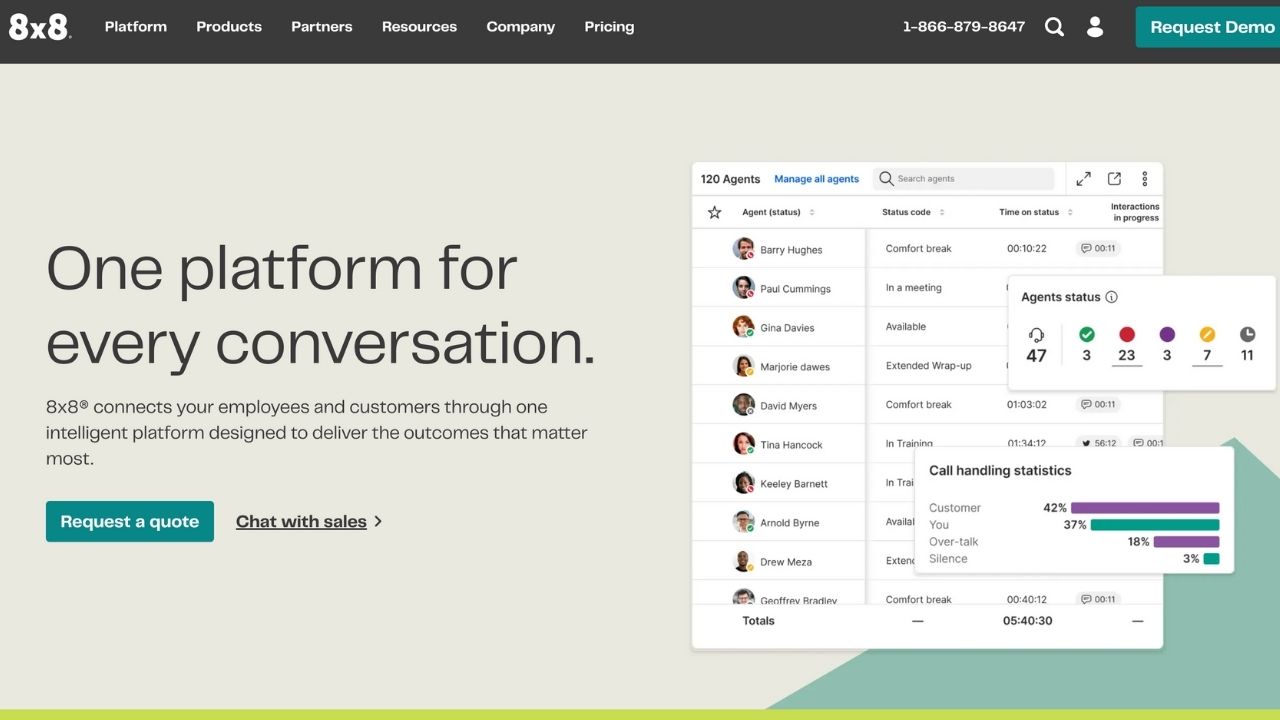
8x8 offers XCaaS, which combines UCaaS and CCaaS in one platform.
The differentiator is unlimited international calling to 48+ countries included in pricing.
For ecommerce businesses with customers in Europe, Asia, and the Americas, that's meaningful cost savings over competitors charging per-minute for international calls.
The platform backs its uptime with a 99.999% financially-backed SLA, meaning you get credits if they miss it.
Key ecommerce features:
- Unlimited international calling to 48+ countries included
- Unified voice, video, chat, and contact center
- AI-enabled routing and sentiment analysis
- CRM and helpdesk integrations
Pricing:
8x8 stopped publishing public pricing in 2023. All plans require a sales consultation for quotes.
| Plan Type | Annual Price (Est.) | Legacy Tier | Key Features |
|---|---|---|---|
| Unified Comms | $15 - $24/user/mo | X2 | Unlimited calling (14 countries), video (500 pax), Team Chat |
| Advanced UC | $44/user/mo | X4 | Calling (48 countries), Barge-Monitor-Whisper, Supervisor Analytics |
| Contact Center | $85/user/mo | X6 | Voice-only CCaaS, Skills-based routing, CRM integrations, IVR |
| Omnichannel CX | $110/user/mo | X7 | Multi-channel (SMS, Email, Chat, Social), Co-browsing, 8x8 Agent Workspace |
| Enterprise AI | $140/user/mo | X8 | Auto-dialer, Speech Analytics, Quality Management, AI Media Storage |
No seat minimums.
Pros:
- Global calling included (significant savings for international support)
- 99.999% uptime SLA with financial backing
Cons:
- No transparent pricing (requires sales call)
- Some users report complicated admin interface
Comparison table: Avaya alternatives at a glance
Here's how all 7 alternatives compare on the criteria that matter for ecommerce.

Ringly.io and Dialpad offer the lowest entry points while Genesys leads on enterprise features
| Platform | Starting Price | Seat Min | AI Features | Ecommerce Integration | Deployment | Uptime SLA |
|---|---|---|---|---|---|---|
| Ringly.io | $349/month | None | AI phone agent resolves 70%+ calls | Native Shopify (Write-access) | 3 minutes | Standard |
| Dialpad | $15/user/mo* | 1 Seat | AI-native, 2B training data, AI Recaps | Salesforce/HubSpot | Hours | 99.9% |
| Nextiva | $15/user/mo* | None | Sentiment analysis, AI transcription | Zapier/CRM | Days | 99.999% |
| Talkdesk | $85/user/mo | None | AI routing, agent assist, Virtual Agent | Salesforce | Weeks | 99.99% |
| Aircall | $30/user/mo* | 3 Seats | Limited (AI add-on: $9/user/mo) | Native Shopify | Under 24 hours | 99.99% |
| Genesys | $75/user/mo* | None | Experience Orchestration (IDC Leader) | Salesforce | Weeks | 99.99% |
| 8x8 | $15/user/mo* | None | Sentiment, AI-powered routing | CRM only | Weeks | 99.999% |
| Avaya | ~$20/user/mo | 200 seats | Limited; legacy enterprise focus | No | 3-6 months | Not disclosed |
Making the switch from Avaya
If you're planning a migration, here's the practical path forward.
Take advantage of waived termination penalties. Avaya waived termination fees through June 30, 2025. If you haven't migrated yet, check whether this still applies to your contract.
Audit what you actually use. Many ecommerce businesses discover they've been paying for enterprise features they never configured.
Document your current call flows, integrations, and must-have features before comparing alternatives.
Start with a trial. Most alternatives offer free trials. Test with a subset of your support volume (one product line, one region, or overflow calls) before committing to full migration.
Consider your call types. If 70%+ of your calls are order status, returns, and FAQs, a specialized AI solution like Ringly.io may deliver better results than a full contact center platform you're only using at 30% capacity.
Plan for deployment timeline. Cloud alternatives deploy in hours to weeks. If you're coming from on-premises Avaya, that's 3-6 months of implementation time you're getting back.
Find the right Avaya alternative for your ecommerce business
The right choice depends on your specific situation.
For Shopify stores wanting AI automation: Ringly.io resolves 70%+ of calls automatically with native store integration.
Start a free trial to test it with your actual call data.
For budget-conscious SMBs: Dialpad at $15/user/month offers the lowest entry point with AI included.
For growing mid-market teams: Nextiva or Aircall balance reliability, integrations, and fast deployment.
For complex support operations: Talkdesk or Genesys provide full CCaaS with enterprise capabilities.
For international customer bases: 8x8 includes unlimited global calling.
The common thread across all these options: none force you into a 200-seat minimum. Your support infrastructure should scale with your business, not the other way around.
Ready to automate your ecommerce phone support?
Start a free trial with Ringly.io and see how The AI handles your customer calls.
Frequently Asked Questions
What are the best Avaya ecommerce alternatives for Shopify stores?
Ringly.io and Aircall offer the strongest Shopify integration among Avaya ecommerce alternatives. Ringly.io's AI phone agent pulls order data natively and resolves 70%+ of calls automatically. Aircall connects to Shopify and Gorgias for customer context during calls.
Why are ecommerce businesses switching from Avaya to Avaya ecommerce alternatives?
The primary driver is Avaya's 200-seat minimum enforcement on AXP cloud service. Ecommerce businesses with smaller support teams must pay for unused seats. Additional factors include product sunsetting (voice recording, SIP trunking), two bankruptcy filings, and limited AI capabilities compared to modern platforms.
What is the controversy around Avaya that makes Avaya ecommerce alternatives attractive?
Avaya filed for bankruptcy twice (2017, 2023), sunset multiple core products in 2025, and enforced a 200-seat minimum that effectively abandoned SMB and mid-market customers. Their pricing page returning a 404 error signals reduced transparency compared to competitors.
How much do Avaya ecommerce alternatives cost compared to Avaya?
Avaya ecommerce alternatives range from $15/user/month (Dialpad, Nextiva) to $240/user/month (Genesys CX4) with no seat minimums. Avaya's 200-seat minimum creates a $4,000+/month floor regardless of actual team size. AI-specific options like Ringly.io start at $349/month flat.
Which Avaya ecommerce alternatives have no seat minimums?
All seven Avaya ecommerce alternatives in this guide (Ringly.io, Dialpad, Nextiva, Talkdesk, Aircall, Genesys, 8x8) operate without seat minimums. This contrasts directly with Avaya's 200-seat requirement for AXP cloud service.
How quickly can I deploy Avaya ecommerce alternatives compared to Avaya?
Avaya ecommerce alternatives deploy in hours to weeks versus 3-6 months for traditional Avaya on-premises systems. Ringly.io sets up in 3 minutes. Aircall goes live in under 24 hours. Enterprise platforms like Talkdesk and Genesys typically take 2-4 weeks.
Which Avaya ecommerce alternatives offer the best AI features for customer support?
Among Avaya ecommerce alternatives, Dialpad (trained on 2 billion conversation minutes) and Genesys (IDC AI Leader) lead in traditional AI capabilities. Ringly.io takes a different approach with an AI phone agent that handles calls directly, achieving 70-73% resolution rates without human intervention.