
This post in 30 seconds.
- What automated phone support actually does on Shopify, what gets handled end-to-end, what escalates.
- Real per-call math: AI runs $0.30 to $0.62 per resolved call vs $15 to $25 for human-handled. Ringly averages $0.42 across 50+ brands.
- Built for $10M to $100M Shopify brands running a paid helpdesk with a visible phone number, plus an honest read on 7 tools.
Most Shopify brands quietly pulled the phone number off their contact page in the last two years. The math stopped working. One support hire costs $4,000 a month before benefits. A BPO quotes $1,500 just to barely keep a line staffed during business hours. And the calls that come in are 80% "where's my order."
So the phone goes away. The customer types into chat, waits, gets frustrated, and bounces.
Automated phone support is what changed the math. An AI voice agent answers your store's number 24/7, finds the order in Shopify, processes the return, and sends the tracking link. The brands that put their number back on the site are pulling in revenue from the calls everyone else is missing.
If you're a founder, COO, or Head of CX at a $10M to $100M Shopify brand and your phone goes to voicemail after 6pm, the easiest thing is to book a 30-min call. We'll look at your last 7 days of missed calls live and show you what the recovered revenue looks like.
What automated phone support actually means on Shopify
Automated phone support is an AI voice agent that picks up your store's phone number, has a real conversation with the caller, and resolves the issue without a human. No menus. No "press 1 for orders." Just a voice that answers and helps.
Three things have to work together:
- A voice layer: a large language model that understands the caller, a speech-to-text engine that hears them, and a text-to-speech voice that responds. Modern stacks run under 800ms of latency, which is what makes the conversation feel real instead of broken.
- Shopify-native actions: the AI has to actually do things in your store. Look up an order by email or order number. Start a return. Trigger a tracking SMS. If the integration is a generic webhook, it falls over the second the caller asks anything beyond "what's my status."
- A knowledge base: your shipping policy, return window, sizing guides, product FAQs. Without this, the AI defaults to "I'll have a team member follow up," which defeats the point.
What it isn't: it isn't a phone tree. It isn't a chatbot bolted onto a number. It isn't a glorified voicemail that emails a transcript to support@. Two years ago that's what voice automation looked like and it's why most brands tried it once and turned it off.
The difference now is that the AI sounds like a person, handles natural interruptions, and can actually pull the order. That last part is where most generic voice tools still fall apart on Shopify.
Why phone still matters for Shopify brands
The pitch deck says phone is dead. The data says otherwise.
71% of Gen Z still reach out via phone when they need real help with a purchase. Phone calls cluster at two moments: right before checkout (pre-purchase doubt) and right after checkout (post-purchase anxiety). Both are high-stakes. Both convert or churn based on whether someone picks up.
Three things make phone economically different from chat:
- Highest urgency: people don't call for fun. They call because they want it solved now.
- Highest AOV: phone callers convert at higher average order value than chat or email, because the questions they're asking are usually about a specific product they want to buy.
- Highest recovery rate: a returning customer calling about a delayed order is often saveable on the call. The same customer who emails will quietly stop reordering.
And then there's the WISMO problem. "Where's my order" makes up 60-80% of inbound support volume for most direct-to-consumer brands. Most of those callers don't need a human. They need a status. AI handles WISMO at full resolution because the answer is a database lookup, not a judgment call.
The brands that don't pick up the phone are leaving recovery revenue on the table. WISMO calls are the lowest-cost, highest-frequency automation win in Shopify support.
What gets automated vs. what doesn't
This is where most "automated phone support" pitches get vague. Here is the honest split.
What the AI handles end-to-end (the automatable five):
- Order status: caller gives email or order number, AI pulls live status from Shopify, reads it back, optionally sends a tracking SMS
- Return start: AI verifies eligibility against your return policy, kicks off the return in your returns app, sends the label
- Shipping questions: cutoff times, shipping zones, expected delivery windows, policy on lost packages
- Product Q&A: pulled live from your knowledge base, with the AI grounding answers in your actual product copy instead of guessing
- Store hours, policy, basic FAQs: location, hours, who you ship to, materials, warranty terms
What still escalates to a human (the escalation four):
- Refund disputes: anything where the policy answer is "it depends" or the caller is asking for an exception
- Complex multi-order issues: replacements that involve canceling one order and rebuilding another
- Angry callers: modern systems detect frustration in tone and route immediately to a human
- Account-level changes: billing disputes on subscriptions, account merges, anything involving payment method changes
Modern systems route between the two with escalation logic you control. You tell the AI "always escalate if the caller mentions chargeback, lawyer, refund over $200, or asks twice for a human." Everything else stays automated.
The realistic resolution rate for a Shopify brand running this for the first time is 65-80%. Ringly's 65% resolution guarantee sets that as the floor: if AI resolves under 65% of your calls in 90 days, we refund the last three months. Most brands run between 70-85% in production.
WashCo generated $22,664 in attributed revenue in the first 7 days post-launch, with 271 calls handled, 85% deflection, 66% resolution, and $0.91 per call vs $2.70 for a human-handled call. That's the proof point we lean on with anyone trying to forecast what month one looks like.
The real cost math
Here is what nobody quotes properly. The unit economics on phone support changed by 30-50x in the last 18 months.
Industry data puts a human-handled support call at $15-$25 per call (loaded cost including agent time, supervision, infrastructure, and benefits). AI phone support runs $0.30-$0.62 per resolved call depending on call length and complexity. Ringly's average across 50+ brands is $0.42 per resolved call.
Worked example at 500 calls a month:
| Option | Monthly cost | Per call |
|---|---|---|
| In-house agent (part time) | $2,400 | $4.80 |
| BPO outsource | $1,500-$3,500 | $3.00-$7.00 |
| Ringly Grow | $349 | $0.70 |
Worked example at 1,250 calls a month:
| Option | Monthly cost | Per call |
|---|---|---|
| In-house agent (full time) | $4,800 | $3.84 |
| BPO outsource | $4,000-$8,000 | $3.20-$6.40 |
| Ringly Pro | $799 | $0.64 |
According to industry ROI analysis cited across voice AI 2026 statistics, companies see an average return of $3.50 for every $1 invested in AI service, with top performers reporting up to 8x. A Forrester Consulting study cited in industry coverage puts three-year ROI on voice AI between 331% and 391%.
Gartner predicted that conversational AI will reduce contact center labor costs by $80 billion in 2026. Most of that savings flows through brands that previously couldn't afford to staff phone at all.
The call makes sense if:
- You're a Shopify (or Shopify Plus) brand doing $10M to $100M
- You run a paid helpdesk (Gorgias, Zendesk, Gladly, Re:amaze, or Intercom)
- You have a visible phone number on your store
- Your CS team is 3 to 12 people
What happens on the call.
- We pull your last 7 days of missed calls live, on the call. No homework for you.
- We show you the recovered revenue at typical resolution rates for your vertical.
- You decide if it's worth a deeper conversation. No deck, no follow-up sequence.
If you're running 200+ calls a month and outsourcing or losing them, book a 30-min call and we'll run the math against your actual call volume.
What to look for in automated phone support for Shopify
Most of the cheap voice AI platforms out there were built for developers and dental offices. Three or four are actually built for Shopify. Here is what to filter on.
- Shopify-native order lookup: the AI should pull live order data from Shopify by email, phone, or order number. Not a Zapier hop. Not a generic webhook. Native, with live writes back when the AI processes a return or exchange.
- Knowledge base ingestion: feed it your site, docs, or PDFs. If you have to manually write FAQs, you'll never finish and the AI will sound dumb on edge cases.
- Helpdesk escalation: clean handoff into Gorgias, Richpanel, Reamaze, or Zendesk. The transcript and call recording should land in the right ticket automatically.
- Per-resolved-call pricing transparency: per-minute pricing looks cheap until you do the math at 1,000 calls. A flat-monthly plan with clear minutes included is usually cheaper at volume.
- Resolution guarantee: most vendors quote "containment rate" (calls that didn't reach a human). That's not the same as resolution. The real metric is whether the customer's problem actually got solved. If a vendor won't put a number on the guarantee, that's a tell.
- Languages: 40+ languages is the new standard if you ship internationally.
- Voice quality and latency: under 800ms response latency is the threshold for the call feeling natural. Above that, callers think they got disconnected.
- Speed to go-live: under an hour for the simple case. Anything that requires a multi-week onboarding for a basic Shopify store is overkill for what this category needs.
The check order status feature and knowledge base ingestion are usually where vendors either land the integration or fake it.
Common mistakes brands make rolling out automated phone
- Treating it like an IVR: over-scripting every response. The point of LLM-based voice is that you don't script it. Set the policy, ground it in your KB, let it talk.
- Skipping the knowledge base step: if you don't load real content, the AI defaults to "I'll have someone follow up." Spend the 30 minutes to feed it your actual site and policies.
- Setting escalation too tight or too loose: tight (everything escalates) means you got nothing. Loose (nothing escalates) means angry calls slip through. Start in the middle and tune from the first week's call review.
- Not putting the number back on the site: brands buy automated phone support and then forget to make the number visible again. The conversions come from people who see "Call us 24/7" on the contact page and actually call.
- Picking by per-minute price: the cheapest per-minute often costs more at real volume than a flat monthly. Always compare at your actual call count.
- Measuring containment instead of resolution: containment counts every call that didn't reach a human, including the ones where the AI dropped them. Resolution counts the calls where the problem got solved. Demand that vendors report resolution.
The 7 best automated phone support tools for Shopify brands in 2026
1. Ringly.io: AI phone support for Shopify brands
Best for: Shopify brands that want phone support without hiring a phone team and want a real resolution guarantee.
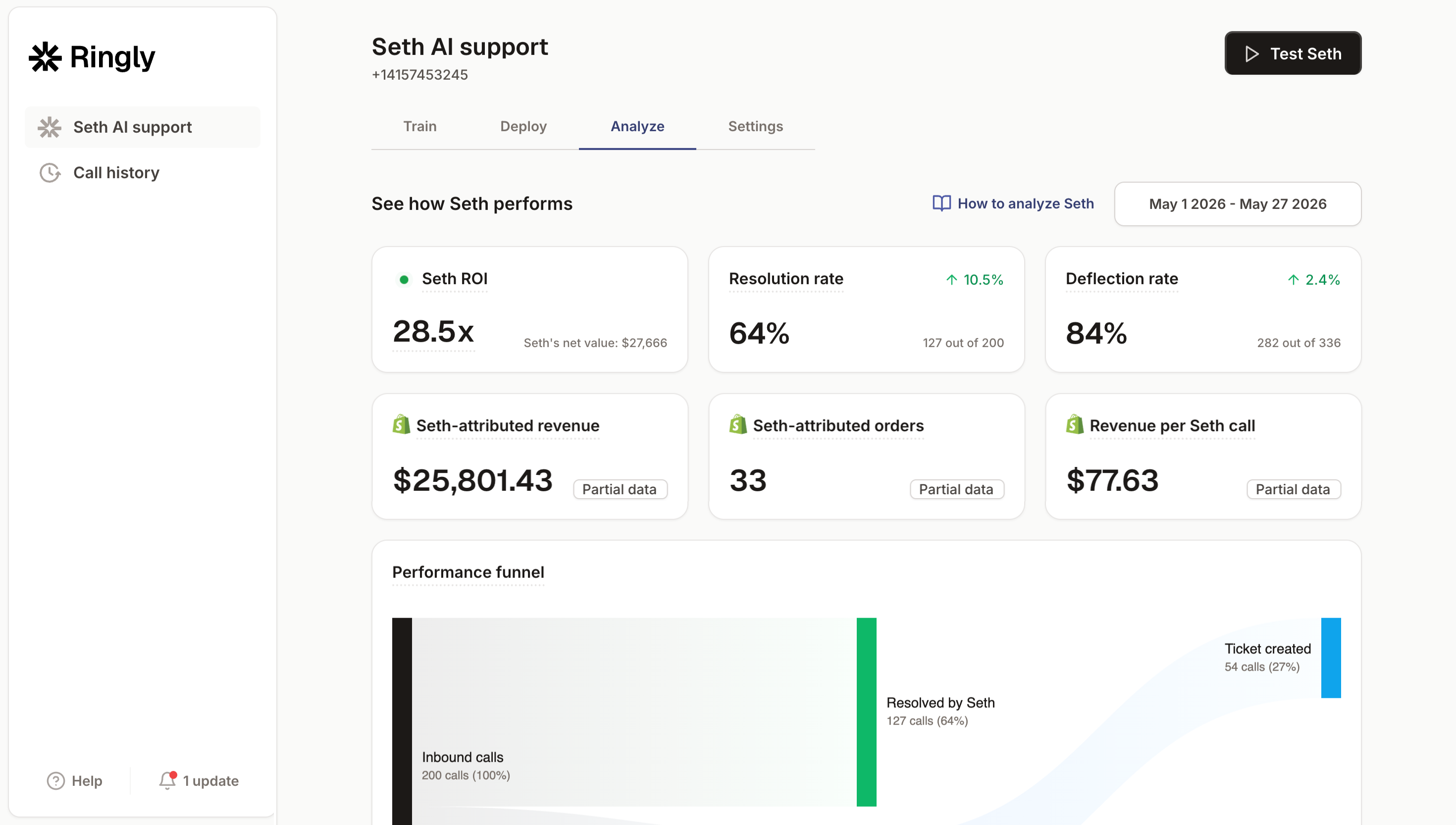
Ringly is AI phone support for Shopify brands. Hiring a phone team scales linearly with call volume. The AI doesn't. Instead of growing your support headcount every time call volume goes up, the AI takes the routine inbound calls so your team can focus on the work that actually moves revenue.
The AI answers inbound calls 24/7. It finds orders in your Shopify store, processes returns and exchanges, answers product questions from your knowledge base, and rescues abandoned carts via outbound follow-up. Across 50+ brands, the AI resolves 73% of calls autonomously at roughly $0.42 per resolved call. Calls that need a human escalate cleanly to Gorgias, Richpanel, Reamaze, or whatever helpdesk you already run.
"My customers also feel like it's a normal person. They feel like they can communicate if they have questions."
Claudia Droge, TechCraft Studio
Pricing
| Plan | Price | Minutes | Best for |
|---|---|---|---|
| Grow | $349/mo | 1,000 (~500 calls) | First-timers, low volume |
| Pro | $799/mo | 2,500 (~1,250 calls) | Growing brands |
| Enterprise | By call only | 5,000+ | High-volume, custom integrations |
- 65% resolution guarantee: if the AI resolves under 65% of your calls in 90 days, we refund the last 3 months of subscription fees
- Live in under an hour
What works
- Shopify-native order actions: live lookup, returns, exchanges, tracking SMS, all writing back to the store
- Resolution guarantee with real teeth: the only vendor in the category putting a refund mechanic against a published resolution number
- Speed to go-live: most brands are live the same day they sign up
- Helpdesk escalation that works: calls that need a human land in your existing helpdesk with the transcript and recording attached
- 40 languages: real production-grade multilingual, not a beta toggle
What doesn't
- Flat-monthly minimum at $349: there's no per-minute trial tier for stores doing under 100 calls a month
- Built for Shopify, not general business: if you're not on Shopify, look elsewhere
Why it ranks first
The only product in this category built specifically for Shopify with a real resolution guarantee and pricing that holds up at volume. The 65% floor is rare, the $0.42 per resolved call is verifiable, and the helpdesk integrations are clean. If your store is on Shopify, this is the default pick.
2. Gorgias AI Voice
Best for: brands that already run Gorgias for chat and email and want voice in the same workspace.
Gorgias added an AI voice product to its existing helpdesk in 2025. If you're already paying for Gorgias for your tickets, voice is an add-on instead of a separate tool. The integration is naturally tight because the rest of your support already lives there.
Pricing
Gorgias helpdesk plans start at $10/mo (Starter) and run to $900/mo (Advanced). Voice AI is a usage-based add-on layered on top. Total monthly cost depends on call volume.
What works
- Single workspace: voice, chat, email, social in one inbox
- Existing Gorgias customers get fast deployment: rules and macros carry over
- G2 rating of 4.6/5 across 600+ reviews for the broader Gorgias platform
What doesn't
- You need Gorgias first: not a standalone phone product, you're buying the helpdesk too
- Voice AI is newer than chat AI: less production tenure than dedicated voice platforms
- Pricing is opaque at total spend: helpdesk plus voice usage adds up fast
Why it ranks second
If you already pay for Gorgias, the integration cost is zero and the workflow is clean. If you don't, you're buying a helpdesk to get voice, which is the wrong way around.
3. Siena AI
Best for: brands wanting a consistent AI persona across voice, chat, and email channels.
Siena is built around the concept of a single AI persona that handles every channel with the same voice and personality. Started as a chat-first product, added voice in 2025. Strong on brand voice consistency, lighter on Shopify-specific actions.
Pricing
Custom, contact sales. Usage-based per resolved conversation.
What works
- Persona-led design: one AI personality across voice, chat, email
- Multichannel consistency: same answers regardless of channel
- Strong chat foundation: voice is layered on a mature chat product
What doesn't
- Opaque pricing: no public plans, you negotiate
- Voice is newer than the chat product: less voice-specific tenure
- Less Shopify-native depth than dedicated Shopify voice tools
Why it ranks third
A solid pick if brand voice consistency across channels matters more than deep Shopify actions. For pure phone-first Shopify deployments, dedicated voice tools win.
4. Unicall.ai
Best for: very small Shopify stores doing under 100 calls a month who want the cheapest entry point.
Unicall.ai targets the smallest end of the Shopify market with a $19/mo starter plan plus per-minute usage. Transparent pricing, Shopify-native, narrower feature set.
Pricing
- Launch: $19/mo plus $0.20 per minute
- Scale: $49/mo plus $0.15 per minute
- Accelerate: $299/mo plus $0.12 per minute
What works
- Lowest entry point in the category: $19/mo gets you started
- Per-minute pricing transparent: easy to forecast at low volume
- Shopify-native: real integration, not a webhook
What doesn't
- Per-minute adds up fast at volume: at 1,000 calls of 3 minutes average, you're at $600+/mo on Scale before the base fee
- Newer brand: less production tenure than Ringly or Gorgias
- Lighter helpdesk integrations
Why it ranks fourth
The right pick if you're doing under 100 calls a month and just want to try the category. Above 300-500 calls a month, the per-minute math turns against you fast.
5. Ava AI
Best for: brands whose #1 phone use case is live order edits during the call.
Ava AI emphasizes live order editing over the phone. The agent can modify an active order while the caller is on the line, change shipping address, swap a variant, apply a discount.
Pricing
See the Shopify App Store listing. Per-store pricing.
What works
- Live order edits on the call: change orders without putting the caller on hold
- 24/7 coverage standard
- Multiple concurrent calls handled
What doesn't
- Smaller customer base: less public proof
- Less pricing transparency than peers
- Narrower integration footprint
Why it ranks fifth
A genuinely useful niche if live order editing is the dominant call type. For broader Shopify support, the more established options handle it plus everything else.
6. VINSI AI Phone Agent
Best for: small Shopify stores that just need a basic 24/7 line and aren't doing complex orders.
VINSI targets small Shopify stores looking for an entry-level 24/7 line. Simple setup, basic Shopify integration, focused feature set.
Pricing
See the Shopify App Store listing for current per-store pricing.
What works
- Simple to set up: install, connect, go
- Focused on small stores: not trying to be enterprise
- 24/7 coverage out of the box
What doesn't
- Lighter Shopify integration depth: fewer native actions than Ringly or Ava
- Fewer helpdesk integrations
- Less public review data
Why it ranks sixth
A reasonable starter for a very small store. Outgrown quickly if call complexity rises.
7. Smith.ai
Best for: brands that prefer humans by default with AI as overflow assist.
Smith.ai is a virtual receptionist service that uses humans first, with AI agents handling overflow and after-hours. The opposite of an AI-first product like Ringly.
Pricing
Plans start around $292/mo for 30 calls per month, scaling up by call volume. Per-call rates are high relative to AI-first competitors because most calls hit a human.
What works
- Real humans answer: customers always get a person
- Bilingual receptionists
- Suits service-based brands with low call volume and high call value
What doesn't
- Cost scales with call volume fast: $292/mo for 30 calls is roughly $10/call
- Not Shopify-native: humans use a script, not deep Shopify actions
- AI is overflow, not primary
Why it ranks seventh
A fit if your call volume is low and your customers expect a human voice. For Shopify brands doing 200+ calls a month who want to automate, AI-first products win on cost by 10-50x.
How to choose the right automated phone support
- Choose Ringly.io if you're a Shopify brand serious about resolution rate, want a real guarantee, and want to be live today. The default pick if your store is on Shopify.
- Choose Gorgias AI Voice if you already run Gorgias for chat and email and don't want a second tool. Voice as an add-on, not a replacement.
- Choose Siena AI if brand voice consistency across every channel is your #1 requirement. Persona-led, multichannel.
- Choose Unicall.ai if you're doing under 100 calls a month and want the cheapest possible starting point. Watch the per-minute math past 500 calls.
- Choose Ava AI if live order editing on the call is your dominant use case. Specific strength.
- Choose VINSI AI if you just need a basic 24/7 line for a small Shopify store and don't need deep actions.
- Choose Smith.ai if you want humans to default and AI to assist, and your call volume is low enough that per-call cost doesn't dominate.
Most Shopify brands run the math and end up on Ringly or Gorgias depending on whether they already have a helpdesk. The other five fit narrower use cases.
Frequently asked questions
What does automated phone support cost for a Shopify store? Entry-level plans start at $19-$349/mo depending on the vendor and call volume. The per-resolved-call cost is typically $0.30-$0.62 once you account for actual usage. Compare against $15-$25 per call for human BPO or in-house agents.
Can the AI actually process returns or just give info? Yes, modern Shopify-native voice AI processes returns, exchanges, tracking SMS, and order edits on the call. It writes back to your store live. Generic voice platforms without Shopify integration can only give information.
How long does it take to set up automated phone support? For Shopify-native tools, under an hour. Connect your store, upload your knowledge base or point to your site, configure escalation rules, and the AI is live. Non-Shopify generic voice platforms can take weeks because the integration is custom.
Will customers hate talking to an AI? Voice AI in 2026 sounds like a person. Production deployments report 85-90% CSAT on fully resolved calls. The customers who care most are the ones who get their problem solved fastest, and AI typically resolves in 60-90 seconds vs. 5-15 minutes for queued human calls.
What happens when the AI can't answer the question? The call escalates to a human through your existing helpdesk. The transcript and call recording attach to the ticket so the human picks up with full context. You control the escalation rules.
Does automated phone support work with Gorgias or Zendesk? Yes. Most Shopify-native voice AI platforms integrate with Gorgias, Richpanel, Reamaze, Zendesk, and Help Scout for escalation handoff. The voice AI handles the call and routes anything needing human judgment into your existing ticket workflow.
What resolution rate should I expect from automated phone support? 65-80% in the first 30 days, climbing to 75-85% after the knowledge base is tuned. Ringly's published guarantee is 65% in 90 days or you get the last three months refunded. Be skeptical of vendors quoting "containment" instead of resolution.
Is there a guarantee if it doesn't work? Most vendors don't offer one. Ringly publishes a 65% resolution guarantee with a refund mechanic. That's the kind of skin-in-the-game commitment to look for, because it forces the vendor to focus on actual resolution instead of vanity containment metrics.
Talk to us
If you're running a $10M to $100M Shopify brand and you're losing calls after hours, a 30-min call is the fastest way to see what you're leaving on the table. We'll pull your last 7 days of missed calls on the call, run the recovered-revenue math for your call mix, and you decide whether it's worth a deeper conversation.
The 3-layer guarantee.
- Live in 14 days or it's free until launched.
- 65% resolution in 90 days or we refund the last 3 months of subscription fees.
- We keep working free until we hit 65%.
Ruben (Ringly co-founder) takes these calls personally.