
Automated phone support runs anywhere from 5 cents a minute to 2 dollars a minute, with flat plans starting around $199 a month and per-resolution deals from 99 cents a pop. That range is wide enough to be useless on its own. The sticker number tells you almost nothing about what you'll actually spend.
I run Ringly.io, AI phone support for Shopify brands, so I price this stuff constantly. Not as a critic, as someone who bills it. I went and put automated phone support next to our own billing across Shopify brands and next to a US customer service rep at the $4,000 a month loaded cost most operators assume. The number that decides whether automation pencils out isn't the per-minute rate. It's the cost per resolved call. More on that below, because it changes the answer completely.
If you run customer experience at a $10M-$100M Shopify brand, with 3 to 12 reps, a paid helpdesk, and a phone number sitting in your footer, this is the breakdown I'd want before signing anything. (If you're on Shopify Plus and the volume is bigger, the same models apply, the Shopify Plus customer service math just runs at a higher call count.)
Most of the cost guides ranking for this are written for a developer wiring up Vapi, not for an operator deciding whether to stop hiring rep number seven. If your phone backlog is the reason you're reading this, the question is really about automated phone support for Shopify brands specifically, not generic voice AI. Book a 30-min call and we'll run the per-resolved-call math live on your store's actual volume.
In this post:
This post in 30 seconds.
- The ranges: per-minute AI is $0.05-$0.15 build-your-own, $0.25-$0.50 managed, up to $1-$2 premium. Flat plans start near $199/mo. Per-resolution starts at $0.99. Enterprise custom builds run $50K-$500K a year.
- The trap: sticker price hides the real cost. What you spend is driven by your resolution rate, not the per-minute rate. Per-resolution pricing quietly punishes you as the AI gets better.
- The benchmark: a loaded US rep is about $4,000/mo and roughly $2.70 per call. On Ringly the AI costs $1.99 a call after the first 50.
- Built for $10M-$100M Shopify brands running 3-12 reps and a visible phone line, deciding whether automation beats the next hire.
What you're actually paying for
Before the numbers, it helps to know what's under them. Automated phone support isn't one line item. It's five, and most vendors only quote you the first one.
There's the usage itself (the minutes or calls the AI handles). There's the build (connecting your Shopify store, loading your knowledge base, wiring escalation to your helpdesk). There's the platform fee that some vendors charge on top of usage. There's oversight, the QA work of actually checking the AI is resolving calls and not inventing return policies. And there's escalation, the cost of handing the hard calls back to a human cleanly. If most of your volume is WISMO calls (where's my order), the routine half is exactly what automation should absorb.
The cheap per-minute number you see first usually covers only the minutes, which is why a $0.10 quote can turn into a $0.50 real cost once the build, the platform fee, and the QA labor land on the invoice. According to Nextiva's 2026 pricing analysis, the components that move a budget most are exactly the ones not in the headline rate: knowledge-base surcharges, extra concurrent calls, transfer fees, and the oversight labor nobody quotes.
Here's where the founder bias matters, so I'll name it. Our numbers come from real Ringly billing across 50+ active Shopify brands, plus the loaded human-rep cost ($4K/mo US, the commodity assumption operators use on calls). Where a figure is a market range rather than our own data, I link the source. That's the whole methodology: real billing, sourced ranges, no list-price math.
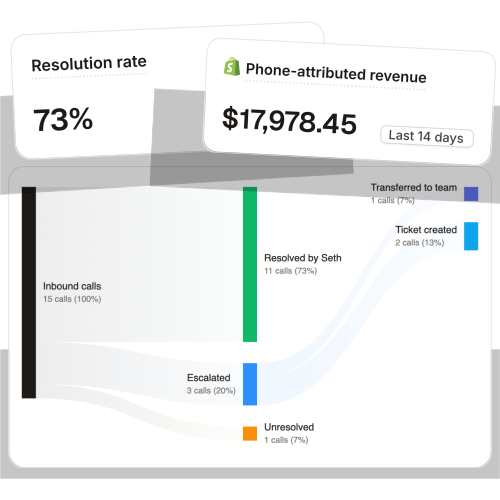
The reason that dashboard matters to a cost conversation: resolution rate is the multiplier on everything. We'll get to why in the cost-per-resolved-call section. First, the four ways this gets priced.
The four ways automated phone support is priced
Almost every vendor uses one of four models. Knowing which one you're being sold tells you where the cost will hide.
Per-minute usage
You pay for the minutes the AI is on the phone. This is the most common model and the most misleading, because a low per-minute rate looks cheap right up until you multiply it by your call volume and your resolution rate.
If you want the full per-minute teardown, our voice AI pricing guide goes deeper than this section can. The ranges, per Aircall's 2026 cost guide and Nextiva:
- Build-your-own / infrastructure layer: $0.05-$0.15/min. This is the Retell / Vapi tier, aimed at developers who'll assemble the stack themselves.
- Managed all-in-one: $0.25-$0.50/min, with the integrations and support included.
- Premium / enterprise voice: up to $1.00-$2.00/min.
The catch is the fine print. Many per-minute vendors round up to the nearest minute, charge for failed calls and voicemails, and price overage at 2 to 3 times the base rate. A 90-second call billed as two minutes is a 33% silent markup.
Flat-rate subscription
You pay a fixed monthly fee for a bundle of minutes or calls. Predictable is the whole point, which is why flat-rate is the model most $10M-$100M operators end up wanting once they've been burned by a usage spike.
- The cheapest flat-rate AI receptionist worth using sits around $149-$199/mo, with NextPhone at $199 as the canonical floor.
- Bundled-minute plans run $30-$200/mo for small volume and $200-$1,000/mo for midmarket.
The catch: when you blow through the bundle, overage minutes are billed at 2 to 3x. Flat-rate is only predictable inside the cap.
Per-resolution / outcome-based
You pay a set price each time the AI resolves a call, not per minute. It sounds like the fairest model. It's the one I'd read the contract on twice.
Pricing starts around $0.99 per resolution (Fin charges $0.99 with no platform fee), with Freshdesk at $0.10/session and Salesforce Agentforce at $2.00+/conversation. Two problems, both flagged by Ada's pricing breakdown:
- "Resolution" isn't standardized. One vendor counts five minutes of customer silence as resolved. Another counts any call that didn't escalate. You can be billed for a customer who hung up frustrated.
- It punishes success. Cost is volume times resolution rate times price-per-resolution. So as your AI gets better and resolves more, your bill goes up for the same call volume. Ada modeled it over three years: a per-resolution deal more than triples in cost while a flat per-conversation deal stays flat, on identical volume.
For phone specifically this is sharper than chat, because phone minutes are more expensive to begin with. A per-resolution phone deal that looks cheap at 30% resolution gets ugly at 75%.
Enterprise custom / managed build
The done-for-you tier. You pay a large annual contract and the vendor builds and runs it.
Expect $50,000 to $500,000+ a year, per Nextiva. Sierra lands at $200K-$350K+ in year one with outcome billing that spikes on volume surges. Decagon runs $95K-$590K and wants agent engineers plus weeks of setup. The catch is the implementation services on top, which is where the $10K-$100K setup fees live. For most $10M-$100M brands this tier is overkill, and a call-center outsourcing comparison usually makes more sense than a half-million-dollar custom build.
Setup fees and the hidden costs nobody quotes
The monthly number is half the picture. The fastest way to misjudge automated phone support cost is to compare two vendors on per-minute rate and ignore that one has a $0 setup and the other has a $40,000 implementation.
Setup fees fall into three bands, per Nextiva:
- Self-serve / no-code: $0-$200. You wire it up yourself.
- Professional onboarding: $500-$2,000 one-time.
- Custom / enterprise: $10,000-$100,000+ in upfront services.
Then the recurring hidden fees, the ones that turn a clean quote into a messy invoice:
- Rounding up to the nearest minute on per-minute plans (a silent 20-40% markup on short calls).
- Charging for failed calls and voicemails you'd assume are free.
- Knowledge-base surcharges once your KB passes a page limit.
- PII redaction billed per call on regulated accounts.
- Extra concurrent calls beyond a baseline, charged per line.
- Transfer and escalation surcharges every time the AI hands off to a human.
- Overage minutes at 2-3x the bundled rate.
None of these are scams. They're just not in the headline. Ask for them line by line before you compare anyone.
Automated phone support vs human reps, side by side
Here's the comparison the developer-focused guides skip: how automation actually stacks up against the reps and the BPO you're paying right now. The numbers below are loaded costs, not base salaries, because that's the real spend.
| Option | Typical cost | What you actually get | Verdict |
|---|---|---|---|
| AI, per-minute (build-your-own) | $0.05-$0.15/min | Cheapest sticker, you build + run + QA it yourself | Cheap until you price the labor to maintain it |
| AI, per-minute (managed) | $0.25-$0.50/min | Integrations + support included | Fair, but watch rounding + overage |
| AI, flat-rate | $149-$1,000/mo | Predictable inside the cap | Best for steady volume, overage stings |
| AI, per-resolution | $0.99-$2.00/resolution | Pay for outcomes | Punishes you as resolution improves |
| US in-house rep | ~$4,000/mo loaded, ~$2.70/call | A human, with sick days + attrition | The baseline you're trying to beat |
| Offshore BPO | $7-$16/hr, ~$0.50-$1.50/call | Lower hourly, real loaded cost climbs | A 2-agent setup lands near $7,500/mo after fees |
| Ringly | Pay per call + 65% guarantee | $99 a month for the first 50 conversations, then $1.99 each | Predictable cost, de-risked by the guarantee |
A few honest notes on that table. A fully loaded US rep runs $55,000-$73,000 a year, not the $40K you see on a job board, per text.com's outsourcing breakdown. Offshore looks cheapest at $7-$16/hr, but Crescendo's 2026 outsourcing research shows a real two-agent ecommerce setup landing near $7,500/mo once you add the $500 setup, $300 in tools, and $200 in QA. Cheap per hour is not cheap per resolved call. If you're actively weighing a BPO for your Shopify store, run those loaded numbers, not the hourly quote.
"My customers also feel like it's a normal person. They feel like they can communicate if they have questions."
Claudia Droge, TechCraft Studio
That quote matters to a cost conversation more than it looks. The whole reason brands keep paying reps for routine calls is the fear that automation sounds like a robot and torches the customer relationship. When it doesn't, the per-resolved-call math is the only thing left to argue about.
The number that decides it: cost per resolved call
This is the part the SERP misses, so it's the part worth slowing down on. The per-minute rate is not your cost. Cost per resolved call is your cost, and it equals the per-minute rate times your average call length, divided by your resolution rate.
Run a real example. Say an AI charges $0.30/min, your calls average two minutes, so $0.60 a call. Looks great. But if that AI only resolves 45% of calls on its own, you're paying $0.60 for every call AND paying your reps to handle the other 55%. Your true cost per resolved call is closer to $1.33, and you barely shrank the team.
Now hold the per-minute rate flat and lift resolution to 73%. The same $0.60 call now costs about $0.82 per resolved call, and far fewer calls reach a human. Same sticker, very different bill. Resolution rate is the hidden multiplier, and almost nobody quotes it on the pricing page.
Ringly resolves up to 90% of calls on its own for $1.99 a call after the first 50, against the $7-$16 per call an industry human BPO runs. WashCo, a Shopify brand we launched, paid $0.91 per call in its first 7 days on the phone. That's the number a cost guide should be reporting, not the per-minute teaser.
So when you read a $0.10/min quote, the right next question isn't "is that cheap." It's "what's your resolution rate, and what's that work out to per resolved call." If the vendor won't answer, that's the answer.
There's a second-order cost here too, and it's the one that bites at the end of the quarter. Every call the AI doesn't resolve doesn't vanish. It lands back in your queue, where a rep handles it at roughly $2.70 a call, plus the context-switching tax of picking up a call a robot already half-handled. So a low resolution rate doesn't just inflate the per-resolved-call number, it quietly keeps your headcount where it was. That's why two vendors at the same per-minute rate can produce wildly different P&L outcomes: the one resolving 73% shrinks your team, the one resolving 40% just adds a line item on top of it. An AI receptionist for ecommerce only saves money if its resolution rate is high enough to actually take calls off your reps' plates.
What this costs you today vs with Ringly
Put it on the P&L. Take a typical $50M Shopify brand running a 6-rep CS team:
| Line item | Today | With Ringly |
|---|---|---|
| 6 reps x $4K loaded per rep | $24,000/mo | n/a |
| Ringly Enterprise (~$5K/mo) | n/a | $5,000/mo |
| Net monthly CS spend | $24,000/mo | $5,000/mo |
| Monthly savings | n/a | $19,000/mo |
| Annual savings | n/a | $228,000/yr |
That's roughly 70% of repeatable calls (order status, returns, the same questions over and over) routed to the AI. The other 30%, the genuinely hard calls, still go to your team, who now have time to actually solve them. The same shape shows up across ecommerce phone support generally: most calls are routine, a minority are hard, and you've been paying human rates for both.
Ringly.io: AI phone support for Shopify brands
Ringly is AI phone support for Shopify brands. The phone shouldn't be a tax on your support team, so the AI takes the routine inbound calls and your reps keep the ones that need a human.
The AI answers inbound calls 24/7. It finds orders in your Shopify store, processes returns and exchanges, answers product questions from your knowledge base, and cancels orders when a caller asks. Seth resolves up to 90% of calls on its own. Calls that need a human escalate cleanly to Gorgias, Richpanel, Re:amaze, or whatever helpdesk you already run.
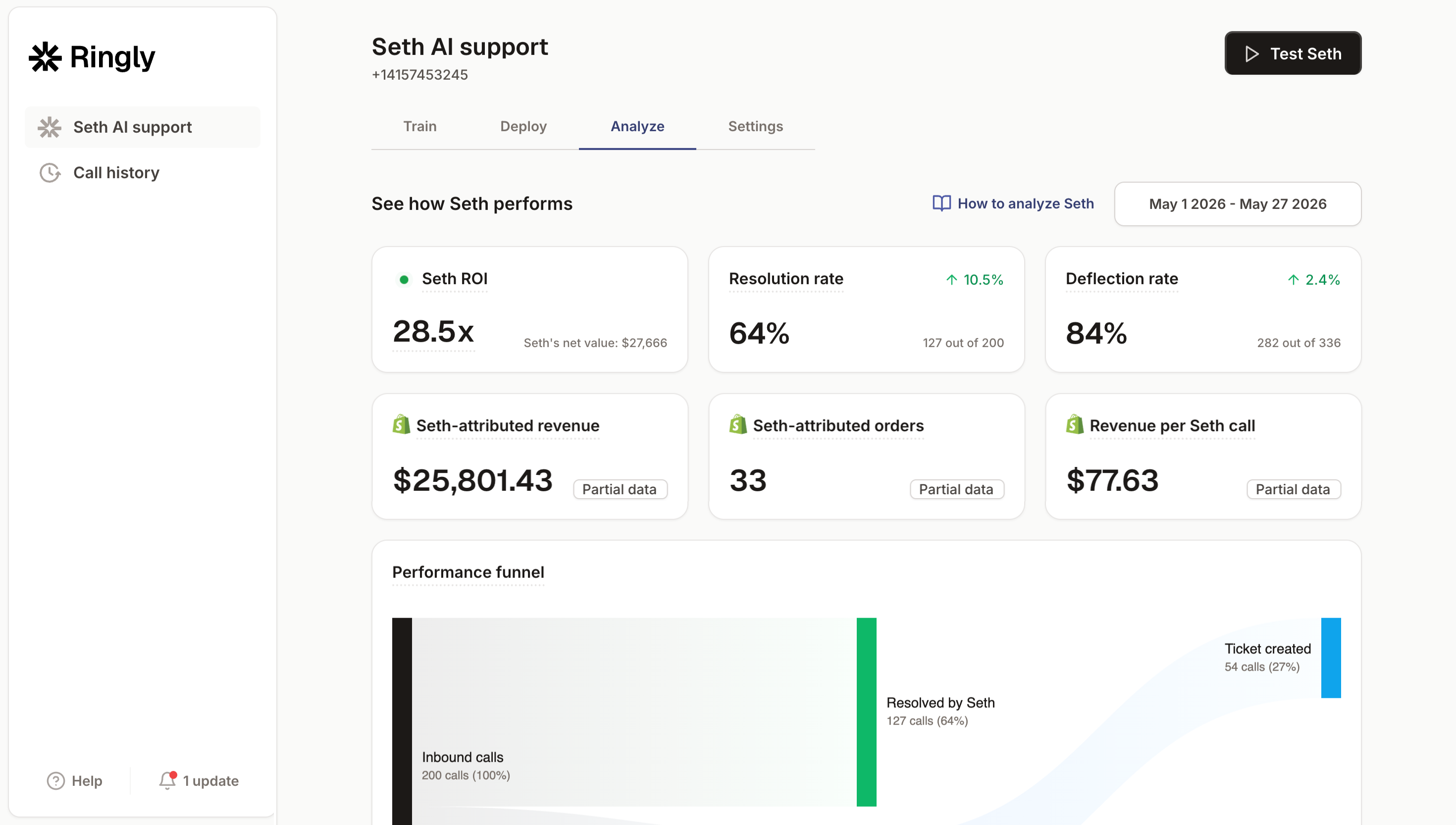
On pricing, Ringly charges per conversation, and spam, hang-ups and wrong numbers are free. The public pricing page shows Pay per call: $99 a month for the first 50 conversations, then $1.99 each. The 65% resolution guarantee is the part that de-risks the spend: if Seth resolves under 65% of your calls in a month, that month comes back as credit (after 90 days on Pay per call). You're not betting the budget on a resolution rate you can't see yet.
If you want to compare us to your current setup, book a 30-min call and we'll do the math live on your real call volume.
How to pick a pricing model for your brand
The right model depends on your volume shape and how much you trust the vendor's resolution number. Pick for predictability and a real resolution rate, not for the lowest sticker, because the lowest sticker is almost always per-minute with the cost hidden in the fine print.
- Choose per-minute if your volume is low and spiky and you want to pay only for what you use, and you've read the rounding + overage terms.
- Choose flat-rate if your volume is steady and you want a number you can put on next year's budget. This is where most $10M-$100M brands land.
- Be careful with per-resolution on phone. It looks fair, but it bills you more as the AI gets better, and "resolution" is whatever the vendor says it is. Only sign if their definition is in writing.
- Consider enterprise custom only if you're past $200M and need a fully bespoke build, and you've budgeted the $10K-$100K implementation.
Want to run the numbers on your own volume instead of reading ranges? Our phone support cost calculator lets you plug in your call count and reps and see the per-resolved-call cost for your store. And if you're weighing this against your current team, the in-house vs outsource breakdown covers the headcount side.
Frequently asked questions
How much does automated phone support cost per month? For a $10M-$100M Shopify brand, expect $200-$2,000/mo on a flat or bundled plan for typical volume, and over $5,000/mo for high-volume or regulated operations. Per-minute plans run $0.05-$0.50/min depending on whether you build it yourself or buy managed.
Is per-minute or flat-rate cheaper? It depends on your volume. Per-minute is cheaper for low, spiky call volume; flat-rate is cheaper and far more predictable once you have steady volume. Most brands at your size end up preferring flat-rate so the cost doesn't spike during a launch.
What is per-resolution pricing and is it worth it? You pay a set fee (from $0.99) each time the AI resolves a call instead of paying per minute. The catch is that "resolution" isn't standardized and your bill rises as the AI improves, so model it over three years before signing, not just month one.
What's the catch with cheap per-minute AI? The headline rate usually covers only the minutes, not the build, QA, or hidden fees like minute-rounding, failed-call charges, and 2-3x overage. A $0.10/min quote often becomes a $0.40-$0.50 real cost once everything lands.
Is automated phone support cheaper than offshore reps? Usually, on a per-resolved-call basis. Offshore reps look cheap at $7-$16/hr, but a real two-agent ecommerce setup lands near $7,500/mo after setup, tools, and QA. The AI handles the routine 70% at a fraction of that, and your reps keep the hard calls.
What setup fees should I expect? $0-$200 for self-serve, $500-$2,000 for professional onboarding, and $10,000-$100,000+ for custom enterprise builds. Ringly is live in under 1 hour, with no separate implementation invoice.
How does Ringly price automated phone support? Pay per call: $99 a month for the first 50 conversations, then $1.99 each. Spam, hang-ups and wrong numbers are free, and the price per call doesn't rise as the AI resolves more.
Does Ringly guarantee the cost saves money? Ringly backs it with a 65% resolution guarantee: if Seth resolves under 65% of your calls in a month, that month comes back as credit (after 90 days on Pay per call). That's the de-risk on the spend.
Talk to us

If you run a $10M-$100M Shopify brand and the phone is eating your reps, a 30-min call is the fastest way to see the real per-resolved-call number for your store. We'll pull the ranges against your actual volume and show you where automation lands on your P&L.
Our 3 promises.
- Live in under 1 hour. Setup and test calls are free.
- 30-day money back on the $99 plan fee.
- 65% resolution guarantee: if Seth resolves under 65% of your support calls in a month, that month comes back as credit (after 90 days on Pay per call).
Ruben (Ringly co-founder) takes these calls personally.