
This post in 30 seconds.
- The short answer: automated phone support runs roughly $0.13 to $0.50 per minute on usage-based platforms, or a flat $3K to $12K per month for a fully built, integrated, done-for-you agent that actually resolves calls.
- The cheap per-minute number only covers answering. The price that matters is the cost to resolve a call end to end (WISMO, returns, order changes), and that depends on integrations, build, and who maintains the agent.
- Built for founders, COOs, and Heads of CX at $10M-$100M Shopify brands running a paid helpdesk with a visible phone line.
If you run a $10M-$100M Shopify brand with a real phone number on your site, you already know the math on humans. A US rep costs about $4,000 a month loaded, and most of their day is the same five questions on repeat. So the real question is simple: what does it cost to hand the repeatable calls to an AI phone agent built for Shopify instead?
Here's the direct answer. Usage-based AI voice platforms charge $0.13 to $0.50 per minute once you add up speech, the language model, voice, and telephony. A done-for-you agent that's built, integrated, and guaranteed runs a flat $3,000 to $12,000 per month depending on your call volume. On a per-resolved-call basis, the good ones land around $0.42 a call, versus $7 to $16 when a human BPO handles it.
A quick note on who this is for, because the number changes a lot by size. We pulled the per-resolved-call data below from 50+ live Shopify brands running phone support on Ringly, not from a pricing page. If your phone goes to voicemail after 6 p.m. and your CS team is drowning in order-status calls, book a 30-min call and we'll run your real numbers live.
The short answer: what automated phone support actually costs
Let's anchor the range before we break it down.
Automated phone support costs $0.13 to $0.50 per minute on usage-based pricing, or $3K to $12K a month flat for a fully built agent that resolves calls instead of just answering them. That spread is wide for a reason, and the reason is the whole point of this post.
On the cheap end, infrastructure platforms advertise rates as low as $0.05 per minute. But that headline number assumes you bring your own language model, your own speech-to-text, and your own phone numbers. Add those back in and the true all-in cost lands at $0.13 to $0.25 per minute, according to Retell AI's 2026 breakdown. Managed platforms that bundle everything sit higher, around $0.25 to $0.50 per minute.
For a brand doing moderate volume (5,000 to 10,000 minutes a month), that pencils to roughly $350 to $1,200 a month, per Aircall's cost analysis. Aircall's own number for the comparison: AI handles similar volume at 10 to 30% of what a $3,000-$4,000-a-month human agent costs. We break the per-minute math down further in our guide to voice AI pricing.
The per-call view is cleaner than the per-minute view. Across 50+ active Ringly brands, a resolved call costs about $0.42. One dashboard example we look at runs $25,801 in attributed revenue at a $0.58 cost per call on higher volume. Compare that to the $7 to $16 a human BPO charges per handled call and the gap is the whole business case.
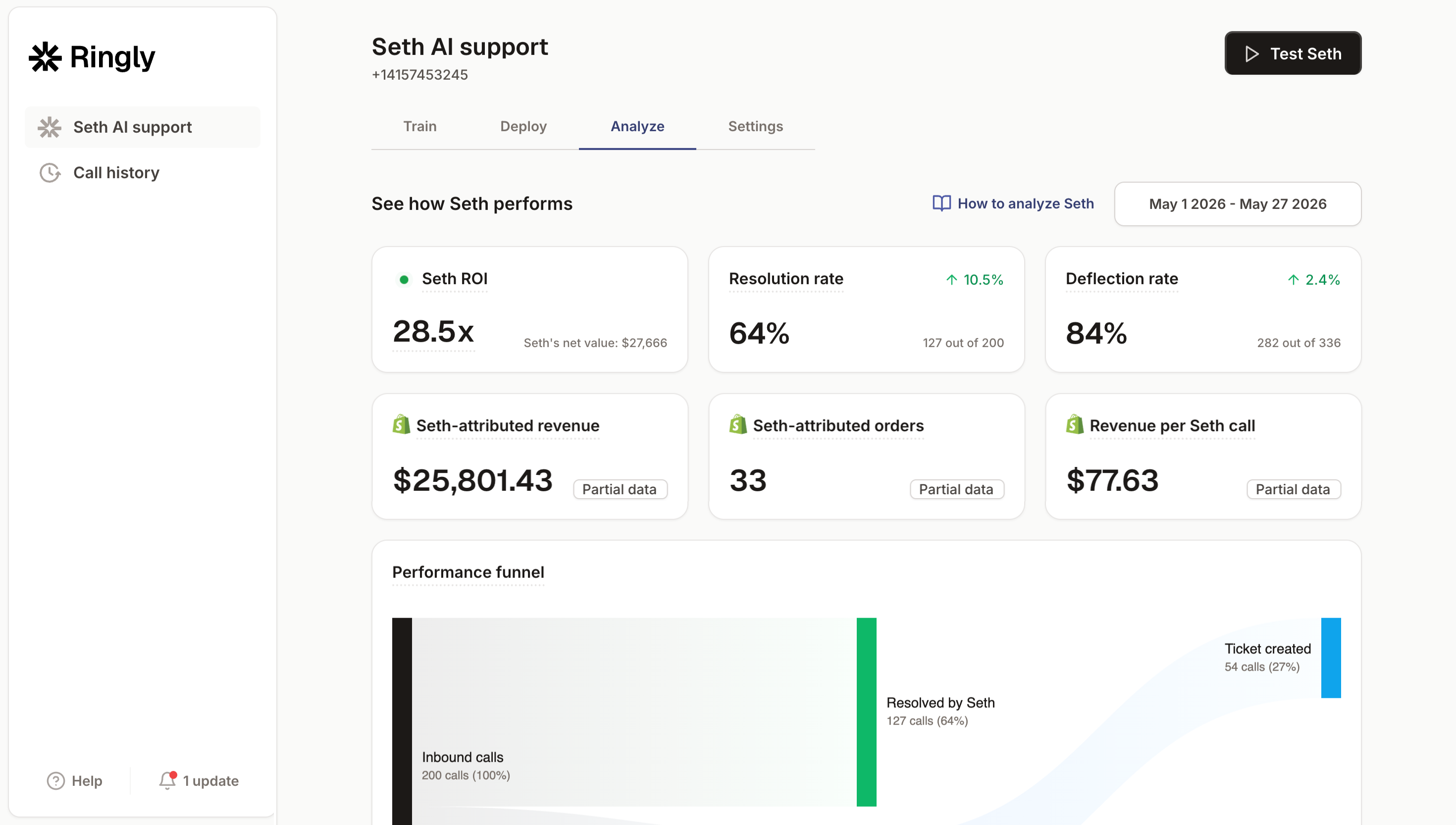
The number you should care about is cost per resolved call, not cost per minute, because a cheap minute that ends in a transfer to your team didn't save you anything. That's the trap in most pricing pages, and it's why the next section matters more than this one.
Answering vs resolving: why the cheap number isn't the real number
There's a difference between answering a call and resolving it, and almost every per-minute quote you'll see is priced on answering.
Answering is easy. A bot picks up, greets the caller, maybe takes a message or routes them. That's the $0.05-a-minute tier. Resolving is harder. The customer wants to know where their order is, change a shipping address, start a return, or ask whether a product is in stock. To actually finish that call, the agent needs to be wired into Shopify, into your tracking provider, into your returns flow. That integration work is what separates a cheap answering line from real phone support.
And resolving is most of the job. "Where's my order" calls alone account for 20 to 40% of ecommerce support tickets, climbing to 50 to 80% during peak weeks, per Salesforce's WISMO data. Shopify's own guidance puts WISMO as the single largest category of inbound support. These are the same questions over and over, and they're exactly the calls software should be closing without a human.
So when you compare prices, compare what the agent actually does. BioLongevity Labs, a supplement brand on Ringly, hits 79% end-to-end resolution autonomously, meaning the AI finishes 79 out of 100 calls without ever pulling in a rep. A cheaper tool that answers and transfers half its calls isn't cheaper. You just moved the cost back onto your CS team and called it savings.
What makes resolution possible is the plumbing. Ringly's check-order-status action pulls live tracking on the call, custom actions handle returns and order changes, and a knowledge base answers product questions. Without that wiring, you're paying for a voicemail with better manners.
This post is about the cost to resolve. If you only need a line answered and triaged after hours, that's a narrower and cheaper question. Resolution is where the real money sits.
The 4 pricing models, side by side
Automated phone support gets sold four different ways. Each one hides the real cost somewhere different.
| Pricing model | Typical price | What's included | Best for | Where the hidden cost lives |
|---|---|---|---|---|
| Per-minute (usage) | $0.13-$0.50/min all-in | Voice + LLM + telephony | Spiky or low volume | Overage rates, you build the integrations |
| Per-call (resolution) | ~$0.42-$1.00/resolved call | Full call lifecycle | Steady WISMO-heavy volume | Defining what counts as "resolved" |
| Flat monthly retainer | $3K-$12K/mo | Build + integrations + tuning + guarantee | $10M-$100M brands | Knowing if you're overpaying for your volume |
| Build-it-yourself | $0.05/min + dev time | Raw infrastructure only | Teams with engineers to spare | Your own eng hours, ongoing maintenance |
The build-it-yourself row is the sneakiest. A $0.05-a-minute infrastructure rate looks unbeatable until you price the engineer who wires up speech-to-text, the language model, and a telephony provider, then keeps it running. Retell AI's own breakdown is blunt about it: the advertised rate rarely reflects the true all-in cost.
The flat retainer is the model most $10M-$100M brands land on, because it folds the build, the integrations, the tuning, and a resolution guarantee into one predictable line item. Smaller brands often start self-serve on a published plan (Grow at $349/mo covers about 500 calls, Pro at $799/mo about 1,250) before graduating to a done-for-you build. The rule of thumb we use: the retainer tends to land near 20% of what you're spending on the CS team it's offloading. If you want the exact math for your setup, that's a 30-min call to compare us to your current setup.
What drives your number up (the 6 cost drivers)
Two brands the same size can pay very different numbers. Here's what moves it.
- Call volume. More calls, more minutes, higher bill on usage pricing. A brand doing 5,000 minutes pays a fraction of one doing 50,000. Flat retainers smooth this out, which is why high-volume brands prefer them.
- Average call length. A WISMO call is 90 seconds. A complex return with a replacement order can run 5 minutes. Your blended length sets your per-minute total.
- Integrations. Answering needs none. Resolving needs Shopify, tracking, and returns wired in. The deeper the integration, the more the agent resolves, the more it's worth, and the more setup it carries.
- Build and onboarding. Some platforms charge a one-time build fee; others fold it into the monthly. Either way, a done-for-you agent costs more to stand up than a self-serve script you write yourself.
- Maintenance. This is the line nobody quotes. When the agent mishandles a call, someone has to tune it. If that's you, it's free in dollars and expensive in time. If it's the vendor, it's in the retainer.
- The hidden BYO stack. On infrastructure platforms, the per-minute rate often excludes the LLM, the speech engine, and telephony. Aircall's analysis flags this as the most common reason real bills run 2-3x the advertised rate.
The single biggest swing isn't volume, it's whether the price includes someone maintaining the agent when it gets a call wrong. A static script degrades. A maintained agent improves. That's the difference between a tool and a service.
What it costs you today vs with automated support
The cleanest way to size the cost is against what you're already spending.
Take a typical $50M Shopify brand running a 6-rep CS team:
| Line item | Today | With automated support |
|---|---|---|
| 6 reps × $4K loaded per rep | $24,000/mo | n/a |
| Automated phone support (~$5K/mo) | n/a | $5,000/mo |
| Net monthly CS spend | $24,000/mo | $5,000/mo |
| Monthly savings | n/a | $19,000/mo |
| Annual savings | n/a | $228,000/yr |
That assumes roughly 70% of your calls are repeatable: order status, returns, product questions, the same five things over and over. The other 30%, the genuinely complex calls, still route to your team via a smart call transfer, so your reps now have time to actually solve them instead of reading tracking numbers off a screen all day.
The human comparison holds up against the outsourced route too. Crescendo's 2026 outsourcing guide puts BPO at $0.75 to $1.50 a minute, US agents at $28 to $40 an hour, and pay-per-resolution models around $5 per resolved call. Automated support resolving at $0.42 a call is an order of magnitude under that.
The revenue side is the part most cost calculators miss. WashCo, a Shopify brand we launched, recovered $22,664 in attributed revenue in its first 7 days on the phone, because the calls that used to hit voicemail after hours got answered and closed. A missed call isn't a $0 event. It's a lost order.
Want the numbers run on your actual call volume? Book a 30-min call.
Is automated phone support worth the cost?
Short version: if a meaningful chunk of your phone volume is repeatable and you're paying loaded humans to handle it, yes, the math almost always works.
It pencils when you've got a visible phone number, a paid helpdesk already in place, and a CS team of three to twelve reps spending most of their day on WISMO and returns. The fixed monthly cost gets cheaper per call as your volume grows, which is the opposite of how human staffing scales. If you're weighing it against standing up a full ecommerce call center, the per-call gap only widens.
It doesn't pencil if your call volume is tiny, if every call is genuinely complex and emotional, or if you don't actually have a phone channel worth defending. In that case you're buying capacity you won't use.
"My customers also feel like it's a normal person. They feel like they can communicate if they have questions."
Claudia Droge, TechCraft Studio
The honest answer to "is it worth it" is that it depends on your repeatable-call percentage, and you can't guess that number. Pull a week of call logs and count how many were the same five questions. If it's more than half, the cost question answers itself.
Frequently asked questions
How much does automated phone support cost per call? On a per-resolved-call basis, well-tuned automated phone support runs around $0.42 a call across active Shopify brands, versus $7 to $16 when a human BPO handles it. The exact number depends on your average call length and how many calls the agent resolves end to end without a transfer.
Is automated phone support cheaper than hiring a rep? Usually, yes. A US rep costs about $4,000 a month loaded. Automated support typically runs 10 to 30% of that for the repeatable share of calls, which is most of them. The savings show up fastest on WISMO and order-status volume.
What's the difference between per-minute and flat-rate pricing? Per-minute pricing ($0.13 to $0.50 all-in) scales with usage and suits spiky or low volume. Flat-rate retainers ($3K to $12K a month) bundle the build, integrations, tuning, and a resolution guarantee, and get cheaper per call as volume grows. High-volume brands almost always prefer flat.
Does automated phone support actually resolve calls or just answer them? That depends entirely on the integrations. Answering is cheap and easy. Resolving WISMO, returns, and order changes requires the agent to be wired into Shopify, tracking, and your returns flow. The good systems resolve 70-80% of calls autonomously; cheaper ones answer and transfer.
Are there hidden costs in AI phone support pricing? Yes, mostly on infrastructure platforms. A $0.05-a-minute headline rate often excludes the language model, speech-to-text, and telephony, pushing the real bill to $0.13-$0.25 a minute. Build fees, overage rates, and ongoing maintenance are the other line items to ask about.
How fast can automated phone support pay for itself? For a brand replacing even part of a multi-rep team, the monthly savings (often $15K-$19K) cover the cost almost immediately. Some brands also see recovered revenue from after-hours calls that used to hit voicemail, which shortens payback further.
Talk to us

If you run a $10M-$100M Shopify brand and you're trying to size the cost of automated phone support against your current team, a 30-min call is the fastest way to see the real number on your own call volume.
The 3-layer guarantee.
- Live in 14 days or it's free until launched.
- 65% resolution in 90 days or we refund the last 3 months of subscription fees.
- We keep working free until we hit 65%.
Ruben (Ringly co-founder) takes these calls personally.