

This post in 30 seconds.
- The 6 tools ranked for a Shopify brand's real call mix, not the appointment-booking frame every other list uses.
- Across 11,000+ calls handled by Ringly agents in the past 30 days, roughly 29% of inbound calls arrived after business hours (6 p.m. to 9 a.m. US Eastern). That's the queue a dentist-built receptionist can't cover.
- Built for Shopify founders, COOs, and Heads of CX at brands doing $2.4M+ a year with a visible phone line and a paid helpdesk.
We've handled 150,000+ customer calls for 50+ Shopify brands, and across those brands the AI resolves 73% of inbound calls autonomously. So when I set out to rank AI receptionist software, I did it from the seat of a Shopify operator, not a generic small business.
That distinction matters more than it sounds. Almost every "best ai receptionist software" list you'll find is written for dentists, plumbers, and law firms, where the whole job is booking an appointment. A Shopify brand's phone doesn't ring for appointments. It rings with "where's my order," returns, and the same product questions over and over. If your receptionist can't see a Shopify order, it's answering the wrong call. This guide ranks the 6 tools worth looking at for that reader, with real pricing, real G2 scores, and the ecommerce gaps nobody else flags. Curious what it sounds like on your own store? Start a free 14-day trial and hear it answer a real call.
If you run support at a Shopify brand past a few million a year, you already know the after-hours problem: a phone line nobody picks up after 6 p.m. and a Monday-morning voicemail backlog of order questions. We've launched AI phone agents for 50+ Shopify brands trying to fix exactly that. Try it free for 14 days on your own calls. We set it up for you.
In this post:
The 6 tools at a glance
Here's the short version before the deep dives. I ranked these on how well they fit a Shopify brand's calls, not on how many calendar integrations they ship. The tool with the slickest appointment booker is usually the worst fit for a store that mostly fields order questions.
| Tool | Best for | Starting price | Pricing model | Shopify + helpdesk fit | Verdict |
|---|---|---|---|---|---|
| Ringly.io | Shopify brands with real call volume | $349/mo | Flat monthly + minutes | Built for it (order lookup, returns, Gorgias) | Best for ecommerce |
| Smith.ai | Legal / medical wanting AI + humans | $95/mo | Per-call | None (no Shopify workflow) | Strong hybrid, wrong stack |
| My AI Front Desk | Solopreneurs wanting the cheapest bundle | $20/mo | Credits | None | Cheap, general-purpose |
| RingCentral AIR | Existing RingCentral phone customers | $39-$49/mo add-on | Add-on + phone seat | None | Only if you're already on it |
| CloudTalk | Sales/support teams on CloudTalk | €99/mo add-on | Per-minute tier + seat | None | Add-on, B2B-shaped |
| Goodcall | Low-complexity repeat-question SMBs | $79/agent/mo | Flat per unique caller | None | Predictable, not ecommerce |
Prices are the current published entry points as of 2026. Two of these (RingCentral and CloudTalk) are add-ons that require a paid phone-system seat underneath, so the real cost is higher than the headline. More on that in the cost section.
How I tested these 6 AI receptionist tools
I'm Ruben, co-founder of Ringly. Over the last few weeks I ran each tool in this list against the workflow of a mid-size Shopify brand, the kind doing a few million a year with a small CS team and a phone line that gets busy after a product drop.
Here's what I scored against:
- Shopify integration depth. I checked whether each tool could actually connect to a store and look up a live order mid-call, or whether "integration" meant a Zapier hook that dumps a transcript into a spreadsheet.
- Ecommerce call handling. I ran the real DTC call mix through each one: "where's my order," a return, and a product question that only lives in the store's knowledge base. Not "book me for Tuesday."
- Helpdesk escalation. I looked at whether a call it couldn't resolve escalated cleanly into Gorgias or the helpdesk the brand already runs, or just got dropped.
- Pricing predictability. I mapped each pricing model onto a real monthly call volume to see where the advertised rate ends and the overage starts.
- Real-world failure mode. I called each tool's own customer support line after hours and noted what actually happened, because a receptionist vendor that can't answer its own phone tells you something.
That last one is where the after-hours reality showed up. Across 11,000+ calls handled by Ringly agents in the past 30 days, roughly 29% of inbound calls arrived after business hours (6 p.m. to 9 a.m. US Eastern). A receptionist that only shines during a 9-to-5 booking window misses nearly a third of the volume. I don't take affiliate commissions on anything below. Ringly is in the list, ranked against the same five criteria as everyone else.
What AI receptionist software actually does for a Shopify brand
AI receptionist software is a voice agent that answers your phone, understands what the caller wants, and either resolves it or routes it. Virtual receptionist software is the same category by another name. The catch is that "resolve it" means something completely different for a Shopify brand than it does for a dental office.
For a dentist, resolving a call means booking a slot. For your store, it means five things:
- Order status (WISMO). The AI pulls the live order from Shopify and tells the caller where it is, without a rep digging through the admin. This is the single biggest call type for most DTC brands. See how order-status lookups work end to end.
- Returns and exchanges. It walks the caller through your actual return policy instead of taking a message a rep reads three days later.
- Product questions from your knowledge base. It answers from your own product docs, so the same five questions stop eating your team's day.
- Abandoned-cart recovery. A good AI phone agent for Shopify also calls out, not just in, to recover carts that stalled at checkout.
- Clean escalation. Anything it can't handle routes into Gorgias, Richpanel, Re:amaze, or whatever helpdesk you already run, so nothing gets lost and nothing needs to be ripped out.
None of that shows up in a standard "best AI receptionist" list, because the whole category grew up serving other industries. By one market estimate, healthcare, legal, and home services account for about 72% of current AI receptionist deployments, while the retail segment is the fastest-growing slice at a projected 31.8% CAGR. Fast-growing usually means underserved, and retail still is. The tools ranking today were built for appointment booking, and the software hasn't caught up to how a store actually uses a phone. That's the gap this list exists to close, and it's why we wrote it as a receptionist guide for ecommerce instead of another generic roundup.
The efficiency angle matters too. The median AI-handled support call in our data runs 72 seconds; the average is just over 2 minutes. A routine WISMO call that used to pull a rep off their queue for three minutes now closes in under two without a human touching it. That's most of the 24/7 ecommerce phone support problem, solved.
The 6 best AI receptionist software tools for Shopify brands
1. Ringly.io: AI phone support for Shopify brands
Best for: Shopify and Shopify Plus brands with real call volume that want the routine calls handled without hiring a phone team.
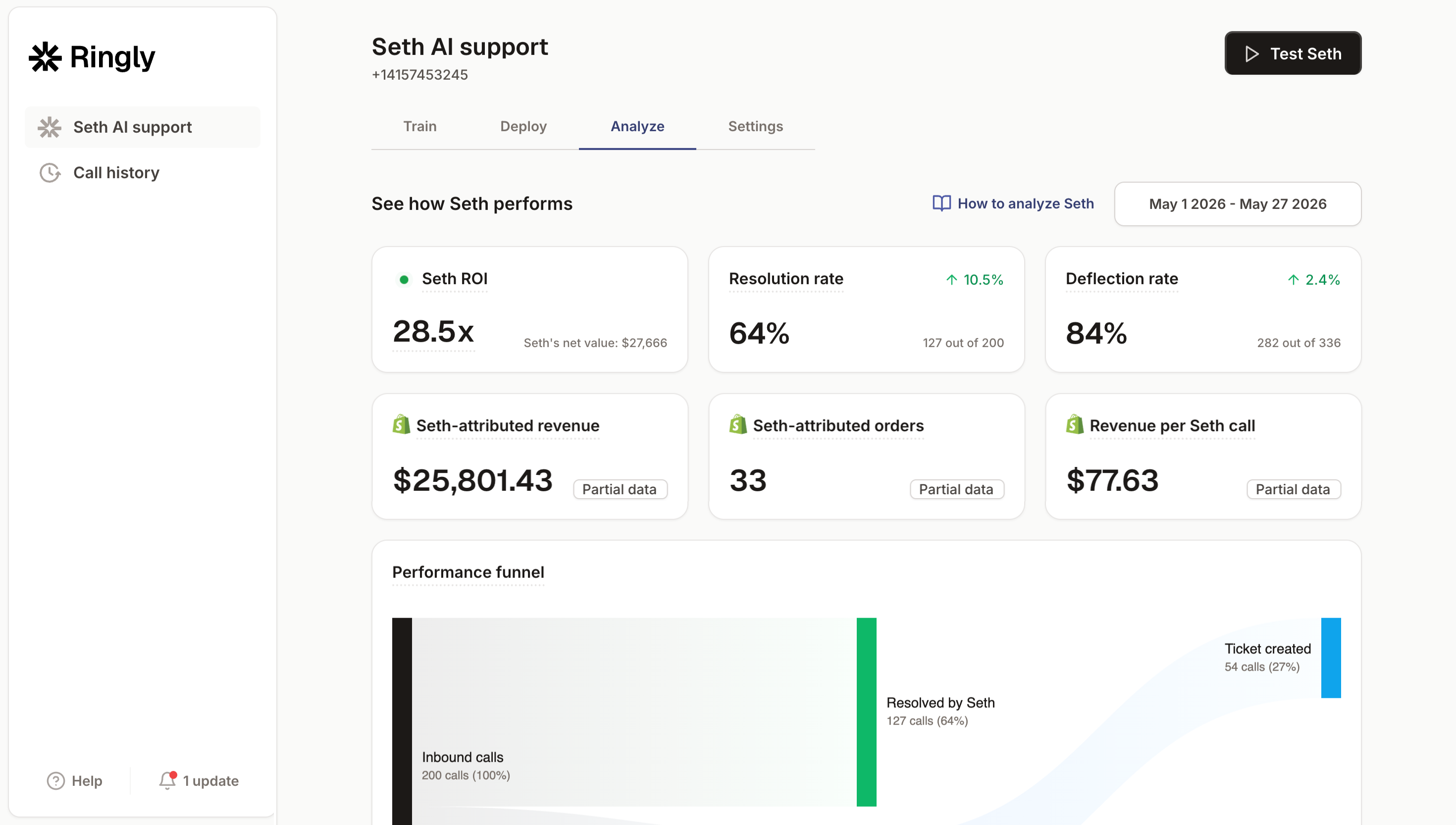
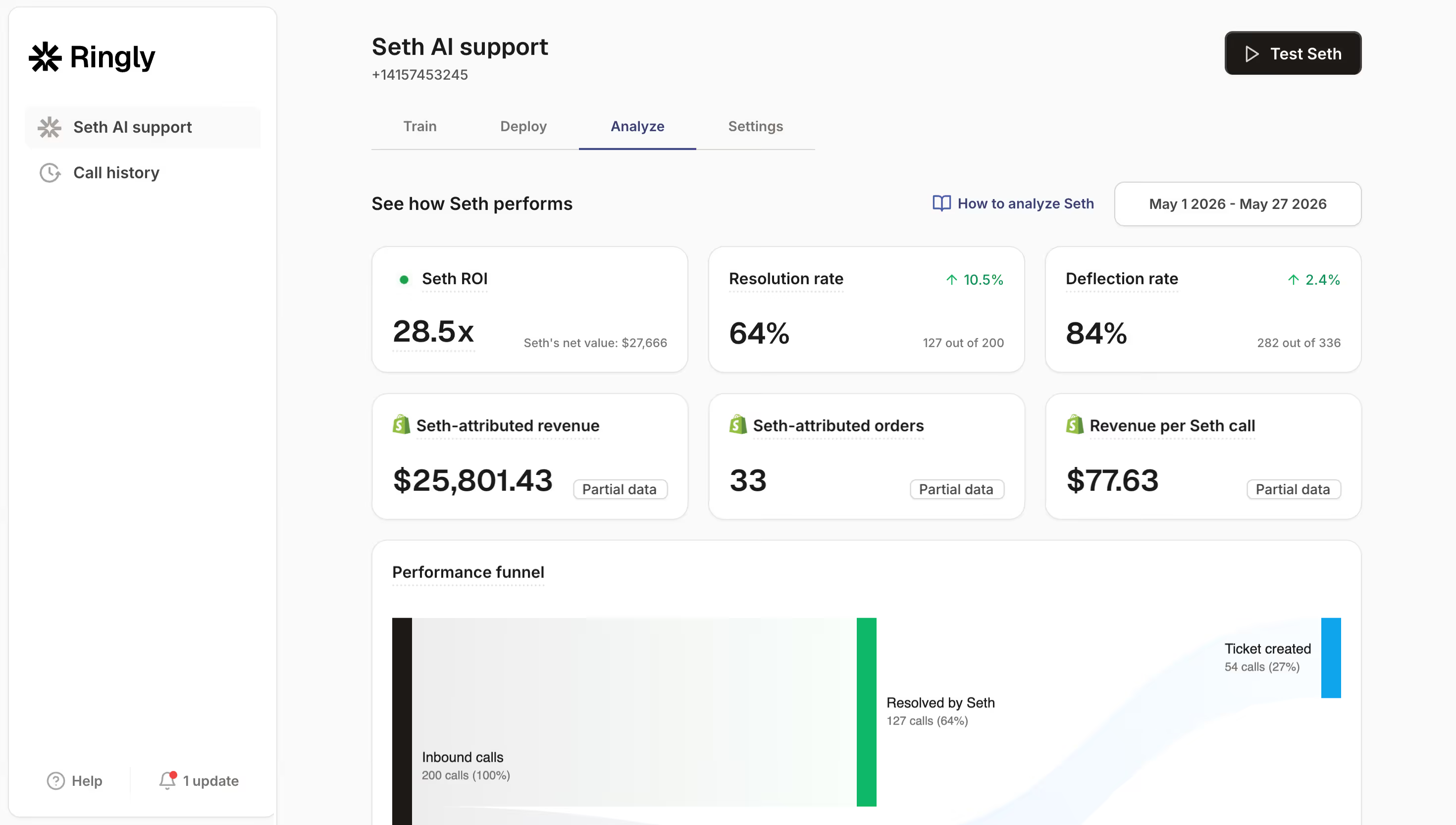
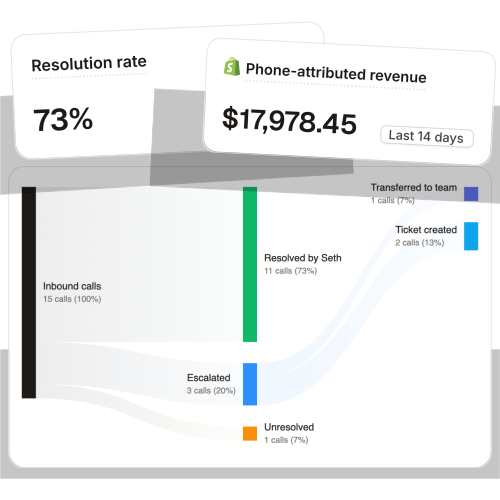
Ringly.io is AI phone support for Shopify brands. The phone shouldn't be a tax on your support team, so instead of growing headcount every time call volume climbs, the AI takes the routine inbound calls. It answers 24/7 in 40 languages, finds orders in your Shopify store, processes returns, answers product questions from your knowledge base, and rescues abandoned carts on outbound follow-up. WashCo, a Shopify brand we launched, generated $22,664 in attributed revenue in the first 7 days post-launch. Across 50+ brands, the AI resolves 73% of calls autonomously at roughly $0.42 per resolved call, and anything it can't handle escalates cleanly to the helpdesk you already run.
Pricing
| Plan | Price | Included minutes | Overage |
|---|---|---|---|
| Grow | $349/mo | 1,000 (~500 calls) | $0.29/min |
| Pro | $799/mo | 2,500 (~1,250 calls) | $0.19/min |
14-day free trial on Pro. Flat monthly plans with minutes included, so there's no per-call overage shock. See the full pricing for details.
What works
- Built for the ecommerce call mix. Order lookup, returns, and product Q&A out of the box, not bolted onto an appointment booker.
- Sits in front of your helpdesk. Plugs into Gorgias, Richpanel, Re:amaze, or Zendesk and logs every call there. You keep your stack.
- Flat, predictable pricing. Minutes are included in the plan, so a busy month doesn't blow up the bill.
- Real attributed-revenue proof. TechCraft Studio handles 88% of calls without a human, and the WashCo revenue number above is from a live dashboard, not a slide.
- 65% resolution guarantee. If the AI resolves under 65% of your calls in 90 days, we refund the last 3 months.
What doesn't
- No live-human hybrid tier. Escalations go to your team via the helpdesk, not to a Ringly-staffed human bench like Smith.ai offers.
- It doesn't take payments over the phone yet. Order taking and subscription cancel-over-phone need a custom action.
- Not for pre-revenue stores. Below real call volume, you won't feel the value.
Why it ranks first
For a Shopify brand, this is the only tool in the list built around your actual calls. Everything else is a general receptionist you'd have to bend into an ecommerce shape.
"My customers also feel like it's a normal person. They feel like they can communicate if they have questions."
Claudia Droge, TechCraft Studio
2. Smith.ai
Best for: Legal, medical, and professional-services firms that want AI plus real human agents and are fine with per-call pricing.
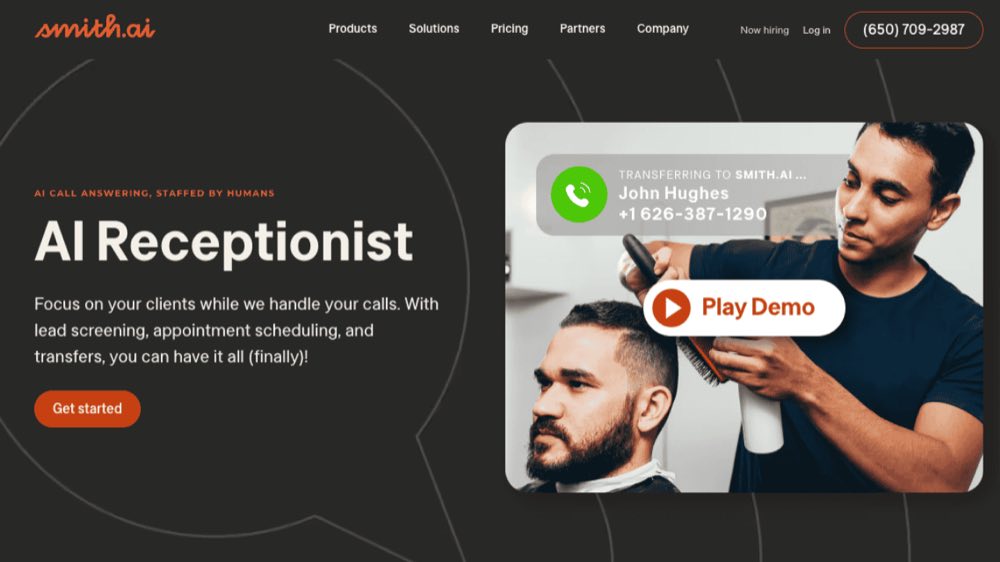
Smith.ai has been in the virtual receptionist space since 2015 and shows up on more "best AI receptionist" lists than anyone. Its differentiator is the hybrid model: AI handles first-line triage, and live North American humans take the complex calls. If you're a Shopify brand, though, none of that touches your order data. If you're weighing it for ecommerce, we broke down the gaps in our Smith.ai alternatives guide.
Pricing
Starts at $95/mo for the AI Receptionist tier (around 60 calls), with per-call overage from roughly $1.60 to $2.40 per call. The hybrid AI-plus-human plans run from $292.50/mo up to $1,950/mo. Cancellation requires emailing support, not a self-serve toggle.
What works
- Established and trusted. G2 reviewers rate it 4.6 to 4.7 out of 5, and Capterra sits around 4.4 across 89 reviews. Highest review volume in this set.
- Genuine human escalation. The AI hands off to a real person, which some buyers want.
- Spam call blocking. Filters junk before it hits a bill.
What doesn't
- Per-call pricing invites overage shock. Trustpilot reviews flag charges continuing after cancellation and automatic transfers inflating bills.
- Zero ecommerce workflow. No Shopify order lookup, no returns flow. It's built for appointment and intake businesses.
- No helpdesk fit. It won't sit in front of your Gorgias stack.
Why it ranks second
It's the strongest general-purpose receptionist here, and a solid pick for a law firm. For a store that mostly fields order questions, it's solving someone else's problem.
3. My AI Front Desk
Best for: Solopreneurs and very small businesses that want the cheapest all-channel bundle.
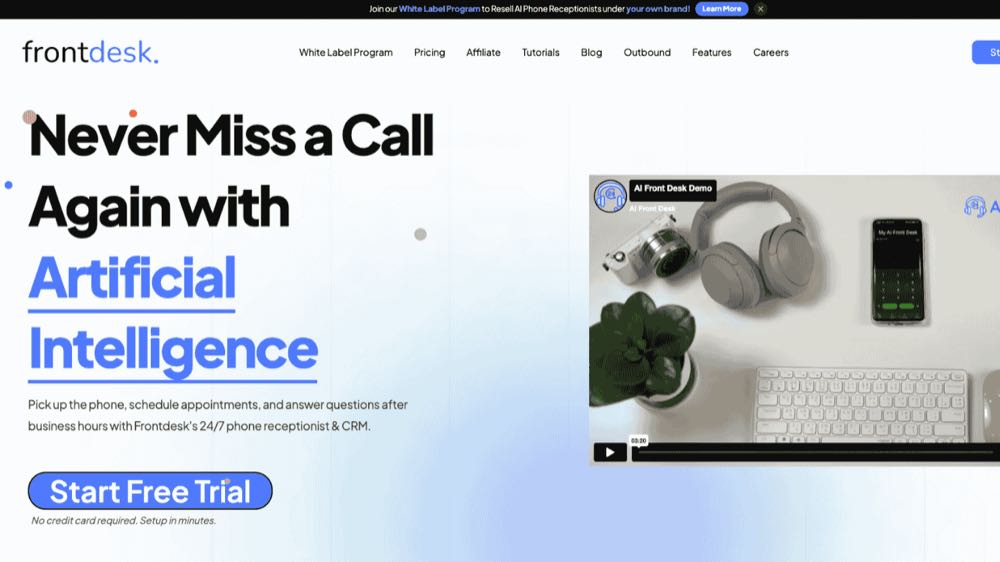
My AI Front Desk (rebranded Frontdesk in 2026) bundles voice, chat, SMS, and email into one low-cost "AI workforce." Setup is fast and there's no contract, which is a real edge over Smith.ai's email-to-cancel friction. It's a general small-business tool, not an ecommerce one.
Pricing
Basic is $20/mo (10 chatbot conversations, 40 SMS, no voice minutes). The popular "Business-in-a-Box" tier is $99/mo ($79 annual) with 200 voice minutes and 20 outbound calls a day. Voice overage runs on a credit system.
What works
- Cheapest entry point here. $20/mo to start, no contract.
- Fast setup. One reviewed source confirms the 5-minute setup claim is real for basic call answering.
- Natural-sounding voice. Sub-500ms latency, rated genuinely natural in independent review research.
What doesn't
- Rating inconsistency is a red flag. One source reports 4.9/5 on G2, another reports 2.0/5 on Capterra citing reliability issues and a HubSpot integration that reportedly never worked. Treat any single perfect score skeptically.
- Email-only support, 24-48 hour response. A misconfigured call can sit broken for two days.
- No ecommerce functionality. General scheduling and lead capture, no Shopify order data.
Why it ranks third
Cheap and quick for a one-person shop. For a Shopify brand with real volume, the reliability question and the missing order data rule it out.
4. RingCentral AI Receptionist (AIR)
Best for: Businesses already on the RingCentral phone system that want to add AI answering without switching platforms.
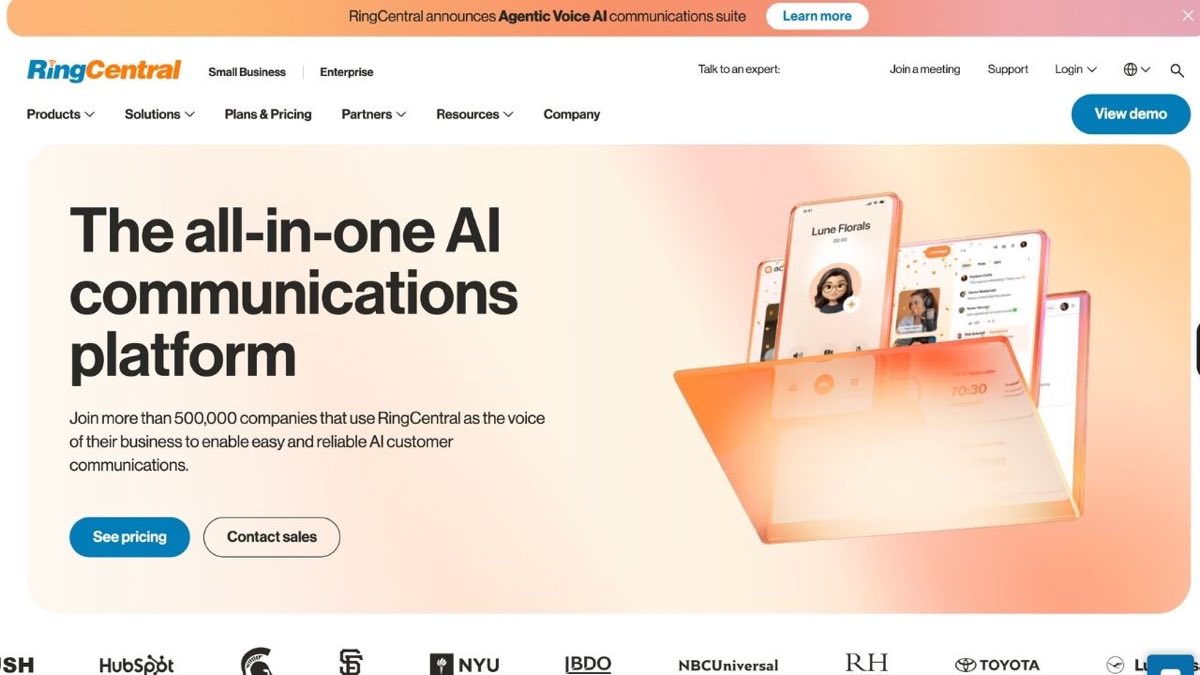
RingCentral AIR ranks first organically for the exact keyword "ai receptionist software" as a vendor landing page, largely on brand strength. It's an add-on layered on RingCentral's phone system, not a standalone tool. The named case studies are impressive but all enterprise healthcare and logistics. We compared it for ecommerce buyers in our RingCentral alternative breakdown.
Pricing
AIR runs $39-$49/mo with 100 included minutes and $0.50/min overage, but it requires the underlying RingCentral phone system at $30-$45 per user per month. A realistic single-user setup lands at $99-$114/month before you go over 100 minutes.
What works
- Backed by an established platform. Security and reliability signal from a large UCaaS vendor.
- Named enterprise case studies. Hard revenue numbers, though all outside retail.
- Natural-language routing. Positioned explicitly against rigid IVR menus.
What doesn't
- Real cost is higher than the headline. AIR alone isn't a low-cost standalone once the required phone seat is added.
- Thin independent reviews. Only about 6 G2 reviews for AIR specifically, versus 100+ for Smith.ai. Hard to verify real-world performance.
- No ecommerce case studies or Shopify workflow. Proof points are healthcare and logistics, not DTC.
Why it ranks fourth
Fine if you're already inside RingCentral. As a fresh purchase for a Shopify brand, you're paying for a phone system you didn't ask for.
5. CloudTalk
Best for: Sales and support teams already running CloudTalk as their phone system.
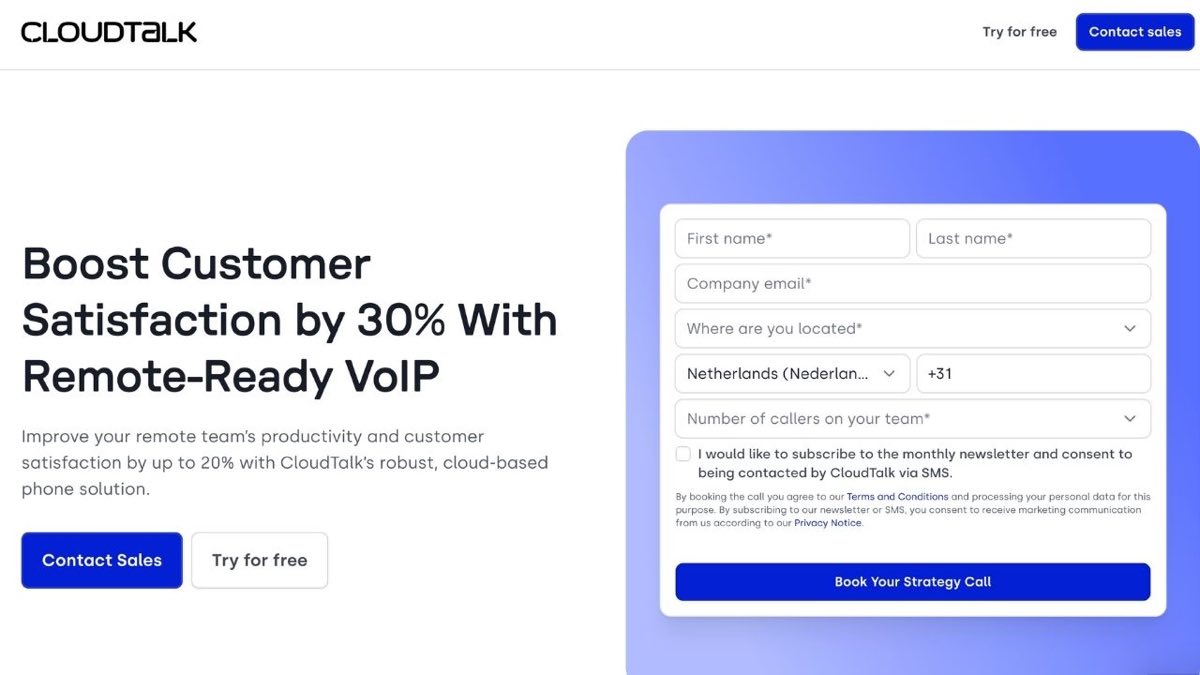
CloudTalk is a cloud phone system that layered AI voice agents (AI Receptionist and a deeper "AI Specialist") on top of its core VoIP. It's more transparent on pricing than RingCentral, but it carries the same add-on cost-stacking problem, and its case studies skew B2B SaaS. For the ecommerce view, see our CloudTalk alternatives page.
Pricing
AI Receptionist tiers run from a free 50-minute trial to €99/mo (200 min), €199/mo (500 min), and up. Base phone-system seats are separate, from roughly €19 to €69 per user with a 3-seat minimum. So the real cost is base seats plus the AI minutes tier.
What works
- Transparent per-minute tiers. Clearer published pricing than RingCentral's sales-gated model.
- Strong review volume. G2 rates it 4.4/5 across 1,738 reviews.
- Two-tier AI depth. Start with basic answering, scale to full resolution.
What doesn't
- Call-quality complaints are the top issue. G2 reviews flag "Call Issues" in 176 reviews and "Connection Issues" in 81 more (dropped calls, lag, one-way audio).
- Add-on cost stacking. Base seat price plus AI minutes, same opacity as RingCentral.
- No ecommerce workflow. Case studies are Nokia, Pipedrive, and gyms, not DTC retail.
Why it ranks fifth
A reasonable pick if CloudTalk is already your phone system. For a Shopify brand starting fresh, it's a sales-team tool wearing a receptionist label.
6. Goodcall
Best for: Low-complexity small businesses that field the same few questions all day.
Goodcall is a plug-and-play AI phone agent with a flat-rate, unlimited-minutes model that sidesteps the per-minute overage trap most competitors have. It's genuinely predictable pricing, just not built for ecommerce. Our Goodcall alternatives guide covers the ecommerce-fit gaps.
Pricing
Starter is $79/agent/mo, Growth $129, Scale $249, with unlimited call minutes on every paid tier. Overage is measured per unique customer beyond the tier cap ($0.50 each), not per minute.
What works
- Predictable pricing. Unlimited minutes removes the category's most common complaint, overage shock.
- Flat per-unique-customer model. Easier to budget than per-minute.
- Simple logic-flow builder. Fine for routing a handful of repeat questions.
What doesn't
- Overage still exists. $0.50 per unique customer over the cap, so "unlimited" has an asterisk at volume.
- No ecommerce functionality. No Shopify order data or returns flow.
- Thin public review signal. G2/Capterra volume isn't clearly available, so less to verify against than Smith.ai or CloudTalk.
Why it ranks sixth
Good value for a business fielding three repeat questions on a fixed fee. For a store with real order-status volume, it can't see the one thing your callers ask about.
What AI receptionist software costs, and how to choose
Pricing across this category is a mess, and it's usually the trap. Providers advertising $25-65/mo typically include only 30-50 minutes. A business averaging 42 calls a month at 3 minutes each needs about 126 minutes, so on a $29/mo plan with $0.50/min overage the real cost balloons to roughly $67/mo, before any CRM or scheduling add-ons (per Upfirst's cost breakdown). Per-minute and per-call models are the norm; a flat plan with minutes included is the exception.
That's the case for a flat plan over a metered one when your volume isn't tiny. Here's the cost-displacement math most brands are actually weighing:
What this costs you today vs what it costs with Ringly
Take a typical Shopify brand running a 6-rep CS team:
| Line item | Today | With Ringly |
|---|---|---|
| 6 reps × $4K loaded per rep | $24,000/mo | n/a |
| Ringly, done-for-you (illustrative ~$5K/mo all-in) | n/a | $5,000/mo |
| Net monthly CS spend | $24,000/mo | $5,000/mo |
| Monthly savings | n/a | $19,000/mo |
| Annual savings | n/a | $228,000/yr |
That's roughly 70% of repeatable calls (order status, returns, product questions, the same five things over and over) routed to the AI. The other 30%, the actually complex calls, still go to your CS team, who now have time to solve them. A rep on $4K a month loaded is a lot to pay for someone reading tracking numbers off a screen all afternoon.
Speed is the other half of the money. Roughly 78% of customers buy from the first business to respond (LeanData), and the average missed call costs about $12.15 (Ambs Call Center, 2025). Every voicemail nobody calls back is a sale you probably lost. If phone support is eating your team's day, start a 14-day free trial and test it on your own calls. We set the agent up for you.
Here's how to actually choose:
- Choose Ringly if you run a Shopify store, most of your calls are order status and returns, and you want it plugged into Gorgias without ripping anything out.
- Choose Smith.ai if you're a law firm or medical practice that wants AI plus a real human bench and doesn't mind per-call pricing.
- Choose My AI Front Desk if you're a solopreneur who wants the cheapest possible all-channel bundle.
- Choose RingCentral AIR if you already run RingCentral and just want to bolt on AI answering.
- Choose CloudTalk if CloudTalk is already your phone system and you want tiered AI depth.
- Choose Goodcall if you're a simple local business fielding a few repeat questions on a flat fee.
The pattern: if your phone rings with "where's my order" more than "can I book an appointment," the ecommerce-native tool wins. If it's the reverse, one of the general receptionists fits better. You can compare the whole ecommerce call center approach if you want the fuller picture, or read up on handling WISMO calls specifically.
Frequently asked questions
What is AI receptionist software? It's a voice agent that answers your business phone, understands what the caller wants, and either resolves the request or routes it to the right place. For an ecommerce brand that means looking up orders, handling returns, and answering product questions, not just taking a message.
Is virtual receptionist software the same thing? Mostly, yes. "Virtual receptionist software" and "AI receptionist software" describe the same category. The older "virtual receptionist" term sometimes refers to human answering services, so check whether a given product is AI-first or a staffed call center before you buy.
What's the best AI receptionist for a Shopify store? For a Shopify or Shopify Plus brand, the best fit is a tool built around your order data, so it can answer "where's my order," process returns, and pull product answers from your knowledge base. Ringly.io is built specifically for that. Most general receptionists can't see your Shopify orders at all.
Does AI receptionist software integrate with Gorgias or my helpdesk? The ecommerce-native ones do. Ringly sits in front of Gorgias, Richpanel, Re:amaze, Zendesk, and Intercom, logs every call there, and escalates cleanly. Most general-purpose receptionists (Smith.ai, Goodcall, My AI Front Desk) don't plug into an ecommerce helpdesk stack.
Can it handle "where's my order" calls? Only if it connects to Shopify. A tool with live order lookup pulls the order mid-call and tells the caller the status without a human. Appointment-focused tools can take a message but can't answer the question, which is why the Shopify integration is the thing to check first.
Will customers know it's AI, or does it sound robotic? Voice quality varies a lot by platform, and it's worth testing. Some tools get praised as natural (Dialzara, My AI Front Desk), others get called robotic. "You don't sound like AI" is the single most common compliment we hear across 50+ Shopify brands, so it's a real, differentiating axis, not a commodity.
AI receptionist software vs a human answering service? A human service costs more per call and doesn't scale with volume without more hiring. AI handles the routine 70% at a fraction of the cost and 24/7, then escalates the complex calls to your team. Most brands run AI first with a human escalation path, not one or the other.
How much does AI receptionist software cost? Entry points range from about $20/mo (My AI Front Desk) to $95/mo (Smith.ai) to $349/mo (Ringly). Watch the model: per-minute and per-call plans with low headline prices often balloon past $60/mo once you use real minutes. Flat plans with minutes included are more predictable.
Does Ringly offer a guarantee? Yes. If the AI resolves under 65% of your calls in 90 days, we refund the last 3 months of subscription fees.
How fast can I get set up? Live in under an hour. Add your website, docs, or knowledge base and the AI is ready to answer calls.
Talk to us

If your phone rings with "where's my order" more than "can I book an appointment," most of the tools on this list are solving someone else's problem. The fastest way to see the difference is to hear the AI answer your own store's calls.
The 3-layer guarantee.
- Live in 14 days or it's free until launched.
- 65% resolution in 90 days or we refund the last 3 months of subscription fees.
- We keep working free until we hit 65%.
Ruben (Ringly co-founder) takes these calls personally.
Start your trial today and you get:
- A free dedicated phone number to test on, so you hear it answer real calls the same day.
- The agent built for you. We set it up, you lift zero fingers.
- It plugs into your helpdesk. Gorgias, Richpanel, Re:amaze, Zendesk, or whatever you already run.
Start your 14-day free trial →
Rather talk it through first? Book a 30-min call.