
This post in 30 seconds.
- A 4.8 on G2 and a 4.6 on G2 are both real, and neither one tells you whether the phone agent will hold up for your store. The star is the least useful number on the page.
- The reviews lump three completely different product categories together. Sort them first and most of your confusion goes away.
- Built for founders and CX leads at $10M-$100M Shopify brands running a paid helpdesk and a visible phone line.
Retell AI carries a 4.8 on G2 across more than 2,200 reviews. Gorgias sits at 4.6 across 555. Both numbers are real. Both are high. And if you run a Shopify brand and you're trying to decide whether either one will actually hold your phone line after 6 p.m., neither number tells you much.
That's the problem with reading AI phone support reviews. You read them defensively, because somewhere in the last two years a tool demoed well for you and then fell over in production. So you scroll the stars, scan a few quotes, and still can't answer the one question you care about: will this work for a store like mine?
This post is about reading past the star. I'll show you the five things the rating hides, the three categories of tool the reviews quietly lump together, what real G2, Capterra, Trustpilot, and Shopify App Store reviews actually say across them, and where each one fits if you're running phone support on Shopify.
If you're a founder or Head of CX at a $10M-$100M Shopify brand, drowning in after-hours calls and the same questions over and over, the reviews you're reading were mostly written by people who don't share your problem. Book a 30-min call and we'll read your own call logs together instead.
In this post:
- How I read the reviews for this post
- The 5 things the star rating hides
- The 3 categories of tool the reviews lump together
- What a useful AI phone support review actually contains
- Where Ringly fits, and where it doesn't
- What this costs vs what the reviews don't price
- How to choose by what you're optimizing for
Here's the fast version before the deep dives.
| Category | Example tools | Public review signal | Who writes the reviews | Best for |
|---|---|---|---|---|
| Done-for-you Shopify phone agent | Ringly | 5.0 Shopify App Store, smaller volume | Operators (founders, CX leads) | $10M-$100M Shopify brands offloading routine calls |
| Voice-AI dev platforms | Retell, Vapi, Bland | Retell 4.8 / 2,200+; Vapi ~3.8 | Developers and builders | Teams with engineers who want to build their own agent |
| Helpdesk AI add-ons | Gorgias Sidekick, Intercom Fin | Gorgias 4.6 / 555 | Support managers | Chat and email first, phone is the weak channel |
| Enterprise support agents | Sierra, Decagon | Mixed, thin public volume | Fortune 500 buyers and procurement | $200K+ year-one budgets, brand-critical CX |
| Shopify-native voice | Consio | Mostly positive on the App Store | Shopify merchants | Outbound revenue and abandoned-cart recovery |
| SMB answering services | Goodcall, Smith.ai | Smith.ai 4.5 / 156 | Small-business receptionist buyers | Receptionist coverage, not high-volume support |
How I read the reviews for this post
I'm Ruben, co-founder of Ringly. We run AI phone support for Shopify brands, so I read these reviews constantly, not as a critic but as someone who has to know what's true before a customer asks me.
For this post I read the public reviews for every tool below across G2, Capterra, Trustpilot, and the Shopify App Store. Then I called the ones with a public phone line at 11 p.m. on a Tuesday to hear what a real after-hours call sounds like. Then I cross-checked every recurring complaint against the actual call logs of the brands we run.
Here's what I scored each review on:
- The body, not the star. I ignored the headline number and read the 1, 2, and 3-star reviews first. That's where the deal-breakers live.
- The reviewer's role. A developer rating a voice platform and a CX lead rating a support agent are answering different questions. I sorted every review by who wrote it.
- The billing complaints. I traced every "the bill kept climbing" review back to the pricing model that caused it.
- The escalation story. I looked for what happened when a call went sideways: looping, dead air, a clean handoff, or a customer stuck talking to a wall.
- The phone test. Where a tool had a number, I called it and noted whether it sounded like a person or a script.
One note on where the reviews live now. G2 acquired Capterra, GetApp, and Software Advice in January 2026, so a large share of the software reviews you read sit under one roof. That doesn't make them wrong. It does mean "I checked another site" often means you checked the same database twice.
The most useful thing I can teach you here is to stop reading the star and start reading who wrote it.
The 5 things the star rating hides
The rating is an average of a lot of different jobs. Here are the five it papers over.
1. It conflates voice quality with the work
Retell's 4.8 is largely a vote on voice and setup speed. Reviewers describe the speech as "shockingly natural" and the build as fast. Great. But Retell's own G2 profile shows 87 separate mentions flagging cost and complexity, and reviewers say plainly it's "not designed for business users." A natural voice and a finished support operation are two different products. The star rates the first one.
2. It hides the billing model
This is the one that bites Shopify operators. Gorgias holds a 4.6 across 555 G2 reviews, and the praise is genuine on the Shopify integration. The recurring complaint underneath it is billing. One widely-shared teardown documents a $360 plan turning into a $960 bill, with AI resolutions billed at $1.50 each on top of the plan and every AI resolution also counted as a billable ticket. The 4.6 doesn't warn you. The body does.
A high star rating with a wall of billing complaints underneath it is a pricing-model problem wearing a customer-satisfaction costume.
3. It hides whether you need an engineering team
Plenty of the highest-rated voice tools are rated by developers who can build. If you're a 40-person Shopify brand without a voice engineer, a 4.8 from people who do this for a living is not a prediction about you. Retell reviewers say it has no full visual builder and lacks no-code workflows. The rating is high and the tool is not for you. Both things are true.
4. It hides escalation quality
The hardest moment for any AI phone agent is the call it can't finish. Enterprise reviewers of Sierra and Decagon report context loss in longer conversations and voice latency past 700ms that creates awkward pauses. A roundup from Assembled lists "looping behaviors and difficult escalation paths" as a category-wide weakness. None of that shows up in a 4-star average. It shows up at 11 p.m. when a customer is angry and the agent won't hand off.
5. It hides who wrote it
A developer, a Fortune 500 procurement lead, and a small-business owner buying a receptionist are three different buyers. They each leave 5-star reviews for three different reasons. If the reviewer's job doesn't look like yours, their star isn't your forecast.
When you do read the bodies, a few patterns tell you more than any average. A review that praises the demo but goes quiet on month-three performance is a yellow flag. A review that mentions a named onboarding contact and a specific resolution number is worth ten that say "great product, easy to use." And a recent uptick in 1-star reviews all mentioning the same word, "billing," "latency," "support," usually means something broke and hasn't been fixed yet. Reviews are most honest in their patterns, not their stars.
The 3 categories of tool the reviews lump together
Once you sort the reviews by what the product actually is, the whole space gets readable. There are three categories, and they get reviewed by three different people. The same word, "great," means a different thing in each one. In the first it means the voice is natural. In the second it means the chat AI resolved a ticket. In the third it means a six-figure deployment finally went live. None of those is the same as "it held my phone line on a Saturday."
Voice-AI dev platforms
Best for: teams with engineers who want to build and run their own agent.
These are the build-it-yourself layers: Retell, Vapi, and Bland. The reviews are written by developers, so they're glowing on voice and flexibility and grumpy on pricing and support.
Retell sits at 4.8 across 2,200+ reviews, the strongest profile in the category. Vapi runs around 3.8 on G2 with a lower Trustpilot, and its cost lands between $0.13 and $0.31 per minute once you add telephony, transcription, and a model. Bland charges from $0.12 to $0.14 per minute and gets praised for outbound and dinged for inbound latency.
The reviews are accurate and they're answering a builder's question, not an operator's. If you don't have an engineer who's going to own this, a great score here is not a great score for you.
Helpdesk AI add-ons
Best for: brands whose pain is chat and email volume, with phone as a secondary channel.
These bolt AI onto a helpdesk: Gorgias Sidekick and Intercom Fin. Support managers write the reviews, and they're sharp on resolution and sharper on billing. Fin reports 67% resolution across 7,000+ customers, with ecommerce brands landing 70-84%, which is real. The catch is that these are chat-first. Phone is the channel they do last and weakest, and the billing complaints on Gorgias are the loudest theme in the body of the reviews.
If your actual problem is the phone, a strong chat-AI review is the wrong proof to buy on.
Enterprise support agents
Best for: Fortune 500 brands with a $200K+ year-one budget and an implementation team.
Sierra and Decagon resolve end-to-end and are genuinely good at it. They're also reviewed by people whose company looks nothing like a $30M Shopify brand. Sierra's year-one budget runs $200K-$350K and up, pricing is quote-only, and reviewers cite a steep build and the need to involve the vendor's team to edit the agent. Decagon's enterprise contracts run from $95K to $590K+. The reviews are positive and they're describing a procurement process you don't want to run for a phone line.
There's also a Shopify-native option here worth naming. Consio gets mostly positive App Store reviews, led by outbound abandoned-cart revenue, with one negative thread about phone-number support and a billing dispute. It's a real merchant tool, more outbound-revenue than done-for-you support.
What a useful AI phone support review actually contains
After reading a few hundred of these, the genuinely useful ones share a shape. They almost always name a real call type, give a real number, and admit a real limit.
- A specific call type. "Handles our WISMO and returns calls" is useful. "Great AI" is not. The reviewer who names the calls is telling you what the tool was actually tested on.
- A real resolution number. A review that says "it resolves about 70% of our calls without us" is worth more than five stars with no figure. Numbers are harder to fake than adjectives.
- An admitted limit. The most trustworthy reviews say what the tool can't do. "It can't cancel subscriptions yet, so those still route to us" is the line that tells you the reviewer actually uses it.
- A timeframe. "Six months in" beats "just set it up." Most AI phone tools demo well. The reviews that matter are written after the honeymoon.
- A named human. Done-for-you tools live and die on the team behind them. A review naming an onboarding contact and what they fixed is a review of the thing you're actually buying.
If a review has none of those, it's a vibe, not evidence, no matter how many stars sit next to it. When you write your own shortlist, weight the reviews that have all five and quietly discount the rest. That single habit will save you from the tool that scores a 4.8 and still can't do your job.
Where Ringly fits, and where it doesn't
I'll review my own tool the same way I'd want you to read everyone else's: with the limits named.
1. Ringly
Best for: $10M-$100M Shopify brands that want the routine inbound calls handled without hiring a phone team. Ringly.io is AI phone support for Shopify brands. Instead of growing headcount every time call volume climbs, the AI takes the order-status, returns, and product questions so your reps get their time back.
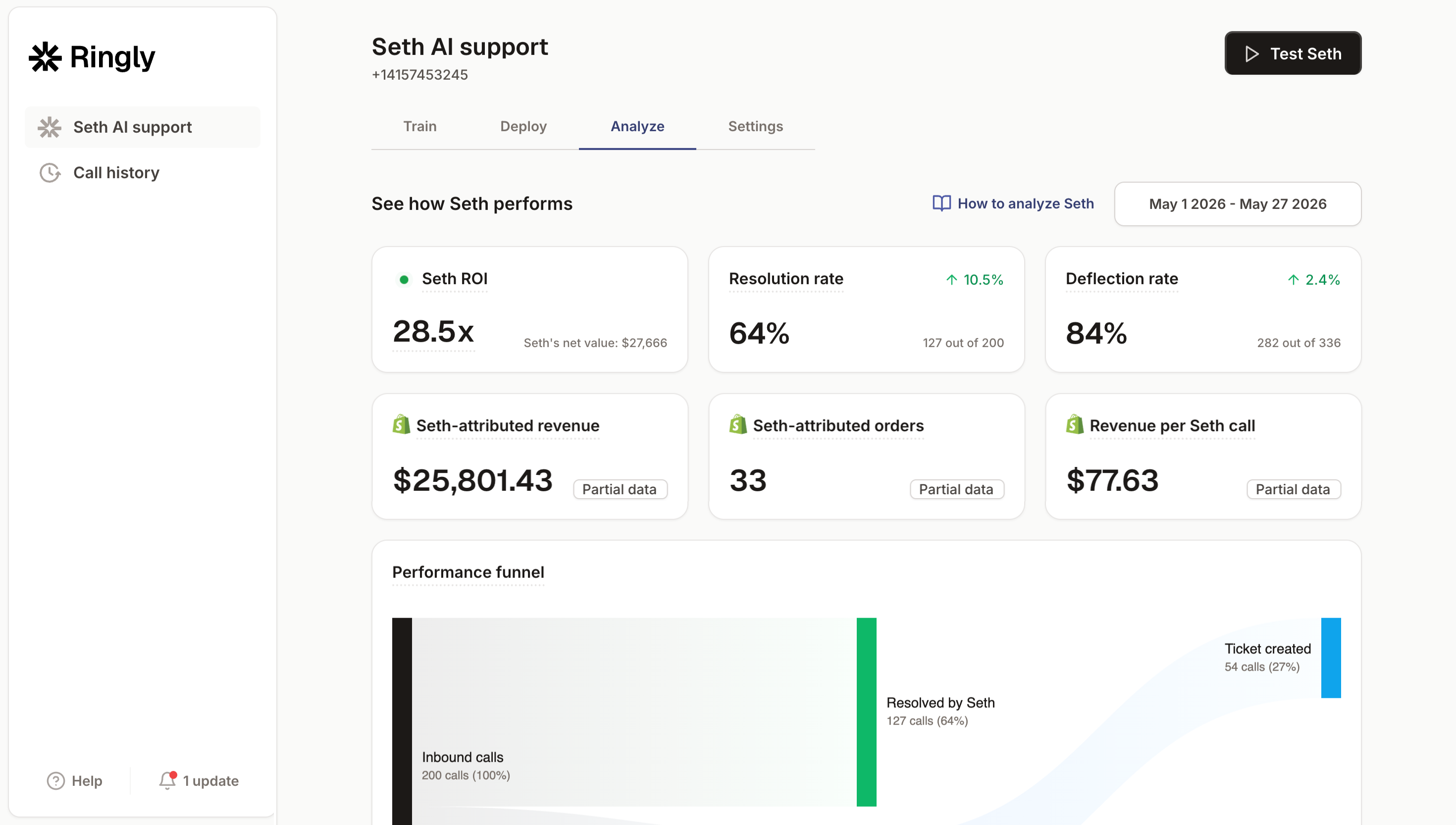
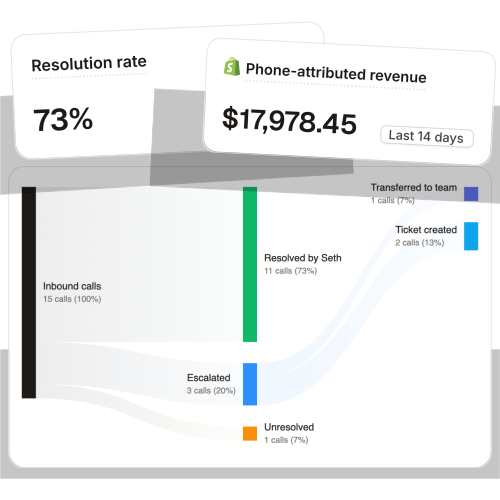
The AI answers inbound calls 24/7 in 40 languages, finds orders in your Shopify store, processes returns, answers product questions from your knowledge base, and cancels orders when a caller asks. It resolves up to 90% of calls autonomously. Calls that need a human escalate cleanly to Gorgias, Richpanel, or whatever helpdesk you already run. WashCo, a Shopify brand we launched, recovered $22,664 in its first 7 days on the phone.
Pricing
| Plan | Price | Included | Best for |
|---|---|---|---|
| Pay per call | $99 a month | 50 conversations, then $1.99 each | Shopify brands taking support calls |
What works
- Done-for-you build: we build and run the agent and an engineer reviews about 10 of your calls a week. You don't become the implementation team.
- Native Shopify: orders, returns, and KB product questions resolve without custom dev.
- It sits in front of your helpdesk: keep Gorgias or Zendesk, the AI just handles the routine calls first.
- The voice holds up: the single most repeated thing customers say is "you don't sound like AI."
What doesn't
- Subscriptions are a custom action, not a default. If cancel-and-manage flows are your top call type, that's a setup conversation.
- No phone-orders: we use an SMS payment-link workaround instead of taking card numbers by voice.
- Inventory is a daily refresh, not real-time.
- Not an all-in-one: Ringly does phone. If you want one tool to do chat, email, and voice equally, this isn't it.
Why it's row 1 for Shopify phone
If the channel you're actually fixing is the phone, and you want it built and run rather than handed to you as software, this is the category-fit answer. It's not the cheapest option and it's not for someone who wants to build their own.
"My customers also feel like it's a normal person. They feel like they can communicate if they have questions."
Claudia Droge, TechCraft Studio
A reviews post is the wrong place to oversell, so here's the honest line: we have fewer public reviews than Retell or Gorgias because we're smaller, with 50+ active brands. Read that the way I told you to read everyone else, by the body and the role, not the count.
What this costs vs what the reviews don't price
The thing no review shows you is the comparison that actually decides this: the agent against your current payroll.
Take a typical $50M Shopify brand running a 6-rep CS team.
| Line item | Today | With Ringly |
|---|---|---|
| 6 reps x $4K loaded per rep | $24,000/mo | n/a |
| Ringly Enterprise (~$5K/mo) | n/a | $5,000/mo |
| Net monthly CS spend | $24,000/mo | $5,000/mo |
| Monthly savings | n/a | $19,000/mo |
| Annual savings | n/a | $228,000/yr |
That's roughly 70% of repeatable calls, the same five questions over and over, routed to the AI. The other 30%, the genuinely hard calls, still go to your team, who now have the time to actually solve them. The star rating on any tool will never run this math for you, because it can't see your loaded cost per rep.
If you want that number for your store instead of a generic example, book a 30-min call and we'll do it live.
How to choose by what you're optimizing for
Skip the ranking. Pick by what you're actually solving.
- Choose a voice-AI dev platform (Retell, Vapi, Bland) if you have an engineer who will own the build and you want maximum control. The high ratings are real for you specifically.
- Choose a helpdesk AI add-on (Gorgias Sidekick, Fin) if your pain is chat and email volume and phone is secondary. Read the billing terms twice.
- Choose an enterprise agent (Sierra, Decagon) if you're a Fortune 500 brand with a $200K+ budget and a team to run the implementation.
- Choose an SMB answering service (Goodcall, Smith.ai) if you need receptionist coverage, not high-volume support deflection.
- Choose a done-for-you Shopify phone agent (Ringly) if the phone is your problem, you're a $10M-$100M brand on a paid helpdesk, and you'd rather it be built and run than handed to you.
If you want to see how this maps to real call volume, our breakdowns of WISMO calls and 24/7 ecommerce phone support go deeper on the patterns behind the numbers, and the ecommerce phone support guide covers the full picture.
Frequently asked questions
Are AI phone support reviews on G2 trustworthy? Mostly, yes, but read the body, not the star. After G2 acquired Capterra, GetApp, and Software Advice in January 2026, a large share of the reviews you'll read sit in one database, so cross-checking sites checks the same source twice. The signal that matters is who wrote the review and what their job is.
Why do AI phone agents have high star ratings but mixed real-world results? Because the rating averages a lot of different jobs. A developer rating a voice platform on naturalness and a Shopify operator needing 24/7 done-for-you support are not measuring the same thing. The star is high for the reviewer's use case, which may not be yours.
What's the difference between a voice-AI platform review and a support-agent review? A voice-AI platform (Retell, Vapi) is build-it-yourself and gets reviewed by developers on voice quality and flexibility. A support agent is built and run for you and gets reviewed by operators on resolution and reliability. A 4.8 in the first category tells a non-technical operator almost nothing.
Why are AI helpdesk billing complaints so common in reviews? Because per-ticket and per-resolution pricing compounds as volume grows. One Gorgias teardown documented a $360 plan becoming a $960 bill, with AI resolutions billed at $1.50 each and double-counted as tickets. The star rating won't flag this, the 2-star reviews will.
How many reviews should a tool have before I trust the rating? There's no magic number, but read review depth over review count. A tool with 50 detailed operator reviews from brands like yours beats one with 2,000 reviews from a different kind of buyer. Thin volume isn't automatically bad, it just means you read the bodies more carefully.
Do AI phone agents really sound human? The best ones genuinely do. Across our brands the single most repeated customer comment is "you don't sound like AI." The way to verify any vendor's claim is to call their public line yourself and listen.
What does Ringly cost and is there a guarantee? Ringly is priced on Pay per call: $99 a month for the first 50 conversations, then $1.99 each. Yes, there's a guarantee: if Seth resolves under 65% of your calls in a month, that month comes back as credit (after 90 days on Pay per call).
Does Ringly work with my current helpdesk? Yes. Calls that need a human escalate cleanly to Gorgias, Richpanel, Reamaze, or whatever helpdesk you already run. You control what escalates and keep your current phone number and workflows.
How fast can I get set up? Live in under 1 hour, and we can do the full build for you. We do the building, not you.
Talk to us

If you run a $10M-$100M Shopify brand and you're trying to read past the star rating, a 30-min call is the fastest way to see what your own call logs would say. We'll pull your last week of missed calls and show you what the AI would have handled.
Our 3 promises.
- Live in under 1 hour. Setup and test calls are free.
- 30-day money back on the $99 plan fee.
- 65% resolution guarantee: if Seth resolves under 65% of your support calls in a month, that month comes back as credit (after 90 days on Pay per call).
Ruben (Ringly co-founder) takes these calls personally.