


Gourmet and specialty-food brands get a specific kind of phone call.
- The mix is its own animal: "will my order arrive before Christmas," "is the coffee still fresh," "I want to send this as a gift," plus the older customer who'd rather call than touch the website.
- One Shopify brand on Ringly handled 1,595 calls in 90 days without a phone rep on payroll.
- Written for founders, COOs, and Heads of CX at $10M-$100M Shopify gourmet and specialty-food brands running a paid helpdesk and a visible phone line.
If you run a gourmet food brand, the phone doesn't behave like the rest of your support. Most of your tickets sit in email or chat. The phone is where the gift orders, the perishable-shipping panic, and the customers who don't trust the website all show up. And it gets loud right when you can least afford it, the eight weeks before the holidays.
This is the operator's version of what an AI phone agent does for a brand like yours, what it can't do, and how to get it answering before the gifting season buries your team.
Most specialty-food teams I talk to are running four or five reps year-round and scrambling to hire seasonal help by October. We've put AI phone agents live for 50+ Shopify brands trying to break that cycle. Book a 30-min call and we'll pull your last week of missed calls and show you what's actually slipping through after 6 p.m.
What an AI phone agent actually does for a food brand
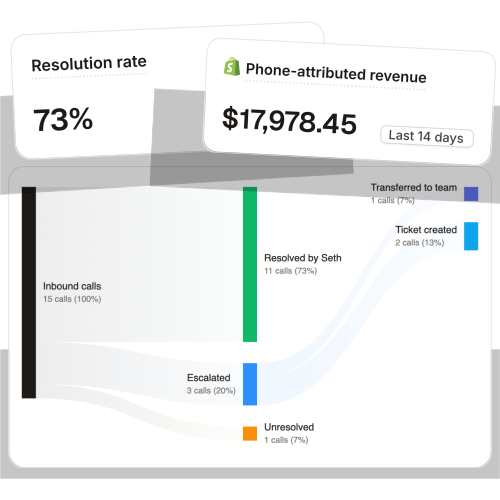
Strip away the category jargon and it's simple. An AI phone agent picks up your inbound calls, 24/7, and handles the routine ones end to end. It finds the order in your Shopify store, reads back the shipping status, processes a return or exchange, and answers product questions from the knowledge base you already wrote. When a call needs a human, it hands off cleanly to your existing helpdesk.
The point isn't to replace your team, it's to take the same five questions off their plate so they can actually solve the hard ones. A Shopify voice agent that handles order status and "where's my package" frees your reps for the gift-gone-wrong call that needs a real person.
Across 50+ Shopify brands, the AI resolves about 73% of inbound calls on its own, at roughly $0.42 per resolved call. Compare that to the $7-$16 a human-handled call runs at most outsourced call centers. Gear Rider, a specialty brand on Ringly, handled 1,595 calls in 90 days without a phone rep on the payroll. That's the volume an agent quietly absorbs while your team sleeps.
It plugs into the stack you already run. Keep your phone number, keep your order-tracking setup, keep Gorgias or Zendesk or whatever helpdesk you've got. The agent sits in front of it and only escalates what it should.
A few things tend to surprise food operators the first time they see it run. It answers in 40 languages, which matters more than you'd think if you ship gift boxes to a customer's relatives abroad. It works the abandoned-cart angle too: if someone gets halfway through a $90 order and bails, the agent can follow up by phone to recover it, which is its own line of voice-agent revenue. And it never has a bad Monday. The tone on call 300 is the same as call one, which is not something you can promise a human team in the back half of December.
The calls a gourmet food brand actually gets
Here's where the generic AI pitches fall apart. They talk about "support volume" like every brand gets the same calls. You don't.
I went through the call logs of the food and beverage brands running on Ringly and counted what people actually call about. The pattern is consistent, and it's different from a supplement brand or an apparel store.
- Shipping and freshness, together. Not just "where's my order." It's "will it still be cold when it lands" and "can you ship it so it arrives Friday, not Monday." Perishables make every ETA question a freshness question too.
- Gift orders. Address changes, gift receipts, "can you not include the price," "send a second one to my mother." Gifting turns one order into three follow-up calls.
- Product questions in real language. Customers ask about "the dark roast" or "this year's harvest," never a SKU. They want the knowledge base answer in plain terms: roast date, allergens, shelf life, how to store it.
- The classic WISMO call. "Where is my order" runs 30-40% of all tickets in a normal week and over 50% at peak, per Salesforce. On the phone it's often the older customer who didn't get a tracking email or doesn't know where to look for it.
The brands that lose customers here aren't bad brands, they just can't pick up fast enough. Look at the public reviews of any big gourmet name and you'll see it. One Goldbelly customer's perishable order spoiled in transit and got a "not our issue." Black Rifle Coffee callers have described the automated line telling them it's busy, then disconnecting with no option to wait. Trade Coffee has shipped the wrong grind because a website setting was confusing and nobody picked up to fix it. None of these are product failures. They're answered-the-phone failures.
According to PCN's 2026 study, 85% of callers who can't reach a person never call back, and 62% switch to a competitor. For a brand selling a $60 gift box, one dropped call at the wrong moment is a lost customer and a one-star review.
There's a second-order cost too. A gourmet customer who calls about a gift is usually a high-value repeat buyer, the person who sends six boxes every December. Lose them on a Tuesday-night call and you don't lose one order, you lose a decade of them. That's the retention math that makes the phone matter more for food brands than the raw call count suggests. The reason it gets missed is mundane: a five-person team physically cannot answer the line and clear the email queue at the same time, so the phone is the first thing to slip.
The gifting-season spike is the real test
Any AI phone agent looks fine in July. The question is what happens in the second week of December.
Holiday ticket volume jumps 200-500% between November and January, and some stores hit 3-4x their normal daily volume the week before Christmas, per CustomerThink. Then the bill comes due in January: one customer-service firm predicted a 45% jump in post-holiday returns, with average resolution time climbing 28% as teams drown.
Your options have always been bad. Hire and train seasonal reps in October for a spike that lasts six weeks, or let the calls roll to voicemail and eat the lost gift orders. Training a rep takes weeks, and replacing one costs around $14,113 per Gartner. For a six-week season, the math never really works.
An AI phone agent doesn't care that it's December 18th. It answers the 11th simultaneous call the same way it answers the first. You staff for your baseline and let the agent absorb the spike, instead of paying a seasonal team to wait for the next one.
What this costs a $20M specialty food brand
Run the numbers on a typical $20M gourmet brand:
| Line item | Today | With Ringly |
|---|---|---|
| 4 reps × $4K loaded, year-round | $16,000/mo ($192K/yr) | — |
| 4 seasonal reps × $4K × 3 months | $48,000/yr peak | — |
| True annual CS spend | ~$240,000/yr | — |
| Ringly (handles routine + the gifting spike) | — | ~$3K-$5K/mo |
| Net annual savings | — | ~$140K-$180K/yr |
That's the routine 70% (order status, gift questions, roast-date, WISMO) on the AI, and your team handling the genuinely hard 30% with time to do it well.
What happens on the call.
- We pull your last 7 days of missed calls live, on the call. No homework for you.
- We show you the recovered revenue at the resolution rates we see for food and beverage brands.
- You decide if it's worth a deeper conversation. No deck, no follow-up sequence.
The call makes sense if:
- You're a Shopify or Shopify Plus brand doing $10M-$100M
- You run a paid helpdesk (Gorgias, Zendesk, Gladly, Re:amaze, or Intercom)
- You have a visible phone number on your store
- Your CS team is 3-12 people
If that's you, book a 30-min call and we'll run the gifting-season math live on your store. The best time to fix the leak is before the season, not after it.
The honest part: can it take orders over the phone?
This is the first question almost every gourmet brand asks, because so many of your older customers call specifically to place an order. So here's the straight answer: not natively, no.
The AI doesn't run a checkout over voice. What it can do is text the caller a payment link so they complete the order on their phone, or transfer them to a human when a person genuinely needs to take it. If more than half your revenue comes from phone orders, you're not our fit yet, and we'll tell you that on the call rather than waste your season. A couple more honest limits: subscription cancellations run through a custom action, and inventory refreshes daily, not in real time.
What it does handle is the part that's killing your team: the after-hours WISMO, the gift-receipt request, the "is this gluten-free" question, the return that isn't really a return because you can't send food back.
In practice, that honesty works in your favor. Most of your phone volume isn't actually order-taking, it's the same handful of routine questions wearing different hats. When you map your own logs, the order-placement calls are usually a smaller slice than the team assumes, and the ones that exist mostly want reassurance ("did my order go through, when does it ship") that the AI answers fine. The genuine "take my card number over the phone" calls are the minority, and those are exactly the ones worth a human's time anyway. So the agent clears the noise and routes the few high-intent buyers straight to a rep who's no longer buried.
The other worry is voice quality, and it's a fair one. Your buyers skew older and skeptical, and a robotic line will lose them faster than no line at all. The most repeated thing customers say after talking to our agent is that it doesn't sound like AI.
"My customers also feel like it's a normal person. They feel like they can communicate if they have questions."
— Claudia Droge, TechCraft Studio
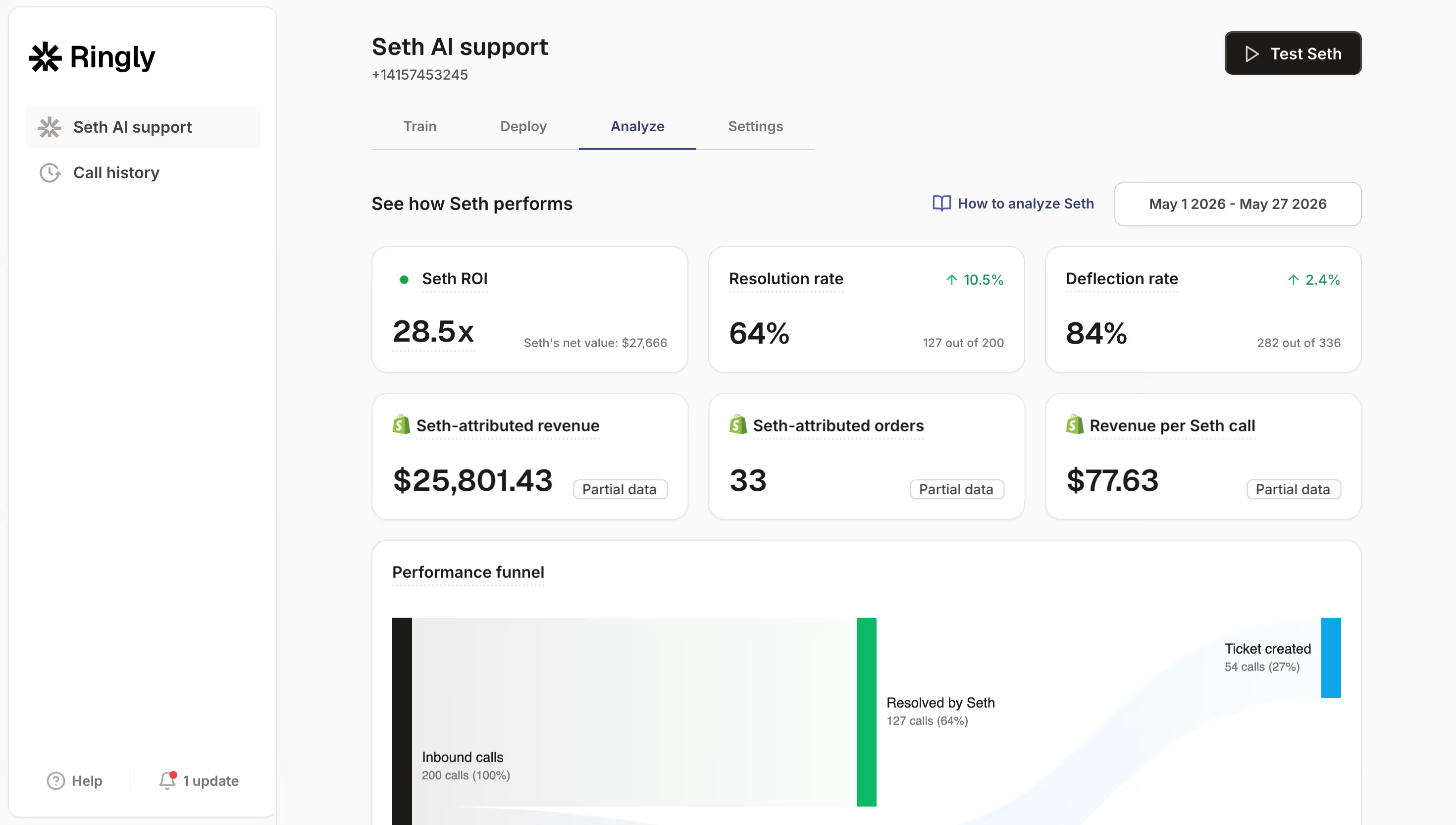
WashCo, a Shopify brand we launched recently, generated $22,664 in attributed revenue in the first 7 days post-launch, with 271 calls handled, 85% deflection, 66% resolution, and $0.91 per call versus $2.70 per human-handled call. That revenue isn't from the AI selling. It's from calls that used to go to voicemail getting answered.
How to get an AI phone agent live before the season

The setup is lighter than hiring would be. Here's the shape of it.
- Feed it what you already have. Point the agent at your site, your FAQ, your shipping policy, and your product pages. That becomes its knowledge base. Roast dates, allergens, cold-chain timelines, gift options.
- Connect your Shopify store. Now it can check order status and answer WISMO calls with the real tracking number, not a guess.
- Write the escalation rules. Decide what always goes to a human: a damaged perishable, a gift that arrived late, anything emotional. The agent handles the routine and routes the rest to your helpdesk.
- Keep your number. Customers call the same line they always have. Nothing on their end changes.
Self-serve, you can be live in under an hour; with a done-for-you build, the Launch Sprint takes 14 days. Either way, the lift is closer to flipping a switch than running a hiring round, which matters when peak season is eight weeks out. If you want the deeper version of this, our 24/7 ecommerce phone support guide walks through the always-on side, and the WISMO calls breakdown covers the single biggest call type.
Frequently asked questions
Can an AI phone agent take orders over the phone for my food brand? Not natively. It can text the caller a payment link to finish the order themselves, or transfer them to a human to take it. If most of your revenue is phone orders, it's not the right fit yet, and we'll say so.
Will my older customers accept talking to an AI? Usually yes, when the voice is good. The most common thing callers say is that it doesn't sound like AI. The failure mode is a robotic line, not AI itself, which is why voice quality is the thing to test first.
How does it handle "will my order arrive before Christmas?" It pulls the live tracking from your Shopify store and reads back the real status and delivery window. For anything outside the norm, like a delayed perishable, you can set it to escalate straight to a human.
Does it work with my Shopify store and my helpdesk? Yes. It connects to Shopify to read orders and tracking, and it escalates cleanly to Gorgias, Zendesk, Gladly, or whatever you already run. You keep your stack and your number.
What happens to a call the AI can't resolve? It transfers to your team with the context attached, so the rep isn't starting cold. You write the rules for what always escalates, like grief calls, damaged perishables, or anything you'd rather a person take.
How much does it cost for a gourmet food brand? Self-serve plans start at $349/mo (Grow) and $799/mo (Pro). Larger brands with seasonal spikes are quoted on a call. For context, a $20M brand spending ~$240K/yr on CS typically nets six figures in savings.
How fast can we get it live before the gifting season? Self-serve, under an hour. A done-for-you Launch Sprint runs 14 days. Both are far faster than hiring and training seasonal reps, so there's time to do this before peak.
Talk to us

If you run a $10M-$100M Shopify gourmet or specialty-food brand and you're staring down another gifting season of missed calls and voicemails you never return, a 30-min call is the fastest way to see what the phone is costing you.
The 3-layer guarantee.
- Live in 14 days or it's free until launched.
- 65% resolution in 90 days or we refund the last 3 months of subscription fees.
- We keep working free until we hit 65%.
Ruben (Ringly co-founder) takes these calls personally.