

This post in 30 seconds.
- Supplement support calls split cleanly into two piles: the routine stuff an AI phone agent can close on its own, and the medical questions it must hand straight to a person. This post draws that line call by call.
- BioLongevity Labs, a supplement brand on Ringly, resolves 79% of its calls autonomously. The other 21% (mostly dosage and interaction questions) route to a human on purpose.
- Written for founders and Heads of CX at $10M-$100M Shopify supplement brands running a paid helpdesk and a phone number that rings.
Supplement calls are not normal ecommerce calls. At 11 p.m. someone is standing in their kitchen deciding whether the magnesium they just bought from you is safe to take with their statin. That call should never be answered by an AI. The "where's my auto-ship" and "pause my subscription" calls stacked up right behind it should never reach a human.
That split is the whole game. Get it right and you keep your phone line live around the clock without hiring a night shift, and without ever putting words in an AI's mouth that the FDA would call a health claim. Get it wrong and you either drown your reps in repeat questions or you let a bot freelance on dosage, which is a much worse problem.
If you run a Shopify supplement brand doing $10M-$100M, your phone backlog is mostly the same five questions over and over, plus a thin slice of calls that genuinely need a person. We've launched AI phone agents for Shopify brands sorting exactly that. Book a 30-min call and we'll listen to a week of your missed calls and show you which ones your team should never have to touch.
In this post:
The five calls your support line actually gets
Pull a week of your phone logs and almost everything lands in five buckets. The mix shifts a little by brand, but the shape holds across every supplement store we've onboarded.
- Order and auto-ship status (WISMO). "Where's my order", "did my auto-ship go out", "why is this late". WISMO runs 30-40% of all ecommerce support tickets in normal weeks and over 50% at peak, according to Salesforce. In supplements it skews higher, because auto-ship creates a predictable monthly spike and your buyers skew older, so they call instead of refreshing a tracking email.
- Subscription changes. Cancel, pause, skip a month, change frequency, swap products, update the card on file. This is usually the second-biggest pile, and it's the one that decides whether the whole thing pays for itself.
- Ingredient and product facts. "Is there soy in this", "is it third-party tested", "what's the lot number", "when does it expire". Straight lookups against your label and knowledge base.
- "Is this safe with my medication" and dosage questions. The interaction calls. The 11 p.m. statin call. These are the ones that need a human, every time.
- Returns and "it didn't work for me." Policy questions, refund requests, the occasional unhappy customer.
Four of those five buckets are routine work that doesn't need a person, and the fifth is the one you never want an AI to touch. That's the line an AI phone agent has to respect to be worth deploying on a supplement line.
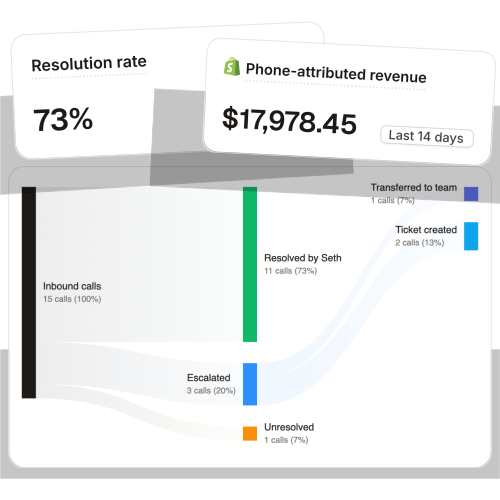
Here's the proof that the split works in practice. BioLongevity Labs, a supplement brand on Ringly with comparable volume, resolves 79% of its calls autonomously. The remaining slice, the dosage and interaction questions, route to their team on purpose. They're not failing to resolve those calls. They're refusing to.
What the AI handles vs what it routes
This is the part nobody in the chat-widget world writes about, because they're not on the phone. Here's the per-call-type line, the way we actually configure it on a supplement deployment.
| Call type | AI handles or routes | Why |
|---|---|---|
| Order / auto-ship status (WISMO) | Handles | Live Shopify lookup. No judgment call. |
| Pause / skip / change frequency | Handles | Custom action into Recharge or Skio, within your billing rules. |
| Cancel a subscription | Handles, with a save offer first | Clean cancel beats a chargeback. A fumbled cancel becomes a dispute. |
| Ingredient facts, lot number, expiration | Handles | Read straight from your label and knowledge base. Facts, not claims. |
| Returns within policy | Handles | Policy lookup plus a return started in your helpdesk. |
| "Is this safe with my [medication]?" | Routes | Interaction question. The AI is not allowed to answer this. |
| Dosage beyond the label | Routes | Anything past label instructions is medical advice. |
| "Will this help my [condition]?" | Routes | A disease or condition question. Hard stop. |
| Adverse reaction report | Routes | Goes to a person immediately, logged with a transcript. |
The handles column is roughly 70% of your volume, the same five things over and over. The routes column is small but it's the part that protects the brand. An AI phone agent earns its place by closing the first column cleanly and refusing the second one on sight.
On the subscription line specifically, the cancel call is the one to watch. Every clean cancel you offer a pause or a skip on is a chance at another twelve months of lifetime value, and the average supplement subscription loses 8-12% of subscribers every month. The AI runs the same save flow your best rep would, then cancels cleanly if the customer still wants out. No fight, no chargeback.
If your subscriptions run on Recharge or Skio (now one company after Recharge bought Skio for $105M in April 2026), the AI changes the subscription inside your existing billing rules, the same as a rep clicking through the dashboard would. You can read more on how that flows through in our guide to supplement subscription management.
Why dosage and interaction calls must route
This is the line that makes supplements different from selling sneakers. Anyone answering your phone is bound by the same rules as your label.
The FDA lets supplement brands make structure/function claims ("supports immune function", "calcium builds strong bones") but not disease claims. You cannot say a product diagnoses, treats, cures, or prevents anything, per the FDA's structure/function claims guidance. The moment someone on your line crosses that line, your supplement is being marketed like a drug, and that's how warning letters start.
So the rule we hard-code into a supplement deployment is simple. The AI will never make a health claim, and it routes any question about dosage, drug interactions, or a medical condition straight to a human. It doesn't try to be careful around those calls. It doesn't try at all. It recognizes the question, says it's getting a person who can help, and transfers with the transcript attached.
A model that freelances on dosage is a liability. A model that knows exactly where to stop is a trust signal. When we set up the knowledge base for a supplement brand, the banned-phrase list and the route-on-medical rules go in before the product facts do. That's the part a chat widget built for general ecommerce doesn't think about.
"My customers also feel like it's a normal person. They feel like they can communicate if they have questions."
— Claudia Droge, TechCraft Studio
That matters more than usual for supplements, because your buyers are older and they're the ones most likely to assume an AI line will be useless. The most repeated thing customers say after a call with our agent is that it doesn't sound like AI. For an older buyer holding a pill bottle, that's the difference between staying on the line and hanging up to call a competitor.
After-hours and renewal-day: the two phone spikes
Supplement phone volume isn't flat. It spikes in two predictable places, and both are where a human team breaks down.
The first is after-hours. Your older buyers call in the evening and on weekends, and when nobody picks up they don't email. They hang up. 80% of callers routed to voicemail hang up without leaving a message, and 85% of people who can't reach a human never call back, according to PCN's missed-call study. For a brand whose customers prefer the phone, the after-hours voicemail box is a slow revenue leak you can't see.
The second is renewal day. Subscription-related calls spike roughly 40% on billing-renewal dates, because that's when cards charge, payments fail, and people who meant to cancel last month finally pick up the phone. You can't staff a steady team for a volume curve that triples on the same few days each month.
I sat with a week of one supplement brand's after-hours calls before we designed their routing, and sorted every single one into handle or route. The handle pile was almost all WISMO and pause-my-auto-ship. The route pile was a handful of interaction questions. Nothing in between. That's the pattern that makes the AI obvious: the spikes are made of exactly the calls it's best at, and a 24/7 phone line that never sends a buyer to voicemail is worth real money on its own.
Every call your team doesn't answer after 6 p.m. is a subscriber a competitor can pick off. The AI doesn't sleep, doesn't get a renewal-day backlog, and doesn't need a weekend rep you'd struggle to keep.
What this costs you today vs with an AI phone agent
Take a typical $30M supplement brand running a 5-rep CS team plus two part-time weekend reps to cover the subscription pause-and-skip calls.
| Line item | Today | With Ringly |
|---|---|---|
| 5 reps × $4K loaded | $20,000/mo | — |
| 2 part-time @ $2K | $4,000/mo | — |
| Ringly (~$5K/mo) | — | $5,000/mo |
| Net monthly CS spend | $24,000/mo | $5,000/mo |
| Monthly savings | — | $19,000/mo |
| Annual savings | — | $228,000/yr |
That's roughly 70% of your repeatable calls (order status, subscription changes, ingredient facts) routed to the AI. The dosage and interaction calls still go to your team, who now have time to actually handle them well. BioLongevity, a comparable supplement brand on Ringly, hits 79% resolution on exactly this mix.
And the routine calls aren't just cost. They're revenue. Here's what one Shopify brand we launched recently saw in week one.
Real numbers from WashCo, a Shopify brand we launched recently:
- $22,664 in attributed revenue, first 7 days post-launch
- 271 calls handled
- 85% deflection rate
- 66% resolution rate
- $0.91 per call vs $2.70 per human-handled call
Source: Ringly dashboard, verified live data.
Seth resolves up to 90% of calls on its own for $1.99 a call after the first 50, versus the $7-$16 a human BPO charges per call. The math isn't really about our price. It's about the gap between $24,000 and $5,000.
The call makes sense if:
- You're a Shopify or Shopify Plus supplement brand doing $10M-$100M
- You run a paid helpdesk (Gorgias, Gladly, Zendesk, or Re:amaze)
- You have a visible phone number on your store
- Your CS team is 3-12 people
What happens on the call.
- We pull your last 7 days of missed and after-hours calls live, on the call. No homework for you.
- We show you the recovered revenue at the resolution rates we see for supplement brands.
- You decide if it's worth a deeper conversation. No deck, no follow-up sequence.
If that's your store, the math usually works. Book a 30-min call and we'll run your numbers live against your current setup.
How a supplement phone deployment goes live
The setup is less work than most brands expect, because the AI sits in front of the stack you already run instead of replacing it.
- Connect your store and tools. Shopify for orders, your helpdesk for escalations, your subscription app (Recharge or Skio) for pause-skip-cancel. Order status and order tracking start working immediately.
- Load the knowledge base, rules first. Banned-phrase list and route-on-medical rules go in before the product facts. Then ingredient details, lot-number lookups, return policy, and your save offers for the cancel flow.
- Set the escalation rules. Anything medical, any dosage question, any adverse-reaction report transfers to a person with the transcript attached. You control exactly what escalates.
- Go live and review. An engineer reviews 10 of your calls every week and tunes the routing. You keep your number, your helpdesk, and your workflows.
Most brands are live in under 1 hour, and setup is free. If you want the longer version of how this works for the channel, our guide to AI phone support for supplement brands walks the whole thing. You can also see how we frame it on the supplement industry page and the Shopify phone agent overview.
A quick note if you're coming from a chat-first tool. If your current AI is a Gorgias-style chat automation doing fine on tickets but falling over on the phone, that's expected. Phone is a different problem, and a different deployment. Brands running Shopify Plus support at scale hit this wall first. The phone line is where the older supplement buyer actually is, and it's the channel most AI support tools quietly skip.
Frequently asked questions
Can an AI phone agent answer questions about supplement ingredients? Yes, the factual ones. It reads ingredient lists, third-party testing status, lot numbers, and expiration dates straight from your knowledge base. What it won't do is interpret those facts into health advice, which is where the routing rule kicks in.
Will the AI make a health claim and get us in trouble with the FDA? No. It's hard-coded to never make a structure/function or disease claim, and it routes any question about treating a condition straight to a person. The banned-phrase rules go into the knowledge base before any product facts do.
Can it cancel or pause a Recharge or Skio subscription? Yes. Pause, skip, change frequency, swap products, and cancel all run as custom actions inside your existing billing rules. On a cancel it offers a pause or skip first, then cancels cleanly if the customer still wants out.
What happens when someone asks if a supplement is safe with their medication? That call routes to a human, every time. The AI recognizes the interaction question, tells the caller it's getting someone who can help, and transfers with the full transcript attached. It does not attempt an answer.
Will older customers actually use an AI phone line? In our experience, yes, once they're on it. The most repeated thing customers say after a call is that it doesn't sound like AI. The bigger risk for an older buyer is hitting voicemail after hours, since 80% of voicemail-routed callers hang up without leaving a message.
How much does AI customer service for a supplement store cost? Ringly is priced on Pay per call: $99 a month for the first 50 conversations, then $1.99 each. See pricing.
Talk to us

If you run a $10M-$100M Shopify supplement brand and your phone goes to voicemail after 6 p.m. or floods on renewal day, a 30-min call is the fastest way to see which calls you should never have to staff for.
Our 3 promises.
- Live in under 1 hour. Setup and test calls are free.
- 30-day money back on the $99 plan fee.
- 65% resolution guarantee: if Seth resolves under 65% of your support calls in a month, that month comes back as credit (after 90 days on Pay per call).
Ruben (Ringly co-founder) takes these calls personally.