

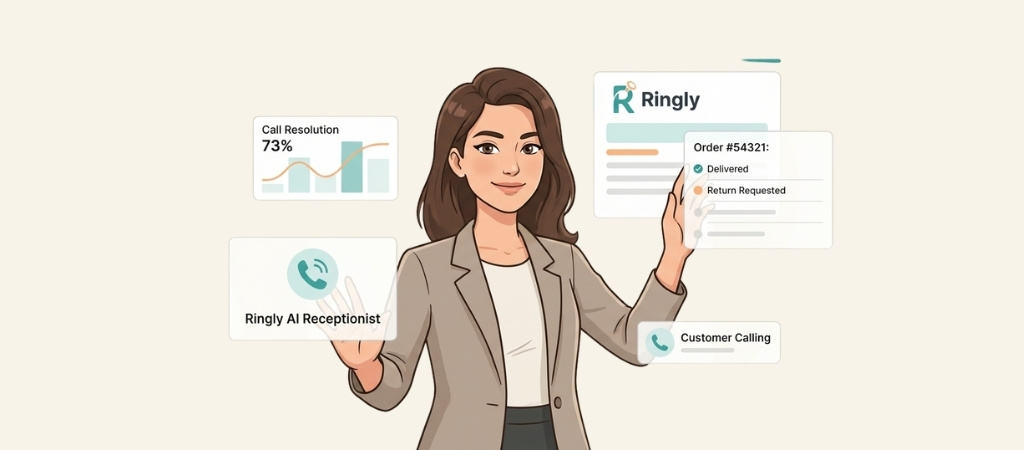
The best AI receptionists for ecommerce are Ringly.io, Smith.ai, Ruby, and Goodcall. Smith.ai and Ruby use human receptionists with AI assist, while Ringly.io is a done-for-you AI phone agent built for Shopify stores that looks up live order data and answers WISMO calls 24/7, billed by usage minutes.
Every minute your team spends on the phone explaining where a package is costs you a part of your growth.
You have built a brand that people love, but now the large volume of "Where is my order?" calls is starting to take up your team.
You want to provide a good experience, but hiring a call center just to read tracking numbers feels like a step backward.
Traditional phone systems frustrate your customers.
You need a way to automate 73% of your support calls while keeping the "human" feel your brand is known for.
First, we will look at how AI receptionists handle live Shopify data.
Then, we will break down the exact costs and setup steps to see if it fits your store.
Editor’s note: Want to hear some sample AI support calls made for your Shopify store?
- Just paste your store URL
- Hear sample calls for your store (no email required)
- Listen to demo AI calls for my store
What is an AI receptionist for ecommerce?

Ringly.io is an AI phone support platform built specifically for ecommerce businesses, with a strong focus on the Shopify ecosystem.
It is designed to handle the communication challenges that online retailers face every day.
The heart of the platform is the AI, a 24/7 AI phone support representative that automatically handles inbound customer calls. Think of the AI not as an answering machine, but as an integrated member of your support team.
Its main job is to understand what a customer needs and resolve their issue right then and there, without needing to pass the call to a human unless it's necessary. This frees up your team to focus on more complex tasks that grow your business.
Ringly.io has handled 200,000+ calls, and Seth resolves up to 90% of support calls on its own. That means nearly three out of every four calls were handled from start to finish by the AI. Because it connects directly with your store's backend, the AI can do more than just read from a script.
It can check live order statuses, look up tracking information, and even start the return process, making it a helpful first point of contact for your customers.
How the Ringly AI receptionist for ecommerce works
When a customer calls, the AI uses real-time speech-to-text to understand what they're saying. It then uses a large language model to figure out what the caller wants and come up with the best response. Finally, it uses natural-sounding text-to-speech to talk back to the customer.
The features built specifically for ecommerce contribute to the AI's effectiveness.
Core capabilities for ecommerce
Ringly's integration with Shopify allows the AI to access your store's live data instead of just pulling answers from a static FAQ page.
It can look up real-time order statuses, provide complete tracking details including the carrier and estimated delivery date, and even handle return and exchange requests automatically.
This means the AI can manage conversations like:
- "I'd like to know where my package is."
- "How do I start a return for order #12345?"
- "What size do you think I should get in the blue jacket?"
For an even smoother experience, the AI can recognize customers by the phone number they're calling from. If that number is in your Shopify records, the AI can pull up their order history before the conversation even starts, creating a personalized and efficient interaction.
Knowledge and AI training
The setup process is straightforward. You can train the AI instantly by providing a link to your website or installing the Shopify app. the AI will automatically scan your site to learn about your products, shipping policies, and frequently asked questions.
One important feature is that the AI is trained to avoid "hallucinating," or making up answers.
If a customer asks something it doesn't know, it will say so and offer to escalate the call to a human. This brand safety feature protects your reputation and prevents customer frustration.
The system also flags these knowledge gaps for you, so you can easily update the AI's knowledge base and make it smarter over time.
Advanced call management and intelligent escalation
You have control over how calls are handled. You can set specific business hours for live agent transfers, and if a call comes in outside of those hours, the AI can automatically create a support ticket with a full transcript for your team to review later.
The escalation rules are also flexible. the AI can be configured to transfer a call to a human agent if a caller sounds angry, if they ask to speak to a person multiple times, or after a couple of failed attempts to resolve their issue. This ensures that complex situations are handled by a person, combining AI efficiency with human support.
Analytics and performance insights
The Ringly.io dashboard gives you a clear view of how your phone support is performing. You get access to call recordings, full transcripts, and key metrics.
With the the AI V2 update, the platform introduced more powerful performance insights. This includes a performance funnel to see how calls are being resolved, a breakdown of call categories like order status vs. returns, and a map showing where your calls are coming from.
Multilingual support and voice customization
If you sell to customers around the world, multilingual support can be challenging. the AI supports over 30 languages, allowing you to offer support to your global customer base without having to hire a team of multilingual agents. You can also customize the AI's voice, accent, and tone to match your brand's personality.
Target market: Why Ringly.io focuses on Shopify
The ideal customer for Ringly.io is a Shopify store owner or an ecommerce business that needs an efficient way to manage and scale its customer phone support. Ringly.io was purpose-built for the needs of online retailers.
Let's find out what sets it apart.
Deep Shopify integration for real-time data
Ringly.io's native Shopify integration allows it to access real-time order data, customer information, and your entire product catalog.
This means the AI can give specific, accurate, and helpful answers. For example, instead of saying, "You can find tracking information in your shipping confirmation email," the AI can say, "Your order #54321 shipped yesterday via UPS and is scheduled to arrive tomorrow."
Setup speed and ease of use
Some call center platforms can take time to implement and may require specialized technical skills. With Ringly.io, you can set up the AI in a few minutes.
The process is designed for non-technical teams. You can get started by installing the Shopify app or providing a link to your website.
There's no code to write and no complex configurations to navigate. This accessibility means you can start automating your phone support almost immediately.
High resolution rate and brand safety
The average autonomous resolution rate of around 73% represents savings in both time and money. When many calls are handled without human intervention, your team is freed up to focus on tasks that drive revenue and growth.
Brand safety is also a focus. The anti-hallucination feature ensures the AI does not provide incorrect information, while the smart escalation rules guarantee that any customer who needs to speak with a person can do so easily.
This design allows you to leverage the efficiency of AI while maintaining the quality of your customer experience.
Ringly.io pricing
Ringly.io offers a straightforward pricing structure designed to fit stores at different stages of growth. The company also offers a performance guarantee.
The performance guarantee
Ringly.io offers a performance guarantee. You can try it for free, and it comes with a 65% resolution guarantee.
Here’s how it works: Pay per call is $99 a month for the first 50 conversations, then $1.99 each, and Ringly is free to try. If the AI doesn't hit that performance benchmark, you pay nothing.
This model allows you to test its ROI before making a financial commitment.
Available add-ons
For businesses that need more, Ringly.io offers several add-ons to customize your plan. You can get a dedicated Slack channel for priority support ($299/mo) or work with the Ringly team on custom integrations with your other business systems (starting at a one-time fee of $500).
Integrations and security
Ringly.io is designed to fit into your existing tech stack, with key integrations that connect it to the tools you already use.
Key integrations
- Shopify: This is the deepest and most important integration, giving the AI real-time access to all your order, product, and customer data.
- Twilio: The platform uses Twilio for its underlying phone and calling infrastructure, ensuring high-quality, reliable connections for every call.
- Helpdesks: When a call needs to be escalated, the AI can automatically create a ticket in popular helpdesks like Gorgias and Richpanel. The ticket includes a full transcript, so your human agents have all the context they need to help.
- Zapier & Make.com: These workflow automation tools allow you to connect Ringly.io with thousands of other apps. You could set up automations to add a new lead to your CRM, send a follow-up SMS after a call, or trigger any number of other actions.
Security and compliance
As a company based in the Netherlands, Ringly.io operates under the data protection regulations of GDPR. The company states that it takes commercially reasonable measures to protect all customer data. It also ensures compliance with local telecommunications regulations in all countries where it provides phone numbers.
Is Ringly.io right for your store?
For growing ecommerce businesses, managing phone support can be a balancing act. Ringly.io offers a solution that addresses common pain points.
The potential benefits include cost savings (the average cost per call with the AI is $0.38 compared to $2.35 with a human agent), 24/7 customer availability, improved first-response times, and the ability to scale your support capacity without scaling your headcount.
Ringly.io is a specialized tool that excels for ecommerce stores, particularly those on Shopify, that need a simple, powerful, and fast-to-deploy solution for automating phone support.
If you are looking for a way to improve both your operational efficiency and your customer experience, Ringly.io is an option to consider.
You can try Ringly.io for free today to experience the benefits. With the 65% resolution guarantee, a month where Seth resolves under 65% of your calls comes back as credit (after 90 days on Pay per call).
For more on ai in social media, youscan.io has a helpful overview.
For more on ecommerce call center, calilio.com has a helpful overview.
For more on customer acquisition examples, trackier.com has a helpful overview.
Frequently Asked Questions
How quickly can I set up Ringly.io for my Shopify store?
You can get Ringly.io up and running in just a few minutes. The process is designed for non-technical users. Just install the Shopify app or provide a link to your website, and the AI (the AI agent) will start learning about your business right away.
What makes Ringly.io different from a generic AI phone bot?
The main difference is its deep, native integration with Shopify. Unlike generic bots, Ringly.io can access real-time order data, customer information, and your product catalog. This allows it to give specific, accurate answers about order status, tracking, and returns, rather than just reading from a script.
Can the Ringly.io AI agent handle calls in multiple languages?
Yes, it supports over 30 languages. This allows you to offer consistent phone support to your customers around the world without needing to hire a multilingual support team.
What happens if the AI agent can't answer a customer's question?
It is trained to not make up answers. If it doesn't know the answer to a question, it will say so and offer to transfer the call to a human agent based on rules you set. This ensures your customers always get the right information and complex situations are handled by a person.
Can I try Ringly.io for free?
Yes, Ringly.io is free to try. Plus, there's a 65% resolution guarantee: if Seth resolves under 65% of your calls in a month, that month comes back as credit (after 90 days on Pay per call).
How does the pricing for Ringly.io work?
Ringly.io is priced on Pay per call: $99 a month for the first 50 conversations, then $1.99 each, including deep Shopify integration. Spam, hang-ups and wrong numbers are free.