
After-sales support in 30 seconds.
- After-sales support sounds like a long tail of unique problems. It's really a short list of the same post-purchase questions, hitting every channel at once.
- The phone is the after-sales channel most brands under-staff, and it's the most expensive one to resource (around $17-25 per ticket vs $1-4 for self-service).
- Built for founders, COOs, and Heads of CX at $10M-$100M Shopify brands running a paid helpdesk and a visible phone line.
Open your helpdesk on a Monday and the after-sales queue tells the whole story. WISMO, refund, WISMO, "where is my exchange," WISMO. The questions barely change week to week, and the volume never really drops, it just spikes after a launch and stays high.
We pulled call volume and resolution data from 50+ Shopify brands on Ringly to write this, and the pattern held everywhere. After-sales support is not a creative problem. It's a volume problem dressed up as a hundred small fires.
If you run customer experience at a $10M-$100M Shopify brand, you already know the shape of this. The same five questions, all day, and a phone line nobody picks up after 6 p.m. This is the playbook 50+ brands we work with use to handle the routine post-purchase volume without hiring rep #5. Book a 30-min call and we'll walk through what your after-sales calls are actually costing you.
What after-sales support actually is for a DTC operator
Most guides open with a dictionary definition. Here's the operator version: after-sales support is everything a customer needs from you between "order confirmed" and "I'd buy from them again." Order tracking, returns, refunds, exchanges, order changes, and the occasional "how do I actually use this thing" question.
Strip away the labels and after-sales support is six repeatable jobs, not a hundred unique ones. That's the insight that makes it manageable at volume:
- Where's my order (WISMO). The single biggest one. WISMO runs 30-40% of support tickets in a normal week and over 50% during peak season, according to Salesforce.
- Returns. The customer wants to send something back and needs to know how.
- Refunds. The second wave of WISMO. "Where is my refund" lands for the same reason "where is my order" does.
- Exchanges. Wrong size, wrong color, wants a swap instead of money back.
- Order changes. Wrong address, add an item, cancel before it ships.
- Product-use questions. Dosage, fit, compatibility, "is this safe with X."
Why does getting this right matter to the P&L and not just to CSAT? Because after-sales is where repeat revenue is won or lost. Returning customers spend 67% more than first-time buyers, and companies generate roughly 65% of their revenue from repeat customers, per Sprinklr. A clean post-purchase experience is the cheapest retention lever you have, and retaining a customer runs about five times cheaper than acquiring a new one.
The trap is treating each of these as a fresh problem. They aren't. They're the same WISMO questions and the same return flows, over and over, which is exactly why a system beats heroics.
It also helps to be clear about what after-sales support is not. It's not your pre-sale chat widget, it's not marketing's job, and it's not a once-a-quarter project. It's a standing operational load that arrives every single day, scales with order volume, and spikes hard after a launch or a sale. Treat it like infrastructure, not like a series of one-off fires, and the rest of this gets a lot easier. The brands that struggle are the ones still solving each ticket as if it were new.
Why the phone is the channel you are under-staffing
Walk through how most $20M-$50M Shopify brands resource after-sales. There's a returns portal, a Gorgias or Zendesk instance for chat and email, an order-tracking page, and a phone number in the footer that rolls to voicemail after 6 p.m.
That last channel is the one quietly costing you. Phone is the most expensive after-sales channel to staff, somewhere around $17-25 per ticket versus $1-4 for self-service, per LiveChatAI's 2025 cost benchmarks. So brands under-resource it. The problem is that the phone is also where the highest-intent post-purchase moments happen. A customer who calls about a missing order is not idly curious. They're upset, they're ready to leave, and they want a person now.
The after-hours queue is where after-sales support quietly leaks revenue, because a missed call doesn't show up as a ticket, it shows up as a customer who didn't come back. When that call hits voicemail, you usually lose it. 85% of callers who can't reach a person never call back, and 62% switch to a competitor. Voicemail doesn't save you either, since 80% of voicemail-routed callers hang up without leaving a message.
This is the part the rest of the SERP misses entirely. WISMO is an information problem more than a support problem, the customer only chases you because they can't see what's happening. Solve the information gap on the channel where they're most upset, and you recover money that was walking out the door. WashCo, a Shopify brand we launched, recovered $22,664 in attributed revenue in its first 7 days on the phone.
There's a second reason the phone matters more for after-sales than for pre-sale. A pre-sale question that goes unanswered costs you one order you never had. An after-sales call that goes unanswered costs you a customer you already paid to acquire, plus their repeat purchases, plus the review they leave on the way out. The downside is bigger, and it compounds. That's why the after-hours gap on the phone is the most expensive blind spot in most ecommerce support operations, even though it barely shows up in the ticket dashboard.
What good after-sales support looks like, the six jobs done right
Knowing the six jobs is half of it. The other half is the bar for each one. Here's what "done right" looks like at a brand that isn't drowning:
- WISMO done right. The answer is instant, accurate, and available 24/7, pulled live from the order in Shopify. No "let me check and call you back." If the customer can get a real tracking update at 11 p.m., the ticket never becomes a complaint.
- Returns done right. A clear policy the customer can act on without a human, plus a fallback for the calls that do come in. Most return questions are about eligibility and process, not edge cases.
- Refunds done right. Set the expectation up front ("3-5 business days to your card") so the second wave of WISMO never starts.
- Exchanges done right. Treat it as a save, not a cost. An exchange keeps the revenue and often raises the order value.
- Order changes done right. Catch them before fulfillment. The faster you resolve an address or cancellation, the fewer downstream WISMO and return tickets you create.
- Product-use questions done right. Answer from a real knowledge base, not a rep's memory. Consistency here is what keeps your CSAT steady when volume spikes.
Notice the pattern. Five of the six are repeatable enough to handle without a human in the loop, as long as the information is accurate and the channel is staffed. The sixth (genuinely complex or emotional calls) is where you want your team spending their time.
"My customers also feel like it's a normal person. They feel like they can communicate if they have questions."
Claudia Droge, TechCraft Studio
That's the bar. The customer shouldn't be able to tell whether the routine answer came from a person or a system. TechCraft handles 88% of its calls without a human and customers still feel heard.
What after-sales support costs you, and the math that changes it
Here's where the after-sales conversation usually goes sideways. Leaders think about it as a CSAT line, not a cost line, so it never gets the budget scrutiny that, say, paid media gets. Run the numbers and the picture sharpens fast.
Take a typical $50M Shopify brand running a 6-rep CS team, much of it absorbed by after-sales volume:
| Line item | Today | With Ringly |
|---|---|---|
| 6 reps x $4K loaded per rep | $24,000/mo | n/a |
| Ringly (~$5K/mo) | n/a | $5,000/mo |
| Net monthly CS spend | $24,000/mo | $5,000/mo |
| Monthly savings | n/a | $19,000/mo |
| Annual savings | n/a | $228,000/yr |
That's roughly 70% of the repeatable after-sales calls (order status, returns, the same five things over and over) handled by the AI, with the genuinely complex 30% still going to your team. And it doesn't count the calls you're losing after-hours today. WISMO alone costs mid-market businesses $50,000 to $200,000 a year in avoidable support work, before you add the revenue from calls that never get answered.
Want to compare this against what your current after-sales setup costs? Book a 30-min call and we'll do the math live on your real call volume.
How to build an after-sales system that holds at volume
The steps below come from real implementation work across 50+ Shopify brands, not from competitor blogs. The order matters, because each step makes the next one cheaper:
- Map your six jobs. Pull a month of tickets and calls, bucket them into WISMO, returns, refunds, exchanges, order changes, and product questions. You'll find 70-80% of volume sits in two or three buckets.
- Instrument one resolution number. Most brands can't answer "what's our after-sales resolution rate" because the data is split across Shopify, the helpdesk, and a shipping tool. Pick one number and make it visible.
- Give customers proactive information. Branded tracking, clear refund timelines, a real returns flow. Every gap you close upstream kills a ticket downstream.
- Staff the phone, especially after-hours. This is the step everyone skips. A 24/7 phone layer that handles the routine post-purchase calls is the difference between recovering an upset WISMO caller and losing them to voicemail.
- Route the hard 30% to humans cleanly. The system should escalate to your existing helpdesk, not replace it. Your team handles the calls that actually need judgment.
- Measure, then tune. Watch the resolution number weekly and feed the misses back into your knowledge base.
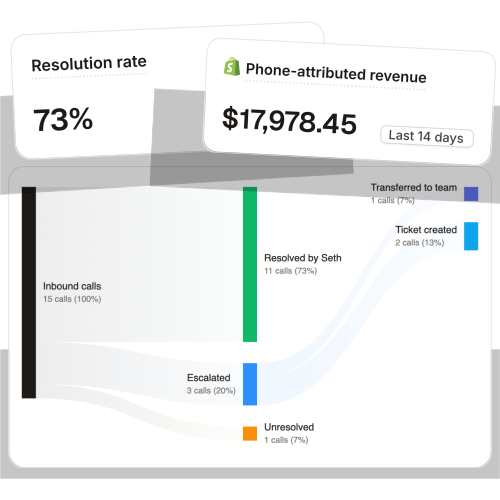
If you're trying to do this without adding headcount, the phone is where AI earns its keep first, because that's the channel you can't realistically scale by hiring. This is exactly where Ringly.io fits. It's AI phone support for Shopify brands. The AI answers inbound calls 24/7, finds the order in your Shopify store, handles returns and exchanges, answers product questions from your knowledge base, and checks order status live. Across 50+ brands it resolves about 73% of calls on its own at roughly $0.42 per resolved call, and the calls that need a human escalate cleanly to whatever helpdesk you already run. BioLongevity Labs, a supplement brand on Ringly, hits 79% resolution this way.
Common after-sales mistakes that cost you repeat revenue
Even strong teams make the same handful of errors. Watch for these:
- Treating after-sales as a cost center. It's a retention engine. The post-purchase experience decides whether the 67%-more-spending repeat customer ever comes back.
- Under-staffing the phone. Chat and email get the headcount, the phone gets voicemail, and the highest-intent calls leak.
- No single resolution number. If you can't say what percentage of after-sales contacts get resolved, you can't manage it, and the founder's "how are we trending" question stays unanswered.
- Letting voicemail be the after-hours plan. It isn't a plan. It's a slow way to lose 80% of the callers who hit it.
- Over-engineering the rare calls and ignoring the common ones. Spend your energy on the two buckets that are 70% of volume, not the edge cases that are 2%.
Frequently asked questions
What is after-sales support in ecommerce? It's the customer service that happens after an order is placed: order tracking, returns, refunds, exchanges, order changes, and product-use questions. For most DTC brands it's the same short list of repeatable requests hitting chat, email, and phone at once.
What's the difference between customer service and after-sales support? Customer service is the whole relationship, including pre-sale questions. After-sales support is specifically the post-purchase slice, which is where the bulk of ticket volume actually lives. WISMO alone is 30-40% of tickets per Salesforce.
How much does after-sales support cost per ticket? It depends heavily on channel. Self-service runs about $1-4 per ticket, while phone support runs $17-25, per LiveChatAI. That gap is why the phone is the channel brands most often under-staff.
What are the most common after-sales requests? "Where is my order" is the biggest by far, followed by returns, refunds, exchanges, and order changes. Five or six buckets usually cover 90% of your post-purchase volume.
How do you handle after-sales calls after hours? You either staff a night and weekend shift, which rarely pencils out, or you put a 24/7 AI phone layer in front of your existing helpdesk to handle the routine calls and escalate the rest. Voicemail is not a real option, since 80% of callers hang up without leaving one.
Can AI handle after-sales support? Yes, for the repeatable jobs. AI phone support resolves order-status, returns, and product questions well, around 73% of calls autonomously across Ringly's brands, while genuinely complex or emotional calls escalate to your team.
Does after-sales support actually increase repeat purchases? It's one of the strongest retention levers you have. Returning customers spend 67% more than first-timers and drive about 65% of revenue, so a clean post-purchase experience pays for itself.
Talk to us

If you run a $10M-$100M Shopify brand and your after-sales calls roll to voicemail after 6 p.m., a 30-minute call is the fastest way to see what that's costing you. We'll pull the math on your real volume and show you what the routine post-purchase calls could be handing back.
The 3-layer guarantee.
- Live in 14 days or it's free until launched.
- 65% resolution in 90 days or we refund the last 3 months of subscription fees.
- We keep working free until we hit 65%.
Ruben (Ringly co-founder) takes these calls personally.