
This post in 30 seconds.
- A knowledge base is the one place every answer your support gives actually lives. Build it from real ticket and call data, not from guesses.
- A solid one cuts support tickets 40 to 60 percent, and 92 percent of customers say they'd use one if you had it.
- Built for $10M-$100M Shopify brands with a visible phone line, a paid helpdesk, and a team re-typing the same five answers all day.
Your team didn't get hired to type "your order shipped yesterday, here's the tracking" forty times before lunch. But that's what most days look like when there's no single place the answers live. So everyone improvises. One rep says returns take 14 days, another says 30, the customer gets two different stories, and you find out about it in a one-star review.
That's the problem a knowledge base solves, and it's bigger than a help center page nobody reads. If you run customer experience at a Shopify brand doing $10M to $100M, the knowledge base is quietly the most valuable thing your support team owns. It's what your customers self-serve from, what your reps copy answers out of, and, the second you add any kind of AI, it's the brain that AI reads from. Get it right and the same questions stop eating your week. Book a 30-min call and we'll look at what your phone line is fielding after 6 p.m.
What a knowledge base for customer service actually is
A knowledge base is a structured, searchable library of answers to the questions your customers and your team ask most. Order status, returns, shipping windows, ingredient questions, subscription pauses, the stuff that comes up over and over. Not a marketing page. A working reference.
The whole point is one source of truth, so every answer your support gives is the same answer. When the policy changes, you change it once, and everyone (customers, reps, and the AI) is suddenly current.
There are two kinds, and you need both:
- External knowledge base: the customer-facing help center. Self-service articles, FAQs, how-tos. This is what 92 percent of consumers say they'd use instead of contacting you, if it exists and actually answers them.
- Internal knowledge base: the version your customer service team works from. Policies, edge cases, the "if a customer asks X, the approved answer is Y" rules. This is what keeps three reps from giving three answers.
People mix up a knowledge base and an FAQ. An FAQ is a short list of questions on one page. A knowledge base is the whole library: categories, search, individual articles, sometimes video. The FAQ is a room. The knowledge base is the building.
Why a Shopify support team needs one (and what it's costing you to skip it)
Here's the part that shows up on your P&L. Without a real knowledge base, every answer gets reinvented. Reps type the same WISMO reply by hand, dig through Slack for the current return policy, and ask a teammate "wait, do we do exchanges on sale items?" Multiply that across a few thousand tickets a month and you're paying senior people to be a slow search engine. This is the headcount math behind scaling support without just hiring more reps.
A well-built knowledge base cuts support tickets 40 to 60 percent and lifts agent productivity, because the routine stuff routes itself. The gap between the brands that do this and the ones that don't is real: 80 percent of high-performing service orgs offer self-service, versus 56 percent of the laggards.
Then there's the part no help center covers: the phone. Your visible phone number rings at 9 p.m. with a customer who can't find their tracking, and if nobody's there, that's a missed call and often a missed reorder. A knowledge base alone doesn't answer the phone. But it's the thing that lets something else answer it for you, which we'll get to.
What it costs you today
Take a typical $50M Shopify brand running a 6-rep customer service team:
| Line item | Today | With an AI phone agent reading your KB |
|---|---|---|
| 6 reps × $4K loaded per rep | $24,000/mo | n/a |
| AI phone support (~$5K/mo) | n/a | $5,000/mo |
| Net monthly CS spend | $24,000/mo | $5,000/mo |
| Monthly savings | n/a | $19,000/mo |
| Annual savings | n/a | $228,000/yr |
That's roughly 70 percent of repeatable calls (order status, returns, the same five things) handled off a good knowledge base. The other 30 percent, the genuinely tricky calls, still go to your team, who finally have time to handle them well.
What makes a knowledge base actually work
Most knowledge bases fail the same way: someone sits down to "write the help center," guesses at 200 articles, publishes them, and moves on. Six months later it's stale and nobody trusts it.
The ones that work are built backward, from what people actually ask, not from what you assume they'll ask. Pull your real data first: your last 90 days of tickets, your WISMO volume, your search logs, and your call recordings if you have a phone line. Rank questions by volume. Write the top 20 to 30 first. That covers the bulk of your tickets before you've written article 31.
A few things separate a knowledge base that resolves from one that just exists:
- One question per article. Don't bury "how do I return a sale item" inside a 2,000-word returns policy. Customers (and AI) find a focused article. They don't find a buried paragraph.
- Answer first, context second. Lead with the answer. The "why" goes underneath for the people who want it.
- Plain language, your customer's words. If they call it "the green one," your article shouldn't only say "Sage variant." Match how people actually ask.
- A real owner and a review date. Every article has someone responsible and a date it was last checked. No orphans.
- Built to be read by software too. Clean structure, clear headings, source-linked facts. This matters more than it used to, because your KB increasingly feeds AI.
Quick note on how I know which questions matter. I read real call logs across 50+ Shopify brands running on Ringly. The biggest gaps weren't in their written help centers, they were phone-only questions, the things customers say out loud after 6 p.m. that a chat-first help center never recorded. If you only build from chat tickets, you'll miss the half of your demand that picks up the phone.
The fastest way to kill a knowledge base: let it rot
A knowledge base isn't a project you finish. It's a thing you keep. And the failure mode is brutal: outdated content is worse than no content at all. A customer who finds nothing tries again. A customer who finds a confident wrong answer acts on it, then calls you angry.
It gets worse the moment AI enters the picture. The single most common reason an AI support agent underperforms is a bad knowledge base: outdated FAQs, conflicting articles, facts scattered across five docs. The AI doesn't know it's wrong. It surfaces the stale answer confidently, at scale, on every call and chat. Garbage in, garbage out, except now it's automated.
BioLongevity Labs, a supplement brand on Ringly, hits 79 percent resolution precisely because the AI is reading a clean, current knowledge base, not a pile of stale articles. That number is a knowledge-base number as much as it's an AI number.
The fix is a maintenance loop, not heroics:
- Source from new tickets. Every week, the question that got asked a lot and wasn't in the KB becomes a new article.
- Review on a cadence. Policies, shipping windows, and seasonal info get a recurring check, not a "someday."
- Kill duplicates. Two articles answering the same thing differently is how the AI and your reps end up contradicting each other.
If your knowledge base is already stale and ignored, you don't need to rebuild all of it. Rebuild the top 20 questions, set the maintenance loop, and let the long tail catch up. Book a 30-min call and we'll look at the questions your store fields most.
How your knowledge base powers an AI phone agent
This is where a good knowledge base stops being a cost center and starts paying you back.
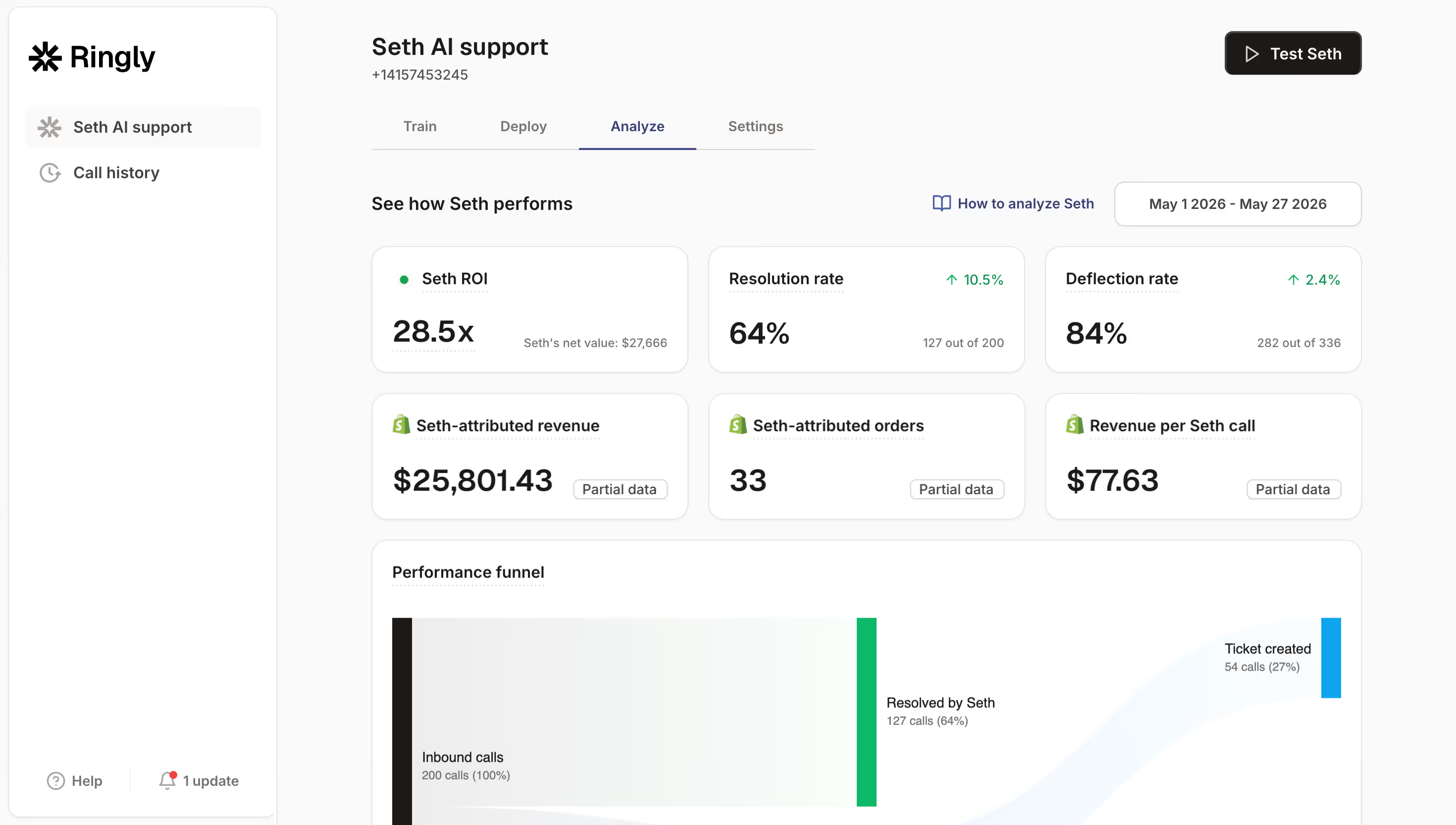
Once you have a clean, current source of truth, you can put something on the phone that reads from it. That's what Ringly is. Ringly.io is AI phone support for Shopify brands. The AI answers inbound calls 24/7, finds orders in your Shopify store, processes returns and exchanges, and answers product questions straight out of your knowledge base. The calls that need a human escalate cleanly to Gorgias, Zendesk, Re:amaze, or whatever helpdesk you already run.
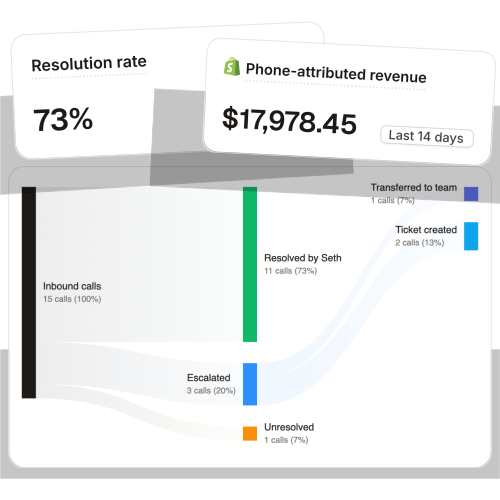
The knowledge base is the brain. The AI is the mouth. Across 50+ brands, the AI resolves 73 percent of calls on its own at roughly $0.42 per resolved call, versus $7 to $16 per call for a human BPO. But that 73 percent is downstream of the knowledge base. Feed it a clean KB and it answers like your best rep. Feed it stale articles and it confidently tells people the wrong return window.
This is also why "you don't sound like AI" keeps coming up. When the answers are right and current, the call just works.
"My customers also feel like it's a normal person. They feel like they can communicate if they have questions."
Claudia Droge, TechCraft Studio
Same idea on the customer-facing side: self-service software and AI deflection can cut support volume 20 to 60 percent, again only if the underlying content is good. The pattern is consistent across every channel: the knowledge base is the constraint. Everything you bolt on, chat, voice agents, an AI receptionist, is only as good as what it reads.
How to structure your knowledge base articles
Structure is what turns a folder of documents into something people and software can actually use. The goal is simple: the answer should be findable in one search and readable in ten seconds.
- Categories that match how customers think. Orders, Returns, Products, Shipping, Account. Not your internal org chart.
- Titles that are the question. "How do I track my order?" beats "Order tracking information." People search in questions.
- One job per article. If an article answers three things, it's three articles.
- Search that works. Most customers search before they browse. If search is bad, the rest doesn't matter.
- A version for your reps. Your internal KB can hold the edge cases and approved phrasing your public articles shouldn't.
Here's the quick way to think about the two layers:
| External KB (customers) | Internal KB (your team + the AI) | |
|---|---|---|
| Audience | Customers self-serving | Reps and your AI phone agent |
| Content | Help articles, FAQs, how-tos | Policies, edge cases, approved answers |
| Tone | Plain, customer-facing | Direct, operational |
| Wins you | Deflection, 24/7 answers | Consistency, faster handling |
If you're building from scratch, start the public help center and the internal reference at the same time, off the same top-20 question list. They'll share most facts. The internal one just goes deeper.
A simple sequence that works for most Shopify support teams:
- Export 90 days of tickets and call notes. Tag each by topic. The volume tells you the order to write in.
- Write the top 20 questions, one article each. Answer first. Keep them short. Get them live before you polish.
- Add the internal layer. For each public article, note the edge cases and approved phrasing your reps need but customers don't see.
- Wire up search and categories. Test it like a customer: can you find the return policy in one search?
- Set the weekly review. Whoever owns it spends 30 minutes a week turning new recurring questions into articles.
You'll have something real and useful inside a week, not the six-month "complete help center" project that never ships. The brands that win here treat the knowledge base as a living thing, the same way they treat their product catalog or their email list.
Frequently asked questions
Is a knowledge base the same as an FAQ? No. An FAQ is a short list of common questions on a single page. A knowledge base is a full searchable library of articles, organized into categories, often with internal and external versions. An FAQ can live inside a knowledge base, but not the other way around.
Internal vs external knowledge base: which do I need? Both. The external one lets customers self-serve and cuts your ticket volume. The internal one keeps your team giving the same answer every time and feeds any AI you run. They share most of the same facts.
How many articles do I need to start? Far fewer than you think. Pull your top questions from real tickets and call data, then write the top 20 to 30. That usually covers the bulk of your volume. Add to it weekly from new tickets instead of trying to write everything up front.
How do I keep a knowledge base from going stale? Give every article an owner and a review date, source new articles from recurring tickets each week, and kill duplicates. Stale content is worse than none, especially once AI is reading it, so the maintenance loop matters more than the initial build.
Does a knowledge base help with phone support? Directly, yes, if you put an AI phone agent on top of it. The knowledge base is what the AI reads from to answer calls, so a clean KB is the difference between an agent that resolves calls and one that gives wrong answers. See how Ringly handles Shopify phone support.
What knowledge base software should I use? Most helpdesks (Gorgias, Zendesk, Re:amaze, Help Scout) include a knowledge base, so if you already pay for one, start there before buying a separate tool. The platform matters far less than whether the content is built from real data and kept current. If you're picking a customer service setup for Shopify from scratch, the knowledge base is the part to get right first.
Who should own the knowledge base? Someone on the support team, not a side project for marketing. The person closest to the tickets sees what's missing first. Whoever owns it should also own the weekly "what did we get asked that isn't in here" review.
Talk to us

If you run a $10M-$100M Shopify brand and your team keeps re-typing the same answers, a 30-min call is the fastest way to see what a clean knowledge base plus an AI phone agent would handle for you. We'll look at the calls and tickets your store fields most, and what's leaking after-hours.
The 3-layer guarantee.
- Live in 14 days or it's free until launched.
- 65% resolution in 90 days or we refund the last 3 months of subscription fees.
- We keep working free until we hit 65%.
Ruben (Ringly co-founder) takes these calls personally.