
WhatsApp software fixes the text-easy half of support. The phone is the half it leaves behind.
- The 7 tools below, what each actually costs once you add WhatsApp's per-message fees, and which channel each one really covers.
- The mechanic every roundup glosses over: the 24-hour service window, and why "WhatsApp deflection" often just moves volume to a new inbox you still have to staff.
- Built for the Founder, COO, or Head of CX at a $10M-$100M Shopify brand already running a paid helpdesk and a visible phone line.
WhatsApp moved a real chunk of your inbox off email. Customers message instead of writing a paragraph, and a lot of "where's my order" gets answered without a rep typing the same reply for the fortieth time. That part works.
The phone still rings after 6pm. The order-status caller, the person who only ever picks up the phone, the launch-day spike, none of those moved to WhatsApp. So if you run support at a $10M-$100M Shopify brand, the real question isn't just which WhatsApp tool to buy. It's which half of your support each tool covers, and what's left leaking.
We've launched AI phone agents for 50+ Shopify brands chasing exactly this gap, the calls WhatsApp software was never going to catch. If your phone goes to voicemail after hours, book a 30-min call and we'll show you what your line is dropping.
In this post:
What WhatsApp customer support software actually does (and what it doesn't)
WhatsApp customer support software routes the messages people send to your WhatsApp Business number into a shared inbox or a ticket, so a team can answer them together instead of one phone passing around the office. On top of that you get the usual: automated replies, templates, chatbots, assignment rules, and a record of who said what.
The pull is obvious. WhatsApp has 2 to 3 billion users, message open rates sit around 98%, and roughly 73% of consumers now say they'd rather message a business than email or call it (Infobip). Gartner has called for about 80% of customer service to move from native apps to messaging. So the channel is real, and ignoring it is a mistake.
Here's the part the roundups skip. WhatsApp messaging is billed per message through Meta's platform, and the cost depends entirely on a 24-hour window most teams don't price in. When a customer messages you first, a 24-hour service window opens, and free-form replies inside it are free. Reply after the window closes, or send a marketing template, and you pay per message (Meta's WhatsApp Business pricing moved to a per-message model on July 1, 2025). The sticker price on the software is never the full bill.
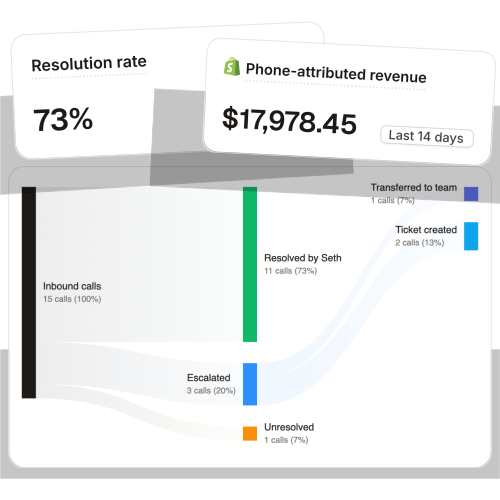
And here's the bigger thing it doesn't do. WhatsApp is text. The order-status call at 9pm, the customer who's angry and wants a human voice, the 60-year-old who has never opened the app and only ever phones, the spike the morning after a creator posts about you, those all land on the phone line. A WhatsApp tool doesn't touch them. That's not a knock on WhatsApp. It's just the shape of the channel, and it's why picking a WhatsApp tool is only half the decision.
How I tested these 7 WhatsApp support tools
I'm Ruben, co-founder of Ringly. Over the last few weeks I set up each tool against the workflow of a real $10M-$100M Shopify brand, not a marketing page. Here's what I scored against.
- Real Shopify connection. I connected each tool to a live Shopify store and pushed a "where's my order" message through it to see whether it could actually find the order, not just log a ticket.
- The 24-hour window cost. I sent the same message inside the window and again outside it, and logged what each one cost once template fees kicked in. The gap between sticker price and real bill is where most teams get surprised.
- Ecommerce action depth. I checked whether the tool could read and write to the order: see the customer, modify a subscription, process a return, or whether it just parked the message in a queue for a human.
- What channel it really covers. Chat-only, omnichannel-messaging, or does it touch the phone at all. This is the criterion the other roundups never name.
- The 11pm test. I called each tool's own support line late on a weeknight to see who picks up. Most went to a form. That told me a lot about how they think about voice.
I don't take affiliate money on anything below. I sell Ringly, which shows up first because it covers the channel the rest leave open, and I'll be just as direct about where it isn't the answer. On the phone side, the numbers behind my read are real: across those 50+ Shopify brands, the AI resolves about 73% of inbound calls on its own, at roughly $0.42 per resolved call.
The 7 best WhatsApp customer support tools
Quick comparison first, then the detail. The "covers" column is the one to read twice.
| Tool | WhatsApp cost | Best for | Covers | Verdict |
|---|---|---|---|---|
| Ringly | n/a (phone) | Shopify brands losing routine + after-hours calls | Phone | Closes the gap WhatsApp leaves |
| Gorgias | Ticket-based, from $10/mo | DTC brands wanting WhatsApp in one inbox | Chat, email, SMS, voice | Best ecommerce helpdesk for WhatsApp |
| Zendesk | $55-$169/agent/mo | Larger teams that need scale | Omnichannel | Powerful, pricey, heavier than most need |
| Tidio | Free tier + paid | Smaller brands wanting cheap chat + a bot | Chat, WhatsApp | Easy start, light ecommerce depth |
| Wati | ~$49/mo headline, real cost 3-5x | WhatsApp-first brands | WhatsApp only | Native, but opaque total cost |
| Respond.io | From $79-$99/mo | Multi-messaging-channel teams | Messaging channels | Strong inbox, no voice |
| Freshdesk | Free tier + add-on | General helpdesk on a budget | Tickets + WhatsApp add-on | WhatsApp is bolted on |
1. Ringly: the phone half WhatsApp leaves open
Best for: Shopify brands where the routine calls and the after-hours line are still eating CS hours WhatsApp never touched.
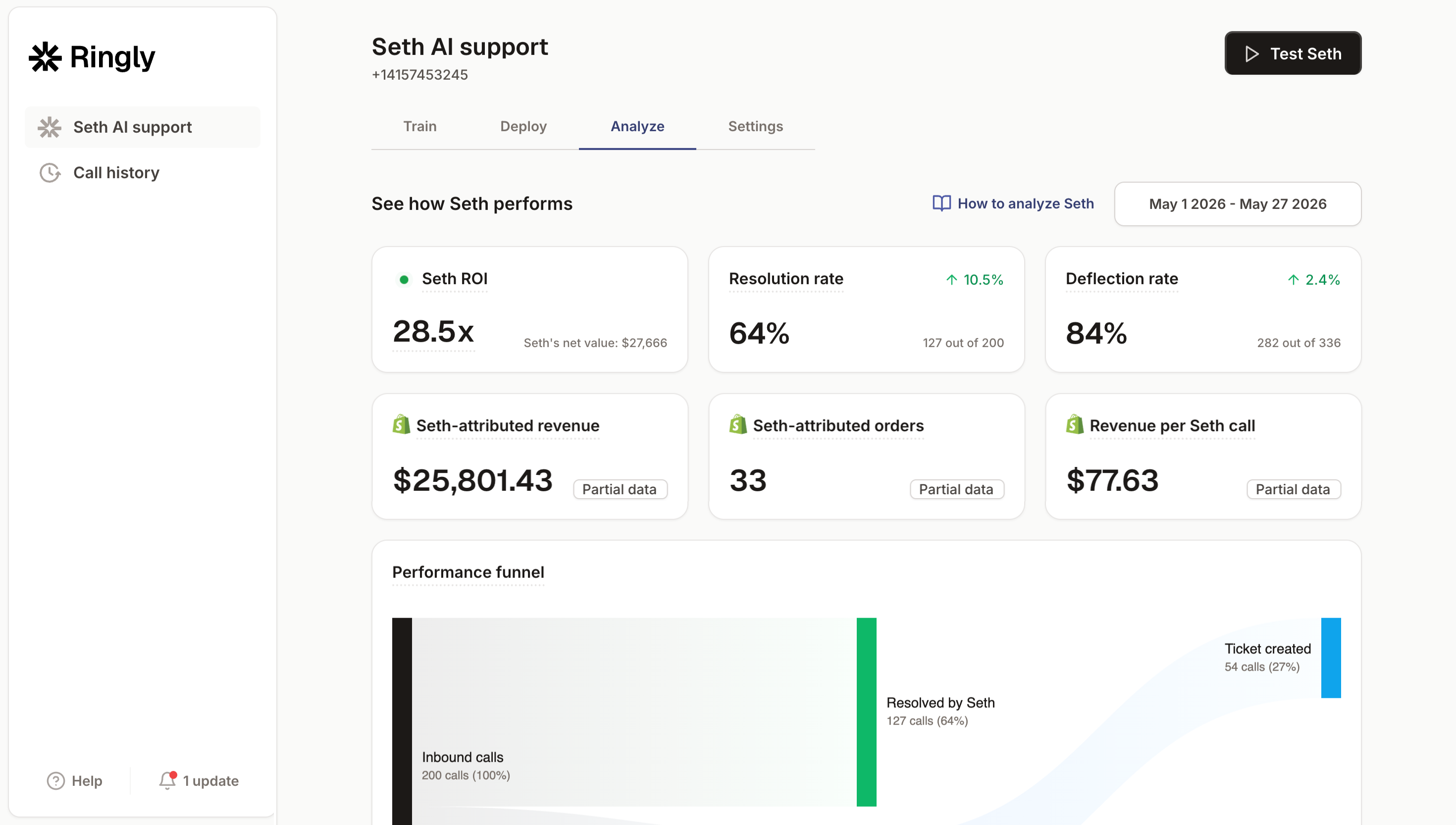
Ringly.io is AI phone support for Shopify brands. It's on this list because every WhatsApp tool here covers chat and none of them answer the phone, and the phone is where your most repeatable and most expensive calls still land. The AI picks up inbound calls 24/7, finds orders in your Shopify store, processes returns and exchanges, answers product questions from your knowledge base, and rescues abandoned carts with an outbound follow-up. Calls that need a person escalate cleanly to whatever helpdesk you already run.
It doesn't replace your WhatsApp tool. It sits next to it and takes the channel that one can't. WashCo, a Shopify brand we launched, recovered $22,664 in its first 7 days on the phone.
Pricing
| Plan | Price | Included |
|---|---|---|
| Grow | $349/mo | 1,000 minutes (~500 calls) |
| Pro | $799/mo | 2,500 minutes (~1,250 calls) |
| Enterprise | By call | Custom volume |
What works
- It answers the phone, not just chat. The order-status call at 9pm gets handled instead of going to voicemail.
- Real Shopify actions. It looks up the actual order, not a canned reply, and can run returns and exchanges.
- Sits in front of your stack. Keep your helpdesk and phone number. The AI takes the routine calls and escalates the rest.
- 65% resolution guarantee. If it resolves under 65% of your calls in 90 days, we refund the last 3 months.
- Live in under an hour. Add your site and docs and it's ready.
What doesn't
- It's phone, not WhatsApp. If you only want a WhatsApp inbox, you still pick one of the tools below for that.
- It's built for Shopify. If you're not on Shopify, the order-lookup depth isn't there.
Why it ranks 1st
Not because it's a WhatsApp tool, it isn't. Because the half of support every WhatsApp roundup ignores is the half that costs you the most, and this is the tool that covers it.
2. Gorgias
Best for: DTC brands that want WhatsApp living inside the same inbox as email, chat, and Shopify order actions.
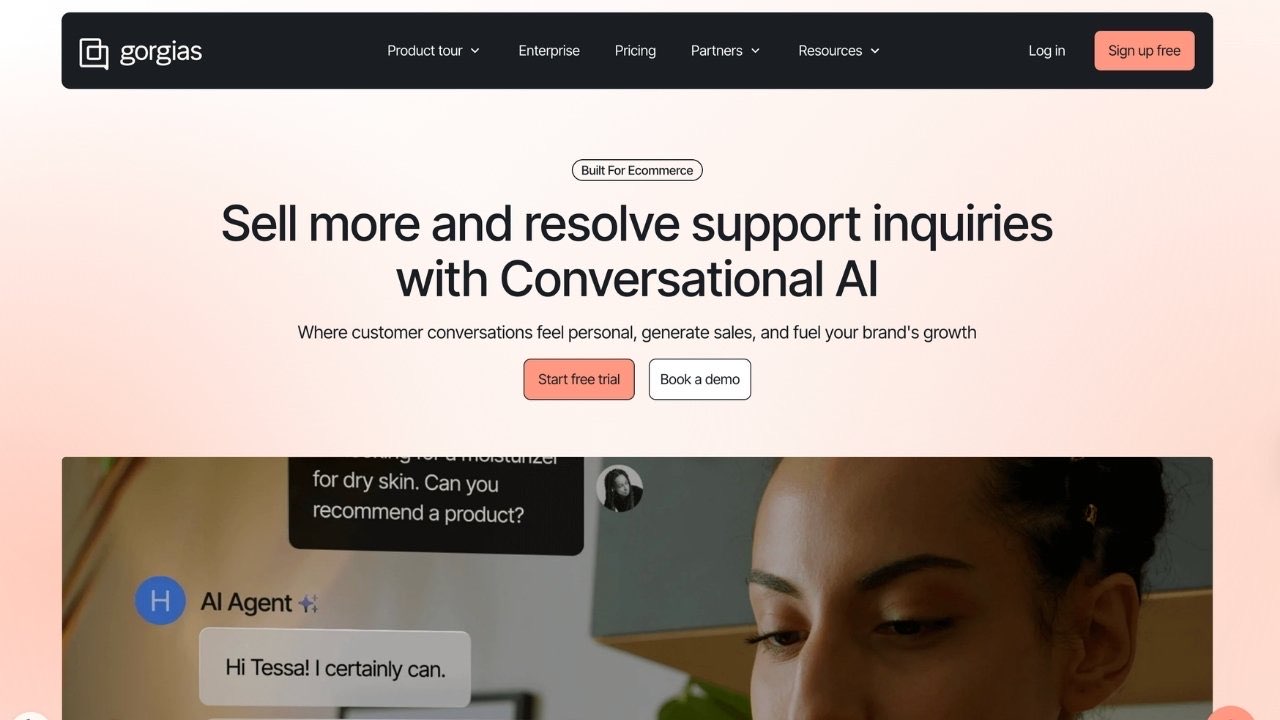
Gorgias is the ecommerce helpdesk built around Shopify. WhatsApp is a native channel in its unified inbox alongside email, chat, SMS, Instagram, and voice, and agents can run refunds, cancellations, and order edits right from the ticket. It's the most ecommerce-aware option for handling WhatsApp here, and it's where most Shopify brands already are.
Pricing
| Plan | Price | Included |
|---|---|---|
| Starter | $10/mo | 50 tickets |
| Basic | $60/mo | 300 tickets |
| Pro | $360/mo | 2,000 tickets |
| Advanced | $900/mo | 5,000 tickets |
Overage runs $0.36 to $0.40 per ticket. The AI Agent is billed on top, roughly $0.90 to $1.00 per conversation.
What works
- Native WhatsApp in one inbox. No separate tool, no separate login.
- Deep Shopify actions. Refund, cancel, edit, all from the ticket view, with 100+ ecommerce integrations.
- Built for DTC. It rates 4.6/5 on G2 across 558 reviews, the highest in this set for ecommerce.
What doesn't
- Ticket pricing climbs. A busy month blows past your tier and the overage adds up.
- AI is double-billed. You pay for the helpdesk ticket and the automation fee on the same conversation.
- It's still an inbox. The human share of tickets still needs humans.
Why it ranks 2nd
If you want WhatsApp handled, this is the cleanest place to do it for a Shopify brand. Just watch the ticket math. See the full picture on our Gorgias alternatives page.
3. Zendesk
Best for: larger support teams that have outgrown a DTC-only tool and need scale and configurability.
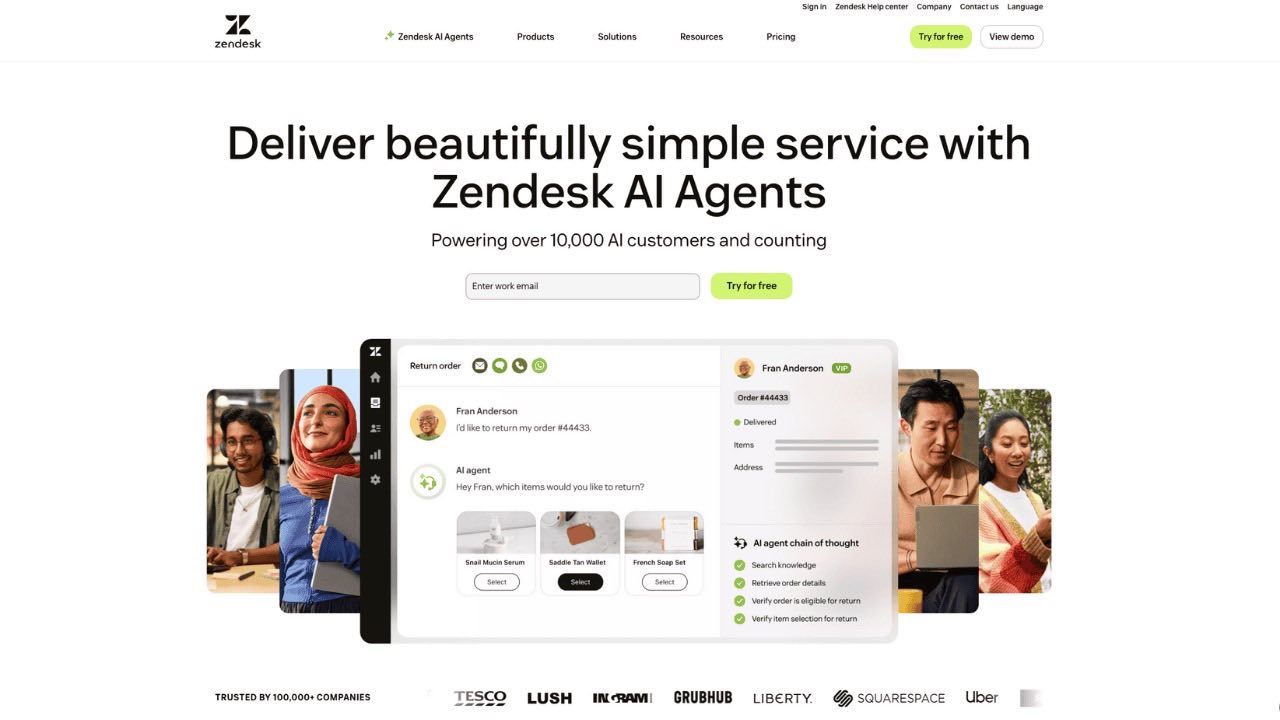
Zendesk is the enterprise-grade helpdesk, and WhatsApp connects as a channel. It scales to big teams and complex routing, which is its real strength. For a mid-size Shopify brand it's often more platform than the job needs, and the ecommerce integrations that come native to Gorgias usually need middleware here.
Pricing
| Plan | Price | Included |
|---|---|---|
| Suite Team | $55/agent/mo | Core omnichannel |
| Suite Professional | $115/agent/mo | Advanced routing |
| Enterprise | $169+/agent/mo | Full platform |
What works
- It scales. Big teams, big volume, mature tooling.
- Omnichannel. WhatsApp sits with everything else.
- Configurable. If you have the ops headcount to set it up.
What doesn't
- Per-agent cost stacks fast. Add-ons are priced per seat on top.
- Ecommerce depth needs middleware. Shopify actions aren't as native as Gorgias.
- Heavier than most DTC brands need. G2 has it at 4.3/5 across 6,800+ reviews, solid, but built for a different buyer.
Why it ranks 3rd
Right tool if you're a large team that already lives in Zendesk. Overkill for most $10M-$50M brands. Our Zendesk alternatives page has the leaner options.
4. Tidio
Best for: smaller brands that want cheap live chat with a built-in bot and WhatsApp as one more channel.
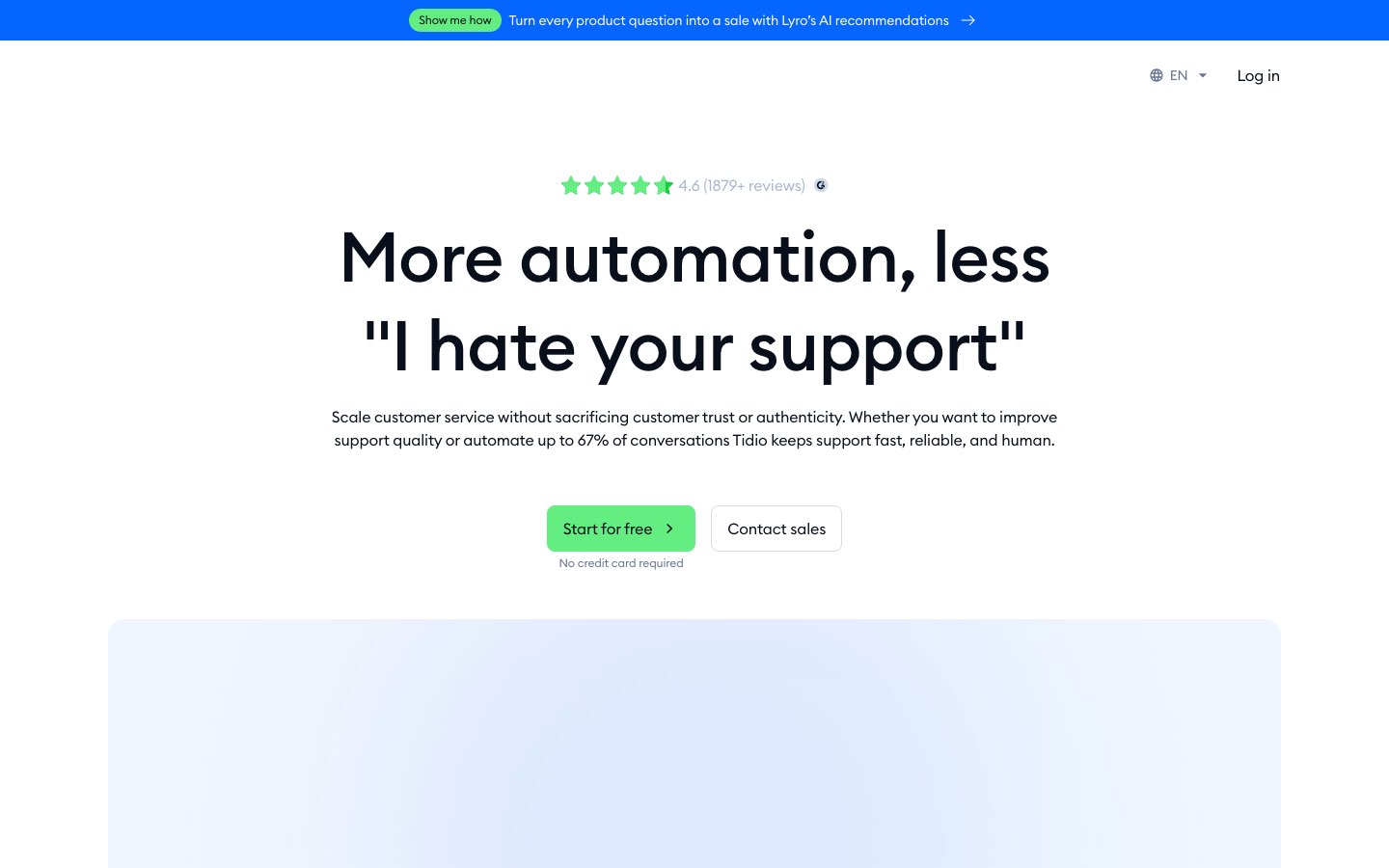
Tidio leads with live chat and its Lyro AI chatbot, with WhatsApp connected alongside. It's easy to set up and the free tier lowers the barrier, which makes it a fine starting point. The ecommerce depth is lighter than Gorgias, and WhatsApp is one of several channels rather than the focus.
Pricing
- Free tier to start. Paid plans scale by conversations and Lyro automations.
What works
- Cheap to start. The free tier and a quick chatbot get you live fast.
- Easy setup. Less ops overhead than the enterprise tools.
What doesn't
- Light ecommerce depth. Order actions aren't as native.
- WhatsApp isn't the focus. It's a connected channel, not the core.
Why it ranks 4th
A reasonable entry point for a smaller brand. As volume grows you'll feel the ecommerce gaps. More options on our Tidio alternatives page.
5. Wati
Best for: brands that want a WhatsApp-first platform with broadcast and no-code automation.
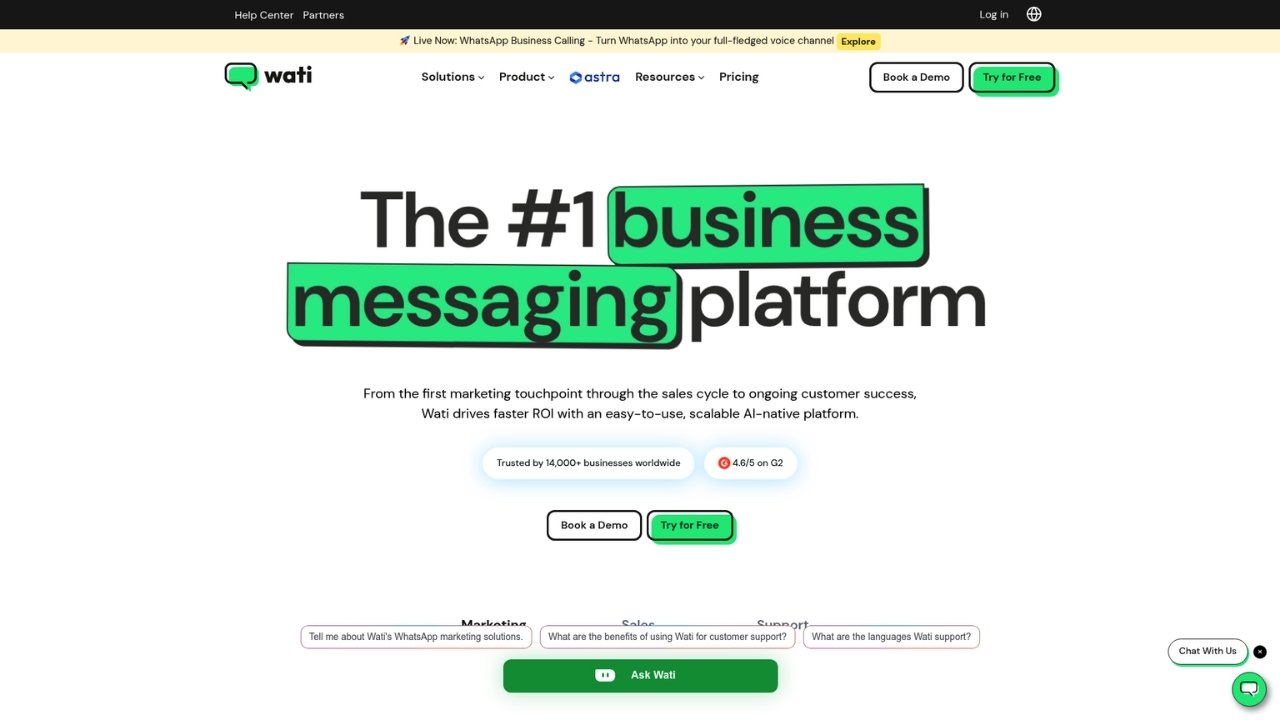
Wati is built around WhatsApp itself: a shared team inbox, broadcasts, a no-code chatbot, and template management. If WhatsApp is genuinely your main channel, it's purpose-built for that. The catch is the bill. The headline is around $49/mo, but real costs often land 3 to 5x that once you add per-message API fees, AI add-ons, and seats, and the entry plan is capped at three users.
Pricing
- Headline from ~$49/mo. Real cost typically 3-5x after API fees, AI, and per-seat charges. Growth plan capped at 3 users.
What works
- WhatsApp-native. Broadcast and automation built for the channel.
- No-code chatbot. Non-technical teams can ship flows.
What doesn't
- WhatsApp only. No phone, no email. It's one channel.
- Opaque total cost. The real bill is well above the sticker.
Why it ranks 5th
Solid if WhatsApp is your whole support world. For a Shopify brand running multiple channels and a phone line, it covers a narrow slice.
6. Respond.io
Best for: teams that route several messaging channels through one inbox and want a strong automation builder.
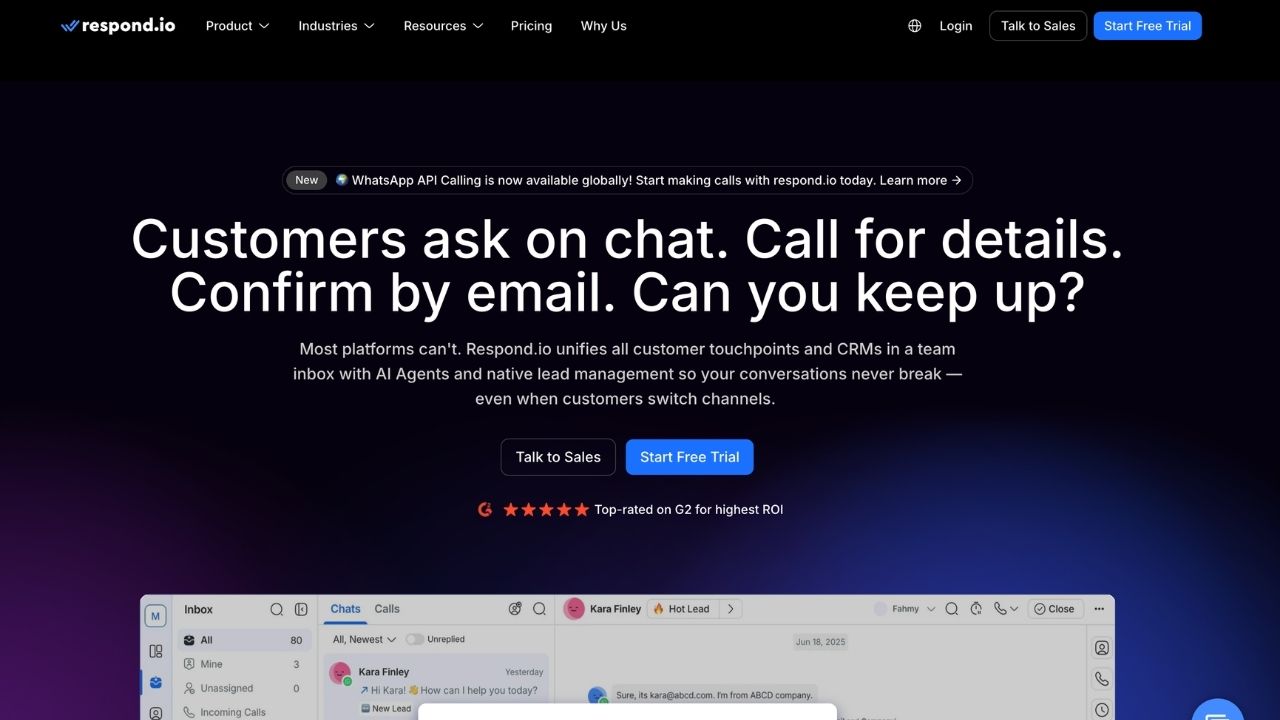
Respond.io is an omnichannel messaging platform, WhatsApp plus Instagram, Messenger, and others, with a capable workflow automation builder and an AI agent. It's a strong messaging inbox. It just doesn't touch voice, and the pricing scales by contacts and seats, which suits agencies and multi-channel teams more than a phone-heavy DTC brand.
Pricing
- From $79-$99/mo, scaling by contacts and seats.
What works
- Many messaging channels, one inbox. Good for teams spread across apps.
- Automation builder. Flexible routing and AI replies.
What doesn't
- Messaging only. No phone coverage at all.
- Contact-based pricing. Costs climb with your audience, not your value.
Why it ranks 6th
A good messaging hub, but it leaves the same phone gap as the rest, and it's priced for a different shape of team.
7. Freshdesk
Best for: brands that want a general-purpose helpdesk on a budget and treat WhatsApp as a side channel.
Freshdesk is a broad helpdesk with a free tier, and WhatsApp comes in as an add-on rather than a native channel. It's cheap and general, which is the appeal. For an ecommerce brand the Shopify depth is thin and WhatsApp feels bolted on rather than built in.
Pricing
- Free tier. Paid plans per agent. WhatsApp is a usage-based add-on.
What works
- Cheap and broad. Covers general ticketing well.
- Free tier. Easy to trial.
What doesn't
- WhatsApp is an add-on. Not native, not first-class.
- Thin ecommerce depth. Not built around Shopify.
Why it ranks 7th
Fine as a general helpdesk. As a WhatsApp-for-ecommerce tool it's the weakest fit here. Our Freshdesk alternatives page has the ecommerce-native picks.
The half WhatsApp software can't cover: the phone
Add any tool above and you'll deflect a real share of text-based tickets. Good. But watch what happens to the phone.
The calls don't stop. They sort themselves. The simple text-friendly stuff goes to WhatsApp, and what's left on the line skews toward the calls that were always the hardest to staff. The after-hours order-status call, the angry customer who wants a voice, and the older buyer who will never open the app all stay on the phone, and that's exactly the volume WhatsApp software was never built to catch. WISMO alone is around 18% of ecommerce questions normally and 30-40% of tickets at peak (Salesforce), and a big chunk of that still comes by voice.
There's a demographic split underneath this too. Messaging is winning overall, but the 65+ group is the fastest-growing segment for WhatsApp calling, not texting. Plenty of your customers will still pick up the phone for anything that feels important. So "we added WhatsApp" doesn't empty the queue. It changes its mix.
This is the part operators feel and the roundups never mention. You can buy the best WhatsApp inbox on the market and your phone line is still the thing that goes to voicemail at 7pm.
"My customers also feel like it's a normal person. They feel like they can communicate if they have questions."
Claudia Droge, TechCraft Studio
If the phone is the channel quietly leaking revenue at your brand, book a 30-min call and we'll pull what your line actually did last week.
What WhatsApp support plus phone coverage actually costs
Most of the comparison so far is sticker price. The number that matters is what you pay per resolved contact once humans are in the loop, because WhatsApp deflection that just moves volume to a staffed inbox doesn't take the cost out, it relabels it.
Take a typical $50M Shopify brand running a 6-rep CS team.
| Line item | Today | With AI phone coverage |
|---|---|---|
| 6 reps × $4K loaded | $24,000/mo | n/a |
| Ringly (~$5K/mo) | n/a | $5,000/mo |
| Net monthly CS spend | $24,000/mo | $5,000/mo |
| Monthly savings | n/a | $19,000/mo |
| Annual savings | n/a | $228,000/yr |
That's roughly 70% of repeatable calls, order status, returns, the same few questions over and over, handled by the AI. The other 30%, the genuinely complex calls, still go to your team, who now have time to actually solve them. Per resolution, an in-house rep call runs about $2.70 loaded; the AI runs closer to $1.20 to $2.00, and BioLongevity, a brand on Ringly, resolves 79% of its calls without a human.
The point isn't WhatsApp versus phone. It's that your support cost lives in human hours, and the WhatsApp tool only removes the hours from one channel. The phone is where the rest of the money is sitting.
How to choose your WhatsApp support stack
Two decisions, not one. First, which WhatsApp tool. Second, who answers the phone.
- Choose Gorgias if you're a Shopify brand and you want WhatsApp inside the inbox you already use, with real order actions. Best default for DTC.
- Choose Zendesk if you're a large team that needs scale and already has the ops headcount to run it.
- Choose Tidio if you're smaller and want cheap chat plus a bot to start, knowing you may outgrow the ecommerce depth.
- Choose Wati if WhatsApp is genuinely your main channel and you want a native, broadcast-first tool, and you've priced in the real bill.
- Choose Respond.io if you run several messaging channels through one team and don't need voice.
- Choose Freshdesk if you want a cheap general helpdesk and WhatsApp is a secondary channel.
- Fix the phone first if your line goes to voicemail after hours, the same routine calls eat your reps' day, and you keep almost hiring rep #5 to cover it. No WhatsApp tool solves that. That's the phone support decision.
The honest version: most $10M-$100M Shopify brands already have WhatsApp handled inside Gorgias or Zendesk and don't need a separate tool for it. What they're missing is coverage on the calls, and that's a different purchase. If you want to compare the phone side to your current setup, book a 30-min call and we'll do the math live.
Frequently asked questions
What is WhatsApp customer support software? It's a tool that routes the messages people send your WhatsApp Business number into a shared inbox or ticket, so a team can answer them together with automations, templates, and chatbots. Most options are either dedicated WhatsApp platforms or helpdesks like Gorgias that include WhatsApp as one channel.
Is WhatsApp customer support free? The conversations aren't. Meta bills per message through its platform, with a 24-hour service window where free-form replies are free and template or out-of-window messages cost per send. On top of that you pay for the software itself, so budget for both.
Does WhatsApp support software work with Shopify? The ecommerce-native ones do well. Gorgias reads and writes Shopify orders directly from the WhatsApp conversation; Zendesk and others usually need middleware for the same depth. Always check whether the tool can actually act on the order, not just log the message.
Can WhatsApp replace phone support? No. WhatsApp handles text-friendly questions, but order-status calls, upset customers, and buyers who only phone still come by voice. Messaging is winning overall, yet the 65+ group is the fastest-growing segment for WhatsApp calling, so the phone doesn't disappear.
If I add WhatsApp, will customers stop calling? Some will, for the easy stuff. What's left on the phone tends to be the harder, more valuable calls, plus after-hours volume. Adding WhatsApp changes the mix of your phone queue more than it empties it.
How much does WhatsApp customer support cost? Software ranges from free tiers (Tidio, Freshdesk) to $55-$169 per agent on Zendesk, plus Meta's per-message fees on top. WhatsApp-first tools like Wati start near $49/mo but often land 3-5x higher once API, AI, and seats are counted.
What's the best WhatsApp tool for a Shopify brand? For most DTC brands, Gorgias, because WhatsApp lives in the same inbox as your Shopify order actions. But it only covers chat. The calls still need their own answer, which is where AI phone support for Shopify comes in.
Talk to us

If you run a $10M-$100M Shopify brand and you've got WhatsApp handled but your phone line still goes to voicemail after hours, a 30-min call is the fastest way to see what those missed calls are costing you.
The 3-layer guarantee.
- Live in 14 days or it's free until launched.
- 65% resolution in 90 days or we refund the last 3 months of subscription fees.
- We keep working free until we hit 65%.
Ruben (Ringly co-founder) takes these calls personally.