

Standing up a virtual PBX is the easy half of the phone problem. You can have one running over a weekend: pick a provider, port your number, point a few extensions at the right people, done. The hard half is the part nobody on the first page of Google talks about. Once the call is routed to a clean queue, a human still has to pick it up.
If you run a $10M to $100M Shopify brand with a visible phone number and a small support team, that gap is where your money leaks. The calls still come in after-hours. Your reps are still drowning in the same five questions every day. Moving the phone system to the cloud organizes the chaos. It doesn't reduce it.
This guide does two things. First, the honest, complete version of what a virtual PBX is: how it works, cloud versus on-premise, what it costs, and when a DTC brand actually needs one. Then the part the telecom guides skip: what you put on top of it so the queue stops backing up. If your phone goes to voicemail after 6 p.m., book a 30-min call and we'll walk through what's slipping through.
Most of the brands we talk to don't have a routing problem. They have an answering problem, and a virtual PBX is only half the fix. We run AI phone support for 50+ Shopify brands, so the queue a PBX feeds is something we look at every day. Book a 30-min call and we'll show you what your after-hours line is actually doing.
This post in 30 seconds.
- A virtual PBX moves your calls to the right place. It doesn't pick them up.
- Cloud-hosted PBX trades the server in your closet for a predictable monthly bill, instant scaling, and answering from any device. On-premise still wins only for huge static teams on a long hardware horizon.
- The license is the cheap part. The reps staffing the queue it feeds are the expensive part. Built for $10M-$100M Shopify brands with a visible phone line and 3-12 support reps.
What a virtual PBX actually is
A PBX is the brain of a business phone system. The name stands for Private Branch Exchange, and all it really does is route calls: between your internal extensions, out to the phone network, into voicemail, around an auto-attendant menu. The old version of this was a metal box bolted to a wall in your office, wired into copper phone lines.
A virtual PBX is that same brain, hosted in the cloud instead of in your building. Calls run over the internet using VoIP (Voice over Internet Protocol) rather than copper, and the routing logic lives on a provider's server you reach over the web. That's the whole definition, per 3CX: an IP PBX hosted in the cloud rather than on an on-premise server.
Here's where the terminology trips people up. Virtual PBX, cloud PBX, and hosted PBX all mean the same thing. Different vendors picked different words for "the PBX lives in a data center, not your closet." RingCentral calls it hosted PBX. 3CX calls it virtual or cloud. They're describing one idea.
VoIP is the part people conflate it with, and it's worth separating. VoIP is the transport, the calls as internet data. The PBX is the control layer that decides where each call goes. A virtual PBX uses VoIP to move the calls, but routing and answering a call are two different jobs. Keep that distinction in your head, because it's the whole point of this article.
Cloud-hosted vs on-premise PBX
The real split between the two isn't features. It's who owns the hardware and how you pay for it.
An on-premise PBX is installed and run at your location. You buy the server, the licenses, the handsets, and you (or your IT person) maintain all of it. It's a capital expense up front, and a maintenance line forever after. A cloud-hosted PBX flips that: no server, no wiring, you add users and numbers instantly, and your team answers from a laptop or a cell phone anywhere there's internet. You pay monthly, per the comparison work from Yeastar.
Here's the honest version of when each one wins.
| Dimension | On-premise PBX | Cloud-hosted (virtual) PBX |
|---|---|---|
| Cost model | Big up-front CapEx + maintenance | Predictable monthly OpEx |
| Setup time | Weeks (hardware, wiring, config) | Hours, no hardware |
| Scaling | Buy hardware, add lines | Add users/numbers instantly |
| Who maintains it | Your in-house IT | The provider |
| Remote / multi-location | Hard | Built in, answer anywhere |
| Best fit | 500+ static users, 7-10 yr horizon | Most growing DTC brands |
For a Shopify brand that's still scaling, the cloud version wins on almost every line that matters. The cost-breakdown analysis from VestaCall lands in the same place: choose cloud for cash-flow flexibility, fast deployment, and easy scaling. Choose on-premise only if you have a massive, static workforce and plan to sweat the same hardware for the better part of a decade. That's not a DTC brand adding a fifth rep this quarter.
One thing the 2026 telecom pitch gets right, and one thing it gets wrong. It's right that the cloud is now where the smart features live. It's wrong about what those features are. Most of them frame "AI" as call monitoring: tone analysis, supervisor alerts when a caller sounds angry. Useful, but that's AI watching your humans answer. It isn't AI answering. We'll come back to that. If you're weighing this against a full cloud contact center setup, the same question applies: who actually resolves the call?
Core features of a virtual PBX
A virtual PBX comes with the full feature set of an old PBX plus the cloud extras. The standard list looks like this:
- Call routing: send calls to the right person, team, or queue based on rules you set.
- IVR / auto-attendant: the "press 1 for orders" menu that sorts callers before a human picks up. (Worth its own read if you handle volume: IVR for ecommerce.)
- Extensions: internal numbers for each person or department.
- Voicemail and voicemail-to-email: missed calls drop to voicemail, transcripts land in an inbox.
- Call queues: callers wait in line when reps are busy, with hold music and position announcements.
- Business-hours and after-hours routing: different rules at 2 p.m. than at 2 a.m.
- Mobile apps: take the office number on a cell phone.
- Business SMS, conferencing, call recording, and analytics: the modern add-ons.
Read that list again with one question in mind: which of these actually answers a customer's question? Every feature here moves a call around. Not one of them resolves it. Routing, queuing, menus, and voicemail are all ways of organizing call traffic so it lands in the right place. They're genuinely good at that. But organizing the traffic and handling the traffic are different jobs, and a virtual PBX only does the first one. If you want to dig into the routing layer specifically, we wrote up call routing and VoIP for ecommerce separately.
What a virtual PBX costs
Pricing splits into two models, and the difference matters more than the headline number.
Most providers charge per user, per month. Tech.co's 2026 pricing analysis puts RingCentral in the $20 to $35 base range, landing closer to $30-$50 per user per month in practice. Vonage runs roughly $20-$40 per user per month. The catch with per-user pricing is obvious: every rep you add raises the bill.
3CX took a different route. It charges per system based on simultaneous calls, not per user. Per its own pricing, the Standard tier is free up to 10 users, and a Professional license for unlimited users starts around $175 a year for four concurrent calls, with hosted packages from about $295. If your headcount grows faster than your peak concurrent call count, the concurrent-call model gets cheaper per seat.
Here's the reframe that actually matters for a DTC brand. The PBX license is the cheap line on the invoice. The expensive line is the loaded cost of every rep staffing the queue it feeds. A US support rep runs about $4,000 a month all-in (salary, benefits, payroll tax, training, attrition). Against that, a $40-per-seat PBX is a rounding error. Moving your phone system to the cloud doesn't change your headcount. It just gives the same headcount a tidier place to work. If headcount is the real cost, that's the number worth attacking, which is the whole idea behind scaling support without hiring. You can see Ringly's own per-call economics on the pricing page.
When a Shopify brand actually needs a virtual PBX
Not every store needs a PBX. A two-person brand with one phone and forty orders a week does not. You need a virtual PBX when the phone stops being a side channel and starts being a system. Concretely, you need one if:
- You have a visible phone number on your site and call volume is climbing.
- Your reps are tethered to desk phones, or worse, the calls route to someone's cell.
- You're remote or multi-location and need everyone on one number.
- After-hours calls hit a dead voicemail you never get around to returning.
- The seasonal spike turns your phone into a backlog you can't dig out of.
That last pair is where the real cost hides. Most of the after-hours calls you're sending to voicemail are the same routine questions you could answer in your sleep, and most of those callers never leave a message. A big chunk of that volume is WISMO, the "where is my order" call. Gorgias data cited by Salesforce puts WISMO at roughly 18% of total support volume for a typical Shopify brand, climbing past 40% at peak, and Shopify's own breakdown backs the pattern. Each one costs somewhere between $4 and $12 to handle by hand. A virtual PBX will route every one of those calls beautifully. It still needs a human on the other end to say "it ships Thursday." If you're staffing that line, an ecommerce call center setup or a dedicated Shopify call center is usually the next question.
The catch: a virtual PBX routes the call, it doesn't answer it
This is the part the telecom comparison pages leave out, and it's the most important thing in this article.
A virtual PBX is excellent at one job: getting a call to the right place. It does nothing to reduce how many humans you need to pick up. Route 800 WISMO calls a day into a perfectly organized queue and you still need reps to answer 800 calls. The queue is cleaner. The headcount is identical.
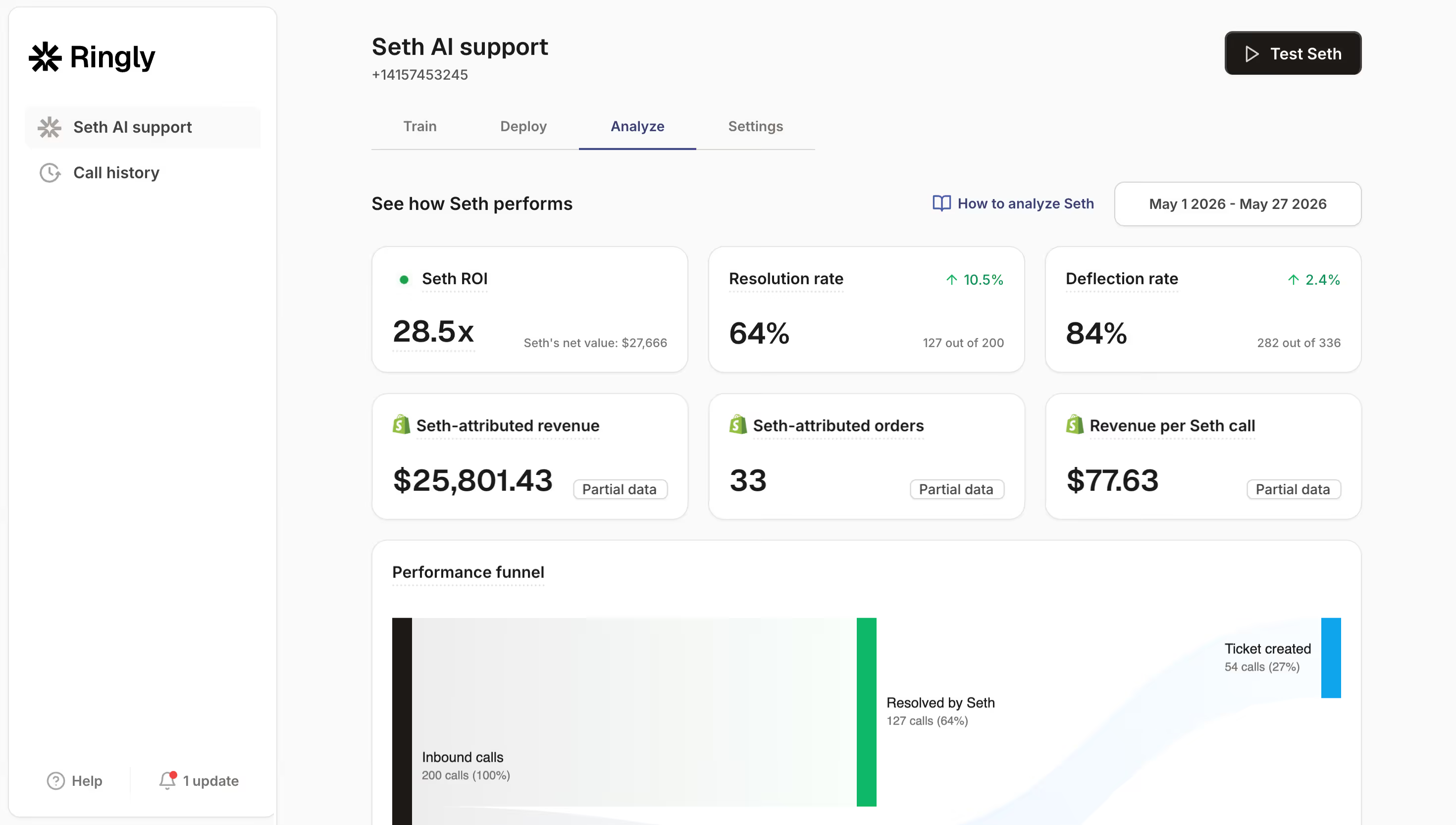
We run AI phone support for 50+ Shopify brands, so we see what the PBX queue actually looks like from the inside. It's the same five questions, all day: where's my order, can I return this, do you ship to Canada, is this in stock, what's your discount code. Across those brands, 73% of those calls get resolved without a human ever touching them, at about $0.42 a call. That's not a routing feature. That's a different layer sitting on top of the routing.
So what does the modern DTC phone stack actually look like? Four pieces:
- The virtual PBX handles your numbers, routing, IVR menus, and after-hours rules.
- An AI phone agent answers the routine 70% (order status, returns, product questions) and resolves them on the spot.
- Your human team gets the 30% that genuinely needs a person: the upset customer, the weird edge case, the high-value save.
- Your helpdesk (Gorgias, Zendesk, whatever you run) catches the clean escalations, so nothing falls through. A smart call transfer handles the handoff.
The PBX isn't the thing that fixes your backlog. It's the thing that organizes the calls so the AI and your team can split them cleanly. This is also why an AI receptionist for ecommerce and a virtual PBX aren't competitors. They're two layers of the same stack.
"My customers also feel like it's a normal person. They feel like they can communicate if they have questions."
Claudia Droge, TechCraft Studio
If your phone rings more than your team can answer, book a 30-min call and we'll talk through what's slipping past the queue.
Pairing a virtual PBX with an AI phone agent
Ringly.io is AI phone support for Shopify brands. It's not a virtual PBX and it doesn't replace one. It's the layer that sits on top of your phone system and answers the routine calls so the queue stops backing up.
The AI answers inbound calls 24/7. It finds orders in your Shopify store, processes returns and exchanges, answers product questions from your knowledge base, and rescues abandoned carts with outbound follow-up. Calls that need a human escalate cleanly to Gorgias, Richpanel, Reamaze, or whatever helpdesk you already run. Across 50+ brands, the AI resolves 73% of calls on its own at roughly $0.42 per resolved call, against the $7 to $16 a human-handled call costs at a typical BPO. You keep your number, your PBX, and your team. You just stop paying people to answer "where's my order" fifty times a day. There's more on how the AI voice agent works for ecommerce if you want the mechanics.
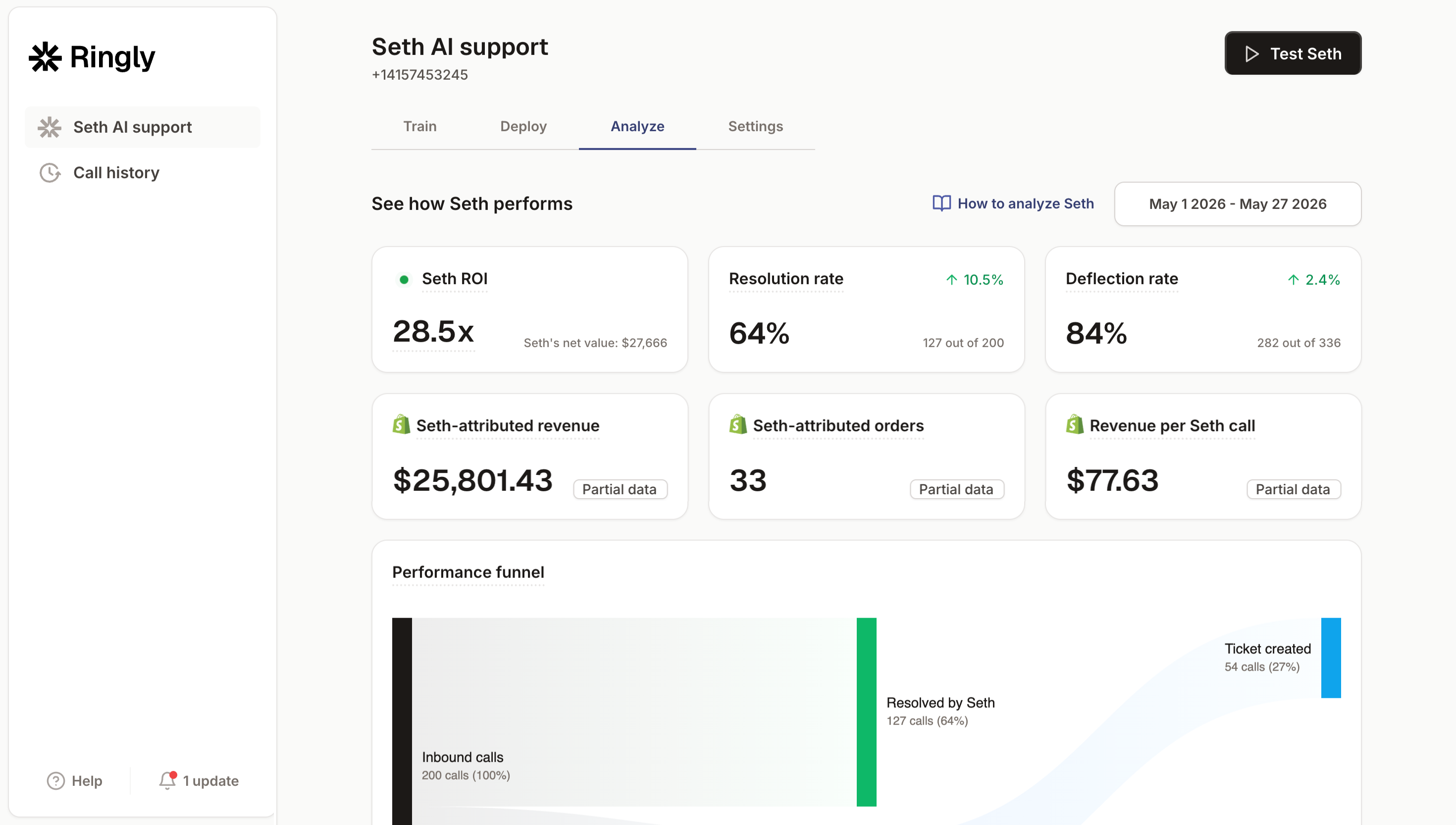
WashCo, a Shopify brand we launched, recovered $22,664 in its first 7 days on the phone. Not because the PBX routed better, but because the calls that used to hit voicemail got answered and turned into orders.
Here's the math on the headcount side. Take a brand running a 6-rep support team:
| Line item | Today | With Ringly |
|---|---|---|
| 6 reps × $4K loaded per rep | $24,000/mo | n/a |
| Ringly (~$5K/mo) | n/a | $5,000/mo |
| Net monthly CS spend | $24,000/mo | $5,000/mo |
| Monthly savings | n/a | $19,000/mo |
| Annual savings | n/a | $228,000/yr |
That's roughly 70% of repeatable calls routed to the AI. The other 30%, the genuinely hard ones, still go to your team, who now have time to actually solve them. You can run your own numbers on the AI phone agent ROI calculator, or read how this works for a Shopify support phone agent specifically. The PBX organizes the calls. The AI is what stops them from costing you a rep each.
Frequently asked questions
Is a virtual PBX the same as VoIP? No. VoIP is the transport, your calls traveling as internet data. A virtual PBX is the control layer that routes and manages those calls. A virtual PBX uses VoIP, but they aren't the same thing.
Is virtual PBX the same as cloud PBX and hosted PBX? Yes. The three terms are interchangeable. They all describe a PBX that lives on a provider's cloud server instead of a box in your office. Different vendors just picked different words for the same setup.
Do I still need any hardware for a virtual PBX? No server and no wiring. Your team can answer on existing laptops and cell phones through an app or a browser. Some brands add desk phones for comfort, but nothing on-site is required.
How much does a virtual PBX cost? Per-user providers like RingCentral and Vonage run roughly $20 to $50 per user per month. 3CX charges per system by concurrent calls instead, starting free for up to 10 users. The bigger cost is always the reps staffing the line, not the license.
Will a virtual PBX reduce my support call volume? No, and this is the honest answer most pages skip. A virtual PBX routes and organizes calls; it doesn't reduce how many a human has to answer. To cut the human workload you pair it with an AI phone agent that resolves the routine calls on its own.
Can a virtual PBX work with Shopify and my helpdesk? The PBX itself handles routing. The Shopify-aware part (looking up orders, processing returns) comes from the AI layer on top, which connects to your store and escalates cleanly to Gorgias, Zendesk, or Reamaze. You keep your existing stack.
Talk to us

A virtual PBX gets your calls to the right place. If they still pile up faster than your team can answer them, the routing was never the problem. If your phone rings more than your team can answer, a 30-minute call is the fastest way to see what's slipping through.
The 3-layer guarantee.
- Live in 14 days or it's free until launched.
- 65% resolution in 90 days or we refund the last 3 months of subscription fees.
- We keep working free until we hit 65%.
Ruben (Ringly co-founder) takes these calls personally.