

A return is three costs, not one: process it, restock it, and answer the call asking where the refund is.
- 8 tactical tips that cut the manual touches per return and get refunds out faster.
- Most "streamlining" advice stops at the portal and the label. We also kill the return-status phone call most teams never count.
- Built for Founders, COOs, and Heads of CX at $10M-$100M Shopify brands running a paid helpdesk and a visible phone line.
Most returns advice treats a return like a single event. A customer ships something back, you refund it, done. But on the operator side a return is a chain of touches, and every touch is either a rep-minute or a dollar. You pay to ship it back, you pay someone to inspect and restock it, and then you pay again when the customer calls to ask if you got it and where their money is.
If you run support at a Shopify brand doing $10M to $100M, you already know returns season is the same five questions over and over. Where's my refund. Did you receive it. Can I exchange instead. The workflow you have probably handles the first two-thirds of that chain and drops the last part on your CS team.
The tips below are about the whole chain. Cut the touches, speed up the refund, and stop the return from turning into a support ticket.
If returns are quietly eating your CS hours, book a 30-min call and we'll look at how much of your phone volume is just refund-status questions. We do this for 50+ Shopify brands.
The real cost of a clunky returns workflow
Returns are not a small line item. US shoppers sent back $849.9 billion in merchandise in 2025, and about 19.3% of online orders got returned, according to the National Retail Federation. Apparel runs 20-40%. So one in five orders, sometimes more, comes back through a process you built.
Each one of those returns costs roughly $25 to $30 to process all-in, and that figure doesn't include the support call it generates. Lateshipment's returns research puts the all-in number there once you count return shipping, labor, inspection, and restocking. Signifyd's data is even blunter: processing a return averages about 21% of the order's value.
Here's the part the cost models skip. A slow refund doesn't just sit there quietly. A refund that lands in two days with a confirmation email produces silence. A refund that takes ten days with no update produces a phone call, sometimes two. That call costs you another $5 or so in rep time, and it's the touch nobody puts in the spreadsheet.
So when we talk about streamlining returns, we're really talking about two things at once: fewer manual touches in the warehouse, and fewer "where's my refund" calls hitting your phone backlog. The tips below do both.
8 tips to streamline your returns
1. Move every return onto a self-service portal
The single biggest lever is getting the customer to start the return themselves. Shopify has built-in self-serve returns: the customer logs in, picks the order, and submits the request without ever touching your support line.
That one change deletes a whole category of inbound tickets. Instead of a rep typing out return instructions for the hundredth time, the customer self-serves in 90 seconds.
A self-service portal is the difference between a return that starts as a customer action and a return that starts as a support ticket. Get the portal live first. Everything else stacks on top of it.
2. Auto-generate the RMA and return label
Once a return is requested, nobody on your team should be manually issuing a return authorization or a shipping label. A decent returns management setup generates the RMA and a prepaid label automatically the moment the request clears your rules.
Speed matters here for a non-obvious reason. Labels that generate instantly, right in the portal, get used. Routing the customer to a separate carrier page to print a label is where returns stall and where the follow-up call comes from.
So make the label a zero-touch step. The system mints it, emails it, done. If you're still on a manual returns process, this is the highest-ROI thing to automate after the portal.
3. Put your policy in a rules engine
Your return policy shouldn't live in a rep's head or a Notion doc. It should be a set of rules the system enforces. Auto-approve anything inside the window that meets your conditions. Flag the edge cases for a human.
A simple rule set might auto-approve any unworn item returned within 30 days, auto-deny anything past the window, and route everything else to review. That removes the guesswork and treats customers consistently. If your written policy is vague, tighten it first with a return policy template, then encode it.
The rules engine is what lets the boring 80% of returns run on autopilot so your team only touches the 20% that actually need judgment. That's the whole game with streamlining: humans on the hard calls, software on the rest.
4. Refund low-risk returns instantly
Refund speed is the trust lever, and it pays for itself. Signifyd found that 23% of consumers who get an instant refund buy something again soon after. Fast money back is a retention move, not just a service one.
The obvious worry is fraud. About 9% of returns are fraudulent, so you don't want to hand instant refunds to everyone. The fix is to scope it: refund instantly when the return looks low-risk and straightforward, and flag repeat high-return accounts for inspection before the refund clears. You're not treating every customer like a suspect, you're just gating the risky ones.
Done right, instant refunds for the clean returns cut both your processing time and the number of people who call to ask where their money is. For the rest, see tip 5. If you want to bring your overall refund rate down at the same time, that starts upstream with the return reasons in tip 6.
5. Stop the "where's my refund" call before it reaches a rep
This is the tip nobody else lists, and it's the one that hits your CS payroll hardest. Even with a great portal and fast labels, a slice of customers will still call. They want to confirm you got the box. They want to know when the refund hits. They called instead of checking the portal because that's just what some people do, especially older demographics.
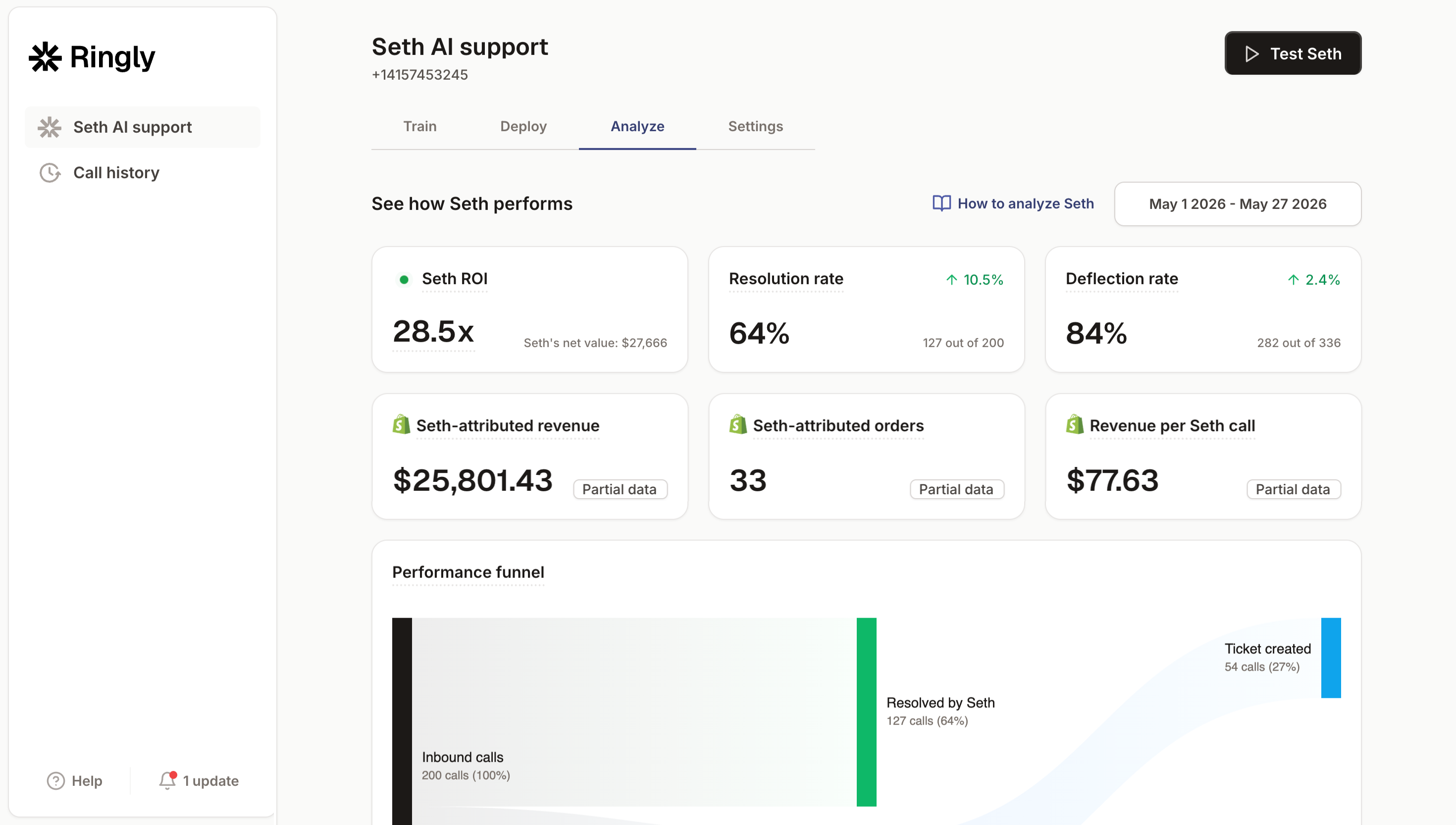
Those calls are a return touch nobody counts. And they're the same script every time, which means they're exactly what an AI phone agent should handle. Ringly.io is AI phone support for Shopify brands. It answers inbound calls 24/7, looks up the return and refund status in your store, tells the customer exactly where things stand, and only escalates to your team when the call actually needs a human. Across 50+ brands, the AI resolves 73% of calls autonomously at roughly $0.42 per resolved call.
WashCo, a Shopify brand we launched, recovered $22,664 in its first 7 days on the phone, because the calls that used to go to voicemail got answered instead. The same engine that answers a sales question at 9pm answers a refund-status question at 9pm.
"My customers also feel like it's a normal person. They feel like they can communicate if they have questions."
Claudia Droge, TechCraft Studio
If your returns process is clean but the phone still rings with refund questions, book a 30-min call and we'll pull a week of your missed calls so you can see how many are just returns. Calls that need a human still escalate cleanly to Gorgias, Richpanel, or whatever helpdesk you already run.
6. Use return-reason data to kill the root cause
Every return carries a reason, and most teams never read them in aggregate. They should. The reasons tell you exactly which products, sizes, or descriptions are driving the volume.
If 40% of a jacket's returns say "smaller than expected," that's not a returns problem, that's a sizing-chart problem. Fix the listing and you cut the returns at the source. This is how you reduce product returns without touching your refund policy at all.
Streamlining the return is good. Preventing it is better, and your return-reason data is the cheapest place to find the next prevention win. Build a monthly habit of reading the top reasons and acting on the top three. Over a few cycles, that compounds into real returns reduction.
7. Speed up inspection and restock
The back half of the chain is the warehouse. A return that sits in a bin for a week is inventory you can't sell and a refund the customer is waiting on. Grade returns quickly, restock the sellable ones fast, and route the rest (refurb, liquidate, dispose) on a clear rule.
Tight restock timing also feeds back into tip 4. The faster you inspect, the sooner you can clear flagged returns for refund, which shrinks the window where the customer calls. Returns processing and fulfillment are the same loop, not two separate ones.
Reverse logistics is expensive on its own (industry benchmarks put it at $30 to $65 per item in electronics), so every day you shave off the restock cycle is real money back in inventory.
8. Offer exchange-first and keep-it options
Not every return needs to become a refund. Lead with an exchange before you offer money back. A clean exchange keeps the revenue and often costs you less than a refund plus a re-acquisition.
For low-value items where the return shipping costs more than the product, a "keep it, here's your refund" rule can be cheaper than processing the return at all. Set a threshold and let the system apply it automatically.
Flexible options (exchange, store credit, keep-it, multiple drop-off methods) give the customer control and give you cheaper outcomes. The point isn't to make returns harder, it's to route each one to its cheapest good ending.
What a streamlined returns workflow saves you
The labor math is where this gets real. Take a typical Shopify brand running a 6-rep CS team:
| Line item | Today | Streamlined |
|---|---|---|
| 6 reps x $4K loaded per rep | $24,000/mo | n/a |
| Phone + return-status automation (~$5K/mo) | n/a | $5,000/mo |
| Net monthly CS spend | $24,000/mo | $5,000/mo |
| Monthly savings | n/a | $19,000/mo |
| Annual savings | n/a | $228,000/yr |
That's the difference between paying reps to repeat the same return-status answer all day and routing the repeatable 70% to automation. The genuinely complex returns (a damaged order, an angry escalation, a fraud edge case) still go to your team, who now have the time to actually solve them.
The exact numbers depend on your call volume and team size, and these are the shapes we see across 50+ Shopify brands, not a quote. The point is that a clunky returns workflow isn't just slow, it's a recurring CS cost that scales with your order volume.
Want the math on your actual numbers? Book a 30-min call and we'll do it live.
How to roll this out without breaking what works
You don't ship all eight at once. Sequence it. Portal first, because it deletes the most tickets for the least effort. Then auto-labels and the rules engine, so the boring returns run themselves. Then instant refunds for the low-risk lane. Then phone automation for the refund-status calls that survive all of that. The data loop and restock improvements run continuously underneath.
When we pulled call logs across our brands to figure out what to automate first, returns and refund-status questions were a steady, predictable slice of inbound, the kind of volume that's boring for a human and perfect for an agent. That's why tip 5 punches above its weight. It catches the touches the other seven tips can't.
Start with the portal this week. Add the next layer when the first one is clean. Streamlining returns is a sequence, not a switch.
Frequently asked questions
What's the fastest way to streamline returns? Get every return onto a self-service portal first. It deletes the most support tickets for the least effort, because the customer starts the return themselves instead of calling or emailing your team. Everything else (auto-labels, rules, instant refunds) stacks on top of the portal.
How do I reduce returns processing time? Automate the touches: auto-generate the RMA and label, enforce your policy with a rules engine, and refund low-risk returns instantly. Each manual step you remove shaves time off the cycle. The all-in cost of processing one return is around $25 to $30, so fewer touches is direct money saved.
Are instant refunds safe, or will they cause fraud? They're safe when you scope them. Refund instantly only when the return looks low-risk, and flag repeat high-return accounts for inspection before the refund clears. About 9% of returns are fraudulent, so you gate the risky ones rather than treating every customer like a suspect.
How do I stop customers calling about their refund? Two moves. Speed up the refund (a 2-day refund produces silence, a 10-day one produces a call), and put an AI phone agent on the line to answer the calls that still come in. Ringly looks up the return and refund status in your store and tells the customer where things stand, 24/7, without a rep.
What does it cost to process an ecommerce return? Roughly $25 to $30 all-in once you count return shipping, labor, inspection, and restocking, rising to $28 to $35 at peak. That figure doesn't include the support call the return often generates, which adds about $5 per ticket. Signifyd estimates processing alone at about 21% of the order's value.
Does Ringly handle return and refund-status calls? Yes. Ringly is AI phone support for Shopify brands. It answers inbound calls 24/7, looks up order and return status in your store, handles returns and refund questions, and escalates anything complex to your helpdesk. Across 50+ brands it resolves 73% of calls autonomously at about $0.42 per resolved call.
Talk to us

If returns are quietly eating your CS hours, a 30-minute call is the fastest way to see how much of that load is just refund-status questions. We'll pull a week of your missed calls and show you what your team is spending time on that an agent could take.
The 3-layer guarantee.
- Live in 14 days or it's free until launched.
- 65% resolution in 90 days or we refund the last 3 months of subscription fees.
- We keep working free until we hit 65%.
Ruben (Ringly co-founder) takes these calls personally.