
Returns grow with every order you ship. Your CS team shouldn't have to.
- Returns scale with order volume, and the per-return labor cost stays roughly flat, so headcount creeps up in a straight line unless you change the model.
- The three levers that bend that curve: cut the rate, automate the routine return, and own the phone wave returns create.
- Written for the founder, COO, or Head of CX at a $10M-$100M Shopify brand with a visible phone line and a returns queue that grows faster than the team.
Every order you ship is a future return you have to staff for. Returns climb in lockstep with volume, and the cost to process each one barely moves, so the math quietly forces your next CS hire, then the one after that. Reading back through 40+ real merchant call transcripts, the call that does the most damage isn't the angry one. It's the quiet after-hours "where's my refund" that rolls to voicemail on a Saturday and never gets returned.
If you run a growing Shopify brand and your returns queue grows faster than your team can hire, this is for you. Most $10M-$100M brands try to solve a scaling returns operation by adding reps, and the spend climbs forever because the underlying model never changes. We've launched AI phone support for 50+ Shopify brands stuck in exactly that loop. Book a 30-min call and we'll do the math on your actual returns-call volume live.
The returns curve nobody staffs for
Start with the number. US retail returns hit $890 billion in 2024, and retailers expect 16.9% of annual sales to come back, according to NRF and Happy Returns. Online runs hotter than the store. The online return rate sits around 19-20%, per the 2025 NRF returns landscape, so roughly one in five things you ship comes back.
That's the visible cost. Each return runs $15 to $30 to process once you count shipping, inspection, restocking, and refund handling, per a 2026 returns data playbook. For a brand shipping thousands of orders a month, that line item alone scales straight up with growth.
The cost nobody budgets for is the second one: every return spawns a support contact, and a big share of those land on the phone. Refund-status questions run 15-25% of support tickets at a lot of brands, and at some DTC brands returns are the single biggest source of tickets, ahead of everything else. WISMO, the "where's my order" call, is already up to half of inbound contacts according to Salesforce. Returns add a second wave on top of it.
So when you model a returns operation that scales, you're really modeling two curves at once. The logistics cost (shipping, restocking) and the support cost (the calls and tickets each return creates). Most teams budget the first and get blindsided by the second. The full cost and causes of returns break down the same way at almost every brand we see.
Where returns ops break as you scale
The breakpoints are predictable. They hit by order band.
Under 100 orders a day, manual returns are fine. One person works the portal, answers the refund-status questions, and closes the loop. Nobody calls this a problem.
Between 100 and 500 orders a day, the wheels start to wobble. This is the plateau where ops time stops scaling with revenue. The portal still works, but the calls don't fit in the day anymore. Your team is answering the same questions over and over: where's my return label, did you get my package, where's my refund. A US-based CS rep costs about $4,000 a month loaded, and a growing chunk of that spend is one human reading a tracking number off a screen.
Past 500 orders a day, it snaps. Three things break in order:
- Refund-status calls outrun the team. The gap between "we received your return" and "the money is back on your card" is 5 to 10 business days because of bank and card-network settling. Customers call into that gap. A lot.
- After-hours and weekends roll to voicemail. The "where's my refund" wave spikes after hours, when no rep is on, and those WISMO calls and their refund-status twin go unanswered. Voicemails pile up. Most never get returned.
- The founder becomes the returns hotline. Once the queue backs up, escalations route to whoever cares most. At founder-led brands, that's the founder's cell.
None of these get fixed by hiring. They get worse, just slower, because each new rep buys you a few weeks of breathing room before the curve catches up. The real fix is changing what a return costs you to handle, which is the next section.
The "you can't hire your way out of it" math
Run the numbers on a typical $50M Shopify brand with a 6-rep CS team handling the returns load plus everything else.
| Line item | Today | With Ringly |
|---|---|---|
| 6 reps x $4K loaded per rep | $24,000/mo | n/a |
| Ringly (~$5K/mo) | n/a | $5,000/mo |
| Net monthly CS spend | $24,000/mo | $5,000/mo |
| Monthly savings | n/a | $19,000/mo |
| Annual savings | n/a | $228,000/yr |
Here's why hiring never closes the gap. The per-return labor cost is roughly flat. A refund-status call handled by a human costs you around $2.70 in loaded time whether you ship 100 orders a day or 1,000. So as orders climb, returns climb, and the human hours scale in a straight line right behind them. Add a rep, and you've bought a bit of breathing room. The cost curve still has the same slope it had before.
The only way to bend it is to change what a routine return costs to handle. When an AI agent takes the order-status and refund-status call, the cost per resolved call drops to about $0.42, versus $7 to $16 per call for a human BPO. That changes the slope of the whole cost curve, not just one line item on it. WashCo, a Shopify brand we launched, recovered $22,664 in attributed revenue in its first 7 days on the phone, while paying a fraction per call of what a human queue costs.
If you want to see this run against your real returns-call volume instead of a worked example, book a 30-min call and we'll do the math live.
Lever 1: cut the rate before it hits ops
The cheapest return to handle is the one that never happens. About 45% of returns trace to expectation gaps the brand created, things like ambiguous sizing, thin product content, and fit guidance buried where nobody reads it, per the same 2026 returns playbook. That's nearly half your return volume sitting upstream of operations, fixable before it ever becomes a label, a restock, and a phone call. Two moves do most of the work here.
- Fix the product page. Sizing charts, real photography, and the return policy on the product page itself, not buried in the footer. Around 60% of shoppers look for the policy on the PDP and a big share of sites don't put it there.
- Make the default an exchange, not a refund. Up to 60% of returns can convert to an exchange or store credit when the flow is built for it, per Narvar data cited in that playbook. That keeps the revenue and changes the unit economics of the whole operation.
There's a longer guide on how to reduce your return rate and on returns best practices if you want to go deep on prevention.
Be honest about the ceiling, though. Prevention caps the rate. It doesn't process the volume. Even at a very low return rate, you still have a returns operation to run, and as you grow that operation, the support cost is where headcount quietly creeps. Prevention is lever one. It isn't the whole job.
Lever 2: automate the routine return so per-return cost stays flat
A returns app does the logistics. Tools like Loop, AfterShip, and Returnly run the self-serve portal, generate the label, and trigger the restock. If you're scaling and you don't have one, get one. The Shopify returns process gets dramatically smoother with a real portal in place, and an exchange-first flow keeps more of the revenue.
Here's the catch. The portal doesn't answer the phone. The customer who started a return still calls to ask where their refund is, whether the package arrived, and why it's taking so long. That contact lands on a human, and it's the same handful of questions every time. The portal solved the logistics and left the conversation untouched.
That conversation is where the headcount curve actually lives. To bend it, the routine returns and refund-status contact has to go somewhere other than a rep's queue. That's the work of scaling customer service without hiring: route the repeatable contact to an AI agent, keep the human for the calls that need judgment.
The fear, of course, is that a customer who's already annoyed about a refund will be more annoyed talking to a machine. In practice it's the opposite when the voice is good.
"My customers also feel like it's a normal person. They feel like they can communicate if they have questions."
Claudia Droge, TechCraft Studio
The single most repeated thing customers say after a call with our AI is that it doesn't sound like AI. A calm, instant answer at 9pm on a Sunday beats a voicemail that gets returned on Tuesday, every time.
Lever 3: own the phone wave returns create
This is the layer nobody owns. Your helpdesk owns tickets. Your returns app owns the portal. The phone, where the "where's my refund" wave actually lands, sits unmanaged, and it's the most expensive channel you have because it ties up a human one call at a time.
Ringly.io is AI phone support for Shopify brands. Instead of growing your support headcount every time returns volume goes up, the AI takes the routine inbound calls so your team can focus on the work that actually moves revenue.
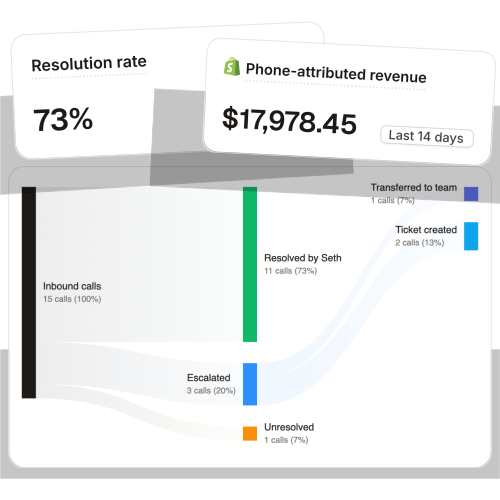
The AI answers calls 24/7. It checks order and refund status in your Shopify store, answers return-policy and product questions from your knowledge base, and escalates cleanly to Gorgias, Richpanel, Reamaze, or whatever helpdesk you already run. Across 50+ brands, it resolves 73% of calls autonomously at roughly $0.42 per resolved call. At 73% autonomous resolution, the after-hours WISMR wave stops being the thing that forces your next hire.
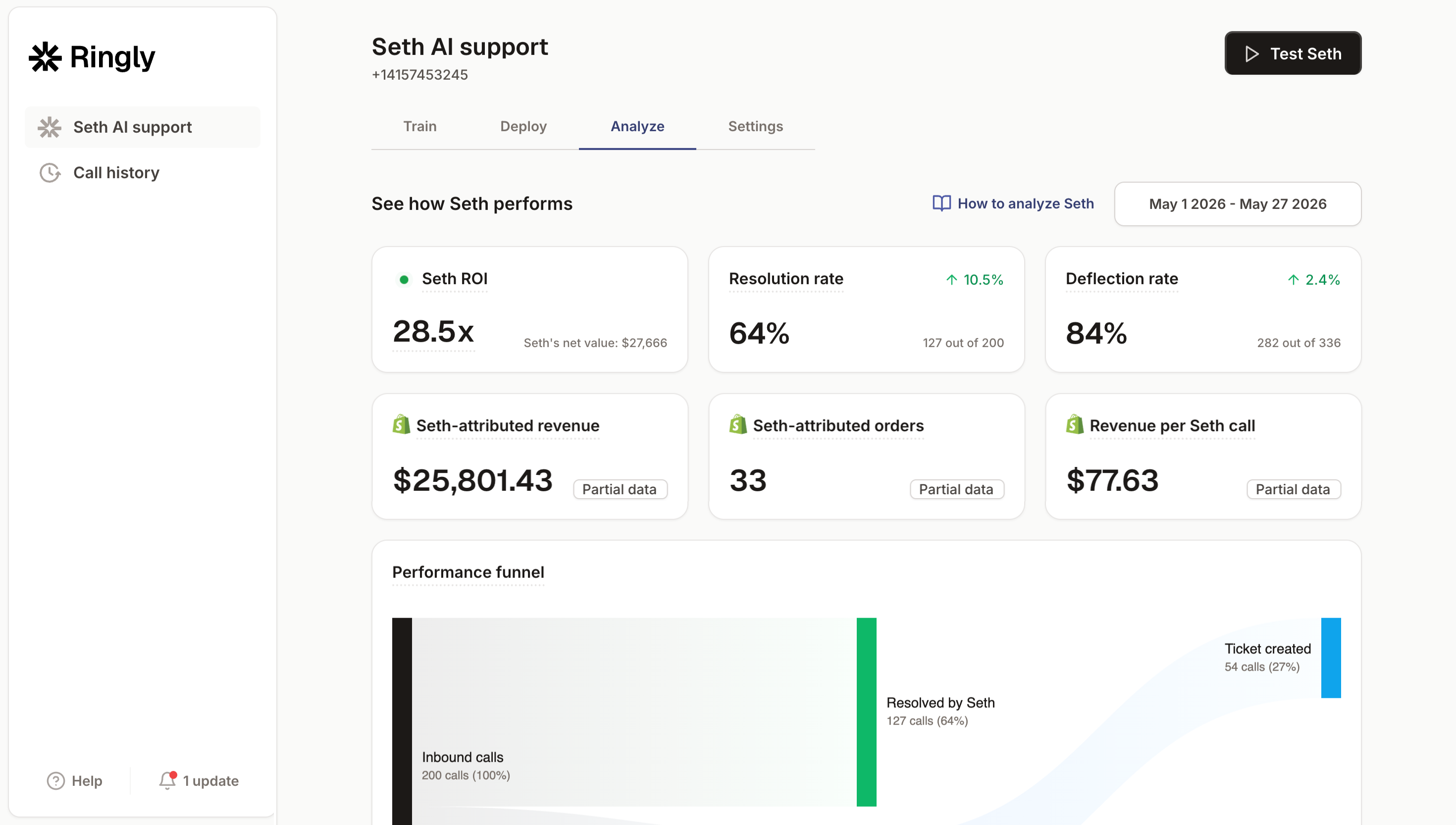
You keep your phone number, your helpdesk, and your workflows. You control what escalates. This is the AI phone support for Shopify layer that keeps the per-return cost flat as order volume climbs. Plans run Grow at $349/mo and Pro at $799/mo, with Enterprise scoped on a call. See pricing for the self-serve tiers.
How to choose where to start
You don't run all three levers on day one. Start where the bleeding is.
- Start with prevention if your return rate is the outlier for your category and the product page is thin. Cutting the rate has the highest ceiling, but the longest payback.
- Start with automation if you're still processing returns by hand without a portal. Get the logistics off your team first.
- Start with the phone layer if your portal already works but refund-status calls still hit a human, after-hours voicemail is piling up, and the founder's cell has become the returns hotline. This is the fastest curve-bender because it changes the per-call cost immediately.
Most growing brands we talk to need lever three first, because they've already done one and two and the calls are still landing on people.
Frequently asked questions
How do you scale ecommerce returns without hiring more CS reps? You change what a return costs to handle, not how many people handle them. Prevention cuts the rate, a returns portal handles the logistics, and an AI phone agent takes the routine refund-status and order-status calls so the per-return cost stays flat as volume grows.
Don't a returns app like Loop or AfterShip already handle this? They handle the portal, the label, and the restock, which is the logistics half. They don't answer the phone. The "where's my refund" call still lands on a human, and that's the contact that drives most of the support cost as you scale.
What's the real cost of a return as you scale? There are two costs. The logistics cost runs $15 to $30 per return, and the support cost is the calls and tickets each return spawns. Most teams budget the first and get blindsided by the second.
Will an AI agent annoy a customer who's already upset about a refund? The most common feedback we hear is that customers can't tell it's AI. A calm, instant answer beats a voicemail that gets returned days later, and anything genuinely tricky escalates to your team with the full context.
How does Ringly handle refund-status calls? The AI checks order and refund status in your Shopify store, explains where the refund is in the settlement window, and answers return-policy questions from your knowledge base. Calls that need a human escalate cleanly to your existing helpdesk.
Should I focus on reducing returns or processing them better? Both, in order. Reducing the rate has the highest ceiling, but you still have to process the volume you can't prevent, and that's where headcount quietly creeps. Most brands underinvest in the processing and support side and overspend on reps as a result.
Talk to us

If you run a $10M-$100M Shopify brand and your returns operation is growing faster than you can hire, a 30-min call is the fastest way to see what the after-hours call wave is actually costing you. We'll pull the math on your real volume and show you where the curve bends.
The 3-layer guarantee.
- Live in 14 days or it's free until launched.
- 65% resolution in 90 days or we refund the last 3 months of subscription fees.
- We keep working free until we hit 65%.
Ruben (Ringly co-founder) takes these calls personally.