
A refund policy is two things at the same time. It's a legal disclosure that protects your store, and it's the answer to a phone call you get every single day.
Most guides only treat it as the first one. They hand you a legalese template, tell you to drop it in the footer, and move on. That's how you end up with a policy that's technically complete and still useless to the person actually fielding "what's your refund policy" for the fortieth time that morning.
If you run a $10M-$100M Shopify brand with a support team and a phone number on the site, you already know the pattern. Returns season hits, the same handful of questions come in over and over, and your reps spend their day reading a policy back to customers instead of doing anything harder. This guide covers the eight things every refund policy needs, a copy-paste skeleton you can fill in today, and how to write the thing so a rep, or an AI agent, can resolve the call straight from it.
We build AI phone support for 50+ Shopify brands, so we read a lot of real call logs. "What's your refund policy" and "where's my refund" are two of the most repeated routine calls on the line. A clear, findable policy is the cheapest deflection lever you own, and almost nobody writes it that way. If you want to see what your own refund calls look like, book a 30-min call and we'll walk through your last week of them.
This post in 30 seconds.
- A refund policy isn't just a legal page. Written clearly, it answers the routine "what's your refund policy" and "where's my refund" calls before a human ever picks up.
- The eight components every policy needs, a fill-in-the-blank skeleton, plus what the FTC and EU actually require.
- Built for $10M-$100M Shopify brands running a paid helpdesk and a visible phone line, where the same refund questions eat real payroll.
Refund vs return vs exchange (clear these up first)
Most policies blur three different things into one paragraph, and that's where the confusion starts. When the customer doesn't understand the difference, and the rep is reading from a fuzzy policy, you get a back-and-forth that should have been one answer.
Get the three terms straight and half your refund confusion goes away before it ever becomes a call. Here's the clean split:
| Term | What it is | When it triggers | What the customer gets |
|---|---|---|---|
| Return | The physical act of sending the item back | Customer wants out of the purchase | Nothing yet, it's the first step |
| Refund | Money back to the customer | After a valid return is received | Cash to original payment, or store credit |
| Exchange | A swap for a different size, color, or item | Customer wants a different version, not their money back | The replacement item, often as instant store credit |
A return is the action. A refund and an exchange are the two outcomes a return can lead to. Exchanges are usually cheaper for you, because you keep the revenue and skip the restocking loss, which is why a lot of brands nudge toward them in the policy itself.
Spell all three out separately. The clearer the language, the fewer "wait, do I get my money back or store credit" calls land on your team. If you want the deeper version of the returns side, we wrote a full ecommerce return policy guide and a breakdown of how Shopify exchanges work in practice.
The 8 things every refund policy must include
A refund policy that misses one of these creates a gap, and every gap turns into a support contact. Walk through each one and ask the same question: does this line answer a call, or generate one?
Return window. How many days the customer has to start a return. Thirty days is the consensus default, with stores ranging from 15 to 90. According to NRF data reported by eMarketer, about 19-20% of online orders come back, so this window gets used constantly. Pick a number and state it plainly.
Eligibility and condition. What state the item has to be in. Unworn, tags attached, original packaging, not used. Be specific, because "like new" means different things to you and the customer.
Non-returnable items. Final sale, perishables, personalized products, intimate items, opened software. List them by name. Every unlisted exception is a dispute waiting to happen.
Refund method. Whether the money goes back to the original payment method, to store credit, or whether you offer the customer a choice. This single line kills a huge share of "how will I get my money back" questions.
Return shipping and fees. Who pays return shipping, and whether you charge a restocking fee. If you do, the number goes here. Customers forgive a fee they were told about and dispute one they weren't.
Processing time. How long the refund actually takes once you receive the item. This is the big one. The full refund cycle averages 9 to 10 days once you add shipping and inspection, so without a stated timeline, customers call to ask where their money is. Set the expectation and you delete the entire "where's my refund" call category.
How to start a return. The actual steps. Email this address, use this portal, include this order number. A self-serve return link here does more for your call volume than any other single line.
Contact and exceptions. How to reach a human, plus the edge cases: damaged on arrival, defective, gifts, international orders. These are the calls that genuinely need a person, so make the path to one obvious.
Notice that six of the eight components exist to answer a question before it's asked. That's the whole game. A policy written to be answered is a policy that defends your ecommerce customer service team's time. For the money side specifically, our ecommerce refunds explainer and the Shopify refunds walkthrough go deeper.
A copy-paste refund policy skeleton
Here's a plain-language skeleton you can fill in. Write it the way you'd say it on the phone, not the way a lawyer would draft it. The single biggest mistake is legalese, because a policy nobody can read is a policy everybody has to call about.
Refund policy
We want you to love what you ordered. If you don't, here's how it works.
Return window. You have [30] days from delivery to start a return.
Condition. Items must be [unworn, unwashed, with tags attached, in original packaging].
Non-returnable. [Final sale items, gift cards, personalized products, perishables] can't be returned.
Refunds. Once we receive and check your return, we'll refund your [original payment method] within [5 business days]. Your bank may take a few more days to post it.
Exchanges. Want a different [size or color] instead? Tell us and we'll send the swap, no extra charge on the difference.
Return shipping. [We cover return shipping with a prepaid label / Return shipping is the customer's responsibility]. [A $X restocking fee applies to Y.]
How to start. [Visit our returns portal at link / Email returns@yourstore.com with your order number] and we'll send instructions within [24 hours].
Damaged or wrong item? Email us a photo at [address] and we'll make it right, no return needed.
Fill the brackets with your real numbers and you have a working policy. Then put it where people actually look: the footer, the checkout page, the product page, and the order confirmation email. The FTC's guidance is blunt about this, your policy has to be clearly disclosed, and a buried policy is functionally no policy. Need a faster start, our return policy generator and refund email generator draft the language for you.
What the law actually requires
This isn't legal advice, but you should know the floor. In the US, no federal law forces you to accept returns on non-defective items, but you do have to disclose your policy clearly. The FTC is clear that hiding or failing to disclose return restrictions can leave you on the hook to honor returns you never intended to.
Defective and misrepresented goods are a separate matter, those fall under consumer-protection and warranty law, and "no returns" doesn't override them.
Sell into the EU or UK and the bar is higher. The EU Consumer Rights Directive gives online buyers a 14-day window to cancel and return most purchases, and the UK Consumer Contracts Regulations mirror it with a 14-day cooling-off period, per iubenda's regulatory summary. If you ship internationally, your policy has to clear the strictest market you sell into, not the most lenient. State numbers reduce trust risk and call volume at the same time.
Why a clear policy is your cheapest deflection lever
Here's the part the template guides skip. The expensive part of returns isn't the refund. It's the support labor wrapped around it.
Each return costs a retailer somewhere between $10 and $65 once you count shipping, inspection, and restocking. But that figure doesn't even include the calls. Every vague line in your policy is a phone call your team has to answer by hand, and those calls follow the same script all day. "What's your refund policy." "Where's my refund." "Do I pay for shipping back." Reading real Ringly call logs, those three are among the most repeated routine calls on any brand's line, right next to WISMO calls.
A clear policy answers most of them on its own. A clear policy that's also structured, so a human rep or an AI phone agent can pull the answer straight from it, answers nearly all of them.
Run the math on the labor. A typical $50M Shopify brand carries a 6-rep support team at roughly $4,000 loaded per rep, so $24,000 a month. A big slice of that spend is the same repeatable returns and refund questions, the ones a well-written policy plus an agent that reads from it can resolve without a human. Move that volume off your team and the savings land in the $15,000 to $19,000 a month range. WashCo, a Shopify brand we launched, recovered $22,664 in its first 7 days on the phone by catching calls that used to go to voicemail.
That's the reframe. Your refund policy isn't a cost-of-doing-business legal page. Written for answerability, it's an ops asset that pays for itself in payroll you don't spend. If you want to see how much of your refund volume is actually deflectable, book a 30-min call and we'll do the math on your real numbers.
Where Ringly fits
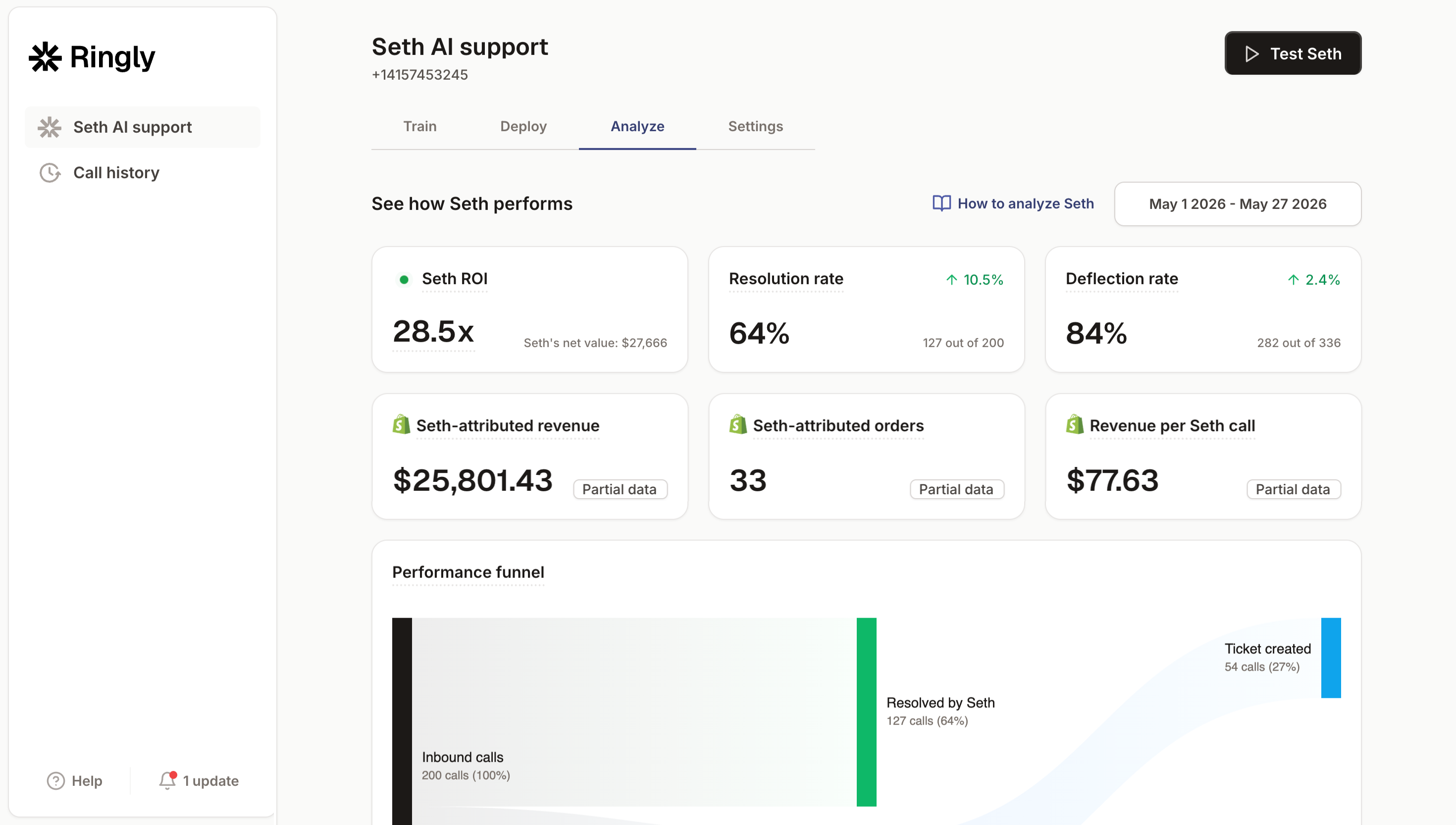
Ringly.io is AI phone support for Shopify brands. Once your refund policy is clear and structured, the AI reads from it the same way a trained rep would, so the routine "what's your refund policy" and "where's my refund" calls get resolved 24/7 without anyone picking up.
The AI answers inbound calls, finds the order in your Shopify store, checks status, and pulls refund-policy answers from your knowledge base. Across 50+ brands it resolves 73% of calls on its own at roughly $0.42 per resolved call. The genuinely hard calls, the damaged-on-arrival and the international edge cases, escalate cleanly to whatever helpdesk you already run. Plans start at $349/mo with a 65% resolution guarantee. The policy is step one. An agent that answers from it is step two.
Frequently asked questions
What should an ecommerce refund policy include? Eight things: the return window, eligibility and condition requirements, non-returnable items, the refund method, who pays return shipping, processing time, how to start a return, and contact info with exceptions. Each one exists to answer a customer question before it becomes a support contact.
What's the difference between a refund policy and a return policy? A return policy covers the whole process of sending an item back, including refunds and exchanges. A refund policy is the money-back piece specifically: whether you give refunds, when, and how. Most stores combine them into one page, which is fine as long as the refund terms are spelled out clearly.
How long should my refund window be? Thirty days is the consensus, and around 62% of consumers expect at least that, per HubSpot data. Fifteen days is on the tight end and can cost you trust, while 90 days is generous and tends to lift conversion. Pick based on your margins and your return rate, then state it plainly.
Are online stores legally required to give refunds? In the US, no federal law forces refunds on non-defective items, but the FTC requires you to disclose your policy clearly. Defective or misrepresented goods are different and fall under consumer-protection law. The EU and UK both mandate a 14-day cooling-off period for online sales.
How do I stop getting the same refund questions over and over? Write the policy to be answerable, then make it findable in your footer, at checkout, on product pages, and in order confirmations. The repeatable status and policy calls drop fast once the answer is everywhere the customer looks, and an AI phone agent that reads from the policy catches the rest.
How long does a refund take to process? Once you receive the item, processing alone runs 1 to 7 business days, and the full cycle averages 9 to 10 days with return shipping and inspection. State your number in the policy so customers don't call to ask, since the gap between "returned it" and "got my money" is where most refund-status calls come from.
Talk to us

If you run a $10M-$100M Shopify brand and your team is answering the same refund questions all day, a 30-min call is the fastest way to see how much of that volume your policy and an AI agent could absorb.
The 3-layer guarantee.
- Live in 14 days or it's free until launched.
- 65% resolution in 90 days or we refund the last 3 months of subscription fees.
- We keep working free until we hit 65%.
Ruben (Ringly co-founder) takes these calls personally.