
This post in 30 seconds.
- A subscription management platform automates the billing. It doesn't pick up the phone when a subscriber calls to pause the next box, and a slice of your subscribers will always call instead of using the portal.
- Here are the 8 platforms worth shortlisting in 2026, with real pricing and the per-order fees most roundups hide, plus the support gap none of them close.
- Built for founders and CX leads at $10M-$100M Shopify subscription brands still running a visible phone line.
A subscription management platform runs the recurring charge, the customer portal, the dunning, and the cancellation flow. That's the part everyone compares. What none of the comparison posts mention is the phone.
I went through 50+ real call logs across the Shopify subscription brands we work with. For a supplement brand, the single most common phone call isn't "where's my order." It's "pause my next box." The platform that bills that box can't answer the call, so it lands on your CS team, or on voicemail, or on a competitor's checkout page.
If you run a $10M-$100M Shopify subscription brand, this is the gap that decides whether your renewal mechanics actually hold. Most $30M supplement brands run a 5-rep CS team that spends half its week on pause-skip-and-cancel calls the portal was supposed to catch. We've launched AI phone agents for 50+ Shopify brands trying to close that gap. Book a 30-min call and we'll show you what those calls are costing you.
What a subscription management platform actually does (and doesn't)
A subscription management platform handles the recurring side of a Shopify store: it creates subscription products, charges customers on a schedule, manages the customer portal where people pause or swap, retries failed payments (dunning), runs the cancellation save flow, and reports on recurring revenue. If you want the billing-software angle specifically, we break that down in our guide to subscription billing software, and the data side in subscription analytics software.
The best subscription management platform handles every billing decision on a screen, but a subscriber who picks up the phone instead of the portal is a problem none of them solve. That distinction matters more than any feature table.
Look at the behavior. According to Recurly's 2026 State of Subscriptions (cited in Klaviyo's roundup), 38% of consumers would rather pause their subscription than cancel it. And 44% of subscription cancellations happen in the first 90 days, per 2026 churn benchmarks. Those are moments where a subscriber is reaching out, and a chunk of them reach out by calling, not by logging in. Especially in supplements and wellness, where the buyer skews older and trusts a voice over a portal.
So a platform comparison that only scores the portal is half the picture. The portal is where most subscribers self-serve. The phone is where the rest of them go, and it's where the genuinely angry ones go: the "you charged me again" calls, which are often the refund-doesn't-cancel-the-contract confusion. You need both layers covered. Most brands have one. If you're also rethinking the box format itself, our subscription box platform guide covers that.
The 8 best subscription management platforms at a glance
Here's the shortlist. Pricing verified June 2026. The per-order fee column is the one that decides your bill at scale, and it's the one most roundups leave out.
| Platform | Starting price | Per-order fee | Best for |
|---|---|---|---|
| Ringly (phone layer) | $349/mo | None | The pause/cancel/billing calls the portal can't answer |
| Recharge | $99/mo + 1.49% | $0.19/order | Scale + deepest integration ecosystem |
| Loop Subscriptions | $99/mo + 1.0% | None | Retention and cancellation save rate |
| Skio (a Recharge company) | $599/mo + 1% | $0.20/order | Subscriber portal UX and conversion |
| Stay AI | $499/mo + 1% | $0.19/order | Churn prediction and retention experiments |
| Appstle | Free to $100/mo | None | Cost-sensitive brands, zero transaction fees |
| Chargebee | Usage-based | n/a | Complex SaaS-style billing |
| Recurly | ~$249/mo + % | n/a | High-volume, multi-model billing |
Ringly sits at the top of the table for one reason: it's not competing with Recharge, it's the layer Recharge doesn't have. The other seven run your billing. Ringly answers the calls that billing generates.
How I evaluated these platforms
I'm Ruben, co-founder of Ringly. We run AI phone support for 50+ Shopify brands, so I evaluate the subscription stack constantly, not as a critic, as someone whose product has to plug into it. Over the last few weeks I scored every platform here against the workflow of a $30M Shopify supplement brand.
Here are the five criteria I scored against:
- Shopify-native billing depth. I checked whether the tool runs natively inside Shopify checkout (the apps) or sits as a separate billing system (Chargebee, Recurly), and how cleanly it pushes subscription state back to the order.
- Per-order fee transparency. I pulled the actual published pricing and the per-order fee, because at 10,000 orders a month that fee, not the base price, is your real cost.
- Cancellation save flow. I ran a mock cancellation through each portal and noted what it offered before letting the subscriber go: pause, skip, swap, discount.
- The calls the portal can't catch. I read 50+ real call logs from Ringly customers and counted what subscribers actually phone in about. This is the criterion nobody else scores, and it's where the platforms all look identical (they all score zero, because none of them touch the phone).
- Integration ecosystem. I checked the Klaviyo, SMS, loyalty, and helpdesk integrations, since a subscription program lives or dies on the rest of the stack.
I don't take affiliate commissions on any tool below. Ringly appears in the list because it solves the fifth criterion, and I'm honest that it doesn't solve the first four. You need a billing platform AND a phone layer.
The 8 platforms, reviewed
1. Ringly.io (the phone layer)
Best for: the pause, skip, cancel, and billing calls your subscription platform generates but can't answer.
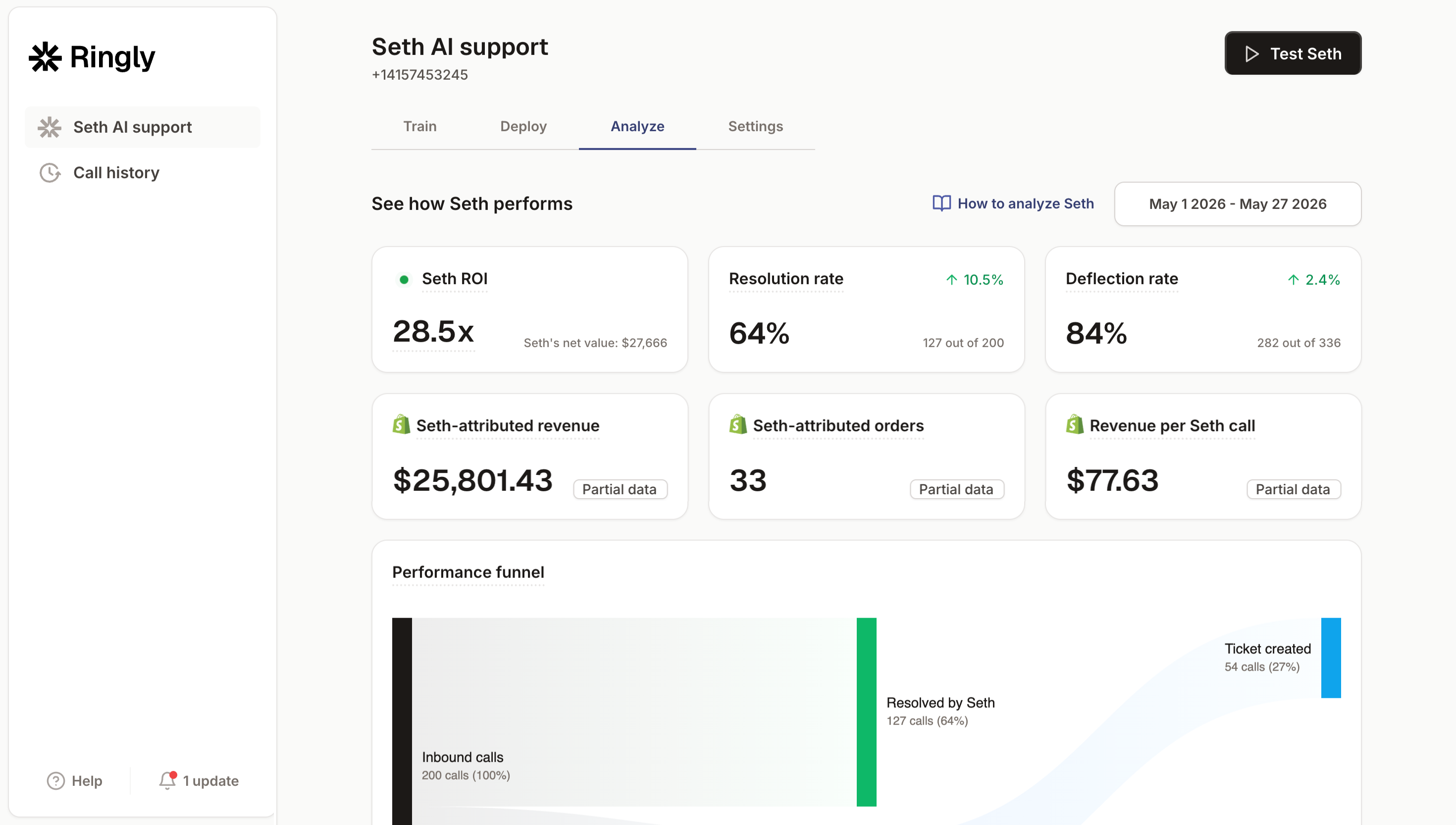
Ringly.io is AI phone support for Shopify brands. It's not a subscription management platform, and I want to be clear about that up front: it doesn't run your billing, it doesn't replace Recharge or Loop. What it does is pick up the phone when a subscriber calls. It finds the order in Shopify, processes the pause or the skip, answers the "why was I charged again" question, and escalates the genuinely complex billing disputes to your team.
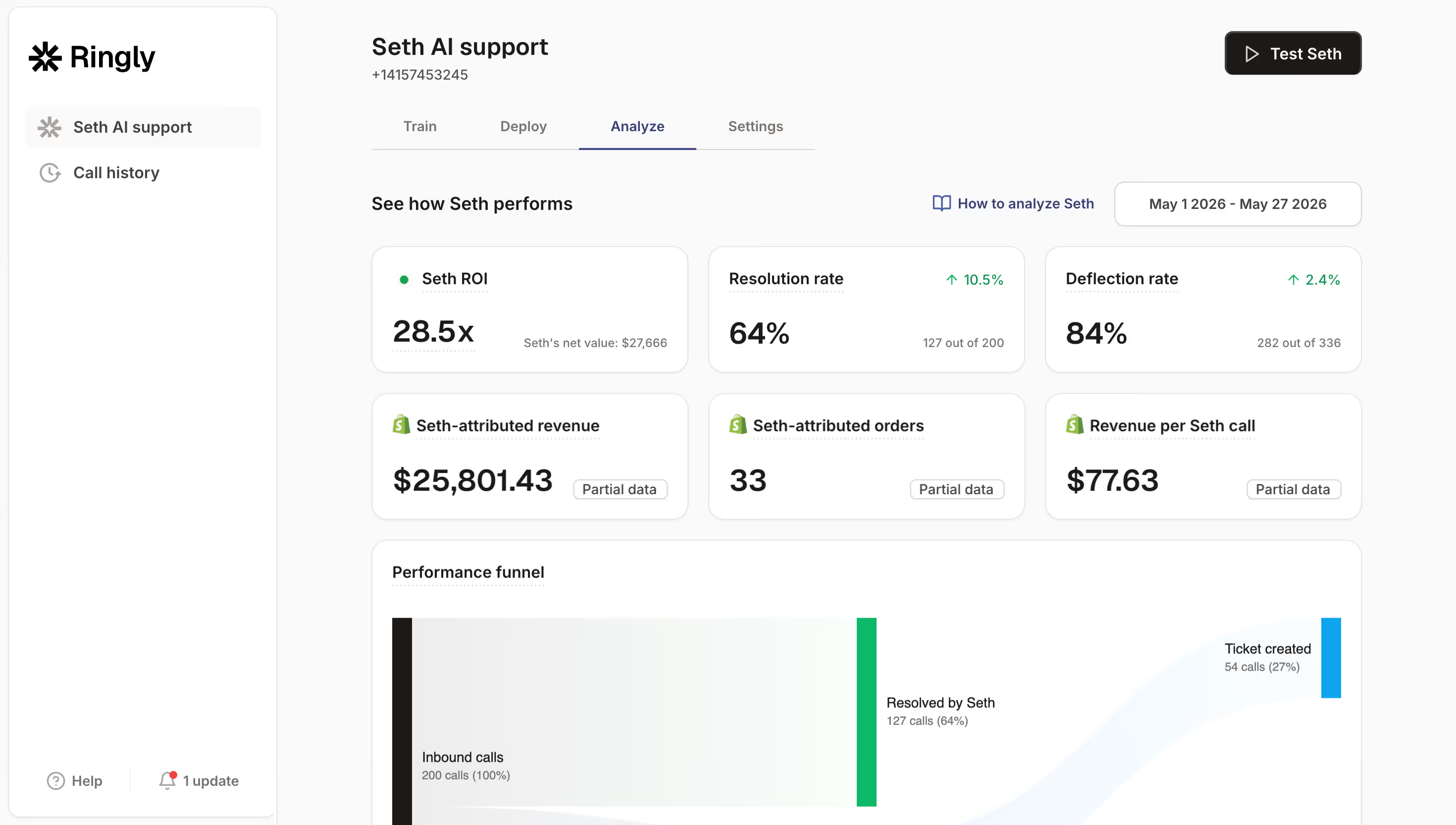
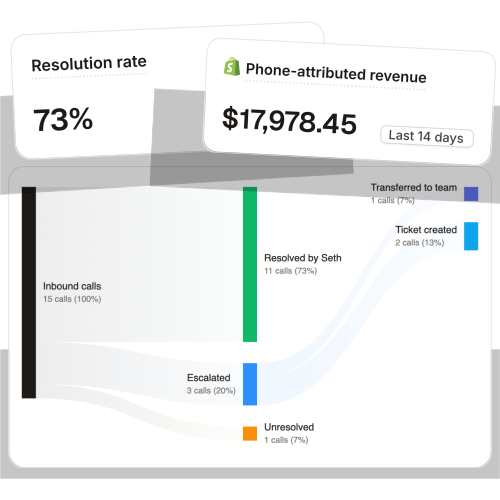
The AI answers inbound calls 24/7. It can check order status and run subscription changes through custom actions. Across 50+ brands it resolves 73% of calls autonomously at roughly $0.42 per resolved call, with calls that need a human escalating cleanly to Gorgias, Richpanel, Reamaze, or whatever helpdesk you already run. BioLongevity Labs, a supplement brand on Ringly, hits 79% resolution autonomously. For subscription brands specifically, that means the pause-and-skip calls stop eating your CS hours.
Pricing: Grow $349/mo (1,000 minutes, ~500 calls), Pro $799/mo (2,500 minutes, ~1,250 calls), Enterprise custom. 65% resolution guarantee: if the AI resolves under 65% of your calls in 90 days, we refund the last 3 months.
What works
- Answers the phone the portal doesn't. Pause, skip, ship-date change, billing confusion, all handled by voice 24/7.
- Sits in front of your stack. Keep Recharge, keep Gorgias, keep your number. Ringly handles the routine calls and escalates the rest.
- Honest scope. It resolves 73% of calls and tells you when it can't, instead of pretending to be a billing platform.
- Live in under an hour with the 65% resolution guarantee behind it.
What doesn't
- It's not a subscription platform. You still need Recharge, Loop, or one of the others for the actual billing.
- Phone-first. If your subscribers never call and live entirely in the portal, you don't need it yet.
Why it ranks first: not because it's the best billing tool (it isn't a billing tool). It ranks first because every other platform on this list leaves the phone uncovered, and for a subscription brand the phone is where your highest-intent and highest-churn-risk subscribers show up.
2. Recharge
Best for: brands that need scale and the deepest integration ecosystem.
Recharge is the most-installed subscription platform on Shopify and BigCommerce. It's the enterprise default: deep Klaviyo, SMS, and loyalty integrations, advanced workflows, and the scale to run a large program. In April 2026 it acquired Skio for $105 million in cash, which reshaped the Shopify subscription market overnight. It also integrates tightly with Klaviyo for lifecycle email.
Pricing: Starter $99/mo + 1.49% + $0.19/order. Plus $499/mo + 1.34% + $0.19/order (12-month commitment).
What works
- Scale and reliability. It runs some of the biggest subscription programs on Shopify.
- Integration ecosystem. The broadest set of native integrations of any platform here.
- Pause-instead-of-cancel prompt built into the portal flow.
What doesn't
- The per-order fee stacks. At 10,000 orders a month, $0.19/order is real money on top of the percentage.
- Dated portal UX compared to Skio and Loop (part of why it bought Skio).
- Portal only. The pause and cancel calls still hit your phone line.
Why it ranks second: it's the safe enterprise pick and the most capable billing platform on the list. It just doesn't touch the phone.
3. Loop Subscriptions
Best for: brands optimizing retention and cancellation save rate.
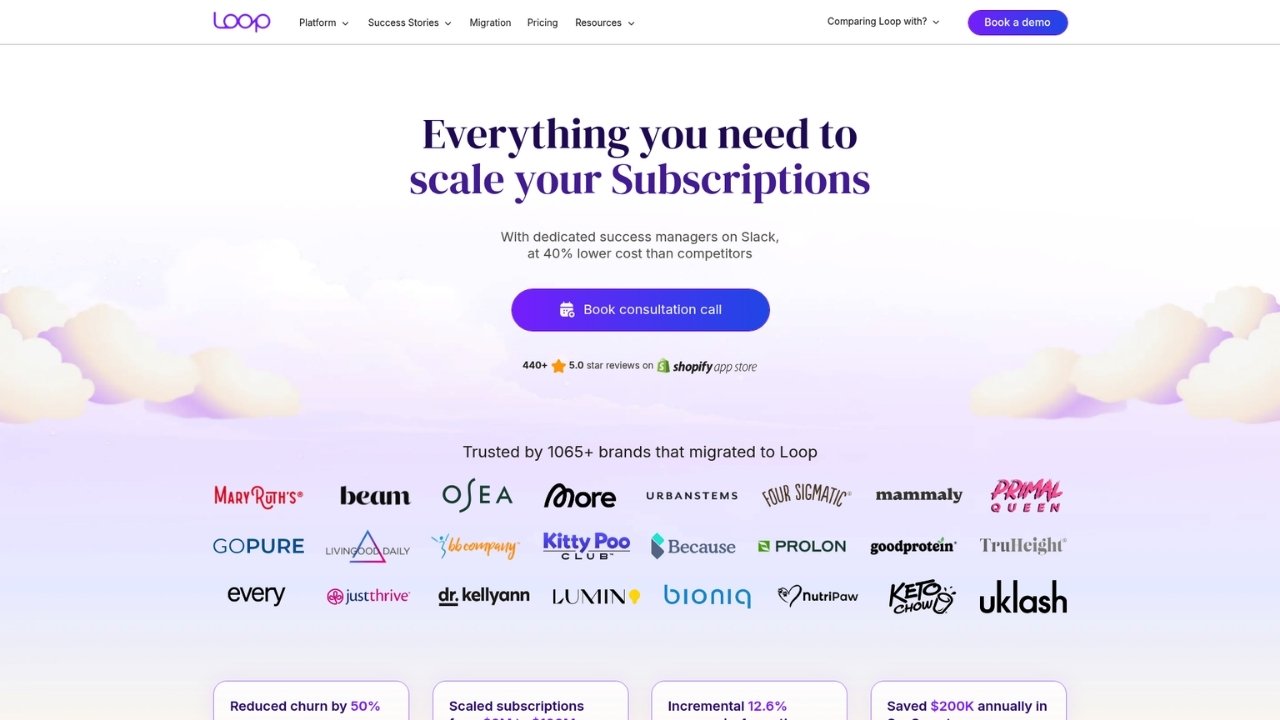
Loop is the retention-first option. Its cancellation flows are reason-specific (offer a skip for "too much product," a discount for cost concerns), and brands running Loop report saving 15 to 30% of would-be cancellations in the exit flow. Its pricing is also the most transparent, with no per-order fee.
Pricing: Starter $99/mo + 1.0% transaction fee, no per-order fee. Pro $399/mo + 0.75%, no per-order fee. Roughly 45% below Skio and 54% below Recharge Plus at scale.
What works
- Best cancellation save flows of the Shopify apps.
- No per-order fee. Just a transaction percentage.
- Churn analytics built for retention teams.
What doesn't
- Smaller integration ecosystem than Recharge.
- Portal only. Same gap as the rest.
Why it ranks third: if your priority is save rate, Loop's exit flow is the best on the list. It still optimizes the screen, not the phone.
4. Skio (a Recharge company)
Best for: brands prioritizing subscriber portal UX and conversion.
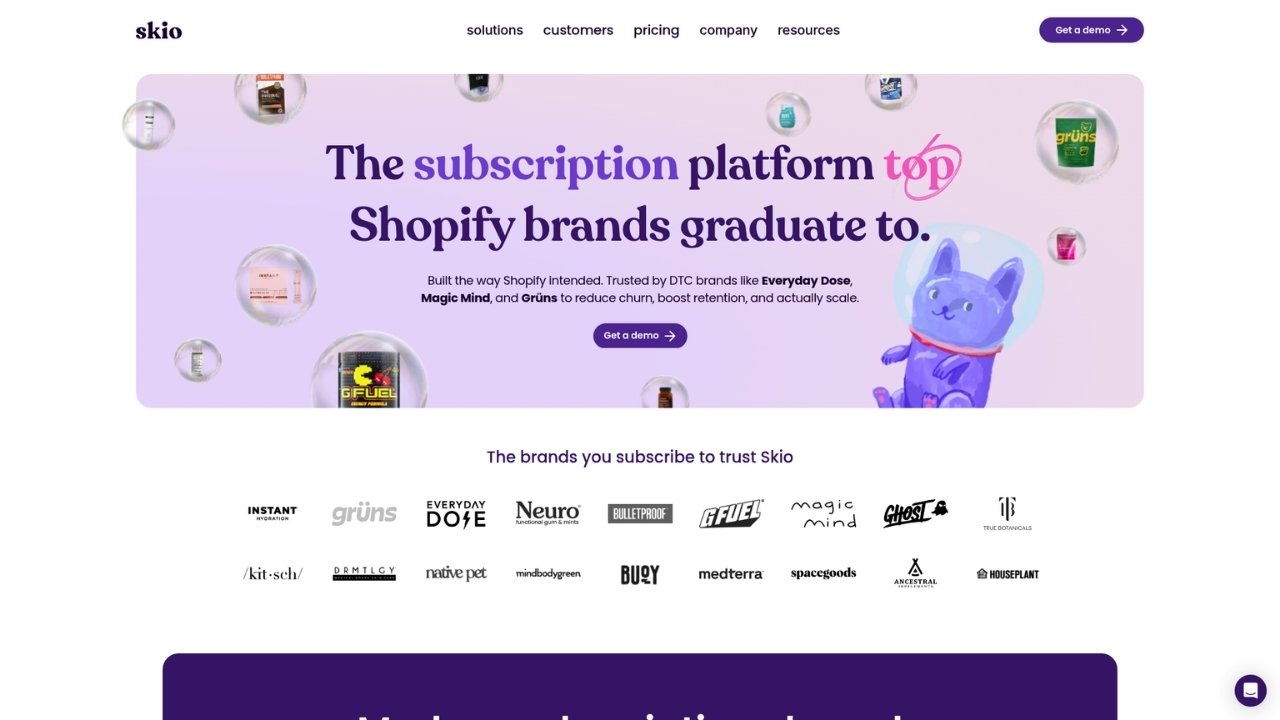
Skio built the best subscriber portal experience on Shopify: passwordless login via SMS or email magic link, frictionless management, fast widgets. Over 1,000 brands run it (IM8, Grüns, Everyday Dose). As of April 2026 it's a Recharge company, so weigh its roadmap against that.
Pricing: $599/mo + 1% + $0.20/order.
What works
- Best portal UX of any platform here.
- Passwordless login removes friction for subscribers managing their plan.
- Strong cancellation save offers (15-25%).
What doesn't
- Premium price with a per-order fee.
- Roadmap now tied to Recharge post-acquisition.
- Portal only.
Why it ranks fourth: the best portal on the list, which is exactly why it's worth remembering that a great portal doesn't help the subscriber who calls instead.
5. Stay AI
Best for: data-driven brands wanting churn prediction and retention experiments.
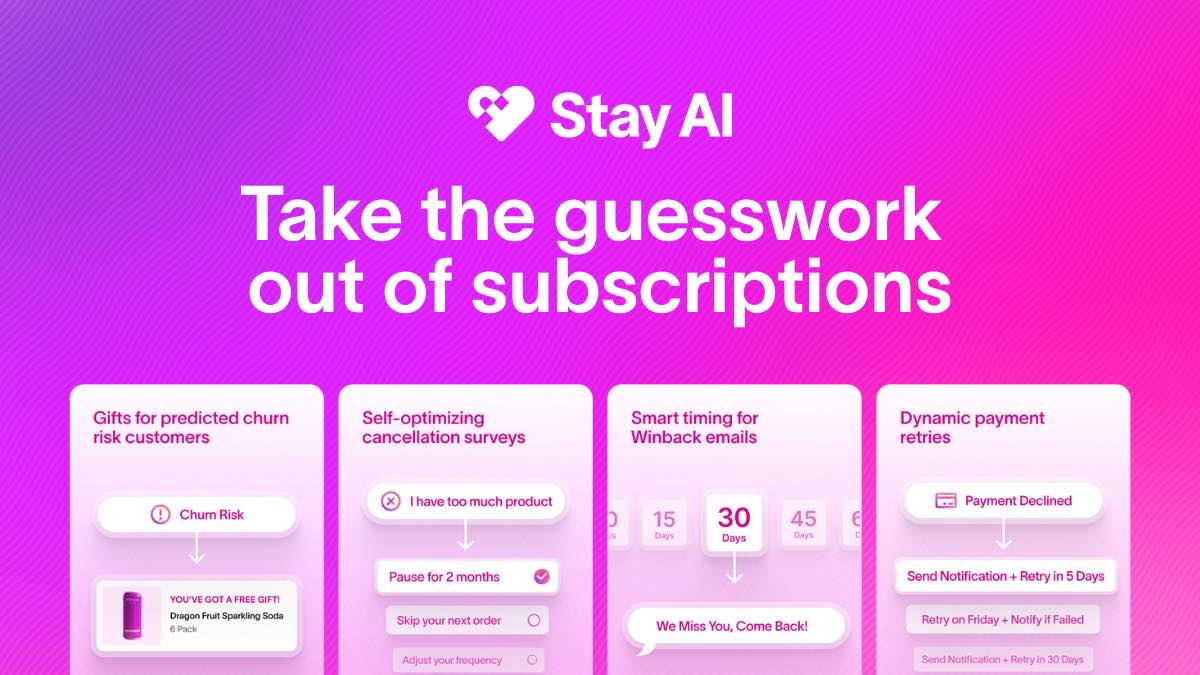
Stay AI leans into prediction. It forecasts churn risk, runs A/B experiments on retention offers, and targets the subscribers most likely to lapse. It holds a 5.0 rating across 140+ Shopify App Store reviews as of May 2026.
Pricing: $499/mo + 1% + $0.19/transaction. 30-day free trial.
What works
- Churn prediction that flags at-risk subscribers before they cancel.
- Experimentation engine for retention offers.
- Strong reviews (5.0 across 140+).
What doesn't
- Premium price with a per-order fee.
- Newer and smaller than Recharge.
- Portal only.
Why it ranks fifth: the smartest retention data on the list. Prediction tells you who's about to call. It doesn't answer when they do.
6. Appstle Subscriptions
Best for: cost-sensitive brands and anyone who wants zero transaction fees.
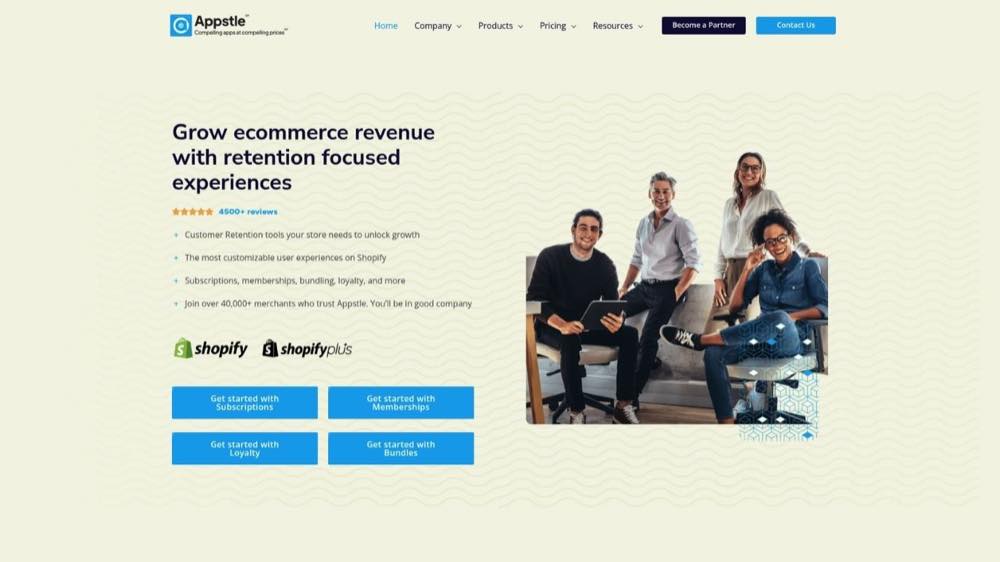
Appstle is the value pick. It powers 40,000+ Shopify merchants, charges no transaction fees on any plan, and starts free. For a brand watching every line of the P&L, it's the cheapest way to run a real subscription program.
Pricing: Free (up to $500/mo subscription revenue), Starter $10/mo (to $5K), Business $30/mo (to $30K), Business Premium $100/mo (to $100K). No transaction fees on any tier.
What works
- Free and cheap tiers with no transaction fees.
- Broad feature set (build-a-box, bundles, loyalty).
- 24/7 support included.
What doesn't
- Less enterprise polish than Recharge or Skio.
- Ticket-based support, not a dedicated CSM at lower tiers.
- Portal only.
Why it ranks sixth: unbeatable on price for a full-featured platform. The gap is the same one every app here has.
7. Chargebee
Best for: complex, SaaS-style billing beyond a simple Shopify box.
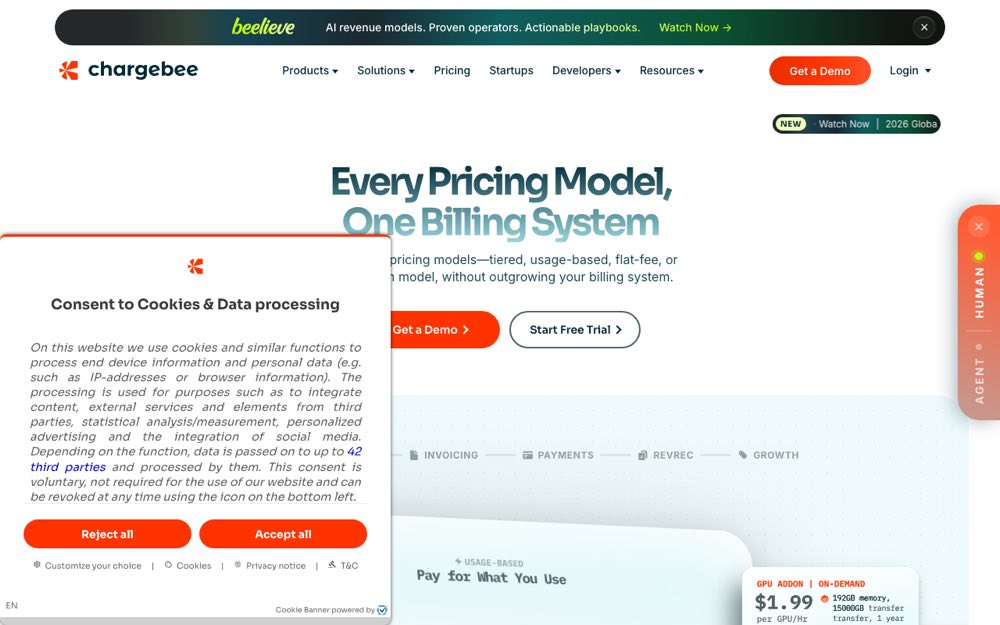
Chargebee is a mature billing platform built primarily for SaaS: plan families, add-ons, coupons, entitlements, multi-currency pricing, quote-to-cash, and revenue recognition. It's heavier than a Shopify app and overkill for a pure DTC box, but if your billing is genuinely complex, it has the depth. G2 reviewers rate it 4.4/5 across 1,033+ reviews, praising support and automation.
Pricing: usage-based, free below a revenue threshold, then scaled, with enterprise quotes above that. Not publicly fixed.
What works
- Deepest billing logic of any tool here.
- Strong support reputation (4.4/5 on G2).
- Multi-currency and revenue recognition out of the box.
What doesn't
- Not Shopify-native. It sits beside Shopify, not inside checkout.
- Overkill for a standard subscription box.
- Portal only.
Why it ranks seventh: the right answer for complex hybrid billing, the wrong answer for a clean Shopify DTC program.
8. Recurly
Best for: high-volume ecommerce and media with multiple billing models.
Recurly is built for volume and flexibility: fixed, tiered, usage-based, prepaid, and ramp pricing, with strong dunning for involuntary churn. G2 rates it 4.6/5, the highest score in this group, with reviewers calling out its payment-recovery strength.
Pricing: Core tier around $249/mo plus a revenue percentage, with enterprise quotes above. Not Shopify-app-native.
What works
- Flexible pricing models in a single plan.
- Strong dunning for recovering failed payments.
- 4.6/5 on G2, the top rating here.
What doesn't
- Not Shopify-native. Heavier setup.
- Built for scale, so it's more than a small box brand needs.
- Portal only.
Why it ranks eighth: excellent at recovering involuntary churn, which is real (failed payments are 25-40% of total churn, per 2026 churn benchmarks). It still leaves the voluntary, phone-driven churn on your line.
"My customers also feel like it's a normal person. They feel like they can communicate if they have questions."
Claudia Droge, TechCraft Studio
The calls your subscription platform can't answer
Every platform above optimizes the same surface: the self-service portal. They've gotten good at it. The cancellation flow, the pause prompt, the passwordless login, all of it lives on a screen.
The subscribers who don't use the screen are the ones most likely to churn, and they're the ones who call. That's the part the comparison posts skip.
Here's what actually comes in by phone at a subscription brand, from the call logs I read:
- "Pause my next box." The most common call at a supplement brand. The portal can do it. The 64-year-old customer would rather a person did it. (There's a whole tactical playbook on this in our subscription cancellation management guide.)
- "Why was I charged again?" Often the refund-doesn't-cancel-the-contract confusion. A refund returns the payment but keeps the recurring contract running, so the customer gets charged next cycle unless you cancel the subscription separately. That's a phone call, and an angry one.
- "Skip this month, I'm traveling." Repeatable, simple, and it still ties up a rep.
- "Change my ship date." Same.
- "Cancel my subscription." The one call where a good save matters most, and where voicemail loses you the whole LTV.
When those calls hit a human team after 6 p.m. or on a weekend, they roll to voicemail. And 85% of callers who can't reach a person never call back, with 62% switching to a competitor, according to PCN's 2026 missed-call study. For a subscription brand, a missed pause call isn't a missed ticket. It's a cancelled subscriber who couldn't reach you to stay. This is also why 24/7 ecommerce phone support matters more for subscriptions than one-time purchases: the subscriber relationship is recurring, so a single dropped call ends a stream of revenue, not one order.
This is the layer Ringly covers. The AI answers the call, runs the pause or skip in Shopify, handles the billing-confusion calls, and escalates the genuine disputes to your team. If you want to see what your missed subscription calls look like, book a 30-min call and we'll review them live.
What subscription support calls cost a $30M supplement brand
A typical $30M supplement brand runs a 5-rep CS team plus 2 part-time weekend reps to cover subscription pause-and-skip calls:
- 5 reps × $4K loaded = $20,000/mo
- 2 part-time @ $2K = $4,000/mo
- Total today: $24,000/mo
Ringly Enterprise at roughly $5K/mo handles 70-80% of those subscription, pause, skip, and product calls autonomously. Your CS team handles the 20-30% that genuinely need a human. Net savings: about $19,000/mo, or $228K/yr. That's CS payroll your platform comparison never priced in, because the platform was never going to answer those calls. It's the same logic behind scaling customer service without hiring: you cap the headcount by routing the repeatable calls, not by adding reps. Supplement brands especially feel this, which is why we wrote a dedicated take on customer service for supplement brands.
How to choose the right subscription management platform
Start with billing, then close the phone gap.
- Choose Recharge if you need scale and the deepest integration ecosystem, and the per-order fee fits your volume.
- Choose Loop if your priority is cancellation save rate and you want transparent pricing with no per-order fee.
- Choose Skio if subscriber portal UX is your edge (and you're comfortable with its Recharge-owned roadmap).
- Choose Stay AI if you want churn prediction and retention experiments on top of billing.
- Choose Appstle if you're cost-sensitive and want a full-featured platform with zero transaction fees.
- Choose Chargebee if your billing is genuinely complex (SaaS-style plans, entitlements, revenue recognition).
- Choose Recurly if you run high volume with multiple billing models and care most about dunning.
- Choose Ordergroove if you're a large enterprise program (minimum around $2,917/mo, sales-led).
- Add Ringly if your subscribers still call to pause, skip, or cancel, and those calls land on a human team or voicemail today.
The honest framing: pick one billing platform from the seven, then decide whether the phone is worth covering. For a $10M-$100M brand with an older or high-touch subscriber base, it usually is.
Frequently asked questions
What is a subscription management platform? It's software that runs the recurring side of an ecommerce store: creating subscription products, charging customers on a schedule, managing the customer portal, retrying failed payments, and handling cancellations. On Shopify the common ones are Recharge, Loop, Skio, Stay AI, and Appstle.
What's the best subscription management platform for Shopify? Recharge for scale and integrations, Loop for retention and transparent pricing, Skio for portal UX, Appstle for value. There's no single winner; it depends on whether you're optimizing for scale, save rate, UX, or cost.
How much does a subscription management platform cost? Most Shopify apps run $99 to $599/mo plus a transaction percentage, and several add a per-order fee of around $0.19 to $0.20. Appstle starts free, and enterprise platforms like Ordergroove start around $2,917/mo. The per-order fee usually matters more than the base price at scale.
Does a subscription management platform handle customer phone calls? No. Every platform here manages the self-service portal, not the phone. When a subscriber calls to pause, skip, or cancel, that call goes to your CS team or voicemail unless you add a phone layer like Ringly.
What happened to Skio after Recharge acquired it? Recharge acquired Skio for $105 million in cash in April 2026. Skio still operates, but its roadmap is now part of Recharge, so factor that in if you're choosing between the two.
Does Ringly replace Recharge? No. Ringly is an AI phone agent, not a billing platform. It answers the pause, skip, cancel, and billing calls your subscription platform generates, and it sits alongside Recharge, Loop, or whatever you run.
How do I reduce subscription cancellations? A good in-portal cancellation flow (pause, skip, swap, discount) saves 15-30% of would-be cancels, and tightening dunning recovers a chunk of involuntary churn. The piece most brands miss is answering the phone, because a subscriber who calls to cancel and hits voicemail is gone for good. More on the retention side in our ecommerce customer retention guide.
What about Skio now that it's a Recharge company? Skio still runs, but its roadmap is folded into Recharge after the April 2026 acquisition. If portal UX is your reason for picking it, weigh that the long-term direction is now Recharge's call.
Talk to us

If you run a $10M-$100M Shopify subscription brand and the pause-and-cancel calls still land on a human, a 30-min call is the fastest way to see what that's costing you. We'll review your missed subscription calls live and map what the AI would have handled.
The 3-layer guarantee.
- Live in 14 days or it's free until launched.
- 65% resolution in 90 days or we refund the last 3 months of subscription fees.
- We keep working free until we hit 65%.
Ruben (Ringly co-founder) takes these calls personally.