
This post in 30 seconds.
- The number: StoreLeads detects Gorgias on roughly 25,000 ecommerce stores, and the Shopify share is what matters to you. We explain why three different counts all show up.
- The workflow: how to filter StoreLeads down to a usable, segmented list of Shopify stores running Gorgias, by revenue and region.
- For: Shopify operators sizing the market, and the BD, agency, and sales people building a list of brands to sell to.
You typed "storeleads gorgias shopify installs" for one of two reasons. You want the number, or you want the list. Both are below, and so is the part nobody covers: how to read the number correctly once you have it.
Here is the thing that trips most people up. StoreLeads, the Shopify-app and Gorgias technology reports, and Gorgias's own marketing page all show different figures, and none of them are wrong. They count different things. We pull this kind of install data routinely (Ringly runs phone support for 50+ Shopify brands, so knowing who runs what is part of the job), so this is the operator's read, not a rehash of the report page.
This is written for Shopify founders and ops leads checking the market, and for the BD, agency, and sales folks who want a real target list out of StoreLeads instead of a screenshot of a stat. If you fall in the second group and you sell anything that sits next to a helpdesk, book a 30-min call and we will tell you what we have learned reading these lists.
The short answer, how many Shopify stores run Gorgias
As of June 12, 2026, StoreLeads put Gorgias on 24,759 Shopify stores, up 12.9% year over year. That makes it the most-installed dedicated helpdesk on Shopify and, as far as the public trackers show, the only major one still growing while Tidio, Zendesk, and Re:amaze shrink.
Pull the StoreLeads pages live and you will see slightly different numbers depending on which report you open. The technology-level report shows roughly 25,967 ecommerce stores. The Shopify app report shows 21,027. Gorgias's own site claims 15,000+ ecommerce brands. None of those contradict each other.
The figure you actually want is the Shopify-only install count, which is the bulk of the total because 93.7% of Gorgias usage sits on Shopify. Roughly 44.6% of those stores are in the United States, so a US-only list is a little under half the global count. If you are trying to size the wider helpdesk market rather than Gorgias alone, our breakdown of Gorgias's merchant count puts the figure in context.
Why the three Gorgias numbers don't match
This is the question that sends people in circles, so here it is plainly. The numbers measure three different things.
| What you see | What it counts | Where it comes from |
|---|---|---|
| ~25,967 | Technology detected on any platform, anywhere the Gorgias script fires | StoreLeads technology report |
| 21,027 | Stores running the specific "Gorgias: Helpdesk, Chat & FAQ" Shopify app | StoreLeads Shopify app report |
| 24,759 | Shopify-only Gorgias footprint, dated snapshot | StoreLeads (June 12, 2026) |
| 15,000+ | Paying ecommerce brands | Gorgias.com |
The technology number is the broadest. It picks up non-Shopify platforms and any page where the Gorgias code loads. The app-level number is the narrowest of the install counts because it only matches the one specific app listing. And the gap between any install count and Gorgias's own 15,000+ is simple: installs always run higher than paying customers. Trials, lapsed stores, and multi-store brands under one account all inflate an install count.
If you only remember one rule: install counts measure where the code is live, customer counts measure who is paying, and they will never be the same number. Pick the count that matches your question and cite the date, because StoreLeads updates as it re-crawls.
For the deeper breakdown of where the headline figure comes from and the install-versus-customer gap, we wrote a full piece on the real Gorgias Shopify install number.
How to pull a Gorgias-store list in StoreLeads
The report page gives you the number. To get a list you can actually work, you segment it. Here is the workflow we use.
- Create a free account. A free StoreLeads account lets you browse the reports and get a feel for the fields. You will need a paid plan to download the full list, but start free to confirm the data is what you expect.
- Set the technology filter to Gorgias. Or open the Gorgias technology report directly and filter from there.
- Filter platform to Shopify. This drops the non-Shopify noise the technology number includes and leaves you with the Shopify install base.
- Layer on revenue and region. Segment by estimated sales band and country. A US filter cuts you to the ~44.6% of Gorgias stores based there. A revenue floor (say, brands above a few million in estimated annual sales) is how you avoid a list full of stores too small to matter.
- Add a vertical if it helps. The Gorgias base skews 27.9% apparel, 14.0% beauty and fitness, 12.9% home and garden, so you can narrow by category if you only sell into one.
- Review the fields, then export. Check that the columns you need (domain, estimated sales, country, other installed apps, social handles) are populated before you pay to download.
That last filter, "other installed apps," is the one most people skip and it is the most useful. It tells you the rest of the store's stack, which tells you what they have already solved and what they have not.
One more thing on the export itself. The estimated-sales figure StoreLeads attaches to each store is a model, not a filed number, so treat it as a sorting tool rather than gospel. Use it to rank and to set a rough floor, then verify the handful of accounts you actually plan to contact. The store count is reliable; the per-store revenue estimate is directionally useful and occasionally off. If you are building a list of a few hundred Shopify brands running Gorgias, that distinction saves you from chasing a store that looks bigger on paper than it is.
What a Gorgias install actually tells you
Here is where the list gets interesting, and where most guides stop.
A Gorgias install tells you a store solved email and chat ticketing. It tells you nothing about whether anyone picks up the phone. That distinction matters more than the install count itself.
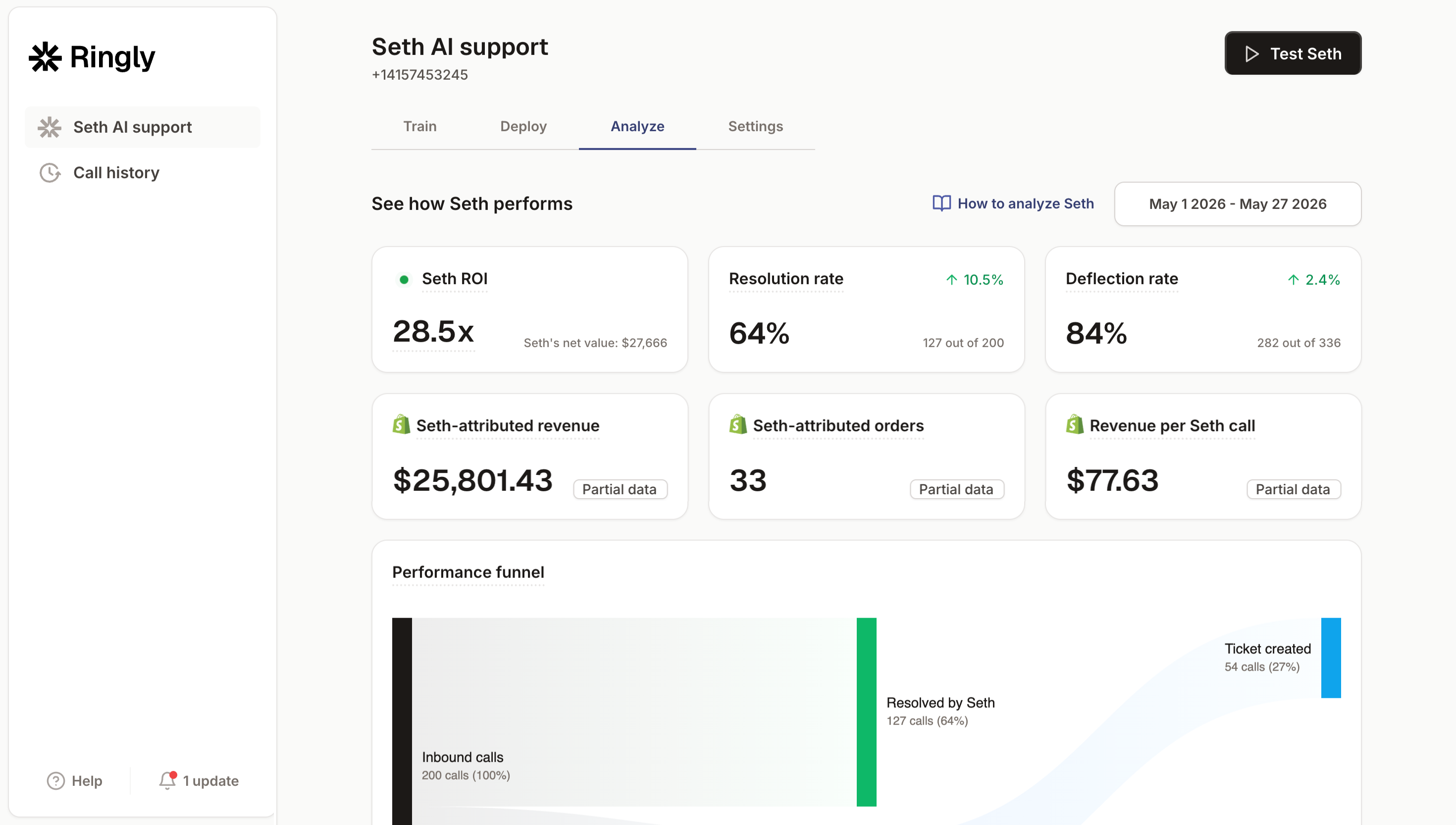
Across the 50+ Shopify brands we run phone support for, the Gorgias-running store almost always still has a phone line rolling to voicemail after 6 p.m. They fixed tickets. The phone stayed half-covered. The same "where's my order" questions that Gorgias deflects in chat come in by phone too, and those calls go to voicemails nobody returns.
So if you pulled a Gorgias list to find brands with a serious support operation, you found exactly that, plus a gap. These are brands big enough to pay for a helpdesk, doing enough volume to need one, and still missing after-hours calls. For a $10M to $100M Shopify brand, that is real revenue walking out the door, which is why 24/7 ecommerce phone support keeps coming up in Shopify Plus customer service planning.
This is the read we sell against. Ringly is AI phone support for Shopify brands. The voice agent answers inbound calls 24/7, finds orders, handles returns, answers product questions from your knowledge base, and escalates cleanly to Gorgias or whatever helpdesk the store already runs. Across 50+ brands it resolves 73% of calls on its own at roughly $0.42 per resolved call. WashCo, a Shopify brand we launched, recovered $22,664 in its first 7 days on the phone.
"My customers also feel like it's a normal person. They feel like they can communicate if they have questions."
Claudia Droge, TechCraft Studio
If you run one of those Gorgias stores yourself, the move is the same. Book a 30-min call and we will look at what your phone line is doing after hours. Worth a read alongside this: how brands handle WISMO calls, what an after-hours answering service actually costs, and why ecommerce phone support is the channel most Shopify brands underbuild. If you are weighing the helpdesk itself, our take on Gorgias alternatives and the Gorgias AI agent covers it.
StoreLeads alternatives for Shopify app data
StoreLeads is the Shopify-first option, but it is not the only one. If you want recent-install signals or a broader web-wide lookup, here is the honest comparison.
| Tool | Best for | What to know |
|---|---|---|
| StoreLeads | Shopify app + revenue segmentation, exportable lists | Strong Shopify coverage. Free to browse, paid to export the full list. |
| StoreIndex | Spotting recent installs, "who added Gorgias lately" | Tracks 8,000+ apps with a 24-hour refresh. |
| BuiltWith | Broadest web-wide tech lookup | Tracks roughly 5.1M Shopify sites, but reviewers question accuracy and the cost runs high. |
| Wappalyzer | Checking one store's stack on the spot | Browser extension, per store. Not a queryable list. |
| Apify store detectors | Scripted per-store app detection | Scrapers that read HTML and headers. Useful, but not a maintained database. |
For a segmented Shopify prospecting list with revenue bands, StoreLeads is the cleanest single source, and StoreIndex is the better pick if you specifically want fresh installs. BuiltWith is fine for a quick web-wide check, less so for a Shopify-tight list. If you only need to inspect one competitor, the free Wappalyzer extension does the job without a subscription. Whichever you use, the read at the end is the same, and most of these brands still have a phone problem you can see in how they scale customer service without hiring.
Frequently asked questions
How many Shopify stores use Gorgias right now? StoreLeads put it at 24,759 Shopify stores as of June 12, 2026, growing 12.9% year over year. Pull the live report and you may see a slightly different figure depending on the date and which report you open.
Why does StoreLeads show a different number than Gorgias? StoreLeads counts installs (where the code is detected on live stores). Gorgias's "15,000+" counts paying customers. Install counts always run higher because they include trials, lapsed stores, and multi-store brands under one account.
Can I download the full list of Gorgias Shopify stores? Yes, with a paid StoreLeads plan. A free account lets you browse the reports and check the fields, but the full segmented export sits behind a subscription.
Is StoreLeads data accurate? For Shopify, StoreLeads and StoreIndex are both well regarded. BuiltWith covers more of the web but reviewers have flagged accuracy gaps, so for a Shopify-tight list the Shopify-first tools are the safer read.
What's the difference between the StoreLeads technology report and the app report? The technology report detects Gorgias anywhere its code fires, across any platform. The app report counts only stores running the specific Gorgias Shopify app listing. The technology number is broader, so it reads higher.
What does it mean if a store runs Gorgias? It means the store has a real support operation and has solved email and chat ticketing. It does not mean the store answers its phone. Most Shopify brands running Gorgias still send after-hours calls to voicemail, which is the gap a phone agent fills (and the reason so many brands look at whether to outsource Shopify customer service instead of fixing the phone directly).
Talk to us

If you pulled a Gorgias list to find brands with a real support operation, you found brands that solved tickets and left the phone half-covered. If you run one of those brands, a 30-min call is the fastest way to see what your line is leaking after 6 p.m.
The 3-layer guarantee.
- Live in 14 days or it's free until launched.
- 65% resolution in 90 days or we refund the last 3 months of subscription fees.
- We keep working free until we hit 65%.
Ruben (Ringly co-founder) takes these calls personally.