

This post in 30 seconds.
- Sourcing support outsourcing in 2026 is no longer just picking a BPO. You're choosing between a human outsourced team and an AI phone agent, and both belong on the same scorecard.
- The line item nobody puts on the RFP: outsourced call centers run 70-100% staff turnover a year (Insignia Resources), so you pay to re-train your vendor's people on a loop. An AI agent has no turnover.
- Written for founders, COOs, and Heads of CX at Shopify brands doing $2.4M+ a year with a visible phone line and a paid helpdesk.
We've handled more than 150,000 customer calls for 50+ Shopify brands, which means I spend a lot of my week inside the exact decision this post is about. Sourcing support outsourcing used to mean one thing: find a call center, vet it, sign a contract, hope. In 2026 the shortlist looks different, because an AI phone agent now sits next to the human BPO on the same evaluation, and most of the guides you'll read pretend that option doesn't exist.
By the time most founders reach this decision, they've already got a quote in hand. Maybe an offshore team at 30 cents a minute, maybe an AI tool at 19 cents, and the two numbers sit close enough to be confusing. One of our own customers said almost exactly that before he signed.
The per-minute price is the wrong place to look, and this post is about where to look instead.
Most Shopify brands past a few million a year hit the same wall: a small support team, a phone line nobody picks up after 6 p.m., and a founder who doesn't want to hire five more reps to fix it. If that's you, start a 14-day free trial and hear the agent answer your own store's calls before you sign anything. We set it up for you.
Human BPO vs AI phone agent, at a glance
Before the deep dive, here's the shape of the two options on the criteria that actually move the decision. Numbers are sourced ranges, not a single vendor's list price.
| Criterion | Human BPO (offshore/nearshore) | AI phone agent (Ringly) |
|---|---|---|
| Cost per resolved call | $1.50-$3.50 loaded | ~$0.42 per resolved call |
| Ramp to full productivity | 6-8 months per agent | live in under an hour |
| Staff turnover | 70-100% a year | none |
| After-hours coverage | extra shift, extra cost | 24/7, same price |
| Time to a real pilot | weeks of RFP and vetting | same-day free trial |
| Contract commitment | often 12-month minimum | month to month |
The table already tells you most of the story. The rest of this post is why each row reads the way it does, and how to score a real vendor against it.
How I put both sourcing paths through the same test
I'm Ruben, co-founder of Ringly. Over the last 30 days I ran the same evaluation I'd run on a customer support outsourcing partner, except I ran it against an AI phone agent as a category, not just against BPOs. The point was to see whether the two options survive the same scorecard.
This is what I actually did:
- Pulled real per-call economics. I took billing across 50+ Shopify brands on Ringly and compared it to published BPO pricing from Text.com and GigaBPO, per resolution, not per minute.
- Called offshore support lines. I timed hold, handle time, and how many transfers it took to resolve, so the cost comparison used real handle time instead of a headline rate.
- Ran the standard weighted scorecard. Industry fit, security and compliance, helpdesk tool fluency, QA metrics, and pricing transparency, applied evenly to both a human team and an AI agent.
- Stress-tested after-hours. I checked what happens to a call at 11 p.m. on both paths, because that's where most brands actually leak revenue.
- Put the turnover number on the scorecard. No BPO RFP template I've ever seen includes it, and it's the single biggest hidden cost in the whole decision.
That last one is the one that changed how I read the quotes. More on it in a minute.
What sourcing support outsourcing actually means now
Sourcing support outsourcing is the process of finding, evaluating, and selecting a partner to run some or all of your customer support. Classic version: you write an RFP, shortlist a few BPOs, vet them, negotiate service levels, run a pilot, and monitor. The whole customer support outsourcing category is built around that human-team assumption.
The process still works fine. What's changed is the shortlist. One of the line items on it can now be an AI phone agent that answers calls 24/7, finds orders in your Shopify store, handles returns, and escalates the hard calls to your team. Same RFP, two very different cost and risk shapes.
This is a big market and it's still growing. Outsourced customer care is roughly an $80B category in 2026, and around 80% of executives plan to hold or increase their outsourcing spend this year. That's a lot of RFPs written on the old assumption.
If you want the ground-level version of what an ecommerce call center actually costs to run, we broke that down separately, and it's the number most people underestimate before they source anything.
Worth reading alongside this: our guides on call center outsourcing, outsourced customer service, and BPO for Shopify. They cover the human-team path in more depth. This post is about running that path against the AI one on the same criteria.
The staffing churn you inherit when you outsource
Here's the number that isn't on your RFP. Outsourced call centers average 70-100% annual staff turnover, and it's a real cost, not just a staffing headache.
- 70-100% annual turnover, vs 30-45% for in-house teams, per Insignia Resources' 2026 turnover research.
- 69-73% first-year attrition, average agent tenure just 14-15 months.
- $10,000-$46,000 to replace one agent, direct cost plus lost productivity, per Call Force Global's 2026 attrition data.
- $2.25M-$4.6M a year in attrition management alone for a 100-agent center at industry-average turnover.
When you source a BPO, you're not only buying capacity, you're inheriting the vendor's staffing problem. The rep who learned your brand voice and your return policy is gone inside about 14 months, and you pay for the replacement's ramp, which runs 6-8 months to full productivity, on a loop you never see on the invoice. It's not free to the vendor either, and it shows up in your rate eventually.
An AI phone agent doesn't have this line item. The agent that learns your policy on day one still knows it in month 20, no re-hire and no ramp to keep paying for. WashCo, a Shopify brand we launched, resolved calls at $0.91 each in its first week live, and there was never a rep to replace.
None of this makes a good BPO a bad partner. It makes the risk profile different, and continuity is a real criterion you should be scoring. Our customer service outsourcing statistics and call center turnover statistics pages have the full data if you want to bring it to a vendor call.
The scorecard: score a BPO and an AI agent on the same criteria
Every serious outsourcing guide gives you a weighted scorecard. GigaBPO uses one with industry experience, technology fit, security, service levels, pricing transparency, and references. EverHelp's checklist runs 11 dimensions. Good frameworks, all of them, and none of them run the AI option through the same grid or break out what a brand evaluating phone support actually cares about.
So the scorecard, tuned for phone and applied evenly to both, looks like this:
- Ecommerce and Shopify fit. For a BPO, ask how many DTC brands they run and whether they've handled your call types. For an AI agent, check it connects to your store, sees the customer, and can modify an order, not just read a script.
- Helpdesk tool fluency. Both should work with Gorgias, Zendesk, Richpanel, Re:amaze, Gladly, or Intercom. If a vendor can't name your stack, that's your answer.
- Security and compliance. SOC 2 and PCI DSS are the baseline for either path. Ask to see the actual reports, not a logo on a slide.
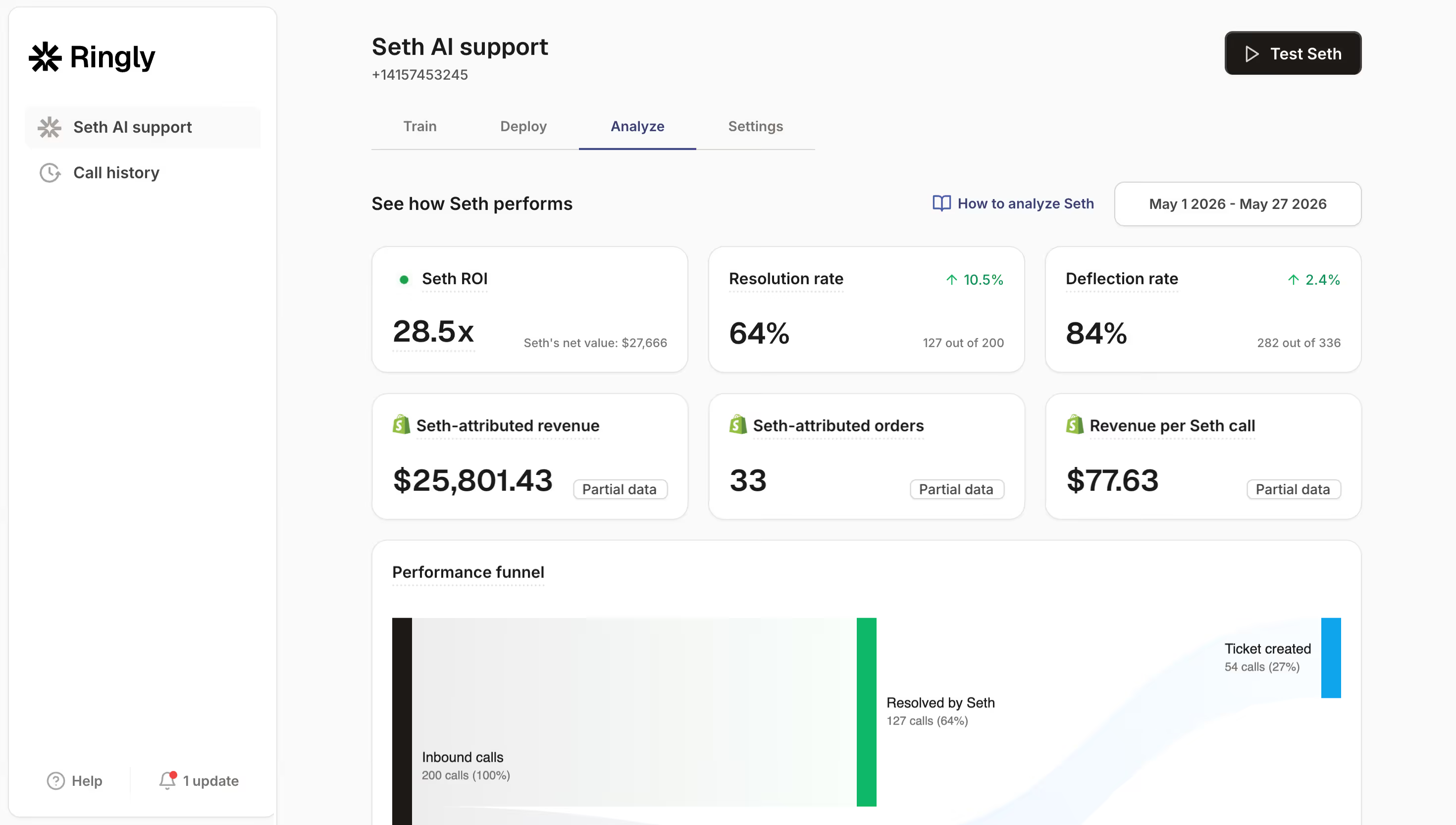
- QA and resolution metrics. BPOs quote resolution in the 85-95% range; in-house lands 75-85%. For an AI agent, ask for a real resolution rate on real calls. Ours is 73% across 50+ brands, and BioLongevity Labs runs at 79% resolution.
- Pricing transparency. If the number moves every time you ask, or it's suspiciously low, that's a red flag on either path.
- Continuity. This is the turnover row from above. A BPO can't promise it. An AI agent doesn't have the problem.
- Voice quality and after-hours. For phone specifically: does it sound human, is there latency, and who answers at 11 p.m.? This is where most sourcing frameworks go quiet.
Score both paths on the same grid and the AI option stops looking like a cheaper substitute and starts looking like a different risk shape. On the voice-quality row, the compliment we hear most is that it doesn't sound like AI at all.
"My customers also feel like it's a normal person. They feel like they can communicate if they have questions."
Claudia Droge, TechCraft Studio
One more thing the scorecard should capture: you're not handing everything to the machine. Ringly agents transferred about 6% of calls to a human in the past 30 days across roughly 11,000 calls; the rest were handled end to end or ended by the caller. Your team keeps the genuinely hard calls. The routine ones stop eating their day. If you're still deciding whether to outsource at all, our take on whether to outsource customer service for your Shopify store walks the same logic, and Shopify customer support outsourcing covers the mechanics.
What it really costs, per resolution not per minute
Back to those two quotes that looked so close. The per-minute number is the trap. A 30-cents-a-minute offshore team and a 19-cents-a-minute AI tool tell you almost nothing, because per-minute hides handle time, management overhead, and the turnover retraining you're funding without seeing it.
Score it per resolution instead. On the human side, outsourced pay-per-resolution runs $1-$7 with an industry average around $4, per Text.com's 2026 BPO pricing guide, and GigaBPO cites $1.10-$4.50 per ticket. Per agent, a dedicated FTE runs $1,200-$5,500 a month depending on geography, with onshore US teams landing at $4,500-$7,000 once you load in management and QA.
Here's how the paths line up per call:
| Channel | Per-call cost (loaded) | Notes |
|---|---|---|
| In-house CS rep | $2.70/call | US, loaded with payroll and benefits |
| BPO contract | $1.50-$3.50/call | plus contract overhead and monthly minimums |
| Ringly (done-for-you) | $1.20-$2.00/call | plus 24/7 coverage |
| Ringly (WashCo, first 7 days) | $0.91/call | real number, real brand |
Across our own book, the AI resolves calls at roughly $0.42 per resolved call, versus $7-$16 per call for a human BPO once everything is loaded in. That gap comes from the turnover math, not from cutting corners.
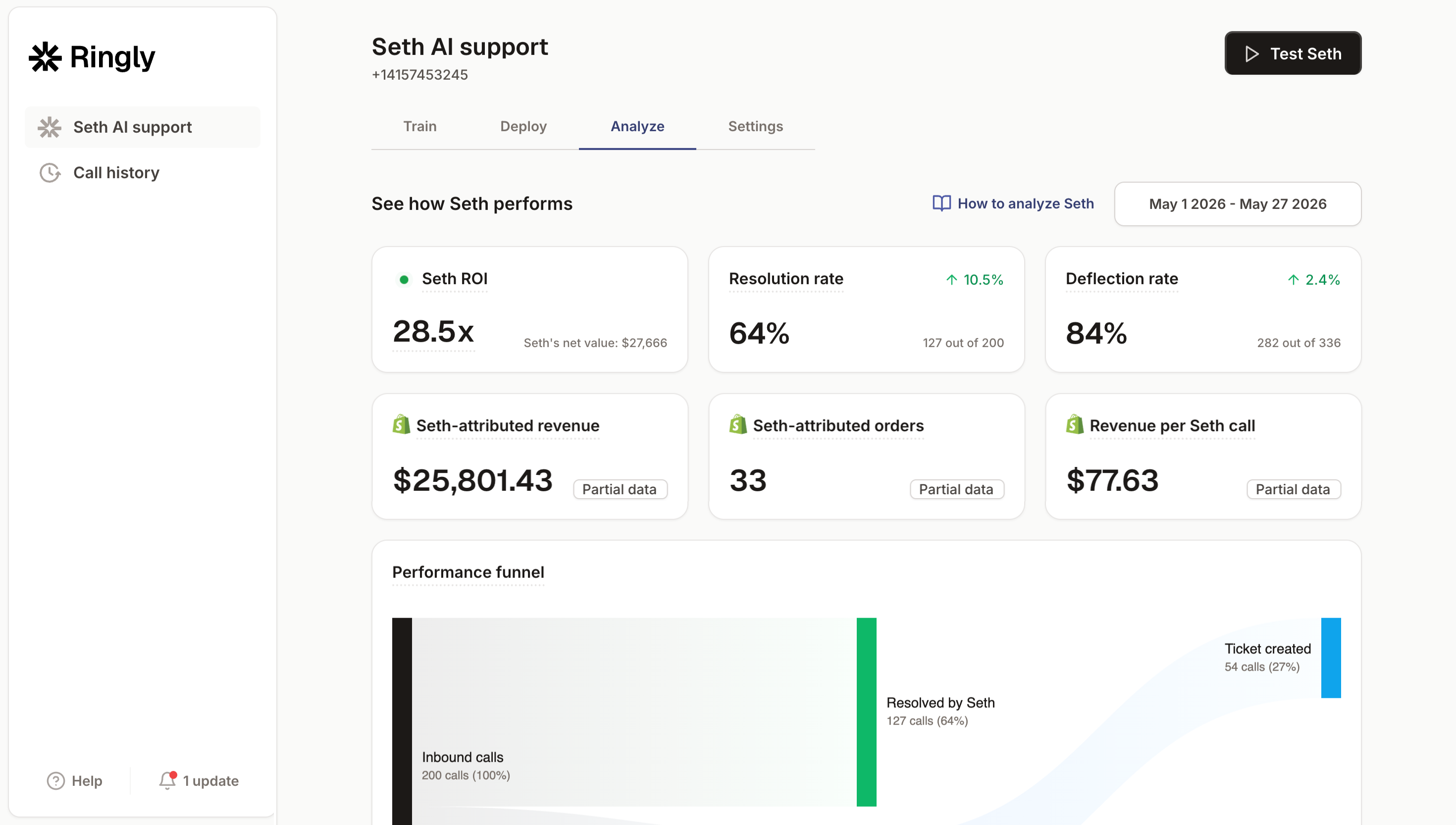
The headcount version is simpler. Take a 6-rep support team at $4,000 loaded per rep, and you're spending $24,000 a month before overage. Done-for-you AI phone support at that volume lands around $5,000 a month, illustrative, which nets out near $19,000 a month, about $228,000 a year. The BPO quote that looks cheap per-minute rarely wins once you count the retraining you keep paying for. The unit that decides this is cost per resolution, and per-minute pricing is designed to keep you from calculating it.
Want to run your own number? Our guides on reducing call center costs and in-house vs outsourced support have the math, and Ringly pricing is public. Or skip the spreadsheet and start a free 14-day trial to see the per-call cost on your own volume. It plugs into Gorgias or whatever helpdesk you already run.
The sourcing process, collapsed to a same-day pilot
The standard cycle every guide describes goes assess needs, write an RFP, vet vendors, negotiate service levels, run a pilot, then monitor. That's weeks to months before you get a real read on whether the vendor was any good. The pilot, the step that actually tells you something, comes last, after you've already invested a month of evaluation.
With an AI phone agent the pilot moves to the front. You start a free trial, we set you up with a dedicated number to test on, and you hear it answer real calls the same afternoon. You get the read that a BPO pilot gives you in week six, on day one, before you've signed anything.
That doesn't make the red flags disappear, and they apply to both paths. Watch for the same things whether you're vetting a human team or an AI vendor:
- Vague or moving pricing. If the number changes each call, or it's suspiciously low, someone's cutting a corner you'll find later.
- No references. A partner worth signing will hand you brands like yours to call.
- One-size-fits-all packages. A vendor that won't assess your actual call mix is selling capacity, not fit.
- Slow, vague sales communication. How they sell you is a preview of how they'll support you.
- Reluctance to share turnover or security details. If they won't talk about attrition or show you the compliance reports, that's the answer.
Run this against both, and the fast-pilot option earns a real edge: you find out early, before the money's committed. If you'd rather talk it through with a human first, book a 30-min call and we'll walk your specific setup. Our roundups on outsourcing benefits, scaling support without hiring, and the best call center outsourcing companies cover the human-team side if that's the direction you land.
Frequently asked questions
What does it cost to outsource customer support? On a human BPO, expect $1-$7 per resolution (industry average around $4) or $1,200-$5,500 per dedicated agent per month depending on geography. An AI phone agent runs closer to $0.42 per resolved call across our book. Score it per resolution, not per minute, or the comparison misleads you.
What's the difference between outsourcing to a BPO and using an AI phone agent? A BPO gives you human reps who handle nuance well but carry 70-100% annual turnover and a 6-8 month ramp per hire. An AI phone agent handles the routine calls 24/7 with no turnover and escalates the hard ones to your team. Most brands end up running the AI for volume and keeping humans for the genuinely complex calls.
How long does it take to source and onboard an outsourcing partner? A traditional RFP-to-pilot cycle runs several weeks to a few months before you get a real read. An AI phone agent collapses that: a free trial with a dedicated test number lets you hear it on real calls the same day. You get the pilot signal first instead of last.
Is outsourced customer support as good as an in-house team? Outsourced teams often post higher resolution rates (85-95% vs 75-85% in-house, per GigaBPO) because volume specialization helps. The trade-off is continuity: turnover means the person who knows your brand keeps leaving. That's the exact gap an AI agent closes, since it never churns.
Can I outsource just phone support and keep email and chat in-house? Yes, and it's a common setup. Phone is where after-hours revenue leaks most, so many brands route calls to an AI agent and keep email and chat on their existing team. Ringly sits in front of your helpdesk and logs every call there.
What questions should I ask before signing with an outsourcing vendor? Ask for their real resolution rate, their staff turnover, references from brands like yours, their security reports, and exactly what a pilot looks like. On price, ask for cost per resolution, not per minute. If they dodge turnover or security, treat it as a no.
What are the biggest risks of outsourcing customer support? The visible risk is quality and brand fit. The hidden one is the turnover you inherit: replacing a single agent costs $10,000-$46,000, and that churn is baked into your rate. An AI phone agent removes the turnover risk entirely, which is why it belongs on the same shortlist.
Does Ringly work with my current helpdesk? Yes. Calls that need a human escalate cleanly to Gorgias, Richpanel, Reamaze, or whatever helpdesk you already run. You control what escalates and keep your current stack.
Talk to us

If you run a Shopify brand and you're weighing an outsourcing quote against building your own team, the fastest way to sanity-check it is to hear the AI answer your own store's calls. You'll know in one afternoon what a BPO pilot takes six weeks to tell you.
The 3-layer guarantee.
- Live in 14 days or it's free until launched.
- 65% resolution in 90 days or we refund the last 3 months of subscription fees.
- We keep working free until we hit 65%.
Ruben (Ringly co-founder) takes these calls personally.
Start your trial today and you get:
- A free dedicated phone number to test on, so you hear it answer real calls the same day.
- The agent built for you. We set it up, you lift zero fingers.
- It plugs into your helpdesk. Gorgias, Richpanel, Re:amaze, Zendesk, or whatever you already run.