

This post in 30 seconds.
- Most bad phone communication on a DTC line isn't a training problem, it's a volume problem: the same five questions hit a 2-3 person team 50 times a day until the tone erodes.
- The fix nobody names is splitting every call into facts (order status, policy, hours) that stay identical every time, and tone (patience, empathy) that flexes per caller.
- Written for founders and Heads of CX at Shopify brands doing $2.4M+ a year with a real phone line.
We've handled more than 150,000 support calls for 50+ Shopify brands, and the whole reason this list exists is that we read the transcripts. These aren't generic customer service communication tips pulled from a call center handbook. They're the specific things that actually break, and fix, phone communication on a direct-to-consumer line.
And the same pattern shows up in almost every account. The advice everyone gives ("be empathetic", "listen actively", "stay positive") assumes the rep has the time and headspace to do it. On a DTC phone line, they usually don't. Two or three people answer the same "where's my order" question 50 times a day, and by hour six the warmth is gone. Not because they weren't trained, but because nobody can stay patient and un-rushed at that repetition rate without either more people or somewhere to put the repeatable calls.
So this guide does two things. It gives you six concrete tips for phone communication that hold up on a real ecommerce line, and it names the split that makes consistency and empathy stop fighting each other.
Most brands running a Shopify store past a couple million a year have a small support team and a phone line that goes quiet after 6 p.m. If the same questions over and over are wearing your reps down, you can start a 14-day free trial and hear an AI phone agent answer your own store's calls. We set it up for you.
How I built this list
I'm Ruben, co-founder of Ringly. This list didn't come from other blogs. It came from reading real call transcripts across the 50+ Shopify brands we run phone support for, then asking one question of each tip: does it correlate with the compliment we hear most, "you don't sound like AI"?
A few things I looked at:
- What breaks first under volume. I mapped where tone drops off on repeat calls, and it's almost always the same call types (order status, returns, hours).
- When the failures cluster. Across 11,000+ calls handled by Ringly agents in the past 30 days, roughly 29% of inbound calls arrived after business hours (6 p.m. to 9 a.m. US Eastern). After-hours is exactly when a tiny team's tone degrades fastest.
- How long good calls actually run. The median AI-handled support call in our data runs 72 seconds; the average is just over two minutes. That number reframes what "efficient" even means on the phone.
- What the top compliment rewards. Tips that make a caller feel heard, not processed.
I left out the advice you can already find in any of the top-ranking guides. If it wasn't specific to a DTC phone line, it didn't make the cut. This is the AI customer service phone lens applied to how humans talk on those same calls.
Tip 1: Split every call into facts and tone
This is the one that dissolves the argument every support team has about scripts. Half the team says scripts keep the brand consistent. The other half says scripts make you sound like a robot. They're both right, because they're arguing about two different parts of the same call.
Every call has facts that must be identical every time, and tone that must flex to the person on the line. The facts are the order status, the return window, the store hours, the shipping cutoff. Those should come out the same whether it's your best rep at 10 a.m. or a temp at 8 p.m. The tone is the patience, the acknowledgment, the apology. That's where a human read of the caller belongs, and it should never be identical, because no two callers are identical.
Script the facts. Never script the tone. A rep reading a canned apology in a flat voice is what "robotic" actually means, not the fact that they had a script for the return policy. When you separate the two, consistency stops threatening warmth.
This is also the bar that AI communication has to clear, and it's the same bar for your humans. One of our customers put it better than any style guide could:
"My customers also feel like it's a normal person. They feel like they can communicate if they have questions."
Claudia Droge, TechCraft Studio
If you want a starting point for the facts half, our guide to customer service scripts for ecommerce walks through the ones worth writing down.
Tip 2: Script the WISMO call, the one you get 40 times a day
WISMO ("where's my order") is the single highest-volume call on almost any DTC line. It runs 30% to 50% of all support contacts on average, and climbs past 50% at peak, according to aggregated 2026 ecommerce CX data. If you're going to make one call type consistent, make it this one.
The structure that works is five beats:
- Greet with your name and the brand. "Thanks for calling [Brand], this is Sam."
- Verify and acknowledge. Repeat back why they called and pull the order. "You're checking on order 4402, let me find that."
- Resolve or set a real date. Never "soon". "It shipped Tuesday, it's out for delivery today by 8 p.m."
- Confirm they got what they needed. "Does that answer it, or do you want me to text you the tracking link?"
- Offer one more thing. "Anything else on the order while I have it up?"
Notice what's scripted and what isn't. The five beats are fixed. The words inside them move with the caller. A calm customer gets a quick version; a customer who's called twice already gets an apology first, then the beats.
This is the exact shape our customer service call script for ecommerce uses, and it's why an AI agent handles the WISMO call well: the facts are pulled live from Shopify, so the order status is right every time, and the tone stays even at the 40th call of the day.
Tip 3: Match your pace to the caller, not the clock
The instinct on a busy line is to go faster. Wrong instinct. Speed is a tool for a simple fact, not a default for the whole call.
The human benchmark most call-center guides land on is 130 to 150 words per minute. That's a fine pace to confirm a tracking number. It's the wrong pace for a customer who's frustrated, confused, or just older and less comfortable on a website. We see this constantly in the transcripts: coffee and specialty-food brands skew to an older caller who wants to be walked through it, and rushing them reads as "this company doesn't care."
The rule is simple: speed up for facts, slow down for feelings. The median AI-handled call in our data runs 72 seconds, and the average is just over two minutes, because most calls are a single fact delivered cleanly. But the ones that go longer go longer on purpose, and a good communicator can tell the difference in the first ten seconds.
And do not interrupt. It's the most common phone mistake and the easiest to fix. Let the caller finish the sentence even when you already know the answer. If you're benchmarking your line, our breakdown of average handle time and phone customer service tips has more on where to trim without rushing.
Tip 4: Handle returns without reading the policy like a robot
Returns are the second call where the facts-vs-tone split earns its keep. The facts are fixed: the window, the condition rules, the process. Read them wrong and you create a bigger problem. Read them in a flat "per our policy" voice and you turn a neutral customer into an angry one.
So lead with the tone, then deliver the facts. Here's the difference:
Flat: "Our return policy is 30 days from delivery. Your order was delivered 34 days ago, so it's outside the window."
Human: "Sorry the fit wasn't right, that's frustrating. Let me check the dates. Looks like it's just past our 30-day window, but let me see what I can do here."
Same facts. The second version acknowledges the person before it delivers the rule, and it leaves a door open instead of slamming one. The policy didn't change. The communication did.
The facts should be written down so every rep quotes the same window and the same process. The acknowledgment can't be, because it depends on why this specific customer is returning this specific thing. For the broader picture on getting this right across channels, our guide to ecommerce customer service and phone support etiquette both dig in.
Tip 5: Treat de-escalation as pure tone, never a script
Here's the flip side of Tip 1. If facts get scripted and tone flexes, then de-escalation, which is 100% tone, can't be scripted at all. That's exactly why angry calls should always reach a human, not a gap in your training.
You can't hand a rep a paragraph that calms an upset customer. What you can do is give them three moves:
- Stay calm and let them finish. The first thing an angry caller wants is to be heard without being cut off.
- Name the follow-up out loud. "Here's what I'm going to do next" beats "I understand your frustration" every time. Specifics defuse; sympathy words don't.
- Own the timeline. Tell them exactly when they'll hear back, then make sure they do.
The stakes are real. After a bad or missed call, 85% of customers never call back and 62% switch to a competitor (PCN, 2026). A de-escalated call isn't just a saved order, it's a customer who didn't quietly leave. For the harder cases, our guides on handling customer complaints and building a clean support escalation path are the next read.
Tip 6: Make communication consistent across every shift
Every helpdesk solved written-tone consistency years ago. Gorgias macros mean every email answer sounds like the brand, no matter who typed it. There is no equivalent for the live phone. Tone on a call is whatever the rep has left in the tank, and it drains across a shift.
That's why phone communication erodes fastest after hours, and after-hours is a bigger slice than most founders think. Roughly 29% of the inbound calls we handle land outside 6 p.m. to 9 a.m., when there's no backup, everyone's tired, or nobody's there at all and the call goes to a voicemail you never return. The written-tone tool exists. The spoken-tone tool didn't, until the calls could be answered the same way every time regardless of the hour.
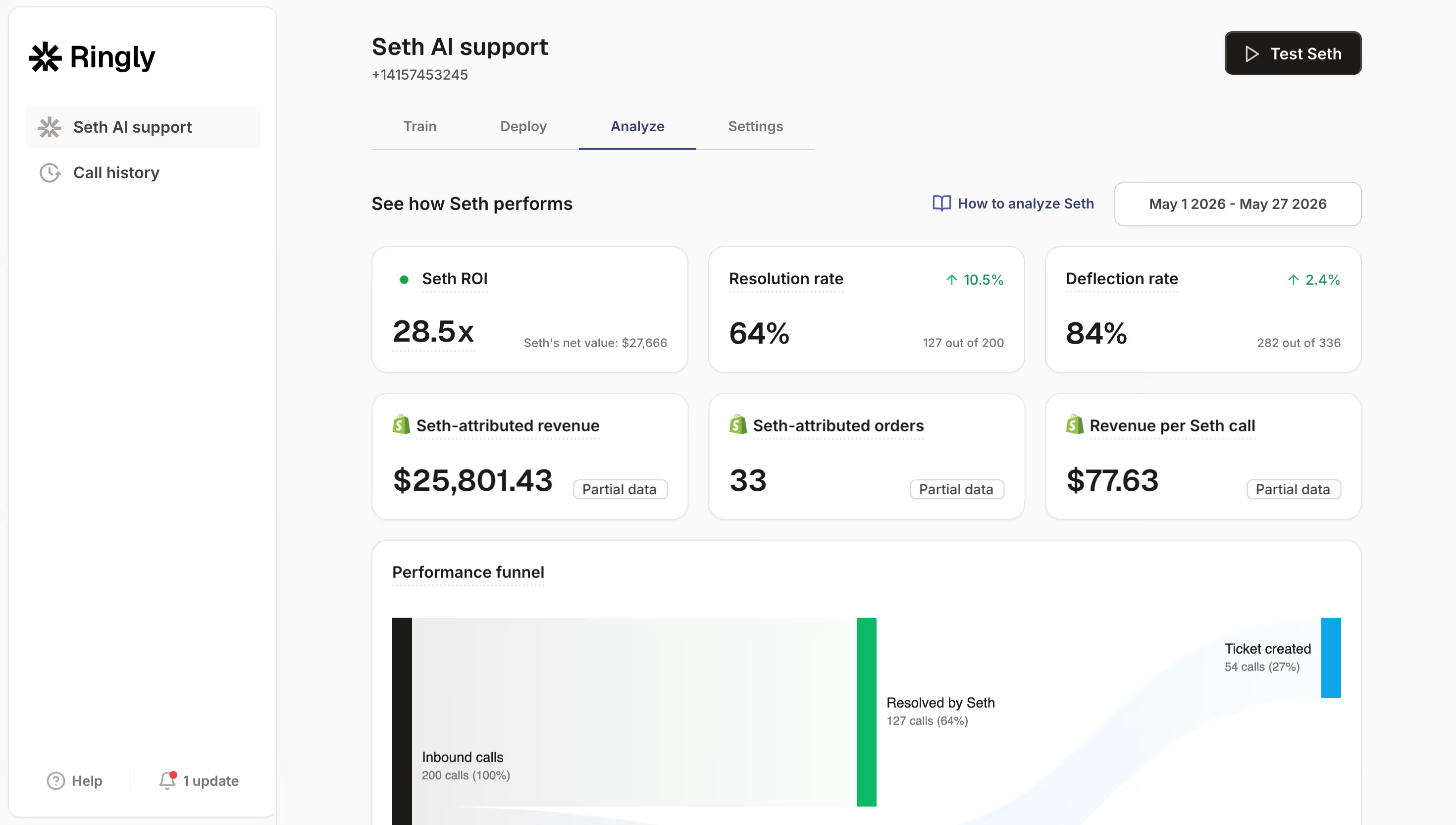
This is the honest bridge to what we build. The most repetitive fact-calls, order status, store hours, return policy, are exactly the ones an AI phone agent can own 24/7 at identical quality. TechCraft Studio handles 88% of its calls without a human, which frees the team's communication skills for the calls that actually need them: the angry ones, the edge cases, the retention saves. Your reps stop being the 8 p.m. WISMO machine and go back to the work only a person can do.
If you want to keep phone coverage consistent without hiring a night shift, that's the same problem covered in how to scale customer service without hiring, our take on AI voice support vs a human team, and the mechanics of an after-hours answering service. Consistency across shifts is also a training question, and our guide to ecommerce customer service training covers the human half.
What consistent communication actually costs
Good phone communication is really a staffing math problem. Take a typical Shopify brand running a 6-rep support team:
| Line item | Today | With Ringly |
|---|---|---|
| 6 reps at $4K loaded per rep | $24,000/mo | n/a |
| AI phone support, done-for-you (illustrative all-in) | n/a | $5,000/mo |
| Net monthly support spend | $24,000/mo | $5,000/mo |
| Monthly savings | n/a | $19,000/mo |
| Annual savings | n/a | $228,000/yr |
That's roughly 70% of repeatable calls (order status, returns, product questions, the same five things over and over) routed to the AI. The other 30%, the genuinely complex calls, still go to your team, who now have the time to communicate well on them. Exact pricing depends on your call volume; these are the savings shapes we see across 50+ Shopify brands. You can see the plans on our pricing page.
The revenue side matters too. WashCo, a Shopify brand we launched, recovered $22,664 in its first 7 days on the phone, because a call that gets answered well is often a call that keeps a sale.
Rather talk it through first? Book a 30-min call and we'll walk your own call data with you. Or start a 14-day free trial and hear it answer a real call today.
Frequently asked questions
What are the most important communication skills for customer service? On a phone line specifically: active listening without interrupting, matching your pace to the caller, and separating the facts you must get right from the tone you must adapt. Empathy matters, but it only shows up when a rep has the headspace to use it, which is why volume management is a communication skill too.
Do scripts make customer service sound robotic? Only when you script the wrong thing. Scripting the facts (order status, return window, hours) keeps you consistent and accurate. Scripting the tone is what sounds robotic. Write down the facts, leave the empathy to the human on the call.
How do you handle an angry customer on the phone? Stay calm, let them finish without cutting in, then name exactly what you're going to do next and when they'll hear back. Specifics defuse anger faster than sympathy phrases. This is a pure tone skill, which is why angry calls should always reach a person.
How can a small support team keep communication consistent across shifts? Written-tone consistency is easy with helpdesk macros; live-phone consistency is the hard part because tone drains across a shift. The practical fix is to route the repeatable fact-calls (order status, hours, returns) to a system that answers them the same way at any hour, and reserve your reps for the calls that need judgment.
How long should a customer service call take? There's no single right number. In our data the median call runs 72 seconds because most calls are one clean fact, but a frustrated or confused caller should get more time, not less. Speed up for facts, slow down for feelings.
What do you say when you don't have an answer yet? Say that honestly, then give a concrete next step: "I don't have that in front of me, let me check and text you within the hour." Never guess, and never leave it open-ended. A real timeline you keep beats a confident wrong answer every time.
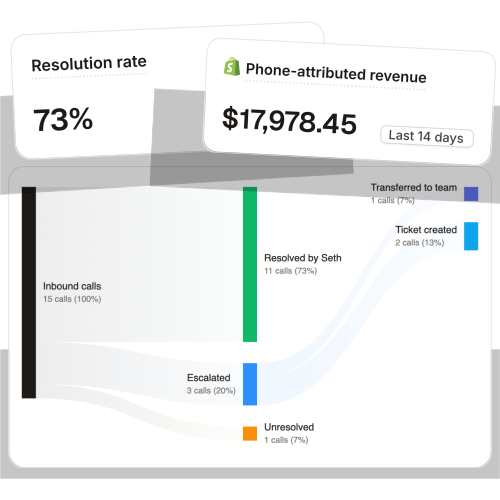
Can AI handle customer service communication as well as a human? For the repetitive fact-calls, yes, and often more consistently, because it never gets terse at the 40th call. Across 50+ Shopify brands the AI resolves 73% of inbound calls on its own. The judgment calls (angry customers, edge cases) still belong with your team.
What communication mistake hurts customer service the most? Sounding processed instead of heard. Reading a flat, canned response, interrupting, or rushing a caller who needs time all signal that the customer is a ticket, not a person. Every tip here is really one rule: make the caller feel heard while getting the facts exactly right.
Talk to us

Good communication tips only stick if your team has the room to use them. If phone communication keeps slipping after 6 p.m., the fastest way to fix it is to hear an AI answer your own store's calls, so your reps can spend their real skill on the conversations that need a human.
The 3-layer guarantee.
- Live in 14 days or it's free until launched.
- 65% resolution in 90 days or we refund the last 3 months of subscription fees.
- We keep working free until we hit 65%.
Ruben (Ringly co-founder) takes these calls personally.
Start your trial today and you get:
- A free dedicated phone number to test on, so you hear it answer real calls the same day.
- The agent built for you. We set it up, you lift zero fingers.
- It plugs into your helpdesk. Gorgias, Richpanel, Re:amaze, Zendesk, or whatever you already run.