

This post in 30 seconds.
- A shipping delay doesn't just slow a package down, it lights up your phone line, and every guide you've read treats the fix as an email problem.
- Across 11,000+ calls we handled in the past 30 days, roughly 29% arrived after business hours, so the delay email you send at 5pm does nothing for the customer who calls at 9pm.
- Written for founders, COOs, and Heads of CX at Shopify brands doing $2.4M+ a year with a visible phone number and a paid helpdesk.
We've handled more than 150,000 customer calls for 50+ Shopify brands, and a big share of them trace back to one thing: a package that's running late. Ecommerce shipping delays are the single biggest driver of "where's my order" contacts, and most brands only ever count the email side. The phone calls never make it onto the spreadsheet, so nobody fixes them.
Customers don't call first, they check the tracking link, then email, and only when neither gives a straight answer do they pick up the phone. By the time a delay-related call comes in, it's already the most frustrated version of that customer, and they want a human to tell them what's actually happening. If you want to skip ahead and hear how that call gets answered, you can start a free 14-day trial and listen to it handle a real one on your own store.
Most brands past a few million a year run a small support team and a phone line nobody picks up after 6pm, and a delay event is when that gap gets expensive. If your customers are already emailing "where's my order" and you suspect the phone is doing the same thing quietly, this is the guide that puts a number on it. Start a trial and we'll set the agent up for you so you can hear it on your own calls.
How we put this guide together
I'm Ruben, co-founder of Ringly. This guide isn't a rewrite of the shipping-delay articles already ranking. It comes from the call data behind 50+ Shopify brands running our AI phone agent, plus the 11,000+ phone calls that came through our platform in the last 30 days.
Here's what I actually looked at:
- Which questions drive delay calls. I pulled the reason codes and counted how many inbound calls are some version of "where's my order" when a delay is in play. It's the number one driver, every brand, every month.
- When those calls arrive. I timed the inbound volume against business hours. Across 11,000+ calls in the past 30 days, roughly 29% arrived after hours (6 p.m. to 9 a.m. US Eastern). A delay notification sent at 5pm doesn't stop them.
- What each channel costs. I compared the loaded per-contact cost of a phone call against email, chat, and an AI agent, using published benchmarks plus our own per-call numbers.
- What has to reach a human. I checked the escalation rate. About 6% of calls transferred to a person in the last 30 days. The rest were handled end to end or ended by the caller.
Where a number is illustrative rather than pulled from a specific customer, I say so.
What actually causes ecommerce shipping delays
There are more causes than any brand can control, so it helps to know which ones actually show up. Most delay events trace back to five things, and none of them are your fault.
- Carrier capacity and peak-season congestion. Parcels queue at depots during Black Friday, holiday surges, and any week a carrier is over capacity. This is the top-three cause every logistics source names, and it clusters, which is why the seasonal spike hits your support team and your carrier at the same time.
- Weather and external disruption. Snowstorms, floods, port congestion, strikes. Extreme weather became the single largest cause of supply-chain disruption in 2025, surpassing cyber outages, per Xeneta's 2026 risk report.
- Customs and documentation holds. The most common reason international orders run late is incomplete paperwork sitting at a customs desk.
- Bad address data. Misspelled streets, missing unit numbers, invalid ZIPs. PostGrid's 2025 State of Address Verification report found 75% of merchants see delays from this, and address verification at checkout cuts them by 77%.
- Geopolitical route disruption. Red Sea diversions have been adding 10 to 14 days on Asia-to-Europe and East-Coast-US ocean routes, according to C.H. Robinson.
You can't stop the weather or a customs queue, but you can control what the customer hears while they wait. That's the part the next section is really about.
The cost of a delay nobody puts on the spreadsheet
Here's the deal: every source that studies shipping delays agrees the actual complaint isn't the delay, it's the silence. A late package with a clear update is annoying, but a late package with no word reads as abandonment. That's when people start reaching out.
When they reach out, the volume is real. WISMO tickets eat 30 to 40% of support resources in normal periods and cross 50% at peak, per Salesforce, and the commonly cited range for avoidable WISMO support cost is $54,000 to $216,000 a year (LateShipment). The churn risk stacks on top: 67.5% of shoppers won't return after a missed delivery promise (Sendcloud Peak Season Index 2025), and 58% stop buying after three delayed deliveries.
Almost every guide stops there and prescribes more outbound email. That advice is fine, and it works on the email side. It just quietly assumes the phone doesn't exist.
The same "where's my order" question that's expensive by email is also coming in by phone, and most brands aren't counting that cost at all. Phone support runs $12 to $17 per call once you load in training, turnover, and after-hours coverage, versus $0.50 to $2.00 for an AI agent, per published cost-per-contact benchmarks. And the timing is the killer. Across 11,000+ calls we handled in the past 30 days, roughly 29% arrived after business hours. Your delay email went out at 5pm. The call comes in at 9pm, and it hits a voicemail box.
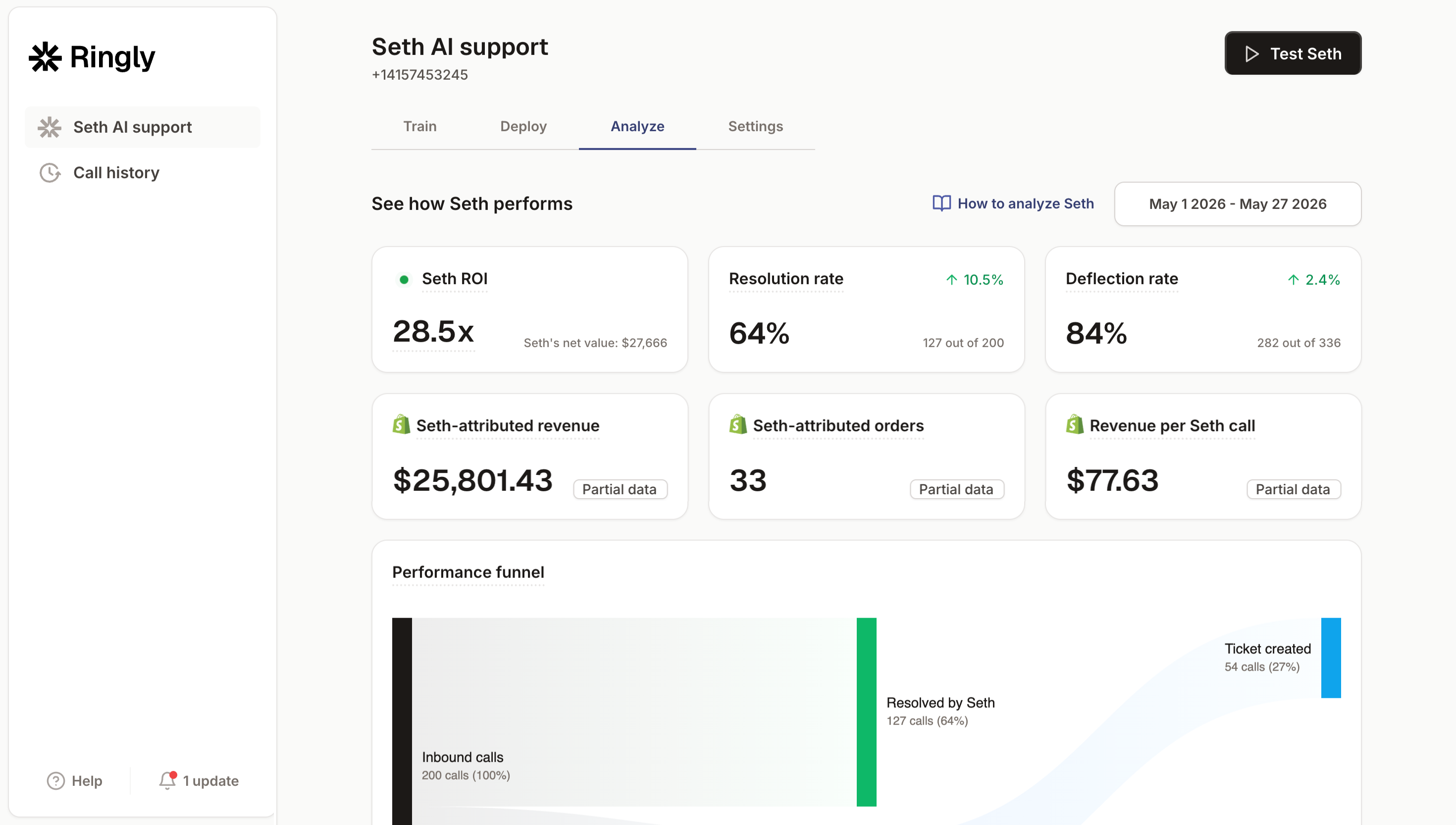
This is where an AI answering machine for Shopify stores does the thing a tracking email can't: it picks up. WashCo, a Shopify brand we launched, recovered $22,664 in its first 7 days on the phone, mostly on the exact routine calls a delay generates. None of that makes AI magic.
A delay creates a call, and a call that rings out to voicemail is a customer quietly deciding whether you're worth the reorder.
What to do when a delay hits: the playbook
You'll get some version of a delay every peak season and plenty of weeks in between. Improvising each time is how the phone queue gets away from you, so here are the five moves worth having ready.
- Get ahead of it on email and SMS. Proactive delay notifications cut WISMO volume 60 to 70% (LateShipment), so this is the first lever, not the last. Tell the customer before they have to ask. Just know it thins the email queue, it doesn't empty the phone line.
- Make the tracking page actually answer the question. A tracking link that hasn't updated in three days is worse than no link, because it confirms the silence. Wire your order tracking so it shows a real status and a real next date, and let the AI read from the same order-status source when someone calls.
- Decide who answers the phone when the notification fails. Some customers will call no matter how good your email is. This is the gap the SERP ignores. If your answer today is "voicemail," that's a churn decision you're making by default. An after-hours answering service or an AI phone agent both close it.
- Cover the spike specifically. Delays cluster around carrier disruptions and peak season, so the support burden and the bill both spike at once. Plan for call overflow and after-hours before December, not during it, and read the holiday prep checklist while you have time.
- Set escalation rules for the genuinely stuck order. A lost package or a wrong address needs a human. In our data about 6% of calls transfer to a person, so route the hard ones cleanly and let the routine "where is it" calls resolve on their own.
The first two moves shrink the email problem, the last three decide what happens to the call. Most brands do the first two and skip the rest, then wonder why the phone still rings.
"My customers also feel like it's a normal person. They feel like they can communicate if they have questions."
Claudia Droge, TechCraft Studio
How to prevent shipping delays before they start
You can't prevent all of them, but you can cut the avoidable ones and buffer the rest. The goal is to shrink both the delay rate and the promise-versus-actual gap that triggers the contact.
- Verify addresses at checkout. Since bad address data causes 75% of merchant delays and verification cuts that 77% (PostGrid), this is the highest-return fix on the list.
- Buffer the promise. Under-promise the delivery window. The gap between "2 to 5 days" on the product page and three weeks in reality is what makes customers call, not the shipping time itself. A slightly longer promise you actually hit beats a tight one you miss.
- Diversify carriers and place inventory closer. One carrier means one point of failure. Splitting volume and holding stock nearer to demand shortens transit and softens the impact when one lane clogs, including on the last mile.
- Set expectations before purchase. Clear cutoffs, honest peak-season notices, and a realistic shipping page do more to prevent the angry call than any post-purchase email. For the deeper stat picture, the ecommerce shipping statistics roundup is a useful benchmark.
What answering the delay calls actually costs
Prevention and proactive email will shrink the volume. They won't take it to zero, so the real question is what the leftover calls cost you, and the channel you route them to is the whole game.
Start with the per-call math, because it's where the gap is widest:
| Channel | Loaded cost per call | Notes |
|---|---|---|
| In-house CS rep | $2.70/call | US, loaded with payroll and benefits |
| BPO contract | $1.50 to $3.50/call | Plus contract overhead and monthly minimums |
| AI phone agent (Ringly) | $0.60 to $1.00/min ($0.91/call verified) | Plus 24/7 coverage, no idle night shift |
The fully loaded cost of keeping a human on the phone runs $12 to $17 per call once you count training, turnover, and after-hours coverage. Across 50+ brands, our AI resolves 73% of inbound calls on its own at roughly $0.42 per resolved call, versus $7 to $16 per call for a human BPO. That's the same routine "where's my order" call, answered for a fraction of the cost, at 9pm, when your team is home.
Here's the shape at team scale. Take a brand running a 6-rep support team to cover the phone:
| Line item | Today | With an AI phone agent |
|---|---|---|
| 6 reps x $4K loaded per rep | $24,000/mo | n/a |
| AI phone support, done-for-you (illustrative all-in) | n/a | ~$5,000/mo |
| Net monthly support spend | $24,000/mo | $5,000/mo |
That's roughly 70% of repeatable calls (order status, returns, the same five questions) routed to the AI, while the harder 30% still go to your team. Exact pricing depends on your call volume, and you can see the plans and pricing directly, but the savings shape holds across brands. If scaling support without hiring is the goal, the delay-call spike is the cleanest place to start.
Want to hear it on your own store's delay calls before deciding? Start the free trial and test it on real calls. We set the agent up for you, and it plugs into Gorgias or whatever helpdesk you already run.
Frequently asked questions
What should I tell a customer whose order is delayed?
Lead with the truth and a next date. Acknowledge the delay, give the current status and a realistic new estimate, and tell them exactly what you're doing about it. Silence is the actual complaint, so a clear update beats a vague apology every time.
How long is too long before I need to act on a delay?
Act the moment the order misses the window you promised, not when the customer complains. If your page said 2 to 5 days and day 6 hits with no movement, that's your trigger to send a proactive notification. Waiting until they email or call means you're already behind.
Do I have to refund a customer for a delayed order?
Not automatically. A delay isn't a lost package, so most brands offer a refund or reship only once the order is genuinely stuck or missing. For a slow-but-moving order, a clear update and sometimes a small gesture (free return shipping, a discount) keeps the customer without eating the margin.
What causes most ecommerce shipping delays?
Carrier congestion, weather and external disruption, customs holds, bad address data, and route disruptions like the Red Sea diversions. Address errors alone cause delays for 75% of merchants (PostGrid), and most of the rest are outside your direct control, which is why how you communicate matters more than the cause.
How can I reduce "where's my order" calls and emails?
Proactive delay notifications cut WISMO volume 60 to 70% (LateShipment), and a tracking page that shows a real status handles a lot of the rest. For the calls that still come in, an AI phone agent answers the routine "where is it" question so your team doesn't. See our WISMO automation guide for the full playbook.
How do I handle shipping-delay questions after business hours?
This is the gap most brands miss, because roughly 29% of support calls arrive after hours in our data. You either staff a night shift you can't fully use, forward to voicemail (where most callers hang up), or route after-hours calls to an AI agent that answers 24/7 phone support. The out-of-hours call handling options break down each path.
What's the difference between a delay and a lost package?
A delay is an order that's still moving, just slower than promised. A lost package has stopped moving or has no scan for an extended window, and it needs a human to file a claim or reship. Treating the two the same is how brands over-refund delays and under-react to real losses.
Should I offer compensation for a shipping delay?
Sometimes, and it depends on the customer and the miss. For a first-time buyer or a big gap, a small gesture protects the relationship and the reorder. For a minor slip you communicated well, a clear update is usually enough on its own.
Talk to us

If a delay event turns your phone into a queue nobody's picking up, the fastest way to see the fix is to hear the AI answer your own store's calls. It handles the routine "where's my order" calls a delay generates, after-hours and during the spike, and escalates the genuinely stuck orders cleanly to your team.
The 3-layer guarantee.
- Live in 14 days or it's free until launched.
- 65% resolution in 90 days or we refund the last 3 months of subscription fees.
- We keep working free until we hit 65%.
Ruben (Ringly co-founder) takes these calls personally.
Start your trial today and you get:
- A free dedicated phone number to test on, so you hear it answer real delay calls the same day.
- The agent built for you. We set it up, you lift zero fingers.
- It plugs into your helpdesk. Gorgias, Richpanel, Re:amaze, Zendesk, or whatever you already run.
Start your 14-day free trial →
Rather talk it through first? Book a 30-min call.