
This post in 30 seconds.
- The fastest refund-dollar savings come from three places: better product pages, defaulting to exchange over refund, and catching the refund request before it processes.
- Sizing, fit, and color drive 45% of all retail returns, and processing a single return runs $10 to $65. Most of that money is recoverable.
- Written for founders, COOs, and Heads of CX at $10M-$100M Shopify brands who watch refunds quietly erase their margin every month.
Refunds are the line item nobody puts on a dashboard until it's too big to ignore. Your return rate sits somewhere around 20% of online orders (Capital One Shopping), and every one of those returns costs you between $10 and $65 to process once you count shipping, labor, inspection, and restocking (Channelwill). Then you refund the order on top of that. The good news is that a big share of refunds are preventable, and another big share can be converted into an exchange that keeps the revenue. This post walks through eight solutions that actually move the number, ranked roughly by how fast they pay off.
If you run returns at a Shopify brand doing $10M-$100M, you already know which SKUs come back the most and you already know your CS team spends half its day approving refund requests it could have talked the customer out of. We've handled 150,000 real support calls for Shopify brands, and a surprising number of them were refund requests that turned into something else. Book a 30-min call and we'll look at where your refund dollars are actually leaking.
Here's the quick version of all eight before we go deep on each.
| # | Solution | What it fixes | Effort |
|---|---|---|---|
| 1 | Fix the product page | The 45% of returns caused by sizing, fit, and color | Low |
| 2 | Default to exchange and store credit | Refund dollars walking out the door | Low |
| 3 | Smart, segmented return policies | Blanket-policy abuse and margin bleed | Medium |
| 4 | Mine your returns data | Repeat-offender SKUs you keep eating | Medium |
| 5 | Stop return fraud cleanly | The ~9% of returns that are fraudulent | Medium |
| 6 | Close the WISMO-to-refund leak | Panic refunds from delivery anxiety | Low |
| 7 | Use the phone to convert the refund | Refund requests that should be exchanges | Low |
| 8 | Layer in returns tooling | Manual, slow, error-prone return ops | Medium |
How I built this list
I'm Ruben, co-founder of Ringly.io. We run AI phone support for Shopify brands, which means I see refund requests land in real time across a lot of stores.
For this list, I pulled the refund-request calls out of the 200,000+ calls our AI agents have handled and counted how many were actually recoverable on the call: a wrong size that wanted an exchange, a "where is it" that wanted reassurance, a product question that wanted troubleshooting. Most refund requests aren't "I hate this and I'm gone." They're a customer who hit friction and reached for the easiest button. The solutions below are ordered by what moved the refund number most across those brands, not by what's easiest to write about.
1. Fix the product page before anything else
The cheapest refund to prevent is the one that never happens because the customer knew what they were buying. Sizing, fit, and color account for 45% of all retail returns, and another 14% come from descriptions that didn't match the product (Return Prime). That's nearly 60% of your returns traced back to the page, not the product.
A product page that sets accurate expectations is the single highest-impact refund prevention you have, and it costs you nothing per order. Start with the SKUs that come back the most and work down.
What actually moves it:
- Exact measurements, not vague sizing. Give real numbers, a scale reference, and a fit note like "fits snug, size up for a looser feel." 65% of online shoppers say they've returned something that didn't fit (Synctrack).
- Photos and video that show the truth. Real product on different body types, video that shows drape, weight, and texture. The customer should feel the thing through the screen.
- A size survey using past-purchaser data. Ask height, weight, and fit preference, then recommend a size from what similar buyers kept. ASOS built its whole fit recommender on this.
- Reviews with structured fit fields. Let reviewers log their height, weight, and the size they ordered, then let shoppers filter by people like them.
For more on the upstream version of this, see our guide on how to reduce product returns.
2. Make exchange and store credit the default, not the refund
When a return is going to happen anyway, the question is whether you lose the revenue or keep it. An exchange keeps it. A store credit keeps it. A refund hands it back. So stop treating the refund as the default path.
The mechanics that work:
- Lead with exchange in the return flow. Show "swap for another size or color" first, "store credit" second, and "refund" last. Most people who wanted a different size will take the swap if it's the easy option.
- Add a small store-credit incentive. A little bonus credit (a few dollars, or a points boost) nudges a meaningful slice of refunds into credit that gets spent in your store.
- Make the exchange easier than the refund. One-click size swaps, prepaid label, fast ship-back. If the exchange is more annoying than the refund, you'll lose the choice.
Shopify brands can wire most of this with a returns app, and our breakdowns of Shopify refunds and Shopify exchanges cover the setup details.
3. Build smart, segmented return policies
A single blanket return policy treats your best repeat customer and a serial wardrober exactly the same. That's how you end up either too generous (margin bleed) or too strict (you lose good customers). Segment it instead.
- Conditional free returns. Free returns for defects and exchanges, customer pays the shipping on change-of-mind returns. You stop subsidizing buyer's remorse without punishing your own mistakes.
- Tiered return windows. 30 days for a full refund, 60 days for store credit only. The window itself becomes a gentle push toward credit.
- Returnless refunds when it makes sense. If shipping and handling cost more than the item, just refund and let them keep it. Common for low-cost accessories, damaged goods, and as a quiet perk for high-value customers.
You can spin up the customer-facing copy fast with our return policy generator, then read ecommerce returns best practices for the policy logic behind it.
4. Mine your returns data and fix the root-cause SKUs
Every return carries a reason, and most brands throw that reason away. Don't. Tag every return, then read the patterns once a month.
- High sizing returns on a SKU? The size guide on that product is wrong. Fix it before you reorder.
- High damage rate? It's a packaging problem, not a product problem. Change the box, not the listing.
- High "not as described"? The page and the product drifted apart. Re-shoot the photos.
Treat returns data as the most honest product feedback you'll ever get. A return is a customer telling you exactly what went wrong, with their wallet. For the broader picture, our ecommerce return statistics for 2026 post benchmarks your numbers against the category, and ecommerce returns management covers the full workflow.
5. Stop return fraud without punishing good customers
Return abuse is now the most common fraud retailers face. 47% of merchants deal with return-policy abuse, roughly 9% of all returns are fraudulent, and you lose about $5.90 to fraud on every $100 of returns (Capital One Shopping). Wardrobing and bracketing went mainstream: 62% of consumers admit to at least one costly return behavior (Liminal).
The trap is over-correcting and making honest customers feel like suspects. Keep it surgical:
- Flag serial returners, don't blanket-restrict everyone. Most of your customers return in good faith. Build rules for the small group that doesn't.
- Require a reason at return. It both gives you the data from solution 4 and adds a tiny bit of friction to casual abuse.
- Segment policy by behavior, not by mood. An adaptive policy that loosens for loyal buyers and tightens for repeat abusers protects margin without a PR problem.
For the wider fraud surface, see ecommerce chargebacks.
6. Close the WISMO-to-refund leak
Here's a refund driver most teams never connect: delivery anxiety. A customer who can't tell where their order is gets nervous, and a nervous customer reaches for "just refund me." Proactive communication kills it. Travelbags cut "where is my order" requests by 39.2% with real-time shipping alerts, and New Look dropped return-status calls 20% with step-by-step notifications (parcelLab).
It matters more than it sounds: 85% of customers are less likely to return after a poor delivery experience (WISMOlabs). Get ahead of the package and you prevent both the WISMO ticket and the panic refund it turns into.
- Send proactive shipping updates at every step, by email and SMS.
- Flag exceptions before the customer notices. If a package stalls, reach out first.
- Make order status one tap away with a real order tracking flow.
Our deeper playbook on WISMO calls goes further on the channel mix.
7. Use the phone to turn a refund into an exchange
This is the lever the other guides skip, and it's the one I'd reach for first if you already have phone support. Most refund requests that come in by phone aren't final. They're a customer who hit friction and wants out of the friction, not necessarily out of the purchase.
On our 150,000 calls, the most common refund request wasn't "I want my money back," it was "this didn't fit, what do I do," and that call wants an exchange, not a refund. When a human or an AI agent picks up, finds the order, and offers the swap on the spot, the refund dollar stays in your store. When it goes to voicemail, the customer files the refund and moves on.
Ringly.io is AI phone support for Shopify brands. Instead of growing your support headcount every time refund-call volume spikes, the AI takes the routine inbound calls so your team can focus on the ones that actually need a person.
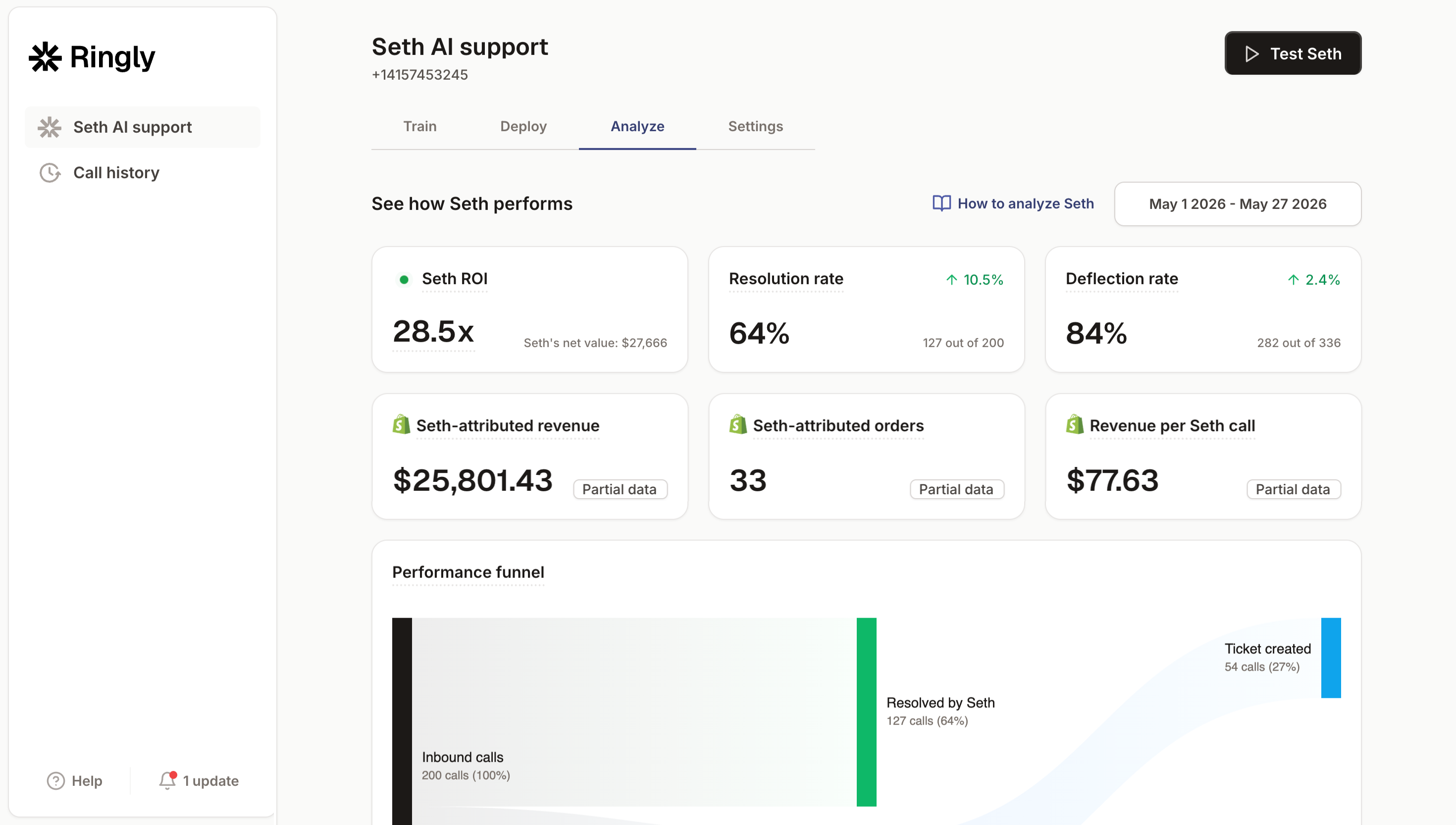
The AI answers inbound calls 24/7. It finds the order in your Shopify store, processes returns and exchanges, answers product and fit questions from your knowledge base, and cancels orders when a caller asks. It resolves up to 90% of calls on its own. Calls that need a human escalate cleanly to Gorgias, Richpanel, Reamaze, or whatever helpdesk you already run.
Three refund moments the phone catches that the website doesn't:
- The pre-purchase fit question. A 30-second answer about sizing means the order is right the first time, and the return never happens.
- The "this didn't fit" refund call. The agent offers the exchange before the refund processes. Revenue stays.
- The WISMO-anxiety refund. The agent finds the order, gives a real status, and the customer calms down instead of cancelling.
WashCo, a Shopify brand we launched, recovered $22,664 in its first 7 days on the phone. And the part customers comment on most is that it doesn't feel like a bot.
"My customers also feel like it's a normal person. They feel like they can communicate if they have questions."
Claudia Droge, TechCraft Studio
What this costs you today vs what it costs with Ringly
Take a typical $50M Shopify brand running a 6-rep CS team that spends a big chunk of every day on refund and return requests:
| Line item | Today | With Ringly |
|---|---|---|
| 6 reps x $4K loaded per rep | $24,000/mo | n/a |
| Ringly (illustrative) | n/a | $5,000/mo |
| Net monthly CS spend | $24,000/mo | $5,000/mo |
| Monthly savings | n/a | $19,000/mo |
| Annual savings | n/a | $228,000/yr |
That's roughly 70% of repeatable calls (order status, returns, exchanges, the same fit questions over and over) routed to the AI. The other 30%, the genuinely complex calls, still go to your team, who now have time to actually save the harder refunds. Exact pricing is set on a call, but the shape of the savings is consistent across the brands we run.
Want to see where your refund calls are leaking? Book a 30-min call and we'll do the math live on your numbers.
8. Layer in the returns tooling
Once the prevention work is in place, tooling makes the rest faster and cheaper. The point of tooling is speed and consistency, not replacing the thinking above it.
- A returns platform with a clear RMA flow, consistent grading, and automated approve/deny rules so refunds don't bottleneck your warehouse.
- Returns analytics so the data from solution 4 surfaces itself instead of living in a spreadsheet.
- A faster refund-email workflow for the cases where a refund really is the right call. Our refund email generator handles the copy.
Tie it together with a retention lens, because a well-handled return is a retention moment. See ecommerce customer retention and DTC returns best practices for the full frame.
Frequently asked questions
What is the average ecommerce return rate?
Around 20% of online orders, though it ranges from roughly 19% to over 24% depending on the source and product mix (Capital One Shopping). Apparel runs much higher than electronics or beauty, so benchmark against your own category, not the blended average.
What's the number-one cause of returns I can actually fix?
Sizing, fit, and color, which drive 45% of all retail returns, plus another 14% from inaccurate descriptions. Both live on the product page, which means both are fixable for free. Start there before you touch policy or tooling.
Is it better to offer exchanges or refunds?
Exchanges, almost always. An exchange keeps the revenue and the customer; a refund hands both back. Default your return flow to exchange and store credit first, and add a small credit incentive to nudge people away from cash refunds.
How much does it cost to process a single return?
Between $10 and $65 once you count return shipping, labor, inspection, and restocking. That's before the refunded order value, which is why preventing the return or converting it to an exchange saves so much more than just speeding up the refund.
Can a phone agent really reduce refunds?
Yes, because a lot of refund requests are reversible on the call. A customer who calls about a wrong size usually wants an exchange, and one who calls about a late order usually wants reassurance. Answer the call, offer the swap, and the refund dollar stays in your store. See our Shopify exchanges guide for how that flow works.
How do I reduce return fraud without annoying real customers?
Keep it surgical. Flag the small group of serial returners instead of restricting everyone, require a return reason, and use an adaptive policy that loosens for loyal buyers and tightens for repeat abusers. Roughly 9% of returns are fraudulent, but the other 91% are honest, so don't build for the minority.
Does Ringly handle returns and exchanges?
Yes. The AI finds the order in your Shopify store, processes returns and exchanges, and answers fit and product questions from your knowledge base. Anything that needs a human escalates to your existing helpdesk. Plans start at $99 a month, with a 65% resolution guarantee.
Talk to us

If you run a $10M-$100M Shopify brand and refunds are quietly eating your margin, a 30-min call is the fastest way to see how much of it you can keep. We'll look at your refund-call patterns and show you what's recoverable.
Our 3 promises.
- Live in under 1 hour. Setup and test calls are free.
- 30-day money back on the $99 plan fee.
- 65% resolution guarantee: if Seth resolves under 65% of your support calls in a month, that month comes back as credit (after 90 days on Pay per call).
Ruben (Ringly co-founder) takes these calls personally.