
This post in 30 seconds.
• SMS handles the routine layer of ecommerce support better than almost anything. It does not handle the calls that actually cost you a customer.
• The 2026 move is splitting the work: text for the repeatable 70-80% (tracking, confirmations, simple questions), a phone layer for the complex 20-30% and everything after hours.
• Built for founders, COOs, and Heads of CX at $10M-$100M Shopify brands with a visible phone number and a paid helpdesk.
Your customers want to text you. They already do, half of them, on whatever number they can find. And honestly, SMS is great at the part of support that's boring and constant: where's my order, did it ship, what's my tracking link. The trouble starts with the tickets that actually hurt. A refund someone thinks is wrong. An order that showed up broken. An angry message at 10 p.m. that needs a real answer, not 160 characters and a "we'll get back to you."
If you run support at a $10M-$100M Shopify brand with three to twelve reps, you've probably been pitched SMS as the fix for all of it. It isn't. It's the fix for some of it, and knowing which part matters more than the open rate. We've launched phone support for 50-plus Shopify brands, and the pattern is the same every time: text takes the repeatable stuff off your team's plate, and the calls that need a person still need a person. Book a 30-min call and we'll map which of your support volume is actually routine and which isn't.
In this post:
• What SMS is genuinely great at
• Where SMS customer service falls short
• The routine-vs-complex split
• How SMS and phone fit together
• A channel cheat sheet
• Will SMS add work for your team?
• The compliance question, kept simple
• What it costs vs what it saves
What SMS is genuinely great at
Let's give SMS its due before we poke holes in it. For the transactional, proactive layer of ecommerce support, text is hard to beat. Open rates sit around 98%, and most messages get read within three minutes (SimpleTexting). Email can't touch that, and nobody's checking a help center at 7 a.m. before work.
The thing SMS does better than any other channel is close out the questions your team gets fifty times a day before a human ever sees them. Order confirmations. Shipping updates. A "text TRACK for your order status" auto-reply that hands back a tracking link in two seconds. These are the WISMO calls and the same questions over and over that eat 30-40% of your ticket volume in a normal week and more during a spike, a pattern the ecommerce customer support statistics bear out year after year.
Done right, SMS does three jobs cleanly:
- Proactive updates: shipping, delivery, back-in-stock, subscription renewal reminders. The customer never has to ask, so the ticket never gets created. This is the same logic behind good WISMO automation on Shopify: kill the question before it becomes a ticket.
- Self-service triggers: keyword replies ("TRACK", "RETURN") that pull from your store and answer instantly without an agent. Wire a "TRACK" keyword to your store's order-status lookup and the most common ticket in your queue answers itself.
- Quick confirmations: address changes, order adjustments, simple yes/no exchanges that would be a wasted phone call.
Pair this with your existing ecommerce customer service stack and you genuinely shave load off the team. So far so good. Here's where it stops working.
Where SMS customer service falls short
I went back through more than 40 of our customers' real call logs to write this, and counted what's actually routine versus what needs a person. The split is consistent, and it's the part the SMS pitch leaves out: a big chunk of inbound support is not a question with a known answer. It's a problem that needs judgment.
SMS breaks the moment a customer needs a conversation instead of an answer. A refund they think is unfair. A return where the policy is fuzzy and they want to argue it. An order that arrived wrong and they're upset. You cannot resolve that in 160-character bursts spread over an afternoon, and trying to makes the customer angrier than if you'd never offered text at all.
Three places SMS quietly fails:
- Complex, emotional, or high-value issues. These need back-and-forth, tone, and someone who can make a call on the spot. Async text drags it out and the customer feels managed, not helped.
- After-hours urgency. SMS implies speed. A customer who texts at 10 p.m. expects an answer in minutes, not "we'll get back to you Monday." That auto-reply reads worse on text than the same delay would on email, because the channel promised fast and didn't deliver.
- The channel handoff. Only about 7% of help centers move a customer between channels without friction (Gorgias research). So the text conversation that can't be resolved gets dumped to email or a phone queue, and the customer repeats their whole story to a new person. This is the seam where a helpdesk like Gorgias and a phone queue stop talking to each other.
None of this means SMS is bad. It means SMS is a layer, not a strategy. The brands that get burned are the ones that turn off the phone, route everything to text, and discover their hardest customers have no way to actually reach a human.
The routine-vs-complex split
So here's the operating model that actually works. Split your support volume by what the work requires, not by which channel is trendy.
The routine 70-80% (tracking, confirmations, simple FAQ, status checks) can run on text and automation. The complex 20-30% (disputes, judgment calls, anything after hours, anything emotional) needs a voice on the line. The mistake is treating these as one problem with one channel. They're two problems, and the cheap one shouldn't subsidize neglecting the expensive one.
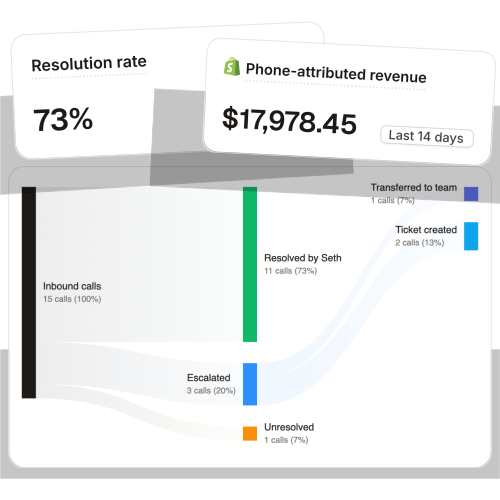
This is where a phone layer earns its place. Across 50-plus Shopify brands, an AI phone agent resolves 73% of inbound calls on its own, at roughly $0.42 per resolved call versus $7 to $16 for a human BPO. The routine calls get handled instantly. The genuinely hard ones escalate to your team with the context already attached. WashCo, a Shopify brand we launched, recovered $22,664 in its first 7 days on the phone, mostly from calls that were rolling to voicemail before.
"My customers also feel like it's a normal person. They feel like they can communicate if they have questions."
Claudia Droge, TechCraft Studio
That last part matters more than the resolution number. The reason this works is the calls don't feel automated. If the phone layer sounds like a robot, you've just moved the after-hours problem from voicemail to a worse voicemail. The point of splitting routine from complex is that the complex stuff still feels human, whether a person or the AI takes it.
A useful way to draw the line in your own queue: pull a week of tickets and tag each one as "answer" or "conversation." An answer has a known, lookup-able response (where's my order, what's your return window, did my address change go through). A conversation needs judgment (is this refund fair, is this return an exception, why is this customer this upset). The answers belong on text and automation. The conversations belong on a voice channel, live or after hours. When you tag a real week instead of guessing, the routine share almost always lands in that 70-80% range, and the surprise is usually how much of it your reps are still doing by hand.
How SMS and phone fit together
The friction nobody designs for is the round trip. A customer calls, hits hold music, gives up, and texts instead. Now you've got two tickets, two agents, and a customer who has to explain themselves twice. That's the 7% handoff problem in miniature, and it's where most "omnichannel" setups fall apart.
The fix is making text and phone share the same context instead of living in separate tools. SMS resolves what it can. What it can't, it escalates, and the call that follows already knows who the customer is, what they ordered, and what they've already tried.
Ringly.io is AI phone support for Shopify brands. Instead of growing your support headcount every time call volume goes up, the AI takes the routine inbound calls so your team can focus on the work that actually moves revenue. It finds orders in your Shopify store, processes returns and exchanges, answers product questions from your knowledge base, and rescues abandoned carts via outbound follow-up. Calls that need a human escalate cleanly to Gorgias, Richpanel, Reamaze, or whatever helpdesk you already run. You keep your number, your tools, your workflows.
The numbers back the split. TechCraft Studio handles 88% of calls without a human. BioLongevity Labs hits 79% resolution autonomously. In both cases the team didn't shrink to nothing, it just stopped spending its day on tracking questions and got the after-hours coverage it couldn't staff. If you're trying to scale support without hiring the next rep, this is the lever: text for the routine, a phone layer for the rest, and one shared context so nobody repeats themselves.
A channel cheat sheet
Here's the short version you can hand to your team. When a customer needs something, the channel should match the job, not the budget.
| Scenario | Best channel | Why |
|---|---|---|
| Order status / tracking | SMS | Instant, no agent needed, customer never has to wait on hold |
| Shipping + delivery updates | SMS (proactive) | Kills the ticket before it's created |
| Refund dispute / "this is wrong" | Phone | Needs judgment and tone, not 160 characters |
| Return where policy is fuzzy | Phone | Back-and-forth resolves faster live than over async text |
| After-hours urgent question | Phone (AI layer) | SMS promises speed it can't keep overnight |
| Documentation / receipts / formal records | Threaded, searchable, no urgency expectation |
A simple way to decide: choose SMS when the answer is already known and the customer just needs it fast. Choose phone when the answer requires a person (or an AI that sounds like one) to weigh something. Choose email when there's no urgency and the record matters. Most brands over-index on one channel and force the other two jobs through it. Don't.
For a deeper look at how the channels stack up on speed and satisfaction, our customer service response time benchmarks post has the raw numbers.
Will SMS add work for your team?
This is the question that actually stops brands from turning SMS on. You've got three to twelve reps already stretched across ecommerce customer service email and chat, and the worry is that adding a channel customers expect instant replies on just buries them deeper.
It does, if you bolt SMS on as another manual inbox. It doesn't, if you build it around automation from day one.
SMS scales on automation, not headcount. The brands that add a channel and add reps did it backwards. The volume you can absorb without growing the team comes from three places:
- Templates and macros for the answers your reps type fifty times a day. A saved reply for "where's my order" is the difference between a 5-second touch and a 2-minute one.
- Keyword self-service that resolves the routine entirely without a human (TRACK, RETURN, address change). These never reach an agent.
- A resolving layer for what self-service can't catch. This is where the how to scale support without hiring play lives: the routine gets handled by automation, the genuinely hard stuff escalates with context, and the headcount line stays flat while volume grows.
The mistake is staffing for SMS like it's email. Email is async and patient. SMS feels urgent, so a team trying to answer every text by hand burns out fast, which is the burnout your reps were already flagging before you added the channel. Let the system carry the repeatable load and your people carry the judgment calls.
The compliance question, kept simple
The TCPA fear is real and it stops a lot of brands from touching SMS at all. Statutory damages run $500 to $1,500 per text, and class actions climbed sharply through 2024 and 2025 (Text-Em-All). The big settlements you've seen in the headlines are scary on purpose.
But here's the distinction that matters: almost every one of those cases was about unconsented marketing blasts, not about answering a customer who texted you first. Transactional messages (an order update or a tracking link the customer asked for) sit on different footing than promotional campaigns you push out. The risk lives in the marketing list, not in the support conversation.
One practical move keeps you clean: keep your transactional support flow separate from your marketing list. Honor opt-outs immediately on both, keep consent records, and don't let your SMS marketing tool quietly fold support replies into promotional sends. That's it. Compliance on the support side is mostly about not blurring the two, which is also the operational reason support SMS and marketing SMS shouldn't run through the same untuned pipe.
What it costs vs what it saves
The per-message cost of SMS is almost nothing, a few cents. So that's not the number to watch. The number that matters is what your team's time costs when they spend it on calls and texts a system could have handled.
Take a typical brand running a 6-rep CS team:
| Line item | Today | With a phone layer |
|---|---|---|
| 6 reps × $4K loaded per rep | $24,000/mo | n/a |
| AI phone support (approx.) | n/a | $5,000/mo |
| Net monthly CS spend | $24,000/mo | $5,000/mo |
| Monthly savings | n/a | $19,000/mo |
| Annual savings | n/a | $228,000/yr |
That's roughly 70% of repeatable calls (order status, returns, product questions, the same five things over and over) routed off your team. The other 30%, the genuinely complex calls, still go to your reps, who now have time to actually solve them. SMS handles a slice of the routine; the phone layer handles the rest plus the after-hours coverage you can't staff with humans.
If you want to run this math against your own volume, book a 30-min call and we'll do it live with your actual ticket mix.
Frequently asked questions
Is SMS customer service worth it for a $10M+ Shopify brand? Yes, for the routine layer. Order updates, tracking, and simple self-service belong on text. Just don't expect it to handle disputes, complex returns, or after-hours urgency, those need a voice channel.
Do I need a dedicated SMS tool or is Gorgias or Zendesk enough? For most brands, the SMS feature inside your helpdesk is fine for support replies. The real gap usually isn't SMS-versus-SMS, it's what happens when the text can't resolve the issue. If you're weighing options, our Gorgias alternatives and Zendesk alternatives breakdowns go deeper.
Does SMS support reduce phone volume or just add to it? It depends on the use case. Tracking and simple questions move off the phone cleanly. Disputes and complex issues stay on the phone, so SMS trims the routine calls but doesn't replace the hard ones.
What response time do customers expect on SMS versus phone versus email? SMS carries an implicit "within minutes" expectation during business hours. Phone is real-time or a callback. Email gets you up to 24 hours. Setting a clear SMS auto-reply about hours is the difference between managing expectations and breaking them.
How do I handle SMS support after hours? Don't leave a dead auto-reply doing the work. Route after-hours volume to a layer that actually resolves, order lookups and FAQs automatically, with a 24/7 phone option for anything urgent.
Do transactional order-status texts need TCPA consent like marketing texts? Transactional messages a customer asked for sit on different footing than promotional blasts, which is where the lawsuits concentrate. Keep your transactional support flow separate from your marketing list, honor opt-outs, and keep consent records. (This isn't legal advice, check with counsel for your specifics.)
How much does SMS customer service cost? SMS per-message is a few cents. The cost that actually moves is your team's loaded time on repeatable work, around $4K per rep per month. Moving the routine volume off humans is where the savings live.
Talk to us

If your phone still rolls to voicemail after 6 p.m. while your texts auto-reply with nothing, that gap is the whole game. A 30-min call is the fastest way to see how much of your support volume is routine, what's actually costing you a customer, and where a phone layer fits next to the text channel you already run.
The 3-layer guarantee.
1. Live in 14 days or it's free until launched.
2. 65% resolution in 90 days or we refund the last 3 months of subscription fees.
3. We keep working free until we hit it.
Ruben (Ringly co-founder) takes these calls personally.