

The short version.
- A Shopify WMS integration syncs your warehouse software with your store both ways: stock counts in, orders out, tracking back. The native-vs-connector choice matters more than the brand on the box.
- We compare 8 WMS options (ShipBob, ShipHero, Cin7, Peoplevox, Extensiv, Linnworks, Ongoing, PULPO) with honest pricing and what each is actually best for.
- Built for the ops lead at a $10M-$100M Shopify brand wiring up or re-wiring their warehouse, who already knows one bad stock feed means overselling and a Monday full of angry calls.
Most ops leads at a growing Shopify brand don't go looking for a warehouse management system because they're curious. They go looking because something broke. A connector silently fell over and the store oversold a SKU that's been out of stock for a week. Or the warehouse is still picking off a printed sheet and the error rate climbs with volume. Inventory distortion, the mix of stockouts, overstock, and plain wrong counts, costs retailers an estimated $1.77 trillion a year.
Here's the part the vendor pages skip. Across the Shopify brands we run phone support for, the week a WMS goes live is reliably a phone week. Tracking and stock feeds briefly desync during the cutover, customers can't see their order, and they call to ask where it is. So this guide covers both halves: picking the right integration, and what to do about the calls a WMS will never answer. If you run a $10M-$100M Shopify brand and you're staring down a warehouse migration with a phone line that already barely gets picked up, book a 30-min call and we'll map where your support load goes during a cutover.
What a Shopify WMS integration actually does
A warehouse management system runs the physical side of your operation: receiving, putaway, picking, packing, cycle counts. The integration is the wiring between that system and your Shopify store, and it moves data in three directions.
A good Shopify WMS integration keeps three feeds honest at once: stock into your store, orders into the warehouse, and tracking back to the customer.
- Inventory into Shopify. When a unit gets picked, received, or counted in the warehouse, the available quantity on your store updates. This is the feed that stops overselling.
- Orders into the warehouse. A new Shopify order drops straight into the pick queue, with no one re-keying it. At volume this is the difference between same-day dispatch and a backlog.
- Tracking back to Shopify. When the order ships, the tracking number and fulfillment status push back to the order record, which powers the customer's shipping email and order-status page.
- Multi-warehouse routing. If you run more than one location, the integration decides which warehouse fills each order based on stock and proximity.
Roughly 93% of warehouse operations now run on a WMS. The variable is how cleanly it talks to Shopify, and that comes down to one decision.
Native integration vs connector vs 3PL: the decision that matters most
Most of the WMS marketing you'll read flattens this into "we integrate with Shopify." That tells you almost nothing. There are three real ways a WMS connects, and they fail in different ways.
The integration type predicts your headaches more accurately than any feature list.
| Connection type | What it is | Where it breaks |
|---|---|---|
| Native app | The WMS publishes a direct Shopify integration it builds and maintains | Rare, but you're dependent on their dev pace for Shopify API changes |
| Middleware connector | A third-party app sits between the WMS and Shopify | Most fragile. Lags, silent failures, another vendor to chase when stock is wrong |
| 3PL with bundled WMS | A fulfillment partner runs the WMS for you and owns the integration | Least control. Their software, their priorities, your customers |
The native path is what you want if you run your own warehouse and want one throat to choke. The connector path is common with marketplace-heavy tools that bolt Shopify on as one of many channels, and it's where most silent-oversell stories come from. The 3PL path makes sense when you'd rather not run a warehouse at all, and it overlaps with the outsourced-fulfillment decision a lot of growing brands face at the same time.
This matters because the typical ecommerce out-of-stock rate already sits around 8%, and 69% of shoppers will abandon and buy from a competitor when an item shows unavailable. A lagging connector turns a stock problem into a lost-sale problem fast.
Comparison table: 8 WMS options for Shopify
Here's the field, with the connection type, who each one fits, and what's actually public on pricing. Ringly isn't in this table, by the way. We're not a WMS. More on where we fit further down.
| WMS | Connection | Best for | Pricing | Verdict |
|---|---|---|---|---|
| ShipBob | Native (Plus certified) | Outsourced fulfillment + optional self-run WMS | ~$5/order, $275/mo min, $975 onboarding | Strong if you want a 3PL and software in one |
| ShipHero | Native | Running your own warehouse | Custom | Built for DTC warehouses + 3PLs |
| Cin7 | Native, 15-min sync | Brands wanting published pricing | Core public, Omni custom | Rare pricing transparency |
| Peoplevox | Native | High-volume, can absorb a long rollout | Custom, enterprise | Powerful, slow to launch |
| Extensiv | Often connector | 3PLs and multi-client operations | Custom | Channel breadth over Shopify depth |
| Linnworks | Often connector | Marketplace-heavy sellers | Custom | Pick it when Amazon beats Shopify |
| Ongoing WMS | Native app | European 3PL connections | ~$304/user/mo | Big in EU 3PL world |
| PULPO WMS | Native app | Fast go-live, small-mid teams | Pay-per-operator | Live in 1-2 weeks |
How I evaluated these WMS options
I'm Ruben, co-founder of Ringly. I don't sell a WMS, so I have no horse in which one you pick. What I do have is a side view of the field: we run AI phone support for Shopify brands, which means I see what their warehouse stack does to their support queue every week.
I scored each option against five things that actually decide whether an integration is a relief or a second job:
- Connection type. Native app, middleware connector, or bundled 3PL. I checked how each one binds to Shopify and where it's known to lag.
- Sync depth. Whether stock, orders, and tracking all move both ways without re-keying, and how fast.
- Multi-warehouse routing. Whether it can split orders across locations on its own.
- Pricing honesty. Whether you can actually find a number, or whether it's "contact sales" all the way down.
- The cutover tax. This is the one nobody else scores: what happens to your customers, and your phone, during the go-live week when feeds briefly disagree.
I pulled feature and pricing detail from each vendor's own pages plus G2 and the Shopify App Store, and noted where reviewers flagged a gap. Where a number isn't public, I say so instead of guessing.
The 8 best WMS integrations for Shopify, reviewed
1. ShipBob
Best for: brands that want a 3PL and a WMS from the same vendor. ShipBob runs a fulfillment network and also licenses its WMS to brands that want to keep their own warehouse, which is a rare two-in-one.
The Shopify integration is native and Plus-certified. Orders sync in near real-time, tracking pushes back automatically, and inventory stays accurate across Shopify, Amazon, and BigCommerce. The picking app, ToolBob, gives warehouse staff batch, cluster, and single-order modes plus cycle counting.
Pricing
3PL pricing starts around $5 per order, with a $275 monthly minimum and a $975 onboarding fee. Shipping is marked up 15-30% over carrier rates (Speed Commerce). The self-run WMS supports brands shipping 3,500 to 120,000 orders a month.
What works
- Native, certified integration. No middleware to babysit.
- Both models under one roof. Outsource fulfillment, or run your own warehouse on their software.
- Real-time multichannel sync. Cuts the overselling risk across Shopify and marketplaces.
What doesn't
- Expensive under 300 orders a month. The minimums and onboarding fee don't pencil out for small brands.
- Shipping markups bite low-AOV products. Those 15-30% markups eat into thin margins.
Why it ranks first
If you want one vendor for software and fulfillment, ShipBob is the cleanest pick. The margin math only works above a few hundred orders a month.
2. ShipHero
Best for: brands that run their own warehouse and want WMS software built for DTC, not retrofitted from enterprise logistics.
ShipHero is a full WMS for DTC brands and 3PLs running their own pick-pack-ship. The Shopify integration is native, and the platform leans into the physical-movement side: picking paths, packing flows, returns.
Pricing
Custom, not published. You'll talk to sales. It's well-reviewed on G2 for the warehouse-operations workflow.
What works
- Built for DTC warehouses. The workflows assume ecommerce volume, not pallet-in-pallet-out.
- Runs your warehouse or a 3PL's. Same software both ways.
What doesn't
- No public pricing. You can't size it without a sales call.
- Overkill if you're outsourcing. If you don't run a warehouse, this is more than you need.
Why it ranks second
The strongest pure self-run WMS on this list for a DTC brand. The opacity on price is the only friction.
3. Cin7
Best for: brands that want published pricing and an inventory-led platform rather than a pure warehouse tool.
Cin7 is inventory-led: it does order management and warehouse work plus a lot of upstream inventory control. It sells two products, Cin7 Core for smaller brands with public pricing, and Cin7 Omni for enterprise on custom quotes. The 2026 Shopify sync runs every 15 minutes with faster product uploads.
Pricing
Cin7 Core has published tiers, which is genuinely rare here. Core Advanced is the realistic starting point for most Shopify brands. Omni is custom.
What works
- Published pricing. You can actually budget without a sales call.
- Inventory-led depth. Strong if your problem is upstream stock control, not just the warehouse floor.
What doesn't
- Not a pure WMS. If you need deep pick-pack-ship floor tooling, this leans more inventory than warehouse.
- Two products to figure out. Core versus Omni takes a minute to untangle.
Why it ranks third
The pricing transparency alone earns its spot. If your bottleneck is inventory accuracy more than warehouse labor, start here. We go deeper on this category in our best Shopify OMS guide.
4. Descartes Peoplevox
Best for: high-volume brands that can absorb a longer rollout in exchange for a powerful native integration.
Peoplevox is a native Shopify WMS aimed at high-volume operations. It replaces paper with guided mobile workflows, which is exactly what you want when pick error rates climb with volume.
Pricing
Custom, enterprise-oriented. Rollouts often run around 12 weeks.
What works
- Native, high-volume integration. Built to scale with order count.
- Guided mobile picking. Cuts the human error that paper picking invites.
What doesn't
- Long, costly rollout. One G2 reviewer cancelled after $20,000 AUD in implementation and 9 months of training.
- Enterprise pricing. Not a fit for a brand that wants live next month.
Why it ranks fourth
Genuinely powerful for high volume, but the rollout is a project, not a plug-in. Go in with eyes open on the timeline.
5. Extensiv
Best for: 3PLs and multi-client operations juggling many sellers and channels at once.
Extensiv (formerly 3PL Central and Skubana) is built around multi-client warehouse and order management. Its strength is channel and client breadth rather than Shopify depth, and some integrations run through a connector layer.
Pricing
Custom.
What works
- Multi-client architecture. Made for 3PLs running many brands.
- Broad channel coverage. Handles a wide marketplace footprint.
What doesn't
- Connector layer for some integrations. That's the fragile path for Shopify specifically.
- More than a single-brand DTC operation needs. The breadth is wasted if Shopify is your whole world.
Why it ranks fifth
Right tool if you're a 3PL or a multi-channel seller. If you're one brand on Shopify, the breadth is overhead.
6. Linnworks (with SkuVault)
Best for: marketplace-heavy sellers where Amazon, eBay, or Walmart generate more revenue than the Shopify store.
Linnworks is multichannel inventory and order management, with SkuVault as the warehouse layer. The Shopify integration often relies on a connector. Its center of gravity is marketplaces, so it shines when Shopify is one channel among several.
Pricing
Custom.
What works
- Marketplace-first. Strong if your Amazon revenue dwarfs Shopify.
- Inventory + warehouse together. SkuVault handles the floor side.
What doesn't
- Connector dependency for Shopify. Same fragility caveat as any middleware path.
- Shopify is secondary. If Shopify is your primary store, a Shopify-native tool fits better.
Why it ranks sixth
Pick it when marketplaces lead and Shopify follows. For a Shopify-first brand it's the wrong center of gravity.
7. Ongoing WMS
Best for: brands connecting to a European 3PL, or running their own EU warehouse, that want a proven Shopify link.
Ongoing WMS is big in the European 3PL world, and its Shopify integration is its most-used, with 1,300+ companies on it. It covers scanning, efficient picking routes, batch-picking, returns, auto label printing, and warehouse maps.
Pricing
Around €275 (roughly $304) per user per month.
What works
- Proven Shopify link. Its most popular integration, by a wide margin.
- Per-user pricing you can find. Easier to budget than custom quotes.
What doesn't
- EU-centric. Most natural fit if your fulfillment is European.
- Per-user cost adds up. Larger warehouse teams scale the bill quickly.
Why it ranks seventh
A safe pick if you or your 3PL sit in Europe. Less obvious for a US-only operation.
8. PULPO WMS
Best for: small-to-mid warehouse teams that want a native Shopify integration live in weeks, not quarters.
PULPO is a cloud WMS with a native Shopify integration, barcode-driven and paperless. The headline is speed: brands report going live in 1-2 weeks, against the 12-week rollouts some enterprise tools run.
Pricing
Pay-per-operator. Reviewers on G2 and the Shopify App Store call out the cost-benefit and the smooth, fast implementation.
What works
- Fast go-live. 1-2 weeks is rare in this category.
- Native, barcode-driven. Cuts pick errors without a paper trail.
What doesn't
- Smaller brand than the enterprise names. Less proven at very high volume.
- Per-operator model. Costs track your warehouse headcount.
Why it ranks eighth
The fastest path to a working native integration here. If a long rollout is a non-starter, start your shortlist with PULPO.
What a WMS integration won't fix
Here's the honest part. A WMS gives you stock truth and a faster warehouse floor. It does not stop your phone from ringing.
A Shopify WMS integration fixes your inventory. It does not answer the customer who still calls to ask where their order is.
The calls that drive the most volume for a Shopify brand, "where's my order" and "is this back in stock," are downstream of fulfillment, not solved by it. A customer who got a shipping email still phones when the tracking hasn't moved in three days. A customer eyeing a sold-out SKU still calls to ask when it's back, no matter how accurate your stock count is now.
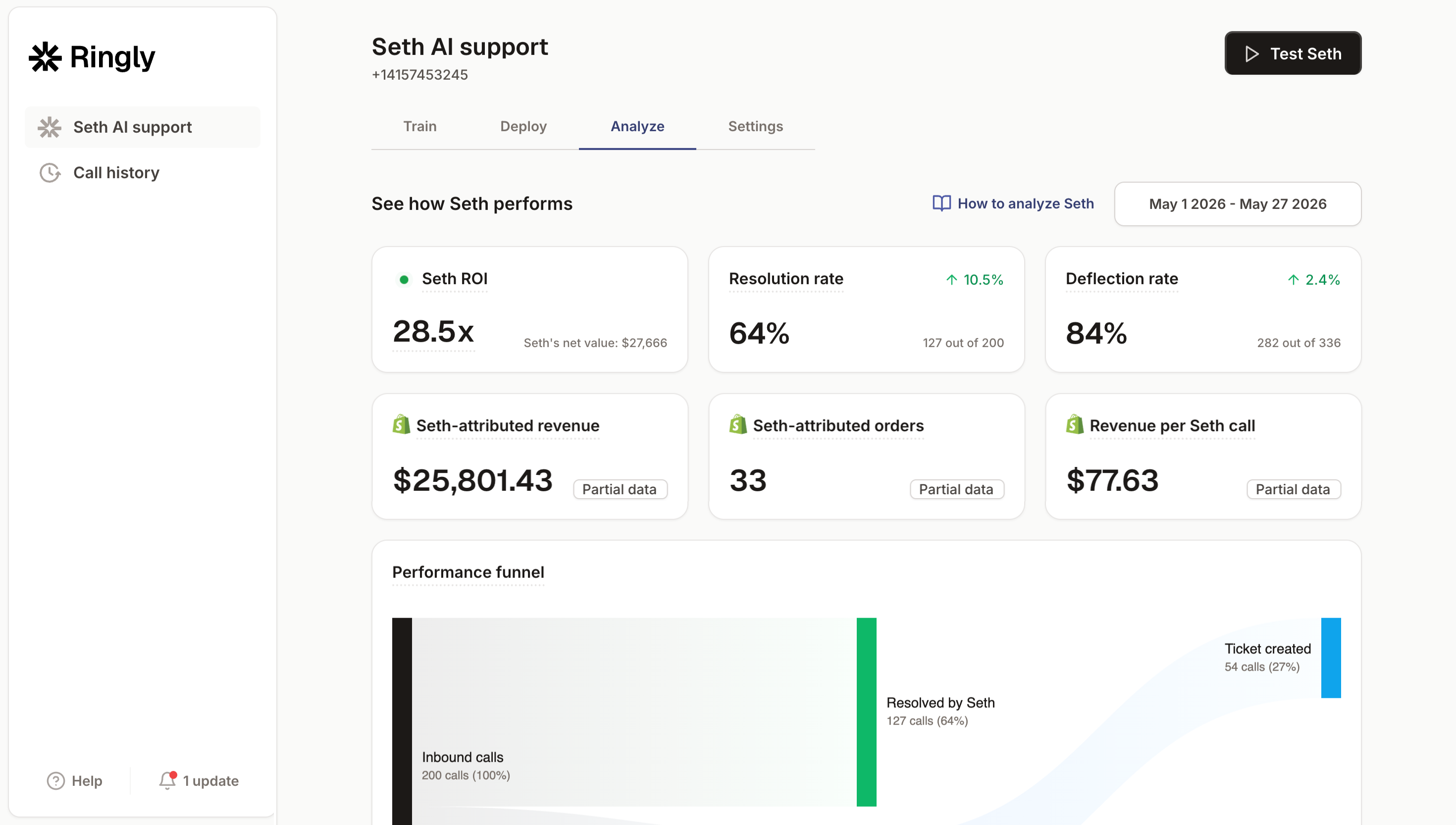
And the cutover makes it worse before it makes it better. The week a WMS goes live, tracking and stock feeds desync for a stretch while everything settles, and the WISMO calls spike right when your ops team has the least slack. We see it across the brands we run phone support for: go-live week is a phone week.
This is the gap Ringly.io fills. We're AI phone support for Shopify brands, not a WMS. The AI answers inbound calls 24/7, finds the order in your Shopify store, checks status, and answers the stock and shipping questions a WMS feeds but never speaks. It resolves up to 90% of calls on its own, and the calls that need a person escalate cleanly to whatever helpdesk you already run. The WMS keeps your shelves honest. We keep the phone from becoming your ops team's second job.
If your warehouse project is going to spike the phone for a week and your support team is already thin, book a 30-min call and we'll do the math on what those calls cost you live.
How to choose the right Shopify WMS
Skip the feature-matrix paralysis. The choice mostly falls out of two questions: do you run your own warehouse, and how fast do you need to be live.
- Choose ShipBob if you'd rather outsource fulfillment, or want a 3PL and self-run WMS option from one vendor.
- Choose ShipHero if you run your own DTC warehouse and want software built for that.
- Choose Cin7 if you want published pricing and your real bottleneck is inventory accuracy more than warehouse labor.
- Choose Peoplevox if you're high-volume and can absorb a 12-week rollout for a powerful native fit.
- Choose Extensiv if you're a 3PL or run many channels and clients.
- Choose Linnworks if your marketplaces out-earn your Shopify store.
- Choose Ongoing WMS if you or your 3PL are European and want a proven, per-user-priced link.
- Choose PULPO if you need a native integration live in weeks, not quarters.
Whatever you pick, plan for the support side before go-live, not after. The brands that come out of a cutover clean are the ones who decided in advance who answers the phone when the feeds wobble, the same way they plan their Shopify Plus customer service around peak.
"My customers also feel like it's a normal person. They feel like they can communicate if they have questions."
Claudia Droge, TechCraft Studio
Frequently asked questions
Does Shopify have a built-in WMS?
No. Shopify has native inventory tracking and basic locations, but it isn't a warehouse management system. It doesn't do directed picking, putaway logic, or barcode-driven floor workflows, which is why brands at volume add a dedicated WMS on top.
Native integration or a connector: which is better?
Native almost always wins. A native app is built and maintained by the WMS itself, so there's one vendor accountable when something goes wrong. A middleware connector adds a third party that can lag or silently fail, which is where most overselling stories start.
What's the difference between a WMS and an inventory app?
An inventory app tracks how much you have and where. A WMS runs the physical movement of goods: receiving, putaway, directed picking, packing, and cycle counts. If your problem is the warehouse floor, you want a WMS; if it's just stock counts, an inventory tool may be enough.
Will a WMS stop overselling?
It helps, a lot, by keeping your Shopify stock count honest in near real-time. But it only works if the integration syncs cleanly. A lagging connector can still oversell, which is why the connection type matters more than the feature list.
How much does a Shopify WMS cost?
It ranges widely and most vendors quote custom. Public anchors: ShipBob runs around $5 per order with a $275 monthly minimum, Ongoing WMS is roughly $304 per user per month, and Cin7 Core publishes tiers. ShipHero, Peoplevox, Extensiv, and Linnworks are all custom-quoted.
Does a WMS reduce customer-service calls?
Indirectly, by shipping faster and more accurately, but it doesn't answer the phone. The high-volume calls, "where's my order" and "is this in stock," still come in. A growing number of Shopify operators pair a WMS with AI phone support so those routine calls get answered without growing the team.
Can a WMS route orders across multiple warehouses?
Yes, most do. The integration picks which location fills each order based on stock and proximity, which lowers shipping cost and speeds delivery. If you run more than one warehouse, treat auto-routing as non-negotiable rather than optional.
Talk to us

If you run a $10M-$100M Shopify brand and your phone still rings after every stock or shipping hiccup, a 30-min call is the fastest way to see what that's costing you. We'll look at your call volume and where the routine questions go during a warehouse cutover.
Our 3 promises.
- Live in under 1 hour. Setup and test calls are free.
- 30-day money back on the $99 plan fee.
- 65% resolution guarantee: if Seth resolves under 65% of your support calls in a month, that month comes back as credit (after 90 days on Pay per call).
Ruben (Ringly co-founder) takes these calls personally.