
The short version.
- "Shopify UGC platform" means two different things: apps that DISPLAY customer content on your store, and marketplaces that SOURCE new creator video. Pick by the job you actually need done.
- For collecting and showing reviews, photos, and video on-site: Loox, Okendo, Yotpo, Judge.me, Stamped, Fera. For sourcing creator video for ads: Billo, Insense, Trend, Minisocial.
- Written for founders and growth or CX leads at $10M-$100M Shopify brands deciding how to add UGC without bolting on the wrong tool.
Type "shopify ugc platform" into Google and you get two completely different kinds of tool stacked in the same list, with nobody telling you they do opposite jobs. One half collects the photos and reviews your existing customers already leave and puts them on your product pages. The other half pays creators to make brand-new video you can run as ads. Both are "UGC." They are not interchangeable, and buying the wrong one is the most common mistake I see growth teams make here.
I run an AI phone support company for Shopify brands, which means I spend a lot of time looking at what happens downstream of a good UGC program: more traffic, more orders, and more of the same questions over and over. So I went and actually installed the Shopify-native apps on a test store and pulled their live App Store ratings, and I weighed the creator marketplaces on what really separates them (pricing model and content rights). If you run a $10M-$100M Shopify brand and you're trying to figure out which UGC tool to add, this is the map. And if your support volume is the thing climbing after every campaign, book a 30-min call and I'll walk you through what that looks like on the back end.
In this post:
The two kinds of "Shopify UGC platform" (and which one you need)
This is the split that the listicles bury. There are two categories, and they solve problems at opposite ends of the funnel.
Put plainly: a UGC platform is either a place to display the content your customers already make, or a place to buy content from creators who don't shop with you yet. Confusing the two is how brands end up paying $500 a month for creator video when all they needed was a $15 review widget.
The first category is on-site display and review apps. These live inside your Shopify theme. They send the post-purchase email asking for a photo or video review, collect what comes back, and show it on product pages as star ratings, photo walls, and shoppable galleries. Loox, Okendo, Yotpo, Judge.me, Stamped, and Fera all play here. You already have the customers. This category turns their experience into proof on the page, which is one of the most reliable ecommerce conversion rate levers there is.
The second category is creator-content marketplaces. These connect you to creators who film branded video for you to run as paid social or organic posts. The output is fresh ad creative, not your existing customers' reviews. Billo, Insense, Trend, and Minisocial play here. You don't have the content yet; you're commissioning it.
So before you compare a single price, answer one question: do you need to surface trust you already have, or manufacture new video you don't have? If it's the first, you want a display app, and most brands underspend here. If it's the second, you want a marketplace, and most brands overspend. Either way, UGC sits inside a broader Shopify marketing app stack, so think about where it fits before you add another login.
The 11 best Shopify UGC platforms at a glance
Here's the full shortlist across both categories, with starting prices and Shopify App Store ratings where the tool is a native app. App Store numbers are as of June 2026 and they move, so treat them as a snapshot.
| Platform | Category | Best for | Starting price | App Store rating |
|---|---|---|---|---|
| Loox | Display / reviews | Photo-first review walls | ~$9.99/mo | 4.9 (~7,985) |
| Okendo | Display / reviews | Reviews plus loyalty | $19/mo | ~4.9 |
| Yotpo | Display / reviews | All-in-one at scale | Free tier, then quote | ~4.8 |
| Judge.me | Display / reviews | Best free plan | Free / ~$15/mo | 5.0 (~39,791) |
| Stamped | Display / reviews | Budget all-rounder | Free / ~$19/mo | ~4.8 |
| Fera | Display / reviews | Custom widgets, social import | Free / ~$9/mo | ~4.8 |
| Moast | Display / video | Shoppable video on product pages | Free / $15/mo | 5.0 (~348) |
| Billo | Creator video | Cheap, repeatable video | ~$79-$199/video | Marketplace |
| Insense | Creator video | Video plus ad whitelisting | ~$500/mo | Marketplace |
| Trend | Creator video | Higher-production video | ~$200-$2,000/project | Marketplace |
| Minisocial | Creator video | Managed micro-influencer UGC | ~$2,500/project | Marketplace |
Judge.me carries a 5.0 rating across nearly 40,000 Shopify App Store reviews, the most-reviewed app in the review category by a wide margin. That alone doesn't make it the right pick for you, but it tells you the floor is high in this category. The real decision is which job you're hiring the tool to do.
How I evaluated these platforms
I'm Ruben, co-founder of Ringly.io. I don't sell a UGC tool, so I have no horse in this race, which is exactly why I wanted to write the neutral version. Over a couple of weeks I put every platform below through the same five checks, against the workflow of a $10M-$100M Shopify brand.
- Install and real-store test. I installed the Shopify-native apps (Loox, Okendo, Judge.me, Stamped, Fera) on a test store, sent the review-request flow through, and watched how the widgets rendered on a live product page.
- Live App Store ratings. I pulled each native app's current Shopify App Store rating and review count in June 2026, because for a Shopify buyer that's a more honest trust signal than a G2 score from a different audience.
- Pricing model, not just price. I separated order-volume pricing (Okendo, Loox, Fera) from flat pricing (Judge.me) from per-video pricing (Billo) from managed-project pricing (Minisocial), since the model is what actually bites you at scale.
- Content rights and distribution. On the creator marketplaces, I checked who owns the video, whether you get usage rights for ads, and whether the creator also posts to their own audience.
- The free-tier stress test. I checked which free plans are genuinely usable and which are a funnel into a sales call.
One thing none of the UGC roundups mention, and the reason I had skin in writing this: when a UGC program works, your traffic and orders climb, and so does the volume of post-purchase contact behind them. Reviews and creator video are top-of-funnel trust machines. The bill they quietly create shows up later, in your support queue. I'll come back to that. For now, just know that's the lens I'm reading these tools through, and that Ringly isn't a UGC platform, so it isn't in the table above.
Best apps to collect and display UGC on your store
If you already have happy customers and you want their photos, videos, and reviews working as proof on your product pages, this is your category. These are the seven worth your time.
1. Loox
Best for: brands with visually driven products that want a beautiful photo-and-video review wall live fast.
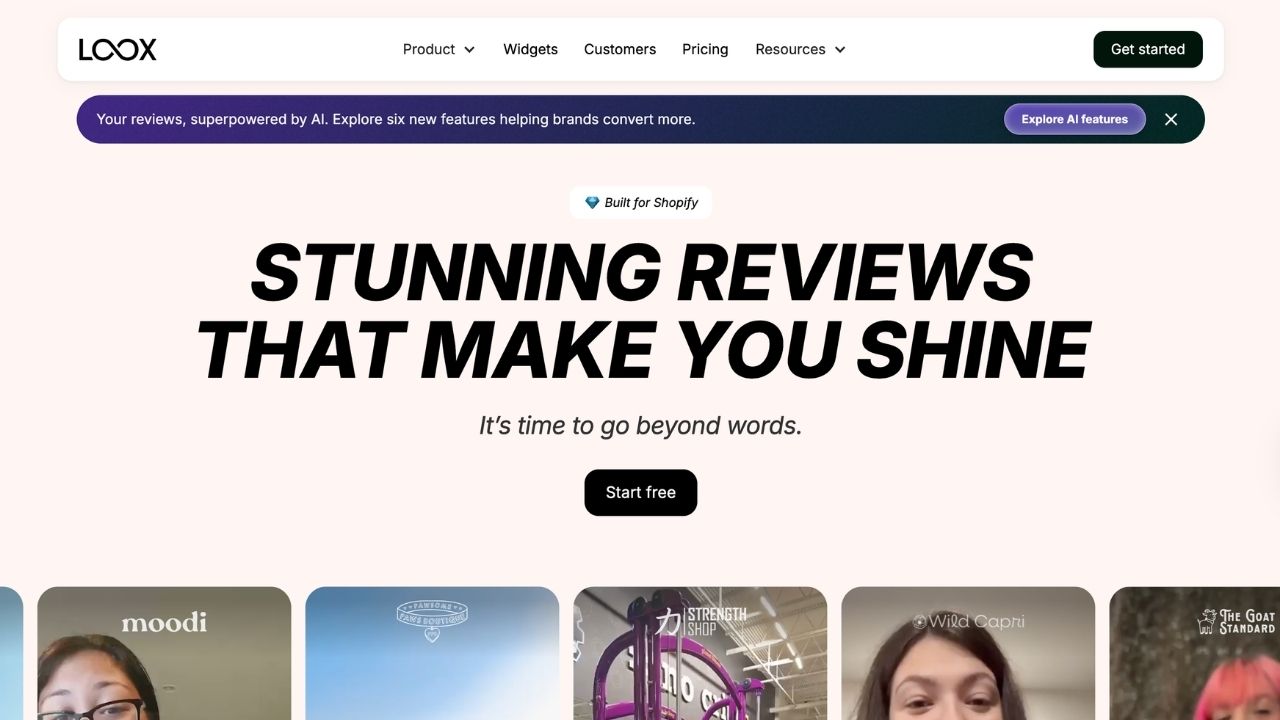
Loox is the photo-first option. It automates the post-purchase review request, nudges customers to add a photo or video, and renders the result in polished galleries that measurably lift conversion on a product page. It's Shopify-only, which is a feature if you're all-in on Shopify and a limitation if you're not.
Pricing
Plans start around $9.99/mo and scale with your order volume, with mid-tiers landing in the $34.99-$99.99/mo range. The order-volume model means the bill grows as you grow.
What works
- Best-looking widgets in the category: the photo and video walls are designed to sell, not just to sit there.
- Photo and video collection that actually converts: incentivized photo requests pull more visual reviews than text-only flows.
- Fast, Shopify-native setup: you can be live the same afternoon.
What doesn't
- No loyalty or SMS: you'll need other apps to cover those, which adds cost and logins.
- Order-volume pricing climbs: a high-volume store pays meaningfully more.
Why it ranks first in display
For most Shopify brands whose products photograph well, Loox is the cleanest path to a review wall that earns its keep. It's not the cheapest and it's not the most full-featured, but it nails the one job.
2. Okendo
Best for: scaling brands that want reviews bundled with loyalty, quizzes, and surveys in one stack.
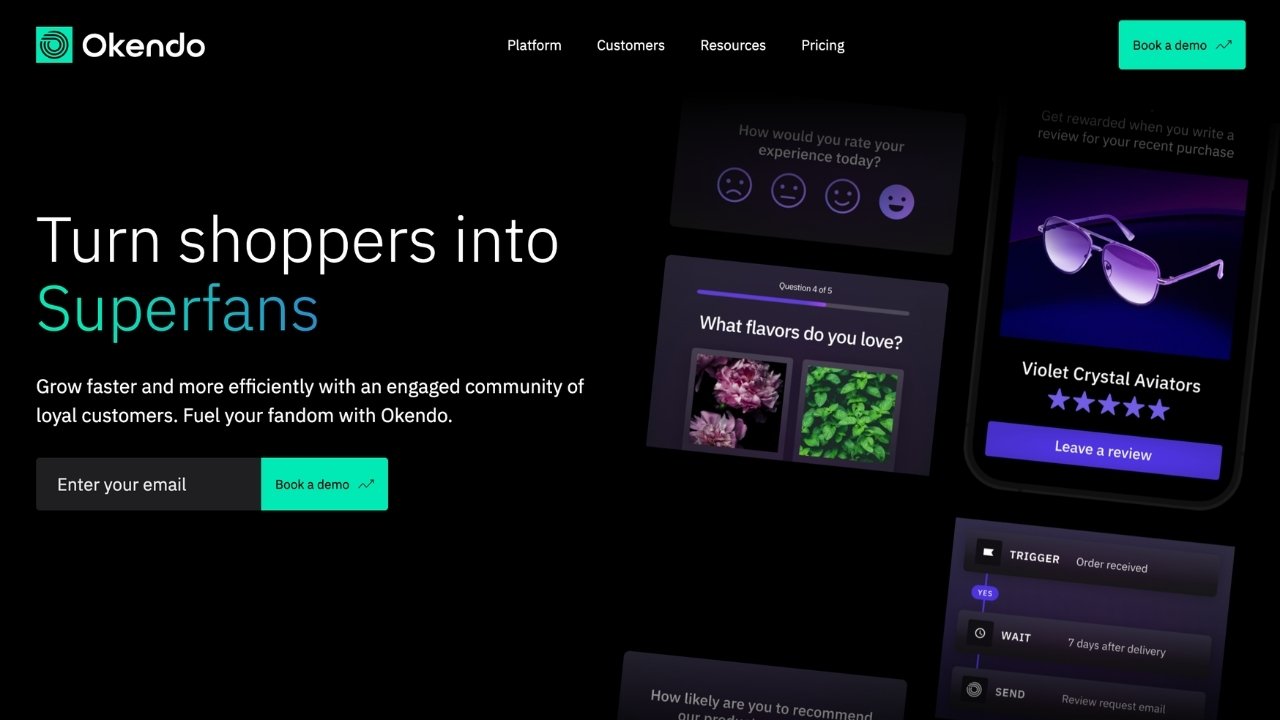
Okendo collects attribute-rich reviews (fit, skin type, use case) and pairs them with loyalty and surveys, so the same tool that gathers your UGC also feeds segmentation and ecommerce customer retention. It's a bigger platform than Loox, and it's priced like one. If you want reviews and a loyalty program under one roof, it's a strong fit. If you just want reviews, it's more than you need, and there are leaner Okendo alternatives worth a look.
Pricing
Essential is $19/mo for up to ~200 orders/mo, Growth is $119/mo for up to ~1,500 orders, and Power is $299/mo for up to ~3,500 orders. Add-ons push it higher.
What works
- Attribute-rich reviews: structured data you can actually segment on, not just stars.
- Reviews plus loyalty in one: fewer tools, one customer record.
- Strong widget customization: it'll match your brand without dev work.
What doesn't
- Price climbs steeply with order volume and add-ons: a busy store on Power plus loyalty adds up fast.
- Overkill for review-only needs: you're paying for a platform you may only half-use.
Why it ranks second in display
Okendo is the right call when reviews are one piece of a bigger retention plan. As a pure review tool it's expensive, but as a reviews-plus-loyalty backbone it earns the spend.
3. Yotpo
Best for: larger brands that want reviews, visual UGC, loyalty, and SMS from one vendor.

Yotpo is the enterprise-leaning all-in-one, and a common fixture in a Shopify Plus stack. Reviews, shoppable visual UGC galleries, loyalty, SMS, and retail syndication all live under one login. That breadth is the draw and the catch: the free reviews tier is real, but the moment you want the modules that make Yotpo "Yotpo," you're into quote-based pricing. For brands that want fewer leaner pieces, the Yotpo alternatives are worth comparing.
Pricing
A free reviews plan exists. Above it, pricing is quote-based, and costs grow as you stack on loyalty, SMS, and UGC galleries.
What works
- Actually all-in-one: reviews, UGC galleries, loyalty, and SMS without four separate vendors.
- Shoppable galleries and syndication: push UGC to product pages and to retail partners.
- Mature, battle-tested platform: it scales to large catalogs.
What doesn't
- Opaque pricing above the free tier: you won't know the real number until you talk to sales.
- Heavy if you only need reviews: the all-in-one value only shows up if you use most of it.
Why it ranks third in display
Yotpo wins when you're consolidating four tools into one and you'll actually use the breadth. If you only need reviews, it's the wrong shape and the wrong price.
4. Judge.me
Best for: brands that want a real, usable free (or low flat-fee) review engine without order-volume pricing.
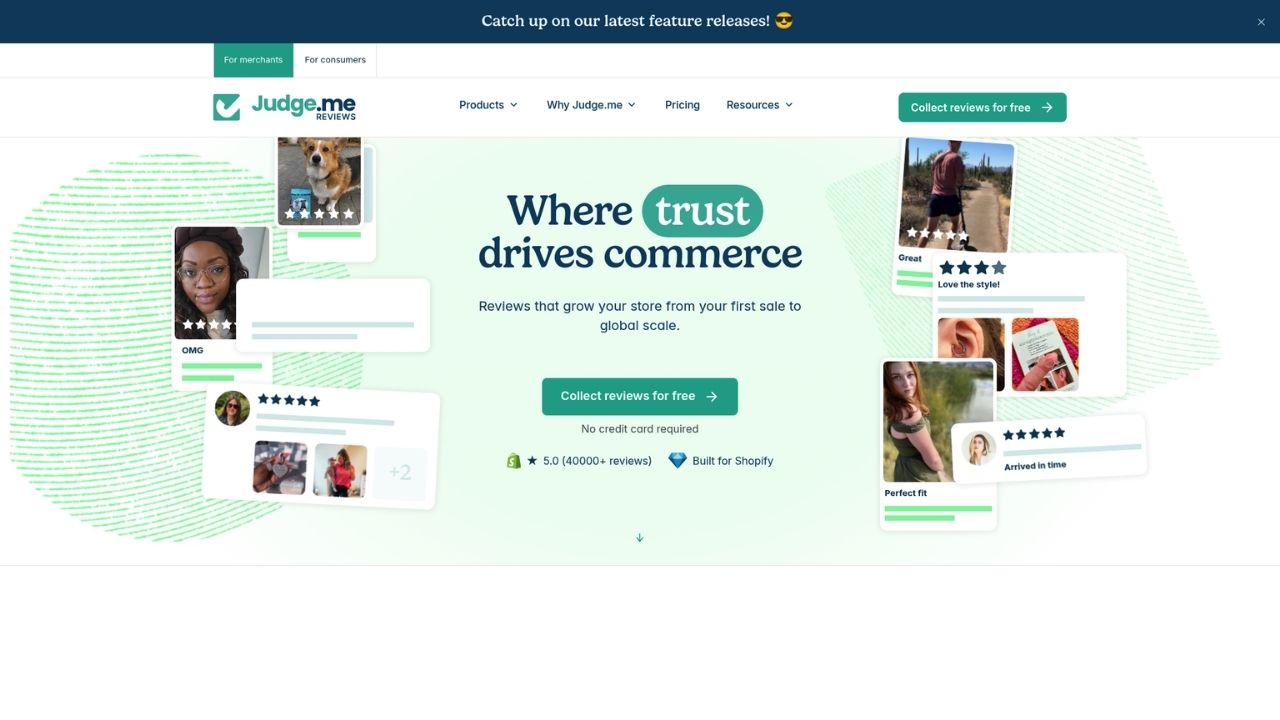
Judge.me is the value pick, and it's not close. Unlimited reviews, photo and video, Q&A, and a free plan that real stores actually run on. The paid Awesome plan is a flat ~$15/mo, not gated by order volume, which means it stays cheap exactly as you scale. The widgets are a notch less designer-polished than Loox, but the substance is all there.
Pricing
There's a genuinely usable free plan. The Awesome plan is roughly $15/mo, flat, regardless of order volume.
What works
- The best free plan in the category: not a crippled trial, a working review engine.
- Flat pricing that doesn't punish growth: the same $15 whether you do 200 or 20,000 orders.
- Huge, trusted install base: a 5.0 rating across nearly 40,000 Shopify App Store reviews.
What doesn't
- Widgets are less polished than Loox: functional, not as beautiful out of the box.
- Fewer marketing modules: no native loyalty or SMS.
Why it ranks fourth in display
On pure value, Judge.me is the best review app on Shopify, and for a lot of brands it's all the UGC display they'll ever need. It ranks below Loox and Okendo here only because those serve specific jobs (visual polish, loyalty) better.
5. Stamped
Best for: budget-conscious brands that want reviews plus light loyalty in one affordable tool.

Stamped is the affordable all-rounder. Reviews, UGC, NPS, and loyalty in one place, with a free tier to start. It covers a lot for the price, which is its appeal. The trade-off is that the breadth can feel sprawling and support reviews run more mixed than Loox or Judge.me.
Pricing
A free plan is available, with paid plans from around $19/mo.
What works
- Broad feature set for the price: reviews, loyalty, and NPS without premium pricing.
- Free tier to start: low-risk way to get reviews live.
- Solid Shopify integration: pulls orders, automates requests.
What doesn't
- Can feel sprawling: more surface area than a review-only brand needs.
- Mixed support reports: not the cleanest experience in the category.
Why it ranks fifth in display
Stamped is the pick when budget is tight and you want more than reviews from one tool. It's not the most polished, but it punches above its price.
6. Fera
Best for: brands that want heavy widget customization and the ability to import existing social UGC.
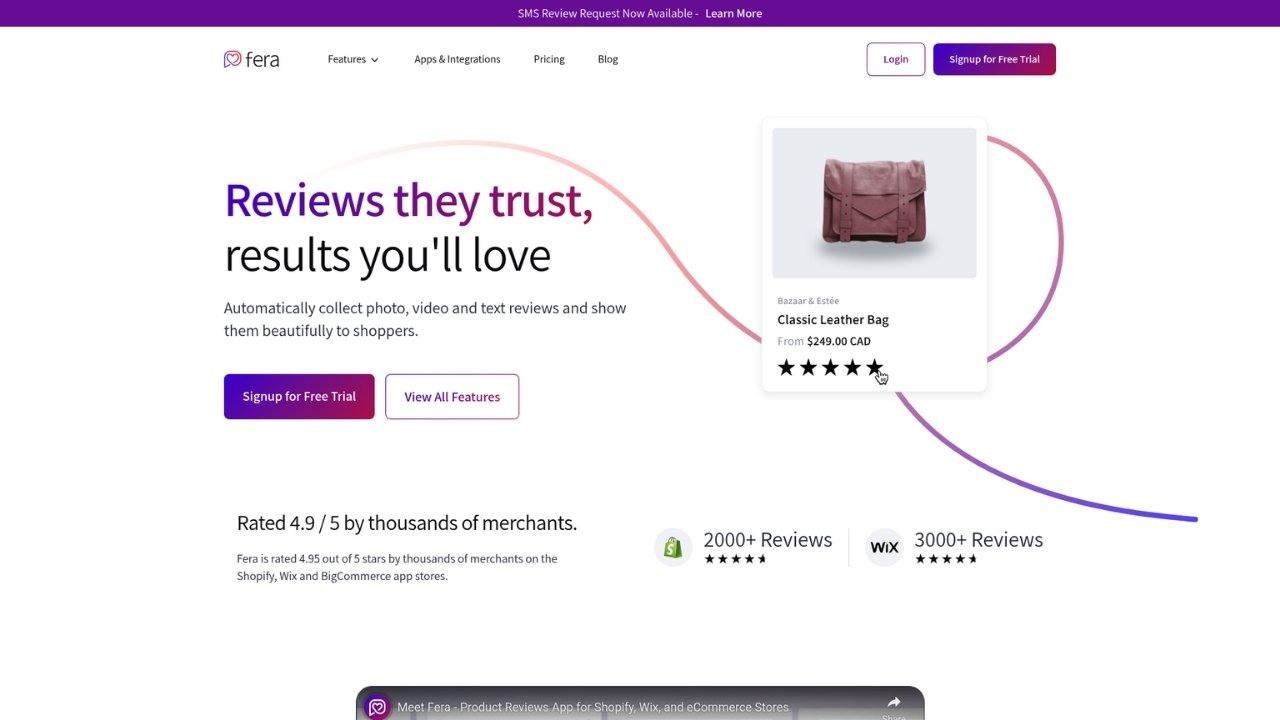
Fera leans into customization. The widgets are highly editable, and it can import reviews and content from Instagram and other sources, so existing social UGC isn't stranded off-site. There's a free tier, and paid plans scale by order volume. The flexibility comes with a small learning curve; it's not as turnkey as Loox.
Pricing
Free plan available, with paid plans from roughly $9/mo, scaling by order volume.
What works
- Deep widget customization: shape the display to match your theme exactly.
- Imports existing social UGC: pull Instagram and other content into your galleries.
- Free tier plus low entry price: accessible for smaller stores.
What doesn't
- Customization has a learning curve: more knobs than a turnkey app.
- Order-volume pricing: the cost grows with you.
Why it ranks sixth in display
Fera is for the brand that wants control over how UGC looks and wants to consolidate existing social content on-site. If you'd rather not tinker, Loox or Judge.me are faster.
7. Moast
Best for: brands sitting on Reels and TikToks that want them working as shoppable video on product pages, not just star ratings.
Moast is the video-native option in this group. Everything above it is review-first: the post-purchase email goes out, photos and text come back, and the widget renders them. Moast starts from content you already have. It pulls in your Reels, TikToks and customer video, lets you tag products inside each clip, and renders them as carousels on product, collection and home pages so a shopper can add to cart without leaving the video. It also collects UGC from customers and creators, so the library keeps filling without a content budget. The carousels are built to stay light, which matters in a category where heavy video embeds are the usual complaint.
Pricing
Free plan available on a live store, with paid plans from $15/mo.
What works
- Video-native rather than review-native: built for motion content, not photo walls with video bolted on.
- Product tagging inside the video: the click-to-cart path is one step, not a bounce back to the grid.
- Free plan that runs on a real store: test whether video moves your conversion rate before paying.
What doesn't
- No star ratings or written reviews: this is not a Loox or Judge.me replacement, and most brands will run it alongside one.
- Needs video to be useful: if you have no Reels or customer clips yet, start with sourcing before display.
Why it ranks seventh in display
Moast is the pick when your proof is already in video form. It does not compete with the review apps above it so much as sit next to them, which is also why it ranks here rather than higher: for a brand with no motion content, a review app does more on day one.
Best platforms to source creator UGC video
This is the other category entirely. You're not displaying what customers made; you're commissioning new video from creators to run as ads. The economics work differently, so price the model, not the sticker.
A quick reality check on cost: across the market, a single UGC video deliverable averages around $198, with a range from $75 to $3,000-plus depending on the creator and the usage rights, and the marketplaces typically take 20-30% commission on top, according to 2026 creator-pricing data. Keep that in mind as you read the entry prices below.
8. Billo
Best for: brands that want affordable, repeatable UGC video for paid social.
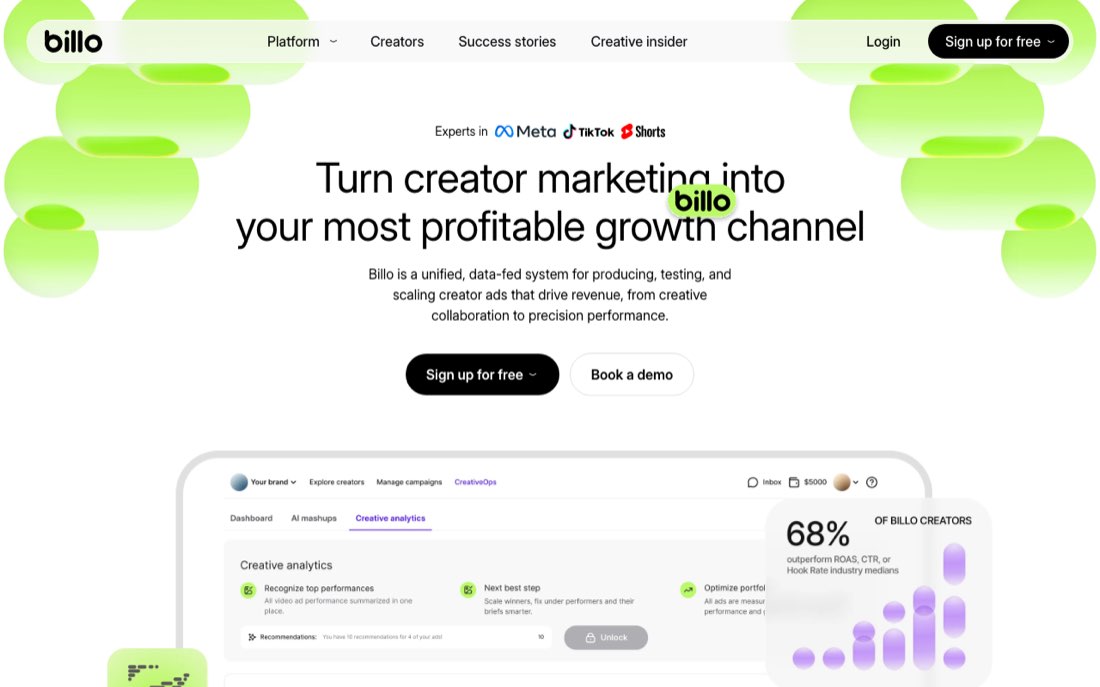
Billo is the cheap, fast option. You brief it, creators film, and you get branded video back in a few days, with the platform fee included. The output is content; you run the ads yourself. It's the right tool when you need a steady stream of test creative without enterprise pricing.
Pricing
Entry is roughly $79-$199 per video, with higher tiers for more involved briefs.
What works
- Cheap entry and fast turnaround: video back in 3-7 days.
- Simple briefing: low operational overhead to get content flowing.
- Repeatable volume: built for a constant drip of test creative.
What doesn't
- You direct the quality: outcomes track how good your brief is.
- Content only, no distribution: you still run and pay for the media.
Why it ranks first in creator video
For most brands starting a UGC-video habit, Billo is the lowest-friction way to test creative at volume without committing to a managed contract.
9. Insense
Best for: brands that want UGC video plus paid-social whitelisting in one platform.
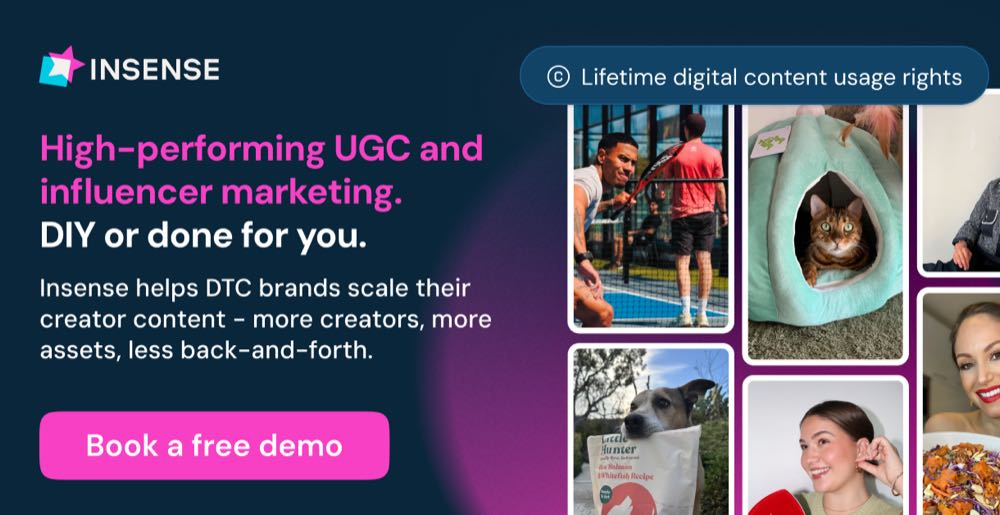
Insense is built for Shopify and goes a step past content into whitelisting and Spark Ads, so the same creator video can run from the creator's handle. That's powerful for paid social, and it's priced accordingly: managed plans start higher, with creator payments separate on top.
Pricing
Managed plans from around $500/mo, with creator payments separate (from ~$100/video) plus a 7-20% marketplace fee.
What works
- Whitelisting and Spark Ads: run video natively from creator accounts.
- Shopify-built: tight integration with your store.
- Creator CRM: manage relationships, not just one-off buys.
What doesn't
- Pricier than Billo: the platform fee plus creator costs add up.
- More to learn: it's a platform, not a single transaction.
Why it ranks second in creator video
Insense earns the higher cost when whitelisting is part of your paid-social plan. If you only need raw video, Billo is cheaper.
10. Trend
Best for: brands that want higher-production, culturally current video.

Trend curates creators toward trend-forward, higher-production content. The per-project cost is higher than Billo's, and you're paying for creative quality and cultural literacy rather than cheap volume. It's the pick when the video itself needs to feel current, not just functional.
Pricing
Roughly $200-$2,000 per project, depending on scope.
What works
- Stronger creative quality: more polished than budget marketplaces.
- Trend literacy: creators tuned to what's working now.
- Project flexibility: scope to the campaign.
What doesn't
- Higher cost per deliverable: not built for cheap repeatable volume.
- Less of a self-serve drip: more campaign, less faucet.
Why it ranks third in creator video
Trend is for the brand that needs video to look current and is willing to pay for it. For pure testing volume, it's the wrong tool.
11. Minisocial
Best for: brands that want fully managed micro-influencer UGC with content rights and organic reach included.
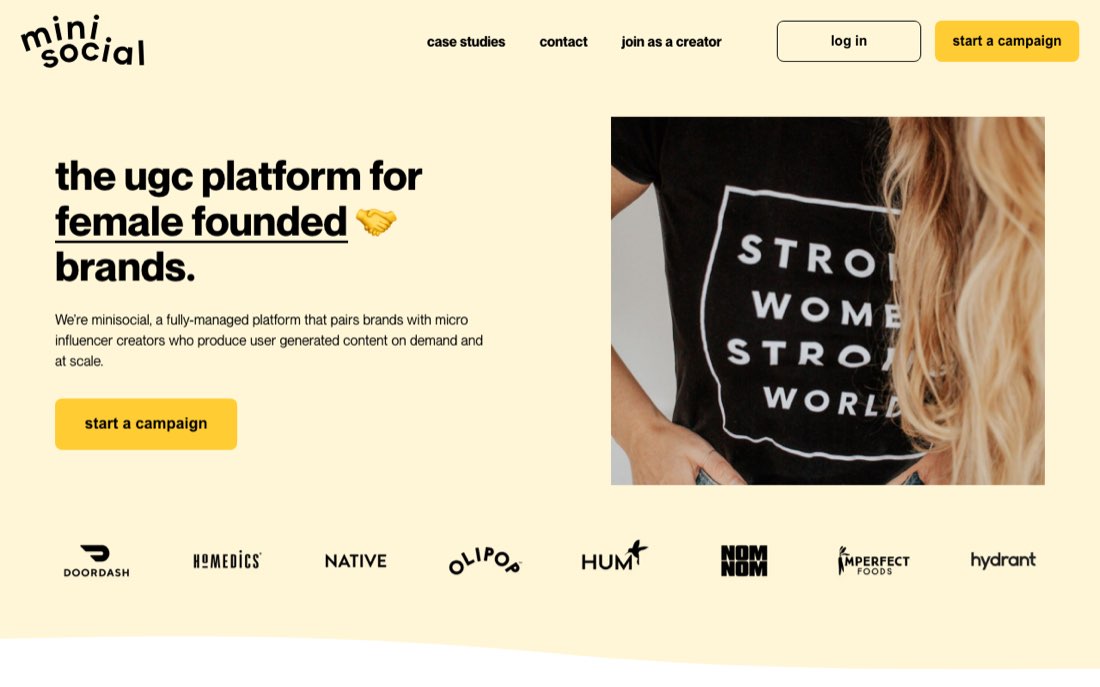
Minisocial is the managed-project option. It pairs you with micro-influencers who make the content and post it to their own channels, and you get fully licensed assets plus the organic reach as a bonus. It's the highest entry cost here because it's end-to-end managed, with no contracts.
Pricing
Project-based, from around $2,500 (roughly 10 creators), fully licensed, no long-term commitment.
What works
- Fully managed end to end: briefing to delivery handled for you.
- Content rights included: licensed assets you can run anywhere.
- Organic reach bonus: creators post to their own audiences too.
What doesn't
- Highest entry cost in this group: project minimums, not a cheap test.
- Project-based, not a drip: less suited to constant creative testing.
Why it ranks fourth in creator video
Minisocial is the pick when you want licensed UGC and organic distribution without managing creators yourself. If you'd rather run lean and cheap, Billo is the other end of the spectrum.
How to choose the right Shopify UGC platform
Start with the category, then the job. The fastest way to waste money here is to compare across categories that don't compete.
- Choose Loox if your products photograph well and you want a beautiful review wall live this week.
- Choose Okendo if reviews are part of a bigger loyalty and retention plan.
- Choose Yotpo if you're consolidating reviews, UGC, loyalty, and SMS into one vendor and you'll use the breadth.
- Choose Judge.me if you want the best value, a real free plan, and pricing that doesn't punish growth.
- Choose Stamped if you want reviews plus light loyalty on a tight budget.
- Choose Fera if you want deep widget control and to pull existing social UGC on-site.
- Choose Billo if you need cheap, repeatable UGC video for ad testing.
- Choose Insense if you want UGC video plus whitelisting for paid social.
- Choose Trend if the video needs to be higher-production and culturally current.
- Choose Minisocial if you want managed micro-influencer UGC with rights and organic reach included.
The display apps and the creator marketplaces aren't competitors, they're a sequence: collect proof from the customers you have, then commission video to win the customers you don't. Most mature brands run one of each.
What UGC success costs you on the back end
Now the part the UGC vendor blogs never mention, and the reason I had skin in writing this. UGC works. The conversion data is real: studies report that product pages featuring UGC can convert up to 161% higher, and 82% of consumers say they're more likely to buy from brands that use it. That's exactly why you're reading this.
But every one of those conversions is a new customer, and new customers generate post-purchase contact. More orders mean more where's-my-order calls, more returns and exchanges, more product questions, the same handful of questions over and over. A UGC program that doubles your conversion rate also raises the volume hitting your ecommerce customer service team and your phone line. The trust machine on the front end quietly bills you on the back end.
That's the seam my company sits in. Ringly.io is AI phone support for Shopify brands. The AI answers inbound calls 24/7, finds orders in your store, handles returns and product questions, and resolves up to 90% of calls autonomously, so the support volume your marketing creates doesn't turn into a hiring problem. WashCo, a Shopify brand we launched, recovered $22,664 in its first 7 days on the phone.
If your UGC and ad spend are working and the support load behind them is the thing growing fastest, book a 30-min call and we'll do the math on what that volume is costing you live.
Frequently asked questions
Is a review app the same as a UGC platform? Not quite. A review app (Loox, Judge.me, Okendo) is one kind of UGC platform: it collects and displays content your existing customers make. The other kind, a creator marketplace (Billo, Insense), sources brand-new video from creators. Both are UGC, but they solve different problems at different ends of the funnel.
What's the best free Shopify UGC app? Judge.me has the best genuinely-usable free plan, with unlimited reviews and a 5.0 App Store rating across nearly 40,000 reviews. Stamped and Fera also offer real free tiers. Yotpo's free reviews plan works but functions mostly as a funnel into paid plans.
How much does UGC video cost? Across the market a single UGC video averages around $198, ranging from about $75 to $3,000-plus depending on the creator and usage rights, and marketplaces typically take 20-30% commission on top. Billo is the cheap end (~$79-$199/video); managed options like Minisocial start around $2,500 per project.
Loox or Okendo, which is better? Loox if you want a photo-first review wall live fast and you sell visually driven products. Okendo if you want reviews bundled with loyalty, surveys, and attribute-rich data as part of a bigger retention stack. Loox is simpler and cheaper to start; Okendo does more and costs more at scale.
Do UGC apps slow down a Shopify store? They can, especially review widgets loading dozens of photos and videos on a large catalog. The better apps (Loox, Judge.me) use lazy-loading and lightweight widgets to limit the hit. Test your Core Web Vitals before and after install and pick an app that publishes its performance approach, because page speed feeds Shopify SEO as well as conversion.
Who owns the content a creator makes for you? It depends on the platform and plan. Managed services like Minisocial include full usage rights in the price; marketplaces like Billo and Insense grant rights per the tier you buy. Always confirm whether you get paid-ad usage rights before you commission, because content you can't run as an ad is worth far less.
Does Ringly do UGC? No. Ringly is AI phone support for Shopify brands, not a UGC platform, so it isn't in the comparison above. It sits downstream of UGC: when your reviews and creator video drive more orders, the AI handles the Shopify support calls that volume creates, resolving up to 90% of them autonomously so you don't hire a phone team to keep up.
Talk to us

Picking the right UGC platform is the front-end win. The back-end cost (the support volume those conversions create) is the part that catches growing brands off guard. If your UGC is working and the phone is ringing more because of it, a 30-min call is the fastest way to see what that's costing you and what it would take to hand it off.
Our 3 promises.
- Live in under 1 hour. Setup and test calls are free.
- 30-day money back on the $99 plan fee.
- 65% resolution guarantee: if Seth resolves under 65% of your support calls in a month, that month comes back as credit (after 90 days on Pay per call).
Ruben (Ringly co-founder) takes these calls personally.