


This post in 30 seconds.
- What Shopify Tax does: it calculates tax at checkout across 11,000+ US jurisdictions. It does not register you, file returns, remit money, or talk to an auditor.
- What to pick: TaxJar or TaxCloud if you want to keep filing in-house, Numeral or Zamp if you want it managed, Avalara if you have an enterprise stack, Quaderno if you sell globally.
- The cost nobody budgets for: every new state you collect in adds customer tax questions on the phone that the tax software never answers.
Shopify Tax adds up the tax. It does not file it, remit it, or answer the customer who calls asking why their order was taxed. That gap is the entire reason a tax compliance category exists on top of Shopify.
To write this I set up a real Shopify store and walked it the way a growing brand actually does: cross an economic-nexus threshold in a second state, on paper, and watch what lands on your desk. Two things show up. The filing work, which these tools handle. And the customer tax questions, which none of them touch. If you run a Shopify or Shopify Plus brand that's expanding into new states and feeling the "where's my order" and "why was I charged tax" calls pile up, here's the honest version of the landscape. I run AI phone support for Shopify brands for a living, so I care about the support side most, and you can book a 30-min call if that part is the bottleneck. I don't take affiliate commissions on any tool below.
What tax compliance software actually does (and what Shopify Tax doesn't)
Sales tax compliance is four jobs, not one: register in a state, collect the right rate at checkout, file the return on the state's schedule, and remit the money you collected. Shopify Tax, the native tool, only does the second one well.
Shopify Tax handles calculation across 11,000+ US jurisdictions, but it does not file, remit, register, or defend an audit. According to Shopify's own Help Center, the native tool calculates tax at checkout and gives you reporting. It's free up to $100,000 in US sales per year, then a small calculation fee kicks in. That's useful, and for a single-state seller it can be enough.
The trouble starts when you scale states. The moment you cross a nexus threshold somewhere new, you're on the hook for registration, monitoring, the filing cadence, the remittance, and the paperwork. Shopify Tax leaves all of that to you. That's why TaxCloud's own roundup frames Shopify Tax as a calculator, not a compliance partner. Tax compliance software fills the other three jobs, and the better managed services do them for you.
So the real question isn't "does Shopify do taxes." It's "how many states am I about to owe returns in," and that's where nexus comes in.
Why multi-state nexus is the real trigger
Before 2018 you only owed sales tax where you had a physical presence. Then the Supreme Court decided South Dakota v. Wayfair, and states got the right to tax remote sellers based on economic activity alone. All 45 states with a sales tax now enforce economic nexus, which means you can owe returns in a state you've never set foot in.
The standard threshold most states use is $100,000 in sales or 200 transactions in a year, but the real range runs from $10,000 to $500,000, and the rules are not uniform. Per the Sales Tax Institute's economic nexus chart and Numeral's 2026 handbook, New York requires $500,000 AND 100 transactions, Texas uses a $500,000 trailing-twelve-month measure, and Alaska dropped its 200-transaction count in 2025. Every state is its own return with its own due dates.
Here's why that matters for a Shopify brand. A single viral product, one good influencer drop, or a strong Q4 can push you over the line in five or six states at once. Each one becomes a registration, a filing schedule, and a remittance you didn't have last quarter. The software exists because tracking that by hand across a dozen states is a job, not a task. Good tools watch your thresholds and tell you when you've crossed one before the state does. It's the same expansion pressure that shows up in Shopify Plus customer service the moment a brand scales past one market.
The 8 best Shopify tax compliance tools (2026)
I looked at the tools growing Shopify brands actually shortlist, scored against four things: does it file for you, is the pricing honest, how heavy is setup, and does it cover where you sell. Here's the quick version, then the detail.
| Tool | Best for | Pricing | Files for you? | Verdict |
|---|---|---|---|---|
| Shopify Tax | Calc only at checkout | Free to $100k, then 0.25-0.35% | No | Baseline, not compliance |
| Avalara | Enterprise breadth + global | Custom (opaque) | Yes | Powerful, heavy |
| TaxJar | Simple US automation | $19-$99/mo + filing fees | Yes (AutoFile) | Easiest US start |
| TaxCloud | Budget filing | $0-$79/mo, $25-$39/return | Yes | Cheapest filing |
| Numeral | Managed + penalty guarantee | ~$75/filing + $150/state | Yes (managed) | Hands-off mid-market |
| Kintsugi | AI exposure monitoring | Free start, ~$75-$100/filing | Yes | Nexus-watch first |
| Zamp | Fully managed everything | Custom all-inclusive | Yes (managed) | Set and forget |
| Quaderno | Global VAT/GST | $49-$149/mo + per-order | Partial | International sellers |
1. Avalara
Best for: enterprise brands with a complex stack and tax types beyond US sales tax. Avalara is the long-standing cloud tax platform that automates sales tax, VAT, GST, and customs across a wide set of integrations.

It's the safe choice when a CFO wants a name they recognize. The breadth is real: more integrations and more tax types than anyone else on this list. But that breadth comes with weight.
Pricing: custom quotes with setup fees and modular add-ons. There's no public number, and you'll talk to sales before you see one.
What works
- Widest coverage: sales tax, VAT, GST, customs, and a large integration library.
- Enterprise-grade returns and registration: built for brands filing in many states and countries.
- Recognized name: easy to get internal sign-off on.
What doesn't
- Steep setup: implementation overhead is real, and configuration takes time.
- Support gripes: on G2, Avalara averages 4.0/5 across roughly 816 reviews, with a support score of 6.9 against TaxJar's 9.0.
- Opaque pricing: hard to budget without a sales call.
Why it ranks here: the most capable tool on the list, and the heaviest. Right for enterprise, overkill for a brand filing in five states.
2. TaxJar
Best for: US Shopify sellers who want simple calculation plus automatic filing without a project plan. TaxJar, owned by Stripe since 2021, is the common first step for brands that just established nexus.

It connects to Shopify, Amazon, Etsy, and the rest, calculates rates, and files returns through its AutoFile feature. The appeal is that you can be running in a day.
Pricing: roughly $19 to $99 per month with order limits, plus per-order and per-state AutoFile fees. Costs climbed after a 2026 increase.
What works
- Easiest US start: G2 scores its ease of setup at 8.5 and support at 9.0, both ahead of Avalara.
- AutoFile: hands-off filing in most states.
- Marketplace coverage: pulls sales from every channel you sell on.
What doesn't
- US-focused: weak if you sell internationally.
- Cost creep: the per-state and per-order fees add up once you're in 10+ states.
Why it ranks here: the cleanest on-ramp for a US Shopify brand crossing its first few state lines.
3. TaxCloud
Best for: brands that want the lowest filing cost and are comfortable staying hands-on. TaxCloud focuses on end-to-end US sales tax with budget pricing.
It's the value pick. Filing runs $39 per return and drops toward $25 at volume, and there's a $599 flat option for national multi-state filing.
Pricing: $0 to $79 per month depending on tier, plus the per-return fees above.
What works
- Cheapest filing: the per-return rate undercuts most managed services.
- Transparent tiers: you can do the math before signing up.
- Registration discounts: helps when you're standing up several states at once.
What doesn't
- US-only: no global coverage.
- Lighter touch: less hand-holding than a managed service if a notice arrives.
Why it ranks here: the best price-per-return on the list for a brand that wants to keep filing in-house.
4. Numeral
Best for: mid-market Shopify brands that want filings managed without an enterprise contract. Numeral wraps a managed layer around registrations and filings.
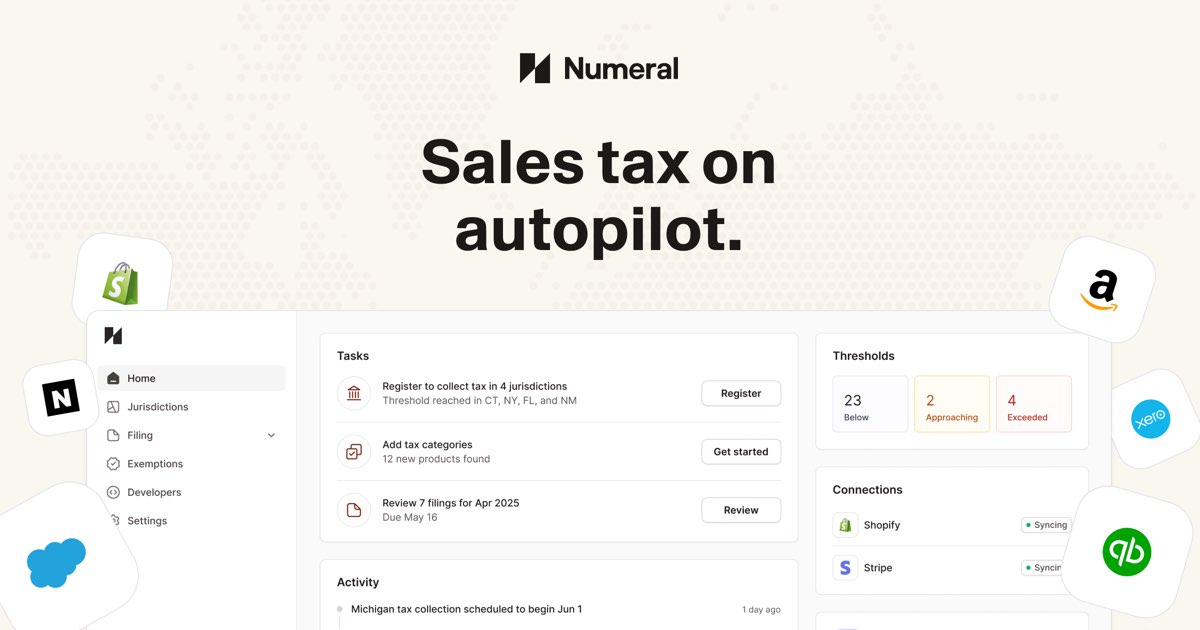
It sits between DIY tools and full enterprise platforms. The pitch that lands: if Numeral files late, it pays your penalties and interest.
Pricing: roughly $75 per filing and $150 per state registration, no big monthly subscription.
What works
- Penalty guarantee: on-time filing or they cover the cost.
- Managed feel: less for your team to own week to week.
- Broad platform support: Shopify, Amazon, Stripe, and more.
What doesn't
- Per-filing math: the cost stacks across many states.
- Less control: you trade hands-on visibility for hands-off ease.
Why it ranks here: a strong middle option when you've outgrown DIY but don't want Avalara's weight.
5. Kintsugi
Best for: brands whose first worry is "which states have I crossed." Kintsugi leads with AI-driven exposure monitoring across the full indirect-tax lifecycle.

Nexus tracking is the headline. It watches where you're approaching thresholds and handles calc, filing, and remittance from there, including VAT and GST across 100+ countries.
Pricing: a free starter plan, then roughly $75 to $100 per filing as you grow.
What works
- Exposure monitoring: the strongest nexus-watch on the list.
- Free entry: real value before you pay.
- Global reach: VAT and GST coverage built in.
What doesn't
- Newer vendor: less of a track record than Avalara or TaxJar.
- Per-filing at scale: the model adds up like the others once you're filing widely.
Why it ranks here: the one to shortlist if monitoring your nexus footprint is the job you're losing sleep over.
6. Zamp
Best for: brands that want to never think about sales tax again. Zamp is fully managed: nexus, registrations, taxability, calculation, filings, notices, and audit support.
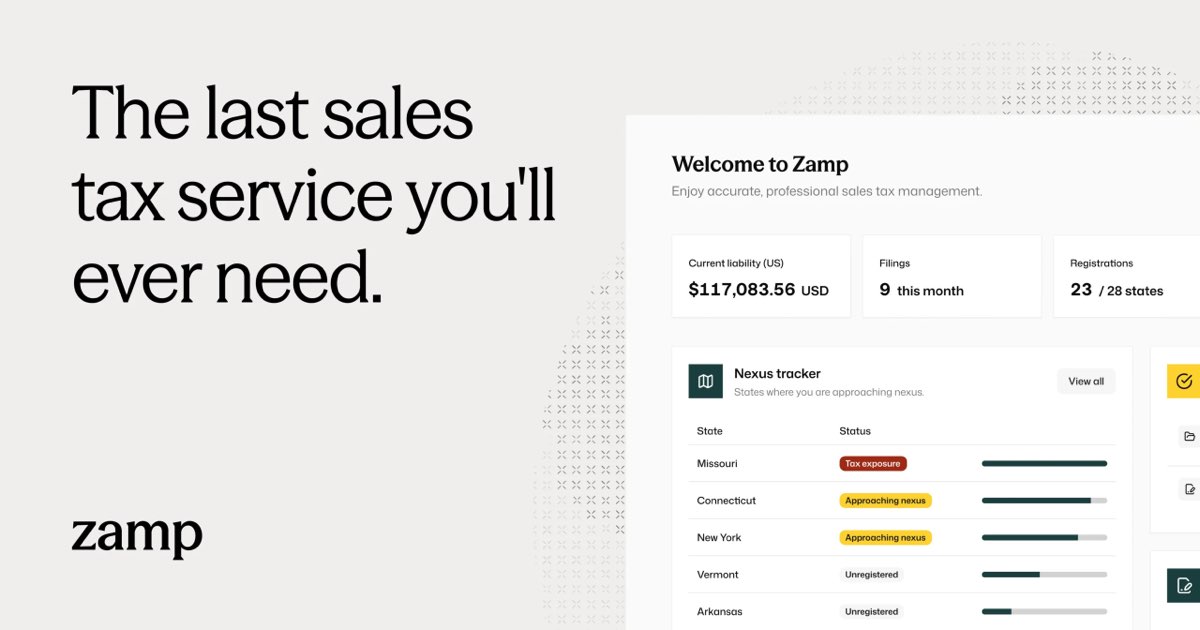
This is the set-and-forget end of the market, built for startups up through $300M+ brands. G2 has handed it Best Support and Best Meets Requirements.
Pricing: one all-inclusive custom monthly price, with no per-transaction or per-filing fees.
What works
- Fully hands-off: they own the whole lifecycle, including notices and audits.
- One price: no surprise per-filing invoices.
- Dedicated account management: a human who knows your account.
What doesn't
- Custom pricing: no public number, so you'll need a quote.
- Overkill for single-state sellers: the value shows up once you're multi-state.
Why it ranks here: the closest thing to outsourcing the entire problem, if the monthly fee fits your stage.
7. Quaderno
Best for: Shopify brands that sell internationally and need VAT and GST handled alongside US sales tax. Quaderno is built for global ecommerce, digital goods, and subscriptions.

If a meaningful slice of your orders ships outside the US, this is the one that won't leave you guessing on EU VAT. It covers real-time calculation across 111+ countries with nexus and threshold alerts.
Pricing: roughly $49 to $149 per month plus per-order charges, with Shopify, Stripe, PayPal, and Xero integrations.
What works
- Global coverage: VAT and GST across 100+ countries.
- Threshold alerts: warns you before you cross a line at home or abroad.
- Digital-goods ready: strong for subscriptions and downloads.
What doesn't
- Lighter US managed filing: not a hands-off US service the way Zamp or Numeral are.
- Per-order cost: adds up at high volume.
Why it ranks here: the pick when your tax problem is a passport problem, not just a multi-state one.
8. Sidr Tax
Best for: Shopify-first US sellers who want native automation with autofile straight to state websites. Sidr is built specifically for the Shopify ecosystem.
It handles nexus tracking, registration, reporting, and autofile, and it lives in the Shopify App Store, so the install is quick.
Pricing: roughly $19 to $89 per month by transaction tier, with a small per-transaction fee over the cap, autofile at $35 to $45 per filing, and $150 per state registration.
What works
- Shopify-native: purpose-built for the platform.
- Autofile to state sites: real filing, not just reporting.
- Transparent tiers: you can see the pricing up front.
What doesn't
- US-only: no global tax types.
- Smaller vendor: newer than the established names.
Why it ranks here: a clean, affordable Shopify-native option if you want filing handled without leaving the app store.
How to choose the right tool
The decision comes down to three questions: how many states, how hands-on, and how global.
- Choose TaxJar or TaxCloud if you're US-only, in a handful of states, and fine keeping filing in-house. TaxJar for the easiest setup, TaxCloud for the lowest per-return cost.
- Choose Numeral or Zamp if you want filings managed for you. Numeral for per-filing with a penalty guarantee, Zamp for one all-inclusive price and full audit support.
- Choose Kintsugi if your first priority is monitoring where you've crossed nexus before the states notice.
- Choose Avalara if you're enterprise, with a complex stack and tax types beyond US sales tax.
- Choose Quaderno if a real share of your orders ships internationally and VAT/GST is the harder half of your problem.
One thing every option above shares: it handles the math and the paperwork. None of them handle the human on the other end of the phone. If you're weighing whether to keep filing in-house or hand it off, it's the same build-vs-buy call you face on outsourced customer service: pay for the work to disappear, or own the process and the risk.
The cost nobody puts on the spreadsheet: the support load
Here's the part that doesn't show up in any tax-software comparison, including the ones ranking above this post. Every new state you start collecting in creates a new wave of customer questions, and they don't go to your tax tool. They go to your phone and your inbox.
"Why was I charged tax this time when I wasn't before." "I'm tax-exempt, here's my resale certificate, can you refund it." "You charged me the wrong rate." "Do you even ship to my state." Multi-state expansion quietly turns your support queue into a tax desk, and your tax software has no idea those calls are happening. These sit right next to the usual where's my order volume, and together they're the work that eats your CS team's day.
That's the part I spend my time on. Ringly.io is AI phone support for Shopify brands. It does not file your sales tax, and I'd be suspicious of anyone who told you a phone agent should. What it does is answer the inbound calls 24/7: order status, returns, product questions, and the routine tax-line questions a customer asks when their checkout total changed. The complex cases, a thorny exemption or a real dispute, escalate cleanly to your team on Gorgias, Richpanel, or whatever helpdesk you already run. Seth resolves up to 90% of calls on its own. WashCo, a Shopify brand we launched, recovered $22,664 in attributed revenue in its first 7 days on the phone.
"My customers also feel like it's a normal person. They feel like they can communicate if they have questions."
Claudia Droge, TechCraft Studio
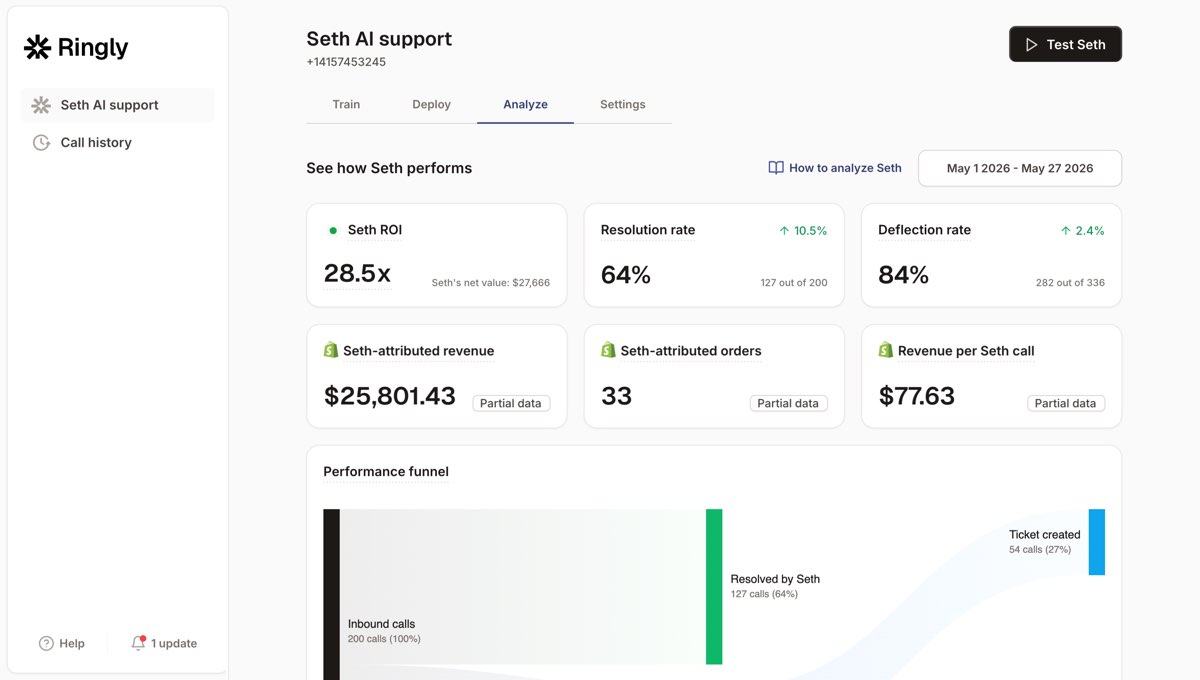
The math is the same one that drives the tax decision: stop adding linear headcount every time volume goes up. Take a $50M Shopify brand running a 6-rep customer service team:
| Line item | Today | With Ringly |
|---|---|---|
| 6 reps at $4K loaded each | $24,000/mo | n/a |
| Ringly (illustrative) | n/a | ~$5,000/mo |
| Net monthly CS spend | $24,000/mo | $5,000/mo |
| Monthly savings | n/a | ~$19,000/mo |
That's roughly 70% of repeatable calls, the order-status, returns, and routine tax questions, routed to the AI. The other 30% still go to your reps, who now have time to handle the exemption certificate properly. If your support queue is buckling under multi-state volume and after-hours calls, book a 30-min call and we'll look at your numbers together.
Frequently asked questions
Does Shopify have built-in tax compliance? Shopify Tax calculates sales tax at checkout across 11,000+ US jurisdictions, and it's free up to $100,000 in annual US sales. But it doesn't register you, file returns, remit the money, or handle audits, so it's a calculator, not a full compliance solution.
Do I need tax software if I only sell in one state? Often not. If you're below the nexus threshold everywhere but your home state, Shopify Tax plus your accountant can be enough. The math changes the moment you start crossing economic nexus thresholds in other states, which is also when the call volume starts climbing and you have to figure out how to scale customer service without hiring.
What is economic nexus and when do I cross it? Economic nexus means you owe sales tax in a state based on your sales there, even without a physical presence, a rule that came from the 2018 Wayfair decision. Most states trigger it at $100,000 in sales or 200 transactions, though the range runs from $10,000 to $500,000 and the rules differ by state.
Avalara vs TaxJar, which for a Shopify brand? TaxJar is the simpler, US-focused pick with easier setup and stronger support scores, ideal for brands in a handful of states. Avalara is heavier and built for enterprise stacks with global tax types, so it's right when your complexity has outgrown a clean Shopify-first tool.
How much does Shopify tax compliance software cost? Self-serve tools run from around $19 to $149 per month plus per-filing or per-order fees, with filings often $25 to $75 each. Fully-managed services like Zamp use custom all-inclusive pricing, while Avalara quotes enterprise contracts with setup fees.
Can tax software answer my customers' tax questions? No. Tax tools calculate, file, and remit, but they don't field the "why was I charged tax" calls that multi-state expansion creates. That's a customer-support job, which is where an AI phone agent that handles routine calls comes in.
Does Ringly file sales tax? No, and that's deliberate. Ringly is AI phone support for Shopify brands, so it answers the customer calls your tax expansion creates, while your tax software handles the actual filing and remittance.
Talk to us

Tax software handles the filing. It can't pick up the phone when a customer calls confused about the tax line on their order. If you run a $10M-$100M Shopify brand and multi-state expansion is pushing more calls than your team can answer, a 30-min call is the fastest way to see what that volume is actually costing you.
Our 3 promises.
- Live in under 1 hour. Setup and test calls are free.
- 30-day money back on the $99 plan fee.
- 65% resolution guarantee: if Seth resolves under 65% of your support calls in a month, that month comes back as credit (after 90 days on Pay per call).
Ruben (Ringly co-founder) takes these calls personally.