
This post in 30 seconds.
- Your support ticket queue is not one pile. It is a handful of repeatable categories (WISMO, returns, product questions) plus a long tail, and each one has a different cost depending on the channel it arrives on.
- The slice almost nobody measures is the part of the queue that starts as a phone call. Phone is the most expensive ticket you handle ($17 to $25 per contact) and the one most likely to be a high-value customer about to walk.
- Written for founders, COOs, and Heads of CX at $10M to $100M Shopify and Shopify Plus brands running a paid helpdesk and a phone line that the team can't always reach.
Monday at 8:34am, Gorgias shows 217 unread tickets stacked since Friday. The subject lines are almost funny: WISMO, WISMO, return, WISMO, "WHERE IS MY ORDER???", WISMO. Two reps called out sick. Five voicemails sit on the weekend line, one from a caller who dialed five times Saturday.
That is the support ticket queue at a real Shopify brand doing real volume. Not chaos exactly, more like a tide that comes in every morning whether you staffed for it or not.
Most advice about Shopify support tickets stops at "set up a help center and write better macros." That is fine, and you should do it. But it skips the part of the queue that costs you the most per ticket and leaks the most revenue: the calls. If your store has a visible phone number and an average order value north of $100, a meaningful chunk of your queue is arriving by phone, and that is the slice this playbook is about. If you want the short version of where the money goes, book a 30-min call and we will pull your last week of missed calls live.
If you run customer experience at a Shopify brand doing $10M to $100M, you already know the Monday queue and the seasonal spike that turns a clean macro setup into a backlog. This playbook is what 50+ brands we work with do with the phone slice of that queue specifically. See your numbers on a call and we will map your ticket-to-call routing for you.
What's actually in your support ticket queue
Before you can manage the queue, you have to see it as categories, not as a number. The mix is remarkably consistent across mid-size DTC brands.
Roughly 70% of your ticket queue is the same five things over and over, which is exactly why it is automatable without losing the customer. Here is the typical breakdown.
| Ticket category | Share of queue | What it actually is |
|---|---|---|
| WISMO (where's my order) | 30-40%, 50%+ at peak | tracking, delays, "did it ship" |
| Returns and exchanges | 10-20% | start a return, swap a size, refund status |
| Product and pre-purchase | 10-15% | "will this work for me", fit, ingredients |
| Billing and subscriptions | 5-10% | pause, skip, cancel, double charge |
| The long tail | the rest | complaints, edge cases, the genuinely hard calls |
WISMO alone is 30-40% of tickets in a normal week and tips past 50% during peak, according to Salesforce. Returns and exchanges add another 10-20% on top of that, per edesk. Add product questions and you are looking at a queue where two thirds of the work is repeatable. We break the WISMO category down further in our guide to WISMO tickets.
That repeatability is good news. It means most of the queue does not need your best rep, or any rep. The trap is treating all of it as one undifferentiated pile and throwing headcount at the whole thing. The smarter move is to slice it by category and by channel, because the channel a ticket arrives on changes everything about what it costs you.
The slice nobody counts: phone-originated tickets
Open your helpdesk dashboard, whether you run Gorgias or Zendesk, and you will see email tickets, chat tickets, and maybe social. The phone calls are usually somewhere else, in a voicemail box or a call-log spreadsheet your lead rep maintains by hand. So they do not show up in the ticket count, and they do not get optimized. They are also the most expensive contact you handle.
| Channel | Cost per contact | Why |
|---|---|---|
| Self-service | $1-4 | customer does the work |
| $8-15 | async, but multiple back-and-forths | |
| Chat | $10-16 | one rep, a few sessions at once |
| Phone | $17-25 | one rep, one call, longest handle time |
Those numbers come from Lorikeet's cost-per-channel benchmark. Phone sits at the top because a human can only take one call at a time and the handle time is the longest of any channel. A phone ticket can cost three to five times what the same question costs in email.
Here is the part the standard ticket-reduction advice misses. Phone volume is not flat across brands. It scales with your average order value. At a $40 AOV store, roughly 3% of orders generate a call. At a $250 AOV store, it is 12-18%, a pattern we wrote up in the Shopify Plus customer service playbook. The higher your basket, the more your customers want a human before and after they buy. So the brands with the most to lose on a dropped call are exactly the ones generating the most calls.
I pulled the channel mix from real call logs across 50+ Shopify brands on Ringly to see how much of the queue actually starts on the phone, then mapped it against the per-channel cost. The pattern is consistent: phone is a small share of total tickets but a large share of total support cost, and an even larger share of the tickets attached to a high-value customer. A dropped WISMO email is an annoyed customer. A dropped WISMO call at a $250 AOV brand is a customer standing at the checkout of a competitor.
"My customers also feel like it's a normal person. They feel like they can communicate if they have questions."
Claudia Droge, TechCraft Studio
And dropped calls do not wait around. 85% of callers who can't reach a person never call back, and 62% switch to a competitor, per PCN's missed-call study. 60% hang up within 60 seconds on hold, according to Brightmetrics. The phone slice of your queue is small in count, expensive per ticket, and the fastest to leak revenue when it goes unanswered.
Why ticket volume scales faster than your team
The reason the queue feels like it is winning is that ticket volume grows with orders, and orders grow with marketing, but your team only grows when you decide to hire. So volume runs ahead of headcount by default.
A shared inbox that handled 2,000 tickets cleanly turns into a backlog the moment volume doubles, because the macros that solved 80% of cases at low volume start missing the long-tail edge cases that flood in at peak. Your seasonal spike does not just add tickets, it changes the mix toward the harder ones.
Then there is the hiring math, which never quite works. A US rep runs about $4,000 a month loaded once you count benefits, training, and the churn replacement. New reps take six to eight months to get to full speed, and most of them quit before their second year. So every time you staff up to catch the queue, you are buying capacity that takes half a year to arrive and tends to leave right as it gets good.
The pattern most brands fall into:
- Volume rises, the queue grows, CSAT slips.
- You hire a rep, who is productive in month four or five.
- Volume rises again, and the queue is back where it was, except now your payroll is higher.
- A rep quits, and you are short-staffed during the exact week you can least afford it.
That cycle is why support payroll quietly eats 60-80% of the CS line. You are not bad at hiring. The unit economics of staffing a queue that moves faster than your team just never pencil out, which is the same reason more and more brands are weighing whether to scale support without hiring at all. If you want to see what your specific queue looks like sliced by category and channel, book a 30-min call and we will do the math live.
Cut the queue before you grow the team
The right first move is not more reps. It is shrinking the repeatable 70% so your team only touches the tickets that actually need a human. Four levers do most of the work.
- Proactive order tracking. WISMO is the biggest single category, and most of it is preventable. Send tracking before they ask, and a chunk of that 30-40% never becomes a ticket. We go deeper on this in the WISMO automation guide for Shopify.
- A real help center. A well-built knowledge base deflects 25-40% of tickets before they reach a rep, and most customers try to self-serve first anyway. Gladly found that the right FAQ updates alone move volume. More tactics in our guide on how to reduce support tickets in ecommerce.
- Self-service returns. A return portal where the customer picks the reason and prints the label cuts return-related tickets by up to 63%. See our Shopify returns app roundup for the options.
- AI on the phone channel. This is the lever almost everyone skips, because phone is hard. But since phone is your most expensive ticket, it is also where automation moves the cost line the most. An AI phone agent that handles WISMO, returns, and product questions takes the routine calls so your reps get the hard ones back.
Chat and email deflection is well-covered ground. The phone channel is where most brands still have a flat, untouched cost. That is the gap worth closing, and it is the reason we built 24/7 ecommerce phone support around the AI rather than around a bigger night shift.
What this costs you today vs with Ringly
Take a typical $50M Shopify brand running a 6-rep CS team to keep the ticket queue and the phone line covered.
| Line item | Today | With Ringly |
|---|---|---|
| 6 reps × $4K loaded per rep | $24,000/mo | n/a |
| Ringly (~$5K/mo) | n/a | $5,000/mo |
| Net monthly CS spend | $24,000/mo | $5,000/mo |
| Monthly savings | n/a | $19,000/mo |
| Annual savings | n/a | $228,000/yr |
That is roughly 70% of repeatable tickets (order status, returns, product questions, the same five things over and over) routed to the AI. The other 30%, the genuinely complex ones, still go to your CS team, who now have time to actually solve them. WashCo, a Shopify brand we launched, recovered $22,664 in its first 7 days on the phone.
The exact number depends on your team size and call volume, but the shape holds across the 50+ brands we run. Book a 30-min call and we will run your real numbers instead of the example.
Where an AI phone agent fits your ticket stack
Ringly.io is AI phone support for Shopify brands. The phone shouldn't be a tax on your support team. Instead of growing headcount every time call volume goes up, the AI takes the routine inbound calls so your team can focus on the work that actually moves revenue.
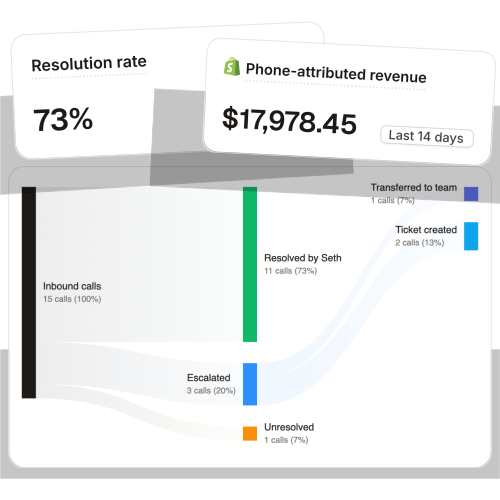
The AI answers inbound calls 24/7. It finds orders in your Shopify store, processes returns and exchanges, answers product questions from your knowledge base, and rescues abandoned carts via outbound follow-up. Across 50+ brands, the AI resolves 73% of calls autonomously at roughly $0.42 per resolved call. Calls that need a human escalate cleanly to Gorgias, Richpanel, Reamaze, or whatever helpdesk you already run, so it sits in front of your stack instead of replacing it. TechCraft Studio handles 88% of calls without a human.
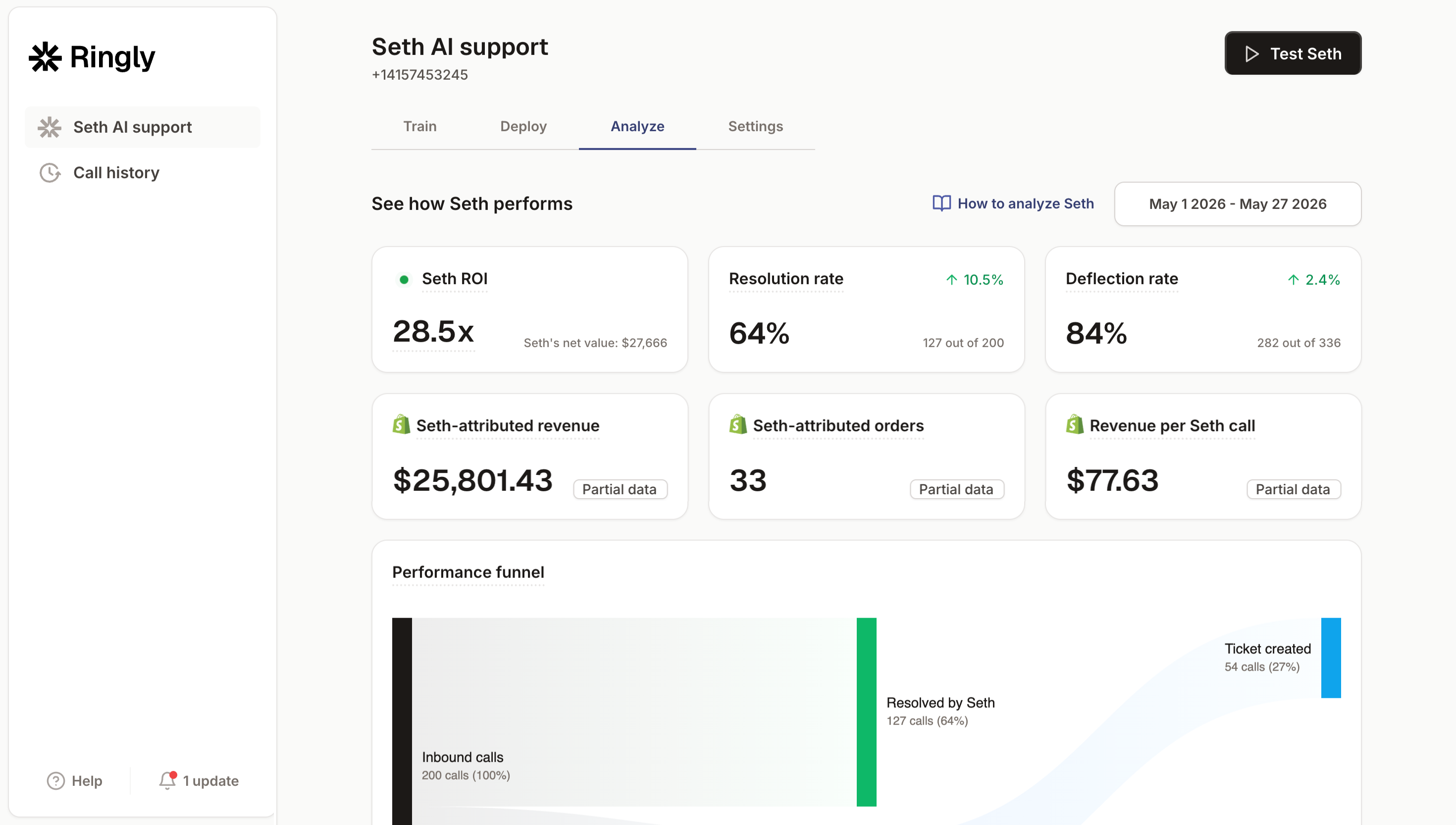
Plans: Grow $349/mo (1,000 minutes), Pro $799/mo (2,500 minutes), Enterprise custom. Live in under an hour. 65% resolution guarantee: if the AI resolves under 65% of your calls in 90 days, we refund the last 3 months. It is the same logic as your help center or your returns portal, applied to the channel that has been left untouched the longest. For more on the broader stack, see our Shopify helpdesk app guide and the ecommerce customer service playbook.
Frequently asked questions
What counts as a Shopify support ticket? A support ticket is any customer request your team has to resolve, whether it arrives by email, chat, social, or phone. Your helpdesk (Gorgias, Zendesk, Gladly, Re:amaze, Intercom) turns those messages into a tracked queue. Phone calls are tickets too, even though most helpdesks log them separately or not at all.
What percentage of Shopify support tickets are WISMO? WISMO ("where's my order") runs 30-40% of tickets in a normal week and over 50% during peak season, per Salesforce. Returns and exchanges add another 10-20%. Together with product questions, the repeatable categories make up roughly 70% of a typical queue.
How do I reduce my support ticket volume without hiring? Start with the repeatable 70%: proactive order tracking to prevent WISMO, a real help center to deflect 25-40% of tickets, a self-service returns portal to cut return tickets by up to 63%, and AI on the phone channel for the calls. Each lever shrinks the queue before it reaches a rep, so you avoid the next hire.
Why are phone tickets more expensive than email or chat? A human can only handle one call at a time and phone has the longest handle time, so it costs $17-25 per contact versus $8-15 for email, per Lorikeet's benchmark. Phone volume also rises with average order value, so high-AOV brands carry more of this expensive channel.
Does an AI phone agent replace my helpdesk? No. Ringly sits in front of your existing helpdesk and handles the routine inbound calls, then escalates anything that needs a human to Gorgias, Richpanel, Reamaze, or whatever you already run. You keep your phone number, your helpdesk, and your workflows.
How fast can I get phone tickets under control? Ringly goes live in under an hour for self-serve plans, and the done-for-you build runs on a 14-day Launch Sprint. The 65% resolution guarantee means if the AI resolves under 65% of your calls in 90 days, we refund the last 3 months.
Talk to us

If you run a $10M to $100M Shopify brand and your phone tickets are sitting in a voicemail box nobody clears, a 30-min call is the fastest way to see what that slice of the queue is costing you.
The 3-layer guarantee.
- Live in 14 days or it's free until launched.
- 65% resolution in 90 days or we refund the last 3 months of subscription fees.
- We keep working free until we hit 65%.
Ruben (Ringly co-founder) takes these calls personally.