
The short version.
- Most of your support spend is people, not tools, and most of that people-cost is doing work that repeats.
- The phone line is usually the most overpaid, least-examined line on the whole P&L. That's where the fastest cut lives.
- Built for founders, COOs, and Heads of CX at $10M-$100M Shopify brands running 3-12 reps and a visible phone number.
Most Shopify support cost reduction advice skips the one number that matters. Ask an operator what a single support rep actually costs and you get a salary figure, and the salary figure is wrong, or at least it's the small half of the truth. Fully loaded, a US rep runs about $4,000 a month, and across an industry sample wages plus benefits land at 60-80% of total support spend (eDesk). I run phone support for Shopify brands, and when I pulled the real per-call billing and read through their call logs, the same thing showed up every time: a big chunk of that loaded payroll was answering the same five questions over and over.
If you run customer experience at a $10M-$100M Shopify brand and "what's the support headcount line next quarter" is a question you dread, this is the playbook for cutting it without dropping your CSAT. We work with founders trying to fix exactly this. Book a 30-min call and we'll do the math on your actual numbers, live.
What your support team actually costs
Start with the loaded cost, because that's the number the rest of the plan hangs on. The base salary you see on a job board is the floor. On top of it sit benefits, payroll tax, the helpdesk seat, training time, the management overhead, and the cost of the seat sitting empty while you hire the replacement.
Add it all up and a US support rep costs you roughly $4,000 a month loaded, which means a six-person team is a $24,000-a-month line whether the queue is busy or not. Across the broader market, fully loaded cost per rep lands somewhere between $55,000 and $73,000 a year (eDesk).
Then there's the part that doesn't show up on the salary line at all: turnover. Replacing one rep runs $12,000 to $35,000 once you count the hiring, the ramp, and the lost productivity, and annual attrition in support sits at 30-45% (eDesk). So the real cost of your team isn't just the people you have. It's the people you keep having to replace.
These aren't list-price guesses. The $4K loaded number and the per-call figures further down come from billing across the Shopify brands we run, plus the public benchmarks above. Where a number is illustrative rather than tied to one brand, I'll say so.
Where the money actually leaks
You can't cut a cost you haven't located. So before anyone talks about tools, map where the spend is actually going. For most Shopify brands it pools in four places.
WISMO is the biggest single drain. "Where's my order" runs 30-50% of DTC support volume (Salesforce). It's the most repeatable work your team does and the most expensive thing to pay a human to repeat. Worse, WISMO spikes exactly when you're busiest, after a launch or a viral creative, so the brands that grow fastest pay for it twice: once in the calls, once in the seasonal reps they staff up to cover the calls.
After-hours is a silent revenue leak, not just a cost. When a caller can't reach a person, 85% never call back and 62% go buy from a competitor (PCN). The voicemails you never return aren't free. They're orders walking out the door. And because the loss is invisible (it never shows up as a ticket), most brands underprice this leak to roughly zero, which is the most expensive number you can put on it. If you've never costed your weekend line, our breakdown of 24/7 ecommerce phone support is the place to start.
Tool sprawl quietly inflates the bill. Plenty of brands pay for three or four overlapping tools (a ticketing tool, a separate chat tool, an AI add-on, a phone line) and overspend 15-25% on the overlap. If you run Gorgias plus a separate chat app that Gorgias already includes, that's a line to question. This one is the easiest win on the list and the one teams skip most, because canceling a tool means admitting you bought one you didn't need.
And the phone is the most overpaid line nobody looks at. Everyone audits chat and email. Almost nobody costs the phone channel on its own, which is exactly why it's where the easy money is hiding. A self-service resolution runs about $1.84 against $13.50 for a human-handled contact (eDesk), and the phone sits at the most expensive end of that range.
| Where it leaks | Share of the problem | The fix |
|---|---|---|
| WISMO calls + tickets | 30-50% of volume | Automate the repeatable answer |
| After-hours + weekend | bursty, high revenue impact | Cover the line 24/7 without a night shift |
| Overlapping tools | 15-25% overspend | Consolidate, cancel the duplicate |
| Phone channel | most expensive per contact | Move routine calls to AI, keep humans on the hard ones |
What to automate, and what to keep human
Here's the rule that keeps cost reduction from turning into a CSAT disaster: automate the repeatable, keep the human on the rest.
Most operators tell us 70-80% of their calls are the same stuff: order status, returns, the same product questions over and over. That 70% is what you route to an AI. The other 30%, the genuinely complex or emotional calls, still go to your team, who now have the time to actually solve them instead of drowning in WISMO.
This is not a "cut the team" move, and I'd push back on anyone selling it that way. Two things tend to be true at a growing brand:
- You don't want to hire the next rep. Volume is climbing, the obvious answer is hire #5, and you'd rather not add the headcount. Automation absorbs the growth instead.
- Or nobody's even answering the phone right now. Calls roll to voicemail, the voicemails never get returned, and the AI becomes the first real response those callers have ever gotten from your brand.
Either way, the math is about the work, not the people. Decide it line by line: if a call type is high-volume and rule-based, automate it. If it needs judgment, a human keeps it.
A quick way to sort your own queue:
- Automate: order status, tracking, returns and exchange starts, store hours, product specs, simple "did my discount apply" questions, the after-hours line.
- Keep human: an angry escalation, a wrong or damaged order with an emotional customer, a high-value account, anything where the right answer depends on judgment you can't write into a rule.
The brands that get this wrong try to automate the judgment calls and end up with a worse experience AND a public Twitter screenshot. The brands that get it right automate the boring 70% first, prove the quality, then expand. Quality is the constraint, not ambition.
The phone channel is your most expensive line. Here's the lever
Run the per-contact numbers and the phone is where the gap is widest. A human-handled call costs roughly $5-$8 in raw agent time, closer to $15-$25 once you load it fully. An AI phone agent handles the same call for cents.
This is where Ringly.io fits. Ringly is AI phone support for Shopify brands. Your team wasn't hired to answer the same call 50 times a day, so instead of growing your headcount every time call volume goes up, the AI takes the routine inbound phone support calls and your team keeps the ones that actually need them.
The AI answers calls 24/7. It finds orders in your Shopify store, processes returns and exchanges, answers product questions from your knowledge base, and cancels orders when a caller asks. It resolves up to 90% of calls on its own, and anything that needs a person escalates cleanly into Gorgias, Richpanel, Reamaze, or whatever helpdesk you already run. WashCo, a Shopify brand we launched, runs its calls at $0.91 each against $2.70 for a human-handled call. Pricing is $99 a month for the first 50 conversations, then $1.99 each, backed by a 65% resolution guarantee, and you're live in under an hour.
The point isn't that the phone is cheap to automate. It's that the phone is the line you're most overpaying on, so it's the line where a fix moves the number fastest. And the worry every operator raises here, "will customers hate talking to a machine," tends to evaporate once they hear it. The single most repeated thing callers say about Ringly is that it doesn't sound like AI, which is the whole reason cutting this cost doesn't cut your CSAT with it.
The 90-day Shopify support cost reduction sequence
Order matters. Do these out of sequence and you cut the wrong thing first. Here's the run order we see work.
- Week 1: measure the loaded cost. Get the real per-rep loaded number from finance, not the salary. You can't manage what you're guessing at.
- Weeks 2-3: stop the WISMO and after-hours leak. This is the biggest, most repeatable chunk. Tighten proactive shipping notifications and put a real answer on the after-hours line. Our guide to reducing WISMO calls covers the playbook in detail.
- Week 4: consolidate the tool stack. Cancel the overlapping chat or AI add-on you're double-paying for.
- Weeks 5-8: put the phone on the AI. Route the routine call types to an AI phone agent, keep your humans on the 30% that needs them. This is usually the single move that does the most for the number.
- Weeks 9-12: re-deploy, don't just cut. Point your now-freed team at the complex calls, retention saves, and the work that actually grows revenue.
Four cost-cuts that backfire
Plenty of "cost reduction" moves look smart on a spreadsheet and cost you more within a quarter. The ones we see most:
- Cutting headcount before cutting volume. Drop a rep while the WISMO load is unchanged and the remaining team buckles, response times blow out, and churn (the customer kind and the employee kind) follows. Cut the work first, then the line shrinks on its own.
- Chasing the cheapest per-hour offshore deal. An $18-an-hour quote can balloon to roughly $7,500 a month once setup, tools, and quality assurance are in. Per resolution it's often no cheaper than what you had, and the handle time goes up. We compare the real numbers in our outsource Shopify customer service breakdown.
- Bolting a chatbot onto the website and calling it done. Chat deflection helps email and chat tickets. It does nothing for the phone, which is the line you're overpaying on most. You can cut the cheap channel and leave the expensive one untouched.
- Measuring cost without measuring resolution. A cheaper contact that doesn't actually solve the problem just creates a second contact. Track cost per resolution, not cost per contact, or you'll optimize yourself into more volume.
The throughline: cut the repeatable work, protect the quality, and watch the cost line follow.
What this costs you today vs what it costs with Ringly
Take a typical $50M Shopify brand running a six-rep CS team:
| Line item | Today | With Ringly |
|---|---|---|
| 6 reps x $4K loaded per rep | $24,000/mo | n/a |
| Ringly Enterprise (~$5K/mo) | n/a | $5,000/mo |
| Net monthly CS spend | $24,000/mo | $5,000/mo |
| Monthly savings | n/a | $19,000/mo |
| Annual savings | n/a | $228,000/yr |
That's roughly 70% of the repeatable calls (order status, returns, the same five product questions) routed to the AI. The other 30%, the genuinely hard calls, still go to your CS team, who now have time to solve them properly.
Per contact, the picture is the same story at a smaller scale:
| Channel | Per-call cost (loaded) |
|---|---|
| In-house rep | $2.70/call |
| BPO contract | $1.50-$3.50/call |
| Ringly (WashCo, verified) | $0.91/call |
"My customers also feel like it's a normal person. They feel like they can communicate if they have questions."
Claudia Droge, TechCraft Studio
Want this run on your actual call volume instead of a worked example? Book a 30-min call and we'll do the math live.
Frequently asked questions
How much does Shopify customer service actually cost? The biggest line is staffing: roughly $4,000 a month loaded per US rep, or $55,000-$73,000 a year fully loaded. We break the full picture down in our Shopify customer service cost guide.
What's the fastest way to cut support costs without hurting CSAT? Cut the repeatable volume, not the people. Move WISMO and after-hours calls off your team and keep humans on the complex 30%, so quality goes up while the cost line comes down.
Should I outsource Tier 1 support to cut costs? Offshore looks cheap by the hour, but per resolution it often isn't once you add handle time, management, and churn. Compare it honestly in our in-house vs outsource breakdown before you sign anything.
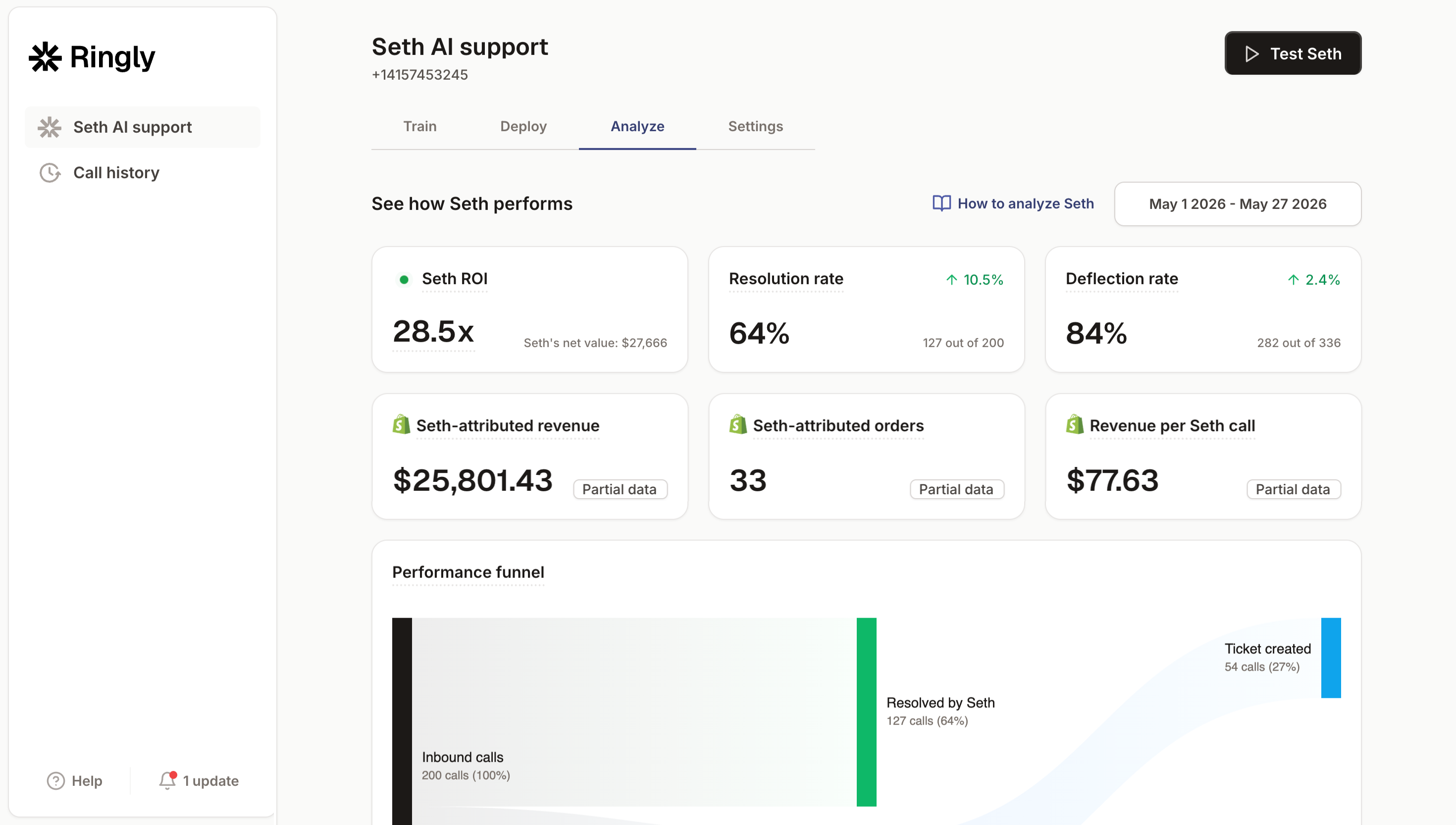
Will an AI phone agent really cut my support cost? On the phone channel, yes, because that's where the per-contact gap is widest. Seth resolves up to 90% of calls for $1.99 a call after the first 50, versus $7-$16 per call for human BPO. See the cost per call benchmarks for the full comparison.
How much of my support volume is WISMO? For most DTC brands, 30-50% (Salesforce). It's the most repeatable, most automatable work your team does, which is why it's the first thing to move. More on that in our guide to WISMO automation on Shopify.
Does Ringly replace my helpdesk or my team? Neither. It sits in front of your existing setup and handles the routine inbound calls, then escalates anything that needs a person into the helpdesk you already run. Your team keeps the hard calls; you keep control.
Talk to us

If you run a $10M-$100M Shopify brand and your support line is the cost you keep meaning to fix, a 30-min call is the fastest way to see the number. We'll pull your real volume, find the leak, and plan the setup on your actual numbers.
Our 3 promises.
- Live in under 1 hour. Setup and test calls are free.
- 30-day money back on the $99 plan fee.
- 65% resolution guarantee: if Seth resolves under 65% of your support calls in a month, that month comes back as credit (after 90 days on Pay per call).
Ruben (Ringly co-founder) takes these calls personally.