

Canceling an order in Shopify takes about four clicks. The expensive part is everything around it.
- You'll get the exact admin flow to cancel and refund an order, plus the policy text that should match each choice you make.
- A cancellation request you catch before the order ships costs you almost nothing. One you catch after it ships becomes a return, which runs 20% to 65% of the item price to process.
- Written for founders and Heads of CX at $10M-$100M Shopify brands that still run a visible phone line.
A customer who wants to cancel an order is on a clock. If their request reaches you before the order drops to your warehouse or 3PL, you cancel it in admin, the money goes back, and nobody loses anything but a few minutes. If it reaches you an hour later, the same request is now a package in transit and a return waiting to happen.
That timing is the whole game with cancellations, and it's the part the Shopify Help Center pages don't talk about. They tell you which buttons to click. They don't tell you what the cancellation costs, what your policy should say, or how to catch the request while you can still act on it. If you run support or operations at a Shopify brand doing $10M-$100M, you already know most of these requests come in by phone, and the phone is the one channel nobody has a real plan for. Book a 30-min call and we'll look at how many of your cancel-and-refund calls are landing after the order already shipped.
This guide stays glued to the Shopify order-cancellation flow: the admin mechanics, the policy that matches them, what a cancellation actually costs you, and the call that triggers the whole thing. If you want the broader rules for writing a returns and refund policy from scratch, our ecommerce refunds guide covers that ground. This one is about cancellations specifically.
Canceling an order vs refunding it (they're not the same)
This trips up new CS reps constantly, so it's worth getting straight before you touch the admin.
Canceling stops the order from being fulfilled. Refunding returns the money. They're two separate actions, and you can do either one without the other. When you cancel an order in Shopify, you can refund right then or choose to handle the money later. When you refund an order, you don't have to cancel it at all, you might just be giving back the cost of one damaged item on an order that still ships.
Here's how the statuses play out. If the payment was authorized but never captured, canceling the order voids it, no money ever moves. If you captured the payment and refund the full amount, the order shows as Refunded. Refund only part of it and the order reads Partially refunded. According to Rich Returns, the cancel-versus-refund mixup is one of the most common questions Shopify merchants ask, which tells you how often it gets handled wrong on live orders.
The practical version: if a customer calls to stop an order that hasn't shipped, you want to cancel it and refund in one move. If they're keeping the order but want money back on something, that's a refund, not a cancellation. Confusing the two is how you end up shipping an order you meant to stop, or stopping one the customer still wanted.
How to cancel an order in Shopify admin, step by step
The flow itself is short. From your Shopify admin, go to Orders, open the order, then click More actions and Cancel order. From there Shopify walks you through a handful of choices, and each one is a decision your policy should already have an answer for.
Pick how the refund goes back. Shopify gives you three options in the Refund payment section:
- Original payment method. Issues a full refund to the card or account the customer paid with. This is the default expectation for a cancellation.
- Store credit. Issues the refund as store credit instead of cash back. Useful when you want to keep the revenue in the business, but it needs the store-credit permission turned on, and your policy has to say you do this.
- Later. Cancels the order now and lets you handle the refund separately. Use this when you need a partial refund or want to split the money across methods.
Then you set the rest:
- Reason for cancellation. A dropdown (customer changed their mind, fraud, items unavailable, and so on). Pick the real reason, it's how you'll spot patterns later.
- Staff note. An optional internal note. Worth using when a cancellation is unusual or a manager approved an exception.
- Restock inventory. Selected by default. It returns the canceled items to your available inventory. Leave it on unless the items can't be resold.
- Send a notification to the customer. Also selected by default. Turn it off only if you're confirming the cancellation through another channel.
Click Cancel order and you're done. Every detail, what was restocked, what was refunded, gets logged in the order's Timeline, so you have a clean record if the customer calls back. If you need to clear a batch, you can select up to 250 orders with the checkboxes and use the Cancel orders bulk action. One caution from Shopify's own docs: the bulk action can skip the refund prompt, and on orders you've already refunded it can fire a duplicate refund. When you need the "Later" option or you're touching already-refunded orders, cancel them one at a time.
How the refund works, and what it costs you
The refund side has its own rules, and a couple of them quietly cost you money every time.
You can refund a whole order or just part of it, send it back to the original payment method or to store credit, and restock the items in the same step. The Restock items option is on by default whenever you track inventory, so a clean cancellation puts the stock right back without a second action. You can also discount individual line items before you finish the refund if you're only giving part of it back.
Two things to know going in. First, if you process payments through Shopify Payments, your credit card transaction fees are not returned when you refund. The percentage usually comes back, but the fixed portion, the $0.30-ish per transaction, you eat. Second, you can't reverse a refund once you've started it from admin. There's no undo. So the refund amount and method need to be right the first time.
Now the part the docs skip: what a single cancellation actually costs you. A cancellation caught before fulfillment is cheap, a few minutes of someone's time plus that lost fixed fee. The average ecommerce support interaction runs 10 to 20 minutes, so even the cheap version isn't free. The expensive version is the one you miss. If the order has already shipped, the cancellation becomes a return, and processing a return runs 20% to 65% of the item price once you add reverse shipping, inspection, and restocking labor. Same customer, same request, wildly different cost depending on whether you caught it in time.
Multiply that across a real CS team and the math gets loud. Take a brand running 6 reps at $4,000 loaded each, that's $24,000 a month, and a big chunk of it is the same routine work: order status, cancellations, returns, the same questions over and over. Route 70% of that volume to an AI phone agent at roughly $5,000 a month and you're saving around $19,000 a month, $228,000 a year, with your team free to handle the 30% that genuinely needs a human. WashCo, a Shopify brand we launched, recovered $22,664 in attributed revenue in its first 7 days on the phone, much of it from calls that would have gone to voicemail.
If most of your cancellations arrive as phone calls, book a 30-min call and we'll do the cost math on your actual call volume.
What your cancellation and refund policy should actually say
Your admin flow makes a series of choices. Your published policy should make the same choices out loud, so your team isn't improvising a different answer on every call. A policy that matches your admin settings is the difference between consistent cancellations and a coin flip.
Here's what the policy needs to cover, mapped to the admin decisions above:
- The cancellation window. State exactly when a customer can still cancel. The honest answer for most brands is "anytime before the order is fulfilled," or a fixed window like 24 hours. Be specific, vague windows generate the calls you don't want.
- The refund method. Say whether cancellations go back to the original payment method or to store credit. If you default to store credit, the policy has to say so plainly, or you'll get chargebacks.
- The processing timeline. Tell them how long the money takes to appear. Refunds typically take 5 to 10 business days to land, and 72% of shoppers expect a refund within 5 days per Digital Commerce 360, so set the expectation before they call to ask.
- Any non-refundable fees. If shipping or a restocking fee isn't coming back, write it down. The transaction fee you eat is yours to absorb, not theirs to know about, but anything they're charged needs to be in the policy.
- How to request a cancellation. This is the one most policies skip. Name the channel: email, phone, or a self-service portal. If you don't, every cancellation defaults to your busiest channel.
If you're starting from a blank page, our return policy generator and refund email generator give you a starting draft you can tighten. For the full set of rules on returns specifically, see our ecommerce return policy guide and the Shopify exchanges walkthrough.
The policy isn't a legal formality. It's the script your team works from when a cancellation call comes in, and it's the thing that decides whether they all give the same answer.
The "cancel my order" call you have to catch in time
Here's the operational catch nobody mentions: Shopify doesn't give your customers a cancel button. There's no native "cancel this order" link on the confirmation page or in a standard customer account. So when someone wants to stop an order, they have exactly one move, contact you. And because it's urgent, a lot of them call.
A cancellation request only saves you money if it reaches a human while the order is still cancelable. Once the order drops to your 3PL, the window's closed and you're into returns territory. The research backs how recoverable these calls are: 45% of post-purchase cancellations are "I changed my mind" and 35% are "delivery's taking too long". Both of those are saves if you reach the customer in time, swap the item, hold the order, offer store credit. Miss the call and you eat the full return cost on a sale you could have kept.
That's the problem a phone line is supposed to solve and usually doesn't, because the call comes in at 7pm or on a Saturday and rolls to voicemail. This is where Ringly fits.
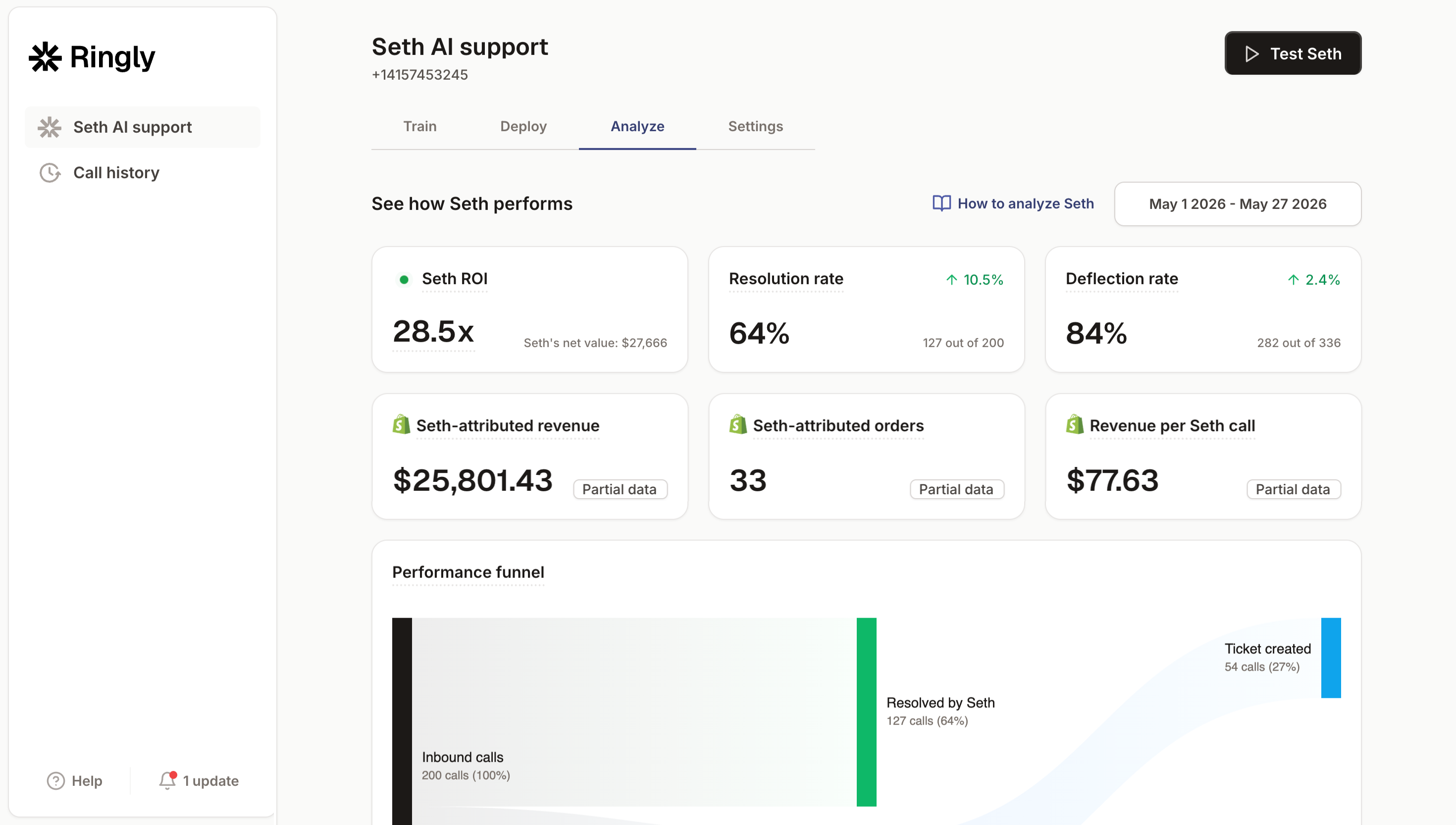
Ringly is AI phone support for Shopify brands. When a customer calls to cancel, the AI answers right away, finds the order in your Shopify store, checks whether it's still cancelable, and either handles the routine path or escalates the tricky one cleanly to whatever helpdesk you already run. Seth resolves up to 90% of inbound calls on its own, and it doesn't go to voicemail at 7pm. Pricing: $99 a month for the first 50 conversations, then $1.99 each. It's live in under an hour, and it's backed by a 65% resolution guarantee.
"My customers also feel like it's a normal person. They feel like they can communicate if they have questions."
Claudia Droge, TechCraft Studio
The point isn't to automate your whole support team. It's to make sure the time-sensitive call, the one where catching it early saves the cost of a return, never hits voicemail in the first place. For more on keeping a phone line live without a night shift, see our guide to 24/7 ecommerce phone support and how brands handle WISMO calls the same way.
Frequently asked questions
How do I cancel an order on Shopify and refund the customer? Go to Orders, open the order, click More actions, then Cancel order. Choose your refund method (original payment method, store credit, or Later), pick a cancellation reason, and confirm. Restock and customer notification are both on by default.
Is canceling a Shopify order the same as refunding it? No. Canceling stops the order from being fulfilled; refunding returns the money. You can cancel and refund in one step, refund without canceling, or cancel now and refund later using the "Later" option.
Do I get my credit card transaction fees back when I refund? If you use Shopify Payments, the fixed portion of the transaction fee (around $0.30) is not returned when you refund. The percentage-based portion usually comes back, but the fixed fee is a cost you absorb on every refund.
Can customers cancel their own Shopify orders? Not by default. Shopify has no native customer-facing cancel button, so customers have to contact you to cancel. You can add a self-service window with a third-party order-editing app or a Shopify Flow hold, but out of the box the request comes to your team.
How long does a Shopify refund take to reach the customer? Refunds typically take 5 to 10 business days to appear on the customer's statement, depending on their bank. Setting this expectation in your policy heads off the "where's my refund" calls, since most shoppers expect the money back within 5 days.
Can I cancel an order after it's been fulfilled? Once an order is fulfilled and shipped, you can't cleanly cancel it, it becomes a return instead. That's why catching the cancellation request before fulfillment matters: after that point you're processing a return, which costs far more than a simple cancellation.
Talk to us

If your phone goes to voicemail while a customer is trying to stop an order from shipping, you pay for that twice: once on the lost sale, once on the return you now have to process. A 30-min call is the fastest way to see how many of those you're missing.
Our 3 promises.
- Live in under 1 hour. Setup and test calls are free.
- 30-day money back on the $99 plan fee.
- 65% resolution guarantee: if Seth resolves under 65% of your support calls in a month, that month comes back as credit (after 90 days on Pay per call).
Ruben (Ringly co-founder) takes these calls personally.