

This post in 30 seconds.
- The exact native Shopify exchange flow, the apps that make exchanges self-serve, and the one channel almost every store ignores.
- Top stores turn 30-40% of return requests into exchanges or store credit. The average store gets 15-20%. That gap is real money sitting in your refund queue.
- Built for $10M-$100M Shopify brands running a paid helpdesk and a visible phone number, where every return that becomes a refund instead of an exchange shows up on the P&L.
Roughly one in five online orders comes back in 2026. Across all of ecommerce the return rate now sits near 20%, up from 11% in 2020 (Eightx). Most stores treat every one of those returns the same way: money out, order closed, customer gone. An exchange does the opposite. The customer keeps shopping with you and the revenue stays in the store.
If you run a Shopify or Shopify Plus brand doing $10M-$100M, you already feel this on the margin line. The question isn't whether to allow exchanges. It's how to handle them without drowning your CS team in manual work, and how to stop the after-hours calls that quietly turn into refunds. The part nobody writes about is the phone, and that's where a lot of the revenue actually leaks. If exchanges are a sore spot, book a 30-min call and we'll look at your call logs live.
Exchanges are also where a chunk of your support team's day goes, because every native Shopify exchange needs a human to process it. We work with founders and Heads of CX who watch the same questions over and over, all day: a different size, a different color, a swap for the thing they meant to order. This is a guide to handling those without bleeding revenue or burning out reps. If you want to skip the reading and just see your numbers, book a 30-min call.
How I built this guide
I'm Ruben, co-founder of Ringly.io. We run AI phone support for Shopify brands, which means I see the back end of how exchanges actually get handled, not the polished version on a help page.
For this guide I did three things:
- Ran the native flow myself. I processed exchanges in a real Shopify admin, on Shopify POS, and through store credit, and noted the exact buttons in the order they appear.
- Logged what the calls sound like. I went through real call logs from the Shopify brands on Ringly. The exchange calls are almost identical: someone wants a different size, the order's right there in Shopify, and the whole thing takes two minutes if a person picks up.
- Priced the apps as a buyer. I pulled current pricing for Loop, Rich Returns, ReturnGO, and AfterShip from their own pages and the Shopify App Store, not from a roundup.
Where the native tools run out of road, I say so. Where an app or a phone agent earns its cost, I show the math.
What counts as an exchange in Shopify (and why it's not a refund)
Three things can happen when a customer wants to send something back. A refund sends their money back and closes the order. An exchange swaps the item for a different one, a new size, a new color, or a completely different product. Store credit is the middle path: the revenue stays with you and the customer spends it later.
The only one of those three that keeps the sale is the exchange, and store credit is a close second. A refund is the default most stores fall into by accident, not because it's the right call.
The reason this matters is volume. With return rates near 20% and each return costing $10 to $65 just to process (Capital One Shopping), the difference between a refund habit and an exchange habit compounds fast. Apparel and footwear brands feel it hardest, with return rates that run 20-40% on clothing and 17-30% on shoes. A smart returns management process is really an exchange-first process. For the full picture on how often things come back and why, our ecommerce return statistics breakdown has the category-by-category numbers.
How to process an exchange in Shopify (native, step by step)
Shopify has a built-in exchange flow. It works, it's free, and it's manual. Here's the path from the admin.
From the Shopify admin
- Go to Orders and click the order you want to handle.
- Click Return.
- Enter the quantity coming back and pick a Return reason.
- In the Exchange items section, click Add products. Add a different variant of the same product (a new size or color) or an entirely different product, then click Done.
- If you want to discount the replacement, click the exchange item's price and add a product-level discount. Note that order-level discounts can't be applied here.
- Shopify calculates the financial outcome automatically. Return fees and the exchange item value get applied against the returned item to decide whether you owe a refund, the customer owes a balance, or it's an even swap.
- When the returned item arrives, click Process return, select the items to receive, choose a restock location, and select the exchange items to release.
- Choose whether to refund any difference Now or Later, then fulfill the exchange item like a normal order.
A clean native exchange takes a human four to eight clicks and a decision on the price difference, every single time. That's fine at low volume. It's a payroll line at high volume.
On Shopify POS
If you sell in person with Shopify POS Pro, the flow is shorter. Tap the menu, tap Orders, tap the order, then tap Exchange. Select the items coming back, tap Next, and choose the replacement from your catalog. If there's a price gap, tap Refund or Collect to settle it.
Store credit as the refund method
When you're settling a difference, you don't have to send cash. In the refund step, open the Refund method dropdown and choose Store credit. You can set an expiration date with the calendar icon. Store credit is the easiest way to keep revenue in the store when an even exchange isn't possible. To keep your written policy consistent with all of this, our return policy generator gives you a starting template, and the check order status feature shows how order lookup ties into the same data the exchange flow uses.
Where the native flow runs out of road
The native flow is solid for the merchant side. The problem is the customer side. Shopify's self-serve returns portal lets shoppers request a return on their own, but it does not let them start an exchange. A customer can ask for their money back without talking to anyone. To swap for a different size, someone on your team has to do it in the admin.
Every native Shopify exchange is a manual task, which means the more you push exchanges, the more human touches you create. That's the quiet tension. Exchange-first is great for revenue and rough on your CS workload.
A few other native limits worth knowing before you build a process around them:
- Fulfilled items only. If the order hasn't shipped yet, you use order editing, not the exchange flow.
- No order-level discounts on exchange items. Product-level discounts work, order-wide ones don't.
- No exchanges on orders with duties. Cross-border orders that carry duties can't run through the exchange flow.
None of these are dealbreakers. They're the reason most $10M+ brands end up adding an app, a better phone process, or both.
Make exchanges self-serve: the apps worth using
If you want customers to start exchanges themselves, you need an app. The good ones turn a return request into an exchange or store credit before a refund is ever on the table. Here's how the main options compare.
| App | Self-serve exchange | Pricing (2026) | Best for | Verdict |
|---|---|---|---|---|
| Loop Returns | Yes, instant exchange and shop-now | From $155/mo (Advanced $272) | Larger DTC, 100-1,000 returns/mo | The retention-focused default for scale |
| Rich Returns | Yes, customizable portal | $19-$199/mo | Smaller to mid stores, multi-language | Best value at lower volume |
| ReturnGO | Yes, AI workflows, shop-now | From $147/mo (shop-now at $113) | Automation at higher volume | Strong rules engine |
| AfterShip Returns | Yes | Free for 3, then $11-$239/mo | Budget start, suite users | Easiest on-ramp |
Loop Returns is the one most large DTC brands name first. It pushes shoppers toward an exchange or a "shop now" credit at the moment of the return, and it's rated 4.7 in the App Store. The tradeoff is price: plans start at $155/mo and the instant-exchange features sit on the higher Advanced tier. If Loop feels heavy for your volume, the alternatives are worth a look.
Rich Returns runs from $19/mo and is the value pick for stores that want a branded portal without a Loop-sized bill. ReturnGO leans on AI-driven workflows and shop-now exchanges, starting around $147/mo. AfterShip Returns has a free tier for up to three returns a month and scales up from $11/mo, which makes it the cheapest way to test self-serve exchanges. For a wider look at the category, see our roundup of Shopify returns apps.
An app fixes the self-serve gap, but it only catches the customers who use the portal. The ones who pick up the phone still hit a human, or worse, hit voicemail.
The revenue case: exchange over refund
Here's the part that should change how you staff returns. Top-performing Shopify stores convert 30-40% of return requests into exchanges or store credit. The average store converts 15-20% (revize.app). The brands at the top aren't lucky. They make the exchange the easy path and the refund the harder one.
Put a number on it. A store doing 100 returns a month at an $80 average order value that converts 30% to exchanges keeps $2,400 a month it would otherwise refund. Across a year that's a difference of $3,000 to $5,000 a month between a refund-only store and an exchange-first one (loopreturns.com). You can run your own version with our AOV calculator. A simple lever that works: offer 110% of the item value as store credit, so the customer feels rewarded for not taking cash and you keep the revenue.
But there's a cost on the other side of the ledger, and it's labor. Every exchange you win is a human touch, and at scale those touches add up to reps. Take a typical $50M Shopify brand running a 6-rep CS team:
| Line item | Today | With Ringly |
|---|---|---|
| 6 reps × $4K loaded per rep | $24,000/mo | — |
| Ringly (~$5K/mo) | — | $5,000/mo |
| Net monthly CS spend | $24,000/mo | $5,000/mo |
| Monthly savings | — | $19,000/mo |
| Annual savings | — | $228,000/yr |
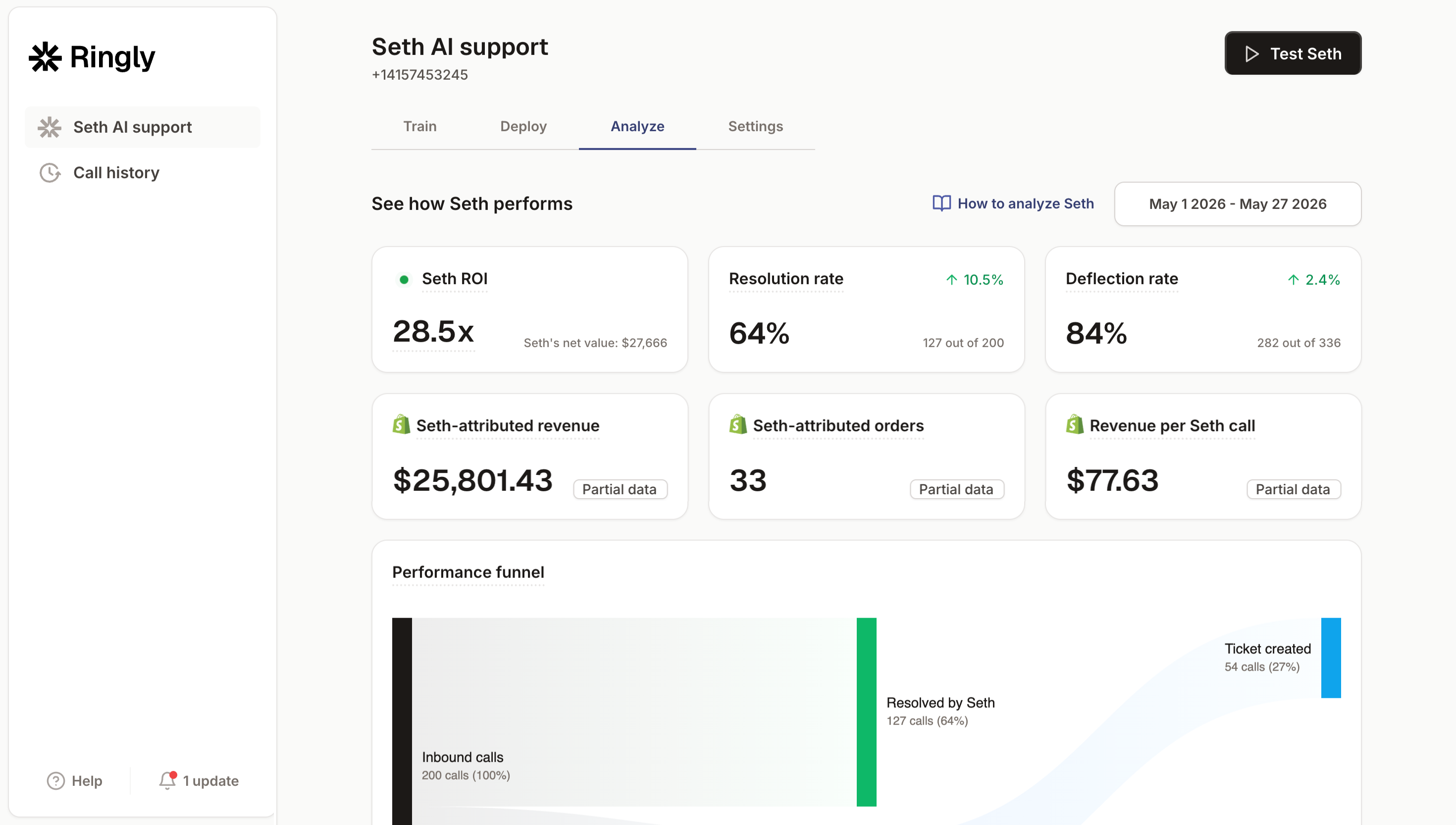
That's roughly 70% of repeatable calls (order status, returns, the same size-swap over and over) handled without a rep. The other 30%, the genuinely complex calls, still go to your team, who now have time to actually solve them. WashCo, a Shopify brand we launched recently, generated $22,664 in attributed revenue in the first 7 days post-launch across 271 calls. Exchange-first is a retention strategy. The thing that makes it sustainable is not paying a rep to process every swap by hand. For the bigger retention picture, see our guide to ecommerce customer retention.
The channel everyone forgets: the phone
Every guide on Shopify exchanges talks about the admin and the portal. Almost none of them talk about the phone, and the phone is where the highest-value exchange decisions actually get made.
Think about the moment. A customer is holding a dress that doesn't fit. They're annoyed and they want a refund. If they hit a self-serve portal, a lot of them just take the cash and leave. If they reach a person who can say "we have it in a medium, want me to ship it today?", the refund becomes an exchange and the sale survives. That conversation can't happen in a form. It needs someone who can find the order and answer a real question in real time.
The exchanges you save on the phone are the ones the portal would have lost. And after hours, when a customer can't reach anyone, the call rolls to voicemail you never return, and the next thing that hits your inbox is a chargeback.
This is the gap Ringly.io fills. Ringly is AI phone support for Shopify brands. Instead of growing your support headcount every time call volume goes up, the AI takes the routine inbound calls so your team can focus on the work that moves revenue. It answers calls 24/7, finds the order in your Shopify store, processes returns and exchanges, answers product questions from your knowledge base, and cancels orders when a caller asks. Calls that need a human escalate cleanly to Gorgias, Richpanel, Re:amaze, or whatever helpdesk you already run. Seth resolves up to 90% of calls autonomously.
The reason it works for exchanges specifically is that most exchange calls are the same call. A different size. A different color. The order is right there in Shopify. A person, or a phone agent that sounds like one, can offer the swap before the customer asks for cash.
"My customers also feel like it's a normal person. They feel like they can communicate if they have questions."
— Claudia Droge, TechCraft Studio
If you want to dig into the phone side of support, our guides on ecommerce phone support, WISMO calls, and the Shopify customer service app landscape go deeper.
Common exchange mistakes that cost you revenue
After looking at how dozens of brands handle this, the same mistakes keep showing up.
- Refunding by default. If your team's first move is "sure, I'll refund that," you've trained customers and reps to skip the exchange. Make the swap the first offer, not the fallback.
- No store credit option. When an even exchange isn't possible, store credit keeps the revenue. Not offering it leaves money on the table on every uneven swap.
- Slow manual processing. A swap that takes three days because a rep has to get to it loses the customer's patience. Speed is part of the offer.
- Voicemail after hours. The exchange call that hits voicemail at 9pm is a refund or a chargeback by morning. Coverage is a revenue decision, not a nicety.
- Punishing return fees. A return fee that also applies to exchanges punishes the customer for keeping money in your store. Waive it on exchanges and watch the conversion rate climb.
Fixing these is mostly process, not software. A clear policy, a refund-is-the-last-resort script, and a way to actually answer the phone. For the written side, our refund email generator and broader customer service for Shopify guide help you standardize the language.
If you want a second set of eyes on your exchange process, book a 30-min call and we'll walk through where revenue is leaking.
Frequently asked questions
Can customers do exchanges themselves in Shopify? Not in the native portal. Shopify's self-serve returns portal lets shoppers request a return, but exchanges have to be processed by your team in the admin. To make exchanges fully self-serve, you need an app like Loop, Rich Returns, or ReturnGO.
What's the difference between an exchange and a refund in Shopify? A refund sends the customer's money back and closes the sale. An exchange swaps the item for a different size, color, or product, so the revenue stays in your store. Store credit is a third option that also keeps the revenue.
Can you exchange for a different product, not just a different size? Yes. Shopify's native exchange flow lets you add a different variant of the same product or a completely different product as the exchange item. The system calculates any price difference automatically.
How do you handle the price difference on an exchange? Shopify works it out for you. Return fees and the exchange item value are applied against the returned item, so you either owe a refund, the customer owes a balance you can collect, or it's an even swap. You can settle a difference as cash or as store credit.
Does an exchange restock the returned item automatically? You control it. During the Process return step you select a restock location for the returned items, and you choose which exchange items to release. Nothing restocks until you confirm the items have arrived.
Which Shopify app is best for self-serve exchanges? For larger DTC brands focused on retention, Loop Returns is the common pick despite starting at $155/mo. Rich Returns ($19/mo and up) is the better value at lower volume, and AfterShip has a free tier to test the workflow.
Can an AI phone agent process a Shopify exchange? Yes. Ringly answers inbound calls, finds the order in Shopify, offers an exchange or store credit, and processes returns and exchanges, escalating to your helpdesk when a call needs a human. It's the way to catch the exchange revenue that walks in over the phone instead of the portal.
Talk to us

If you run a $10M-$100M Shopify brand and your exchange calls are going to voicemail or eating rep hours, a 30-min call is the fastest way to see what you're leaving on the table.
Our 3 promises.
- Live in under 1 hour. Setup and test calls are free.
- 30-day money back on the $99 plan fee.
- 65% resolution guarantee: if Seth resolves under 65% of your support calls in a month, that month comes back as credit (after 90 days on Pay per call).
Ruben (Ringly co-founder) takes these calls personally.