
The fee on your statement is the cheapest part of a chargeback.
- Shopify Payments charges a flat chargeback fee per dispute ($15 in the US), refunded only if you win.
- Once you add the lost product, shipping, processing, ad spend, and staff time, a lost dispute usually costs about 2x to 2.5x the order value.
- Built for founders and ops leads at $10M-$100M Shopify brands who want to stop the fee bill from quietly compounding.
If you run a $10M-$100M Shopify brand, the chargeback fee is the number you see and the cost you ignore. The $15 line shows up on the statement, you sigh, you move on. The damage that doesn't show up on the statement, the goods you'll never get back, the shipping you already paid, the ad dollars that bought a customer who reversed the sale, is the part that actually moves your margin.
This is a breakdown of what a Shopify chargeback fee is, what the full cost behind it looks like, and the cheapest lever you have against it. We work AI phone support for Shopify brands, so we see where a lot of these disputes start: a "where's my order" call that nobody picked up. If your phone backlog is turning into chargebacks, book a 30-min call and we'll show you what that's costing you.
What the Shopify chargeback fee actually is
When a customer disputes a charge with their bank, Shopify Payments charges you a flat chargeback fee on top of clawing back the disputed amount. The fee is small, fixed, and refunded only if you win the dispute. Lose it, and the fee stays gone along with the sale.
The amount depends on the currency you get paid in, not where the customer lives. Here's the current fee by region, straight from Shopify's chargeback documentation:
| Payout region / currency | Shopify chargeback fee |
|---|---|
| United States | $15 USD |
| Canada | $15 CAD (or $15 USD if paid in USD) |
| United Kingdom | £10 GBP |
| European countries | €15 EUR (Ireland adds 23% VAT) |
| Australia | $25 AUD |
| Japan | ¥1,300 JPY |
| Mexico | $200 MXN |
So a US brand pays $15 per chargeback. If you win, Shopify returns the fee and the disputed amount. If you lose, you eat both.
One thing worth knowing before the fee even hits: a dispute can start as an inquiry rather than a full chargeback. An inquiry is the bank asking for information, and if you respond fast with the right evidence, it can close before it becomes a fee-bearing chargeback at all. Miss the inquiry window and it escalates, and now you're paying the fee and fighting the full dispute.
The timeline matters too. You typically get 7 to 21 days to submit your evidence after a dispute is filed, and the card company can take up to 75 days to rule. That's nearly three months of a clawed-back sale sitting against your cash flow before you find out if you kept it. For the full lifecycle and how the four parties in a dispute actually interact, we wrote a separate piece on how ecommerce chargebacks work.
Why the fee is the smallest part of the bill
Here's the trap. You budget for chargebacks as if they cost $15 each, because that's the only number that hits a line item. The real cost of a lost dispute runs about 2x to 2.5x the order value once you add up everything that doesn't show on the statement.
Mastercard's own 2025 research puts the average all-in merchant cost at roughly $110 per chargeback when you factor in merchandise loss, fulfillment, and operational labor, according to ClearSale. The processor fee alone is only $20 to $50 across the industry ($15 on Shopify in the US). The rest is the part operators forget to count.
Walk one lost dispute through your P&L. Take a $120 order, a normal mid-market AOV:
| Cost line | Amount | What it is |
|---|---|---|
| Disputed amount | $120 | the sale reverses |
| Product / COGS | ~$42 | goods gone, no return |
| Shipping + fulfillment | ~$12 | outbound you already paid |
| Shopify chargeback fee | $15 | not refunded on a loss |
| Payment processing fee | ~$3.50 | the ~2.9% + 30c, not returned |
| Customer acquisition cost | ~$30 | ad spend that bought this order |
| Labor (review + dispute work) | ~$15 | staff time |
| All-in cost of one lost dispute | ~$237.50 | ≈ 2x the order |
So a $120 order didn't cost you $120 plus a $15 fee. It cost you close to $238. Run that across a few hundred disputes a year and the gap between "the fee" and "the cost" turns into a real number on your margin.
And the volume is going the wrong way. Ecommerce chargebacks are projected to cost merchants around $33.79 billion in 2025, with global dispute volume heading past 324 million per year by 2028, per the same ClearSale data. The fee per dispute barely moves. The cost behind it keeps climbing.
There's a second-order cost most operators miss entirely. Internal research pegs the staff time per chargeback at roughly $82, with another $46 in third-party fees layered on, separate from the processor fee. So even the chargebacks you eventually win cost you real money to defend. Winning gets you the sale and the fee back. It doesn't get you the hours your team spent building the case.
The hidden lines operators forget
The 2x rule is the average. A few categories push it higher, and they're exactly the lines that never make it into a "chargebacks cost us $X" slide.
- Customer acquisition is the quiet killer. If you're spending 25-40% of revenue on ads, every disputed order torches the acquisition cost that bought it. On a high-CAC product the all-in hit can reach 3x to 3.5x the order value.
- Network fees stack on top. Once your dispute rate crosses Visa or Mastercard thresholds, you pay extra per-dispute network fees and program assessments above Shopify's flat fee. We break the rate side down in our guide to what a normal Shopify chargeback percentage looks like, so we won't relitigate the thresholds here.
- The product rarely comes back. Unlike a return, a chargeback gives you no reverse logistics step. The goods are gone.
- Representment is labor you didn't staff for. Fighting a dispute means pulling order records, tracking, and proof, then writing it up inside a tight window. That's hours your CS or ops team wasn't hired to spend.
When we ran the numbers across the brands we work with, the pattern was consistent: the line operators underestimate most is the labor, because it's invisible until a rep is buried in dispute paperwork instead of answering the phone. The tools that help you organize that fight are worth knowing, and we list the better ones in our roundup of chargeback management tools.
If chargeback costs are eating more of your week than the fee line suggests, book a 30-min call and we'll do the math on your real numbers.
Can you get the fee back? Fee recovery on Shopify
Yes, in two ways, and both have limits worth understanding.
Win the dispute. If you submit evidence and the card company rules in your favor, Shopify returns the disputed amount and refunds the chargeback fee (the refund is country-dependent). The catch is the win rate. Friendly fraud disputes, where the customer genuinely received the product, are hard to win even with clean evidence, and the representment work is heavy.
Use Shopify Protect. On eligible orders, Shopify Protect / Fraud Protect covers qualifying fraud chargebacks, refunding both the disputed amount and the fee. It only applies to the fraud chargebacks Shopify deems eligible, so it's a backstop, not blanket coverage. It does nothing for the friendly-fraud disputes that make up most of your volume.
Both of these are reactive. They help after a dispute is filed. The cheaper move is not getting the dispute in the first place, which is where the cost math actually points. If you want the full playbook on heading disputes off, we cover it in ecommerce chargeback prevention.
The cheapest dollar against your fee bill
Every prevented dispute saves you 2x its order value, not $15. That changes where you should spend your effort. Fighting chargebacks recovers pennies on a dollar of work. Preventing them recovers the whole bill.
And most of them are preventable. Friendly fraud now makes up more than 45% of all chargebacks, and the reason is uncomfortable: 81% of customers admit they filed a chargeback simply because it was easier than contacting the merchant, per 2025 chargeback research. Roughly half of shoppers skip the merchant entirely and go straight to the bank. Card networks technically require customers to try the merchant first, but only if the merchant is actually reachable.
That's the part our own data keeps confirming. Across the Shopify brands on Ringly, a large share of the disputes that turned into chargebacks started life as a simple "where's my order" call, the kind that rolled to voicemail after 6 p.m. and never got returned. The customer didn't get an answer, so they got their money back the easy way. A voicemail you never return is a chargeback you didn't have to take.
This is the support-problem-disguised-as-a-payments-problem nobody budgets for. The fix isn't another fraud filter. It's being reachable when the customer has a question, before they decide the bank is faster than you are.
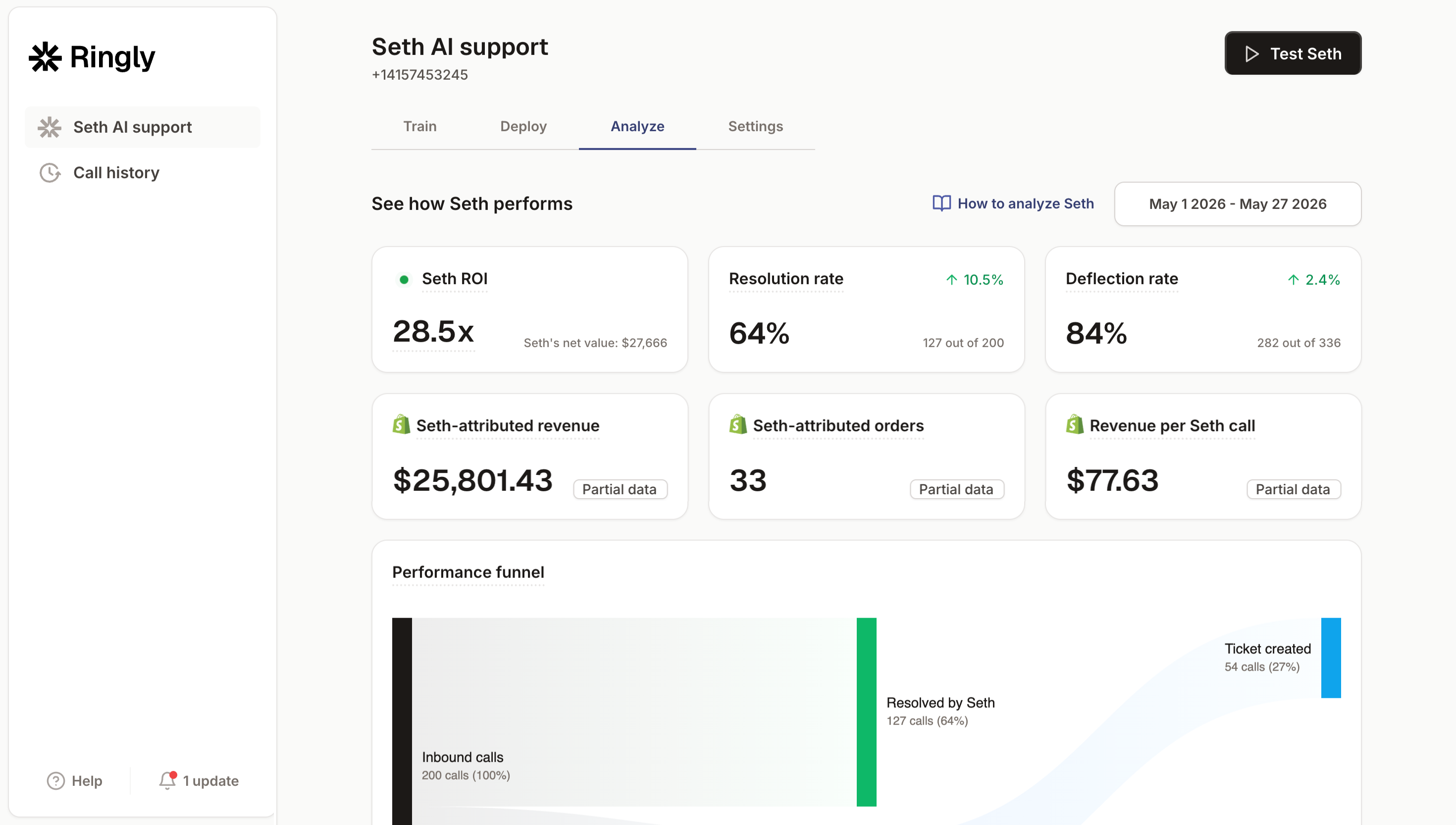
That's the lever we build. Ringly is AI phone support for Shopify brands: it answers inbound calls 24/7, finds the order in your store, and handles the order-status questions that otherwise become disputes. It resolves up to 90% of calls on its own for $1.99 a call after the first 50, so the WISMO calls that drive friendly fraud actually get answered. WashCo, a Shopify brand we launched, recovered $22,664 in attributed revenue in its first 7 days on the phone. Keeping that line answered after hours is a far cheaper dollar than the fee bill, the lost goods, and the ad spend behind every dispute you could have prevented with 24/7 phone coverage.
None of this replaces good ecommerce customer service or a clean billing descriptor. It just makes sure that when a confused customer reaches for the phone instead of the bank, someone actually answers. You can see the plans on the pricing page, or book a 30-min call and we'll map your missed-call volume against your dispute volume live.
Frequently asked questions
How much is the Shopify chargeback fee? Shopify Payments charges a flat fee per chargeback, which is $15 in the US. It varies by payout currency: £10 in the UK, €15 in the EU, $25 AUD in Australia, ¥1,300 in Japan, and $200 MXN in Mexico.
Do I get the chargeback fee back if I win? Yes. If you win the dispute, Shopify returns the disputed amount and refunds the chargeback fee, though the fee refund is country-dependent. If you lose, you keep neither.
Why does a chargeback cost more than the order value? The fee is only the visible part. You also lose the product (which rarely comes back), the shipping you already paid, the processing fee, the ad spend that acquired the customer, and the staff time to fight it. All in, a lost dispute usually runs about 2x to 2.5x the order value.
Are Shopify chargeback fees different by country? Yes. The fee tracks your payout currency, not the customer's location. A US brand pays $15 USD even on an order from abroad, while a UK brand pays £10 GBP.
Does Shopify Protect cover the chargeback fee? On eligible fraud orders, Shopify Protect refunds both the disputed amount and the chargeback fee. It only applies to the chargebacks Shopify deems eligible, so it won't cover the friendly-fraud disputes that make up most of your volume.
What's the cheapest way to reduce chargeback fees? Prevention beats recovery. Because most disputes start as an unanswered customer question, being reachable by phone and resolving "where's my order" before the customer calls their bank cuts the fee bill at the source, and saves the 2x cost behind it.
Talk to us

If chargeback fees are creeping up because calls go unanswered, a 30-min call is the fastest way to see what that's actually costing you. We'll pull your missed-call pattern against your dispute volume and do the math on the prevented-cost number, live.
Our 3 promises.
- Live in under 1 hour. Setup and test calls are free.
- 30-day money back on the $99 plan fee.
- 65% resolution guarantee: if Seth resolves under 65% of your support calls in a month, that month comes back as credit (after 90 days on Pay per call).
Ruben (Ringly co-founder) takes these calls personally.